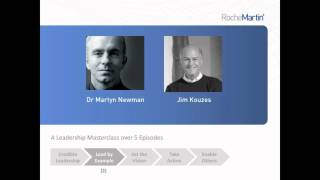
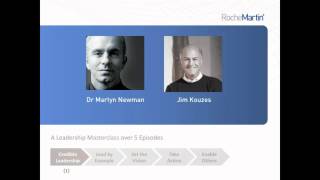
Transcript of Episode 2 of The Challenge of Leadership masterclass: Dr Martyn Newman interviews Jim Kouzes on emotional intelligence and leadership. Main points: self-confidence is largely a consequence of competence gained through practice; optimal confidence arises when skill and challenge align (flow); leaders should provide frequent positive reinforcement to build employees' self-liking, confidence, and engagement. Notable numeric claims: Kouzes mentions speaking to 4,500 people; Newman cites a statistic of ~432 negative vs ~32 positive statements for an average American student (~16:1); recommended positive:negative feedback ratios for leaders cited as at least 3:1, with some research suggesting ~5:1 or 5.6:1.
Questions this video answers
4,500 people
Approximately 432 negative statements vs 32 positive statements (about 16:1)
At least 3:1; some research suggests about 5:1 or 5.6:1 (a joking 12:1 is also mentioned)
Chapters
Roche Martin Institute presents the Challenge of Leadership, A conversation on emotional Intelligence and.
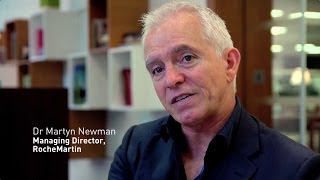
Leadership with Martin Newman and Jim Kouzes. Hi, I'm Martin Newman and I'm pleased today to bring you the second episode in the leadership Masterclass series, Emotional Intelligence and the Challenge of Leadership. In this masterclass, I've recorded a series of short interviews with one of the world's most authoritative business leaders, Jim Kouzes. In this conversation, Jim and I talk about the emotional intelligence skill that is the strongest predictor of leadership performance. It's also an indispensable skill for taking on tough challenges. And according to Jim, it's the skill that leaders often don't do very well at and it costs them money. I hope you find the conversation inspiring and that it encourages you to rise to the opportunity of leading with greater confidence.
And I find interesting in your book, you actually talk about self confidence as a strong predictor of job performance. What is it, do you think about that attribute that enables people to perform so consistently?
Well, the couple of responses, there's a lot in what you just said, a great deal, and I, I'll respond to your question, but I'd like to come back to a couple of other observations. Self confidence, at least from the work that we have done, is a consequence of competence. One develops confidence in one's abilities as a consequence of developing the skills that go with them. So again, let me give you an example. I speak to a lot of people as you do, and many people have the fear of public speaking. While I continue to get nervous before every presentation, it wouldn't be classified as stage fright. I'm going to be speaking to 4,500 people in Orlando, Florida. Coming up, 4,500 people in an auditorium. Now, many people might find that a very frightening situation, might not have the self confidence to get up in front of a group and speak like that. And so watching me do that, one might assume that somehow this just came to me from my, you know, was born into me as consequence of some gene I got from my parent. But if they look at my history, they'll find that I was performing in front of other people in music and in poetry reading and prose reading and stage plays from my grade school days. My mother told me she was a frustrated actress, so she took it out on me. So my confidence in my ability some 60 years later comes not as a consequence of some inborn characteristic rather, but a lot of experience and practice that started very young. So if you look at people who are really, really, really good at something, who are experts. Whether it's a pianist or a leader, whether it's a tennis player or an engineer, you'll find that those individuals have confidence in their ability because they learned how to do it really well. They started learning very early and they are practicing practically every day. So confidence comes from competence in our work, the kind of confidence that enables you to execute at an expert level. And yes, it does lead to people being more successful in their jobs because they're able to take initiative, they're able to assert themselves when called upon because they feel that their skill matches the challenge or difficulty. Now we lose our confidence, however, when the challenge becomes too great for our current capacities, we lose a degree of confidence. So if you can imagine one of those little two by twos where you have like challenge low to high, say on the vertical axis, and you have skill and ability on the horizontal axis, imagine how you would feel if your skill is low and the challenge is high. We'd feel frightened and scared and inept. But what happens if the challenge is low and the skill is high? We feel bored. So our ability to have confidence and what Mihaly Csikszentmihalyi calls flow, comes as a result of finding a match between the challenge of the situation and the skill and the abilities that we have. And of course the implications of that are huge. We want to improve confidence people have, then we need to help them improve their skills and abilities to, to confront new challenges.
That's a very detailed and insightful response, Jim. As a psychologist, I've often thought about what you've just said, really in terms of what enables people to really be the authentic person or the credible leader that you describe. And I've come to the conclusion that there is a level of credibility of competence, that competence, or what psychology has more recently described as self efficacy, this experience of achievement that continues to become self reinforcing, that builds systematically a person's self confidence or their competence. I think there's a second thing, and some colleagues of mine from the University of Texas have done the research in this. They talk about a second pillar, if you like, that underpins this notion of self confidence, and that is self liking. I point out that the average American student hears something like 432 negative statements in one form or another about themselves on a regular basis pretty much every day, compared to 32 positive, which is something like a 16, 1 ratio. And any wonder, therefore, when we mature into adults that we have this ongoing almost dialogue inside our heads that tends to undermine our sense of personal value. And I think this is pointing us to something beyond the American notion of self esteem, to take us even beyond our egos, to begin to really appreciate who we are and like who we are. Bruce Barton said it. He said nothing splendid has ever been achieved except by those who dared to believe something inside themselves was superior to circumstance. And I think this goes hand in hand with what you've described as competence, that notion that you've got to both appreciate and value yourself as well as back your experience and back your judgment in order to step up to a challenge. Does that make sense to you?
Absolutely, it does make sense. I think that I'm looking more at it as a behavioral scientist than a psychologist, a social psychologist who looks at the context in which people behave and group behavior. But the psychology which I develop about myself comes as a consequence then of all of those experiences that I've had and skills and abilities that I've developed and the reinforcements that I get. As I'm sure you're aware, research indicates that in order for employees, for example, to feel fully engaged in work, they need to hear at least to experience at least 3 positive to 1 negative affect from their, let's say, their leader, their manager in the workplace, at home, it happens to be a greater number, at least 5 to 1. And some researchers have recently said it's 5.6 to 1 at work, meaning that as leaders we need to understand that in order for other people to commit themselves fully engaged, to feel confident about their own abilities to perform at high levels, they need to hear at least three, and some are saying five.
Positive.
Comments or gestures, it could be verbal and nonverbal from their leader in order to feel fully engaged. Now you go to 12 to 1. It's a little bit overboard, but. And the data you're sharing suggests that we're not hearing that. So it's no wonder, no wonder that people are underperforming. Yeah.
So what you're saying is that really if it's true that you do need to have some sense of self liking and self confidence in order to be at your best every day, so do the people who work for you. And therefore as a leader, one of your primary responsibilities is to in a genuine way make sure that you're pointing out people's strengths and abilities and your level of confidence in what, if you like their capable of achieving in order to draw out their best. Is that really what you're saying?
Absolutely. It is something that according to our data is not the skill at which leaders are least capable, but it's sort of second on the list of what they don't do very well. There's often assumption that people are here in the organization to work for a paycheck. They get paid and so that's enough reward. Why should I say nice job mate when you've already you're getting a paycheck, that's just fine. And in fact I put it in very utilitarian way. If people are more engaged and more productive and respond more positively if you tell them at least three times a day in some way, verbally or non verbally, that you appreciate their work and they're doing a good job, doesn't that as a leader make you want to do that? And it is about showing positive affect to other people. That is one of the things leaders can do to increase people's self confidence and therefore their performance.
Listening to you then Jim, you almost sounded a bit of an Australian when you said good job mate. Have you spent any time down in Australia?
Well, my co author Barry Posner has had three sabbaticals there and will be there again this year. My first trip hopefully will be coming up in 2010.
Oh great. Well we really look forward to welcoming you Down Under.
You've been listening to Jim Kouzes talk about the challenge of leadership. That was the second in a series of five short conversations that I'll be presenting to you. And as you listen to Jim, I'm not sure what what struck you. Whether it was his comment that to build self confidence requires sustained deliberate practice and lots of it. Or maybe his view on the importance of building the self confidence of your employees if you want a fully engaged team that people need to hear. Three Compliments to every single critique and as a psychologist I suppose for me self confidence has always been the reactor core of a person's personality. Building it is the starting point for unlocking a person's potential and accomplished accomplishing more than they ever thought possible. If you want to change your performance and the results in any area of your life, then start by building your self confidence. You can do that by reminding yourself that although you're not everything you'd like to be, thankfully you're not what you were and concentrate on and celebrate your achievements. Make a conscious decision that you're okay and totally accept yourself just the way you are. Build your self confidence by pinpointing areas of strength and capitalizing on these. But also remember to build the self confidence in your people by finding ways each day to communicate that you like them and that you believe in them and then provide challenging assignments that draw out their talent. In the next episode, Jim cuts straight to the chase and makes an astonishing comment which distills the pure essence of leadership. I find it surprising, and I'm sure you'll find it surprising, too. I'm Martin Newman. I'm looking forward to bringing you that third installment. In his continuing conversation with Jim Kouzis on the challenge of leadership.