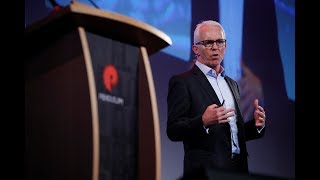
The mind of a leader with Dr Martyn Newman at Mind & Its Potential 2014
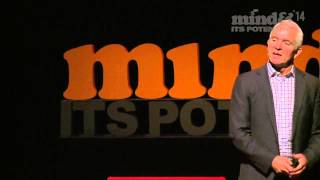
Dr. Martyn Newman delivers a conference talk arguing that emotional and social skills—collectively framed as emotional intelligence or "emotional capital"—are foundational to leadership and human potential. He reports a synthesis of the EI–leadership literature that identifies 10 distinguishing skills (e.g., self-reliance, optimism, self-actualization, self-confidence, self-knowing, empathy), describes a psychometric "emotional capital report" with standardized scores (mean=100, SD=15), and illustrates each competency with clinical and organizational anecdotes (Nicaragua, clinical training, Sky TV leadership program). He emphasizes that these competencies can be defined, measured, and developed to unlock talent.
Questions this video answers
He cited 117 scholarly articles (141 if including additional unpublished doctoral dissertations).
10 skills.
Scores reported with a mean of 100 and a standard deviation of 15.
About 700 senior executives.
He said by the time we're 60, more than 90% of us will have someone close who has suffered some sort of neurological disorder.
Chapters
And there's been really one central theme, hasn't there, that's captivated us, I think, this remarkable idea that we're all capable of cultivating our minds and shaping our experience to achieve extraordinary things with our lives. I just find that really inspiring. Robbie mentioned that I was a psychologist. I came to psychology through an interesting and intriguing route. For many years, I was a human rights activist. And on one occasion I was down in Central America in a little country called Nicaragua that at the time was embroiled in a civil war. And I was down there as part of a human rights group. And we were taken out to a very remote village, and the villagers had gathered to listen to the gringos from. From the north. And as I stood up to speak to the village through a translator, within a minute or so, a young boy stood up and interrupted me. And he asked a question. He said, could you ask the doctor to come and treat my mum because she's not feeling very well. And the translator explained, oh, he's not that kind of doctor's son, if you know what I mean. So I went on speaking, and a couple of minutes later he stood up again and asked another question. But on this occasion, the translator didn't bother translating. So I stopped and I said, no, I'm really interested. What's the lad's question? And he said, well, what kind of a doctor is he if he can't help anybody? And the blood drained from my translator's face. And he apologized for interrupting my train of thought. Do you know, he had absolutely no idea, that guy, how often that little boy's question was going to interrupt my train of thought in my career as a psychologist. It's an interesting discipline, isn't it? We're all fascinated by it, but we've spent the best part of 100 years describing and defining mental ill health, psychological disorders with very few cures. So much so that in my family, my young son said to me one day, he said, dad, why is it that everybody you seem to know seems to have something wrong with them? Such had become the pervasive language in our home. But as we all know, in the last 10 or 15 years or so, psychology has begun to turn its vast resources and its rigorous methodologies in pursuit of a more positive view of human potential. And we're all glad about that. And I love that. And over the years I've thought, what is it that I really love about being a psychologist? And it's, you get to help people think about the future. And I love that. And I'M convinced that if you're in leadership, in business, or in your family to that matter, your job is to really help people imagine what the future looks like and then turn them to themselves, to find inside themselves the resources they're going to need to meet the challenges of that future. And, you know, you've got to do this in this moment in which we find ourselves in the most difficult economic, cultural and business climate that any of us have ever seen in our lifetime. In fact, celebrated economists, people like Robert Reich, are telling us that a new form of capitalism is emerging, a new form of economics is emerging, and nobody has any idea where new insights for leadership is going to come from. Well, every now and again, ideas do come along which change the world. And no one saw this idea coming. You all will have seen this book. Most of you will have it on your shelves. And when Dalton Goleman brought to our attention emotional intelligence, he challenged everything we thought we knew about what constitutes human potential and human performance for over 100 years. Basically, the book said we were wrong about it. We used to think it was accounted for by your intellect, your iq, or at least sticks and carrots. And if you went to the school I went to, they'd never heard of carrots. Let me tell you. Anybody go to that school? Extraordinary idea. You get the best out of young people by threatening them, by sending them to the principal's office, or by shaming them. And Dan's book came out, and he says, it's not about that. It's not intellect. It's not rewards and punishments. It's actually a set of deep is the way you understand your own emotional experience and manage that experience and understand the emotional experience of other people. Those are the skills that set the most successful men and women apart from the rest. And he made the claim that EI emotional intelligence was the foundation of leadership, of greater performance, and ultimately of a better world. But of course, he made those claims and he got very enthusiastic. But at the time, there was very little evidence to substantiate a lot of what he's saying. And I want you to imagine, what do we know now about emotional intelligence 20 years later? Well, imagine if I handed out to you every single piece of published literature in the last 10 or 15 years that have looked at the relationship between the emotional and social skills and leadership. And I gave you all a highlighter, and you went away for the rest of the conference and you read these details. And for you to do that, you'd have to read 117 scholarly articles and that doesn't include unpublished doctoral dissertations. If you want to get really serious, you'd be reading 141 scholarly articles. And if we came back on the last day and we put our heads together to say, what did we discover? And we synthesized that information, you know what you'd find? 10 skills. 10 skills that separate the good from the great. Out of that wealth of research, and I can look you in the eye and tell you that, because I've read every word and you know what I found? I'm a child psychologist by background. Once you've told your kids, if you've got kids that you love them and they must not for a second doubt the value of their lives, These are the 10 skills to teach them. And over the course of the last 10 years, we built a psychometric tool so that we can begin to measure these quite accurately, particularly in professional people. So what happens when you give the emotional capital report a rigorous psychometric to a group of international leaders from the top end of Fortune 500 companies? You get these scores with a mean of 100 and a standard deviation of 15 on measures of self reliance, one of the first skills that set leaders apart almost one standard deviation from the mean. Can you imagine if we could pull the curtain back and understand how that competency works? Let me give you a clue. Bruce Barton, the American philosopher, put it this way. He said, nothing splendid has ever been achieved except by those who dared to believe something inside them was superior to circumstance. Don't you love that? People with high levels of self reliance refuse to be a product of their moment in time, rise above the challenges of their life to grasp the opportunities or Friedrich Nietzsche, Hegel, the German philosopher, said it this. He, he said, to be independent of public opinion is the first condition of achieving anything great. A colleague of mine said it less eloquently. He said, you can't lead a cavalry charge if you think he looked funny on a horse. In psychology, in clinical psychology, I call this the Snow White syndrome. What's interesting is that people in their 30s, they come into the clinic and they sit on the couch. And within about 10 minutes, as they begin to relate their story, the story sounds remarkably similar. And it goes a little bit like this. My parents weren't good enough. My teachers didn't quite really understand me. The boss, gosh, she's a difficult character, you know, and it's almost like as they lie on the couch, they're waiting for someone to come along and kiss them on both cheeks, you know, take them by the hand and Say, come on into the second half of your life where your potential is going to be realized. And then as they lie there in their 30s, you know, it dawns on us, nobody's coming. I'm sorry, is that a surprise for you? And then, you know, I've noticed that people tend to go in one of two directions. There's some people who begin then to construct a story of their lives about how they never had the opportunities that other people were given. They never had the right support, they never got the lucky breaks. And so they're going to conduct a story or construct a story that's going to leave them lying there for the rest of their lives. Other people find something deep inside themselves that get them up off the couch and out the door, and they pick up the pen and they determine, from here on out, I am going to author the next chapter of my life and what I found in business. These young people walk into businesses determined to write a chapter in the life of the business. And people who have real self reliance. As Jack Welch points out, before you got into leadership, it was all about you. Once you decide to lead, it's all about can you grow other people. These people, out of becoming a resource to other people, are able to hand the pen to young men and women in the business and say, here, you write a paragraph and I'll back you up. That's self reliance. And it forms inside organizations, the most remarkable resource of leadership right across the business. And then optimism. We know so much about optimism. You know, in 23 years of research, there's no single stronger predictor of success in life than optimism. And we're not talking here about Monty Python. You know, always look on the bright side of life. Now in business, we're talking about those who can see opportunities and sense opportunities just over the horizon, but also have a deep emotional resilience in the pit of their stomach that takes them back and back and back and back in the face of life's disappointments and setbacks. It was Einstein who's reportedly said, the first question we've got to answer in our human journey is, is the universe friendly? You know, and depending on how we answer that question will determine a lot about our perception of the world and how we engage with it. If you've got young children, this is the skill par excellence to teach them, to set them up for the resilience they need to bounce back in life and grasp its opportunity, opportunities and then self actualization. Well, this is the closest we get in the emotional intelligence framework to spiritual Intelligence. When Abraham Maslow gave us this term, he was knocking on heaven's door. You know any wonder before he became a psychologist, he was studying for the ministry and he got seduced by the behavioral sciences away from the ministry. But he was always chasing that dangerous deep fire in the belly that gets us out of bed in the morning, that fuels our vision, our vision of what can be achieved, that sustains our capacity over the course of our lives. It was Yeats who said education is not filling a bucket, it's lighting a fire. Do you know, I'm absolutely convinced it's the same with leadership. There's only two ways you can influence human behavior. At the end of the day, you can either manipulate it or you can inspire it. And leaders who understand how to cultivate the fire of self actualization and extract those energies that Alan's been talking to us about so eloquently this morning that lead to eudaimonia, that sense of well being become infectious and contagious inside organizations. And then self confidence. This is not the American idea of self esteem. And in fact this is the strongest when we ask leaders around the top of Fortune 500 companies, young entrepreneurial leaders, that they score. This is not self esteem. You can look into the mirror and repeat to yourself over and over, I'm number one, I'm number one. And not only if you're Australian will you feel stupid doing that. It won't do you much good. Self confidence is the deep reactor core of your personality. And what we know about it we've learned from the University of Texas. Bill Swan and his partner Tafroedi found two pillars that underpin your self confidence. It goes very, very deep in your psychological makeup. And the two pillars are self liking and self competence. You know, when I was at the University of California, we followed kids around with video cameras for a day. The average child, it will surprise you to learn, hears 432 negative statements about themselves in one form or another in the course of an average day. Not by mean spirited people, just by careless people. Well, don't be stupid. Those sorts of throwaway comments compared to 32 positive. That's a 16, 1 ratio. It's any wonder when we grow up, we rush out and buy books like I'm okay, you're okay. Desperately trying to bolster that sense of our own self respect and self valuing. And you know, when people in midlife come in and take the emotional capital report and we take the lid off and we have a look inside at their emotional life, I Say this to each one of them before you walk out the room. Today, you've got to make this decision. If you're in midlife, whatever you find inside there today, you've got to make the decision to like it. Because if you don't, no one else will. And you'll spend the second half of your life trying to compensate for not really valuing the person that you are. And it will distort your personality and people will see straight through it. The second pillar is self competence. Let me tell you where that comes from. A child comes out and she sees a tree and she has this grandiose idea, do you know what? I can get to the top of that tree. So she climbs up and one parent comes out, oh, my God, what do you think you're doing? Get down and don't let me ever see you do that again. The child comes down and says, good grief, I won't be trying that again in a hurry. And over the course of that child's life, that child will become more and more conventional. They won't take risks, they won't innovate. They check with people. Another parent comes out, sees the kid at the top of the tree and says, my God, you must be able to see forever. How did you do that? That's extraordinary. But listen, next time let me know and I'll make sure you're safe. But that's incredible. You know, the kid comes down with a feeling in the pit of the stomach. Do you know with that feeling you can change the world? That's competence. You say, look, that's really interesting, child psychology. What on earth has it got to do with leadership and management in corporate life today? Well, it's simply to be at your best every single day. You need two things. You need to genuinely value and like yourself for who you are as a person. And you need to believe in your competence of what skills you possess. So does everybody who works for you. And if you're in leadership, if you can let people know that you genuinely like them as people and that you believe in what they're capable of achieving, they will work extraordinarily well for you. Nobody likes being told what to do. That's self confidence. The last five self knowing. Currently we're running leadership programs across Sky TV in Europe for about 700 senior executives across this enormous network of Sky Television. And three weeks ago, I took the first group away. And after a couple of days I said this to them. I said, in the second half of your life, the most important skill you will need to lead effectively in your family and at work is the capacity to develop a peaceful mind. And, you know, the room fell silent because there wasn't a single person in that room that could quieten their mind for more than a few seconds at a time. To be able to show up with a quiet and a calm mind, with clear judgment enables you to make crystal clear decisions, decisions that are right, decisions that are constructive. And it will do more to build your leadership brand and authority in your leadership influence than just about anything else you do, rather than showing up manic. And finally, empathy. For 10 years, I was the clinical supervisor at one of the clinical psychology programs at a large Australian university. And I used to find it interesting that in an auditorium like this, the new cohort of students would come in and they'd sit there keen as mustard to become therapists, you know, carers. And most of them were there, if I'm honest, to try to sort out their own personal problems. That's why most of us get into psychology, as you know. And I just tell them this, I say, listen, my job's simple. I'm here to get you through the single most challenging moment in your professional lives. And it's called the knock at the door. TITTER OF LAUGHTER They've got no idea what you're talking about, just nervous. Well, here we are, four to six years later, they graduate, they get out. They've done rats and stats, they've done Freud, they've done Jung, they've done behavioral psychology, they're now got a license to care, a license to be therapists. You see, they've got the diploma on the wall, they've got the brass plaque on the gate. You know, smell a fresh carpet in the clinic, we're ready to go now. And then it comes, knock at the door, first real client, no two way mirrors, nobody with a pause button. Oh, geez, I don't think you should have said that. You know, let's try this. Nothing. You're on your own now. You just got out of university, can't remember a single lecture, not a fact, not a single thing. Standing behind that door is a person who's twice your age with a problem so complex that you can't possibly understand it. And you're going to invite them to sit down and talk to them about it for an hour, and then you're going to charge them $165 for the privilege. You are terrified. I just say this to them. There's only one thing that will get you through that moment. Just one thing. When they leave your office in 60 minutes time. They should walk up with this feeling. No one in the world understands me and my situation better than that psychologist. If they walk out with that feeling, they will come back and be your client for a long, long time and you won't have to solve their problems with the wisdom of Solomon. Do you know, I think it's exactly the same in leadership with one difference. You never have 60 minutes. You're lucky if you've got 60 seconds. But when people leave your presence, your capacity to give them your attention, as Jetsumna was saying to us so eloquently this morning, is one of the great gifts that you can give someone. To suspend judgment and let them know that they are the center of the universe as they engage with you will do more to build your leadership brand than just about anything. And somebody who said it far better than me was David Henry Thoreau who said this. What lies behind us and what lies before us are small matters compared to what lies within us. And when we bring that out into the open, miracles happen. Men and women, I put it to you, if you're in leadership, that's your job, to bring out into the open the talent that resides within young men and women. And we no longer any excuses. We know what these competencies look like. We can define them, we can measure them, we can build them to engage with young people, to set their talent free in organizations to dance and create productivity. The skills you need to do that are emotional and social. And we can measure the value of them. And I call it emotional capital. Thank you. By the time we're 60, more than 90% of us will have someone close to us who has suffered from some sort of a neurological disorder. You all know you're not going to live forever. There's only one way into this life and one way out. I cannot prove to you anymore that anything is possible. Talk about the marvelous thing that we now understand about our brains. It gets so much better.
More from Dr
Inspirational Thought Of The Day with Dr. Martyn Newman: Leading With Emotional Intelligence
Dr Martyn Newman - Putting Humans at the Heart of Business Transformation. MSL UK