The Challenge of Leadership - Episode 1
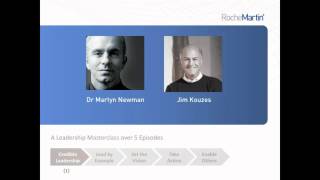
Episode 1 of a leadership masterclass series (The Challenge of Leadership) — a recorded conversation between Dr Martyn Newman and leadership scholar Jim Kouzes. Kouzes describes research using "personal best" leadership stories showing that leaders often emerge during adversity, argues that leadership rests on relationship-oriented competencies (self-awareness, self-management, social awareness, interpersonal skills) and on personal values, and identifies credibility (alignment of values and actions) as the foundational, learnable attribute of effective leaders. The episode closes with Newman summarizing these takeaways and previewing the next installment.
Chapters
Roche Martin Institute presents the Challenge of Leadership. A conversation on emotional intelligence and leadership with Martin Newman and Jim Kouzes.
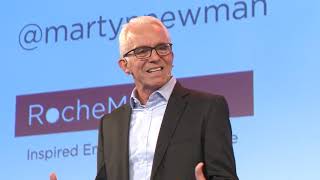
Hi, I'm Martin Newman and I'm excited today to bring to you this leadership masterclass series, Emotional Intelligence and the Challenge of Leadership. Over the next few weeks, I'd like to present to you a series of short conversations that I had with Jim Kouzas, one of the world's most authoritative and influential business leaders. And over 10 years ago, Jim and his partner, Barry Posner authored a book, the Leadership Challenge. Now, most leadership books don't last a week, let alone a decade. Well, the Leadership Challenge went on to sell over a million copies and it's now in its fourth edition, has become one of the most authoritative leadership books of all time. But of course, the world has changed dramatically since the publication of that first edition. So I was keen to catch up with Jim and ask him if he thought that the leadership lessons that he teaches in that book are just as relevant to the world today. Now, those of you that know me well know that I believe in the power of emotional intelligence to help leaders succeed. So in this series of short interviews, Jim shares candidly his views on the relevance of emotional intelligence. He talks to us about why great leaders really emerge from setback and struggle and shares with us the five exemplary leadership practices. And in the final session, he shares with us the single best leadership secret of all time. Now, I didn't see it coming and it took my breath away and I'm sure you'll find it just as surprising. I enjoyed every moment of the conversation with Jim and I hope you enjoy it too. I hope it encourages you to be the leader that you can be in your community, in your family, in your organization, as you inspire ordinary people to achieve extraordinary things.
I'd like to welcome Jim Kouzes to this interview and really thank you Jim, for taking the time to join me to discuss your book and this fascinating topic of emotional intelligence and leadership. Jim, of course, needs no introduction. He is the co author of the best selling book the Leadership Challenge. And since its first publication way back in the late 80s, this book, the Leadership Challenge is now in its fourth edition and has achieved the status of a classic text in the leadership literature. Jim and his co author, Barry Posner were named by the International Management council as the 2001 recipients of the prestigious Wilbur M. McFeely Award and countless awards since. This honour puts them in the company of people like Ken Blanchard and Stephen Covey, Peter Drucker, Norman Vincent Teale and Tom Peters, among many others. So, Jim, it's a real honor to have the opportunity to talk with you today to explore this fascinating topic with someone like yourself who's been at the coalface now of leadership for several decades.
Well, it's my pleasure, Martin. Thank you very much for the opportunity to talk with you. And congratulations on your new book. I guess it's not so new in that it's been published in Australia, but not here in the States. It's forthcoming. Right.
It's a well kept secret in the States. It's done really well in Asia Pacific, this part of the world where I live, and of course in the uk and it's being released in the US just in late April. So I'm really looking forward to that. And one of the things I wanted to ask you about today, Jim, is what you describe really as the best kept secret of successful leaders. And I know people who haven't read your book will be very eager to get the answer to that question, particularly from someone who's conducted such serious research into that question. But before we get to that, I notice in the press.
Yes, I was going to suggest we save that for the end.
Exactly.
We'll tell everyone the secret to success at the end.
I think it's what our colleagues in the marketing department call the hook. That's right. But I noticed in the preface of your book you describe some of the ways in which the world has changed over the few decades since you authored the first edition. And yet in this edition you still insist that despite the change in the context of leadership, really the content of leadership remains the same. Would you still hold that view in light of these current economic challenges that we're facing at the moment?
Actually, I've been speaking a lot on this theme these days and it's even more essential during these times and not less. If I might explain why. When we did our research, Martin, we asked people to tell us a story about their personal best leadership experience. So we asked them questions about a time when in their own opinion, they had performed at their very best. These were people who ranged from middle to upper level at the time. We've since repeated this study with students with frontline leaders and even people who are and non managerial roles in organizations, in volunteer groups and in communities, teachers, coaches, so that it's not just about people who are managers inside business, but can be generalizable to many different roles. And we asked those individuals to tell us a story about their personal best. Now they could have written about anything they wanted and yet they chose to write about times that were the most difficult, stressful, adverse in their careers. There were cases of doing something for the very first time, turning around a company, dealing with a mandate from the corporate office. Turn this division around or we'll shut it down in two years. These were individuals then who took on very challenging tasks and yet called them their personal best. And so what we realize about change and challenge and adversity and difficulty is that it tends to bring out the best in us. It causes us to have to reach deep down within, draw on all our training and experience, and utilize every bit of capacity we have. That's why I remain very optimistic about these times, because if history is the lesson and our own research is a lesson, then we should be optimistic that people will rise to the occasion and find ways to. Innovative ways to deal with these problems.
Well, that's really fascinating, isn't it, that it's the pressure of the moment that seems to draw out the qualities inside all of us that help us respond to these challenges. And I notice in your book that you insist today that you describe some of these qualities, some of these competencies really, as things such as self awareness, self management, social awareness, and things like interpersonal skills or relationship skills. These are, of course, the specific skills that various frameworks of emotional intelligence in the last few years have begun to describe and help us understand. And we can have a look at some of those details. But in your view, Jim, then does emotional intelligence, particularly in leadership, really make a difference to the way people respond to these challenges?
Well, the effective elements of successful leadership and teamwork and coaching and teaching all draw from the very same short list of human behaviors. People are naturally drawn to imitate those people and respond to those people who exhibit the behaviors that bring about the most desirable results. And what we found in research over 25 years is that those skills are primarily relationship skills. Those skills are primarily skills around people, as you say, being aware of their own needs, aware of their own motivations, their values and principles. They are able to articulate those. They are able to be assertive about them in such a way that other people are clear about what individuals stand for. They do stand for those beliefs. So they have a great deal of personal resilience. They're individuals who are optimistic about the future. They're individuals who have a sense of social responsibility because they're thinking about the collective, not just about themselves. So they have a sense of long term rather than short term, what we call inspire a shared vision. And I could go through additional lists of Skills. But these best practices that are talked about in the emotional intelligence literature are some of the very same behaviors that leaders draw on when they get extraordinary things done in organizations.
Yes, it's interesting that you talk about them as skills. The way you describe them there, they have a feeling about them as if they're values, really. And I think we can all think of people who've had a big influence on our own lives. Someone who has inspired us to take a certain direction in our own life, or someone whose personal style that we've modeled our own lives on. And when we ask ourselves, what is it about that person that has impacted on us so powerfully? Chances are that there is a set of skills. But there's something deeper than that, isn't there? There's something that resonates with values. Are these really values?
Well, there's a set of skills and abilities, and then there are, of course, the values that we hold, the preferences we have about what's right, what's wrong, what's most important, what's least important to us. So a set of skills might be around clarifying my values, going through an exercise or activity that permits me to get clear about what's really important to me. That's a skill set. You can apply technique and method to that. But values then come from my family background, my upbringing, the people I've associated myself with, the schools I've gone to, the clubs I belong, and all those activities that have shaped me. So leadership is just like much of emotional intelligence is a set of skills and abilities that are learnable over time. If one has the desire to learn and one has the commitment to practice over a period of time, and one can apply those skills in ways that help clarify values and inspire a shared vision and so on.
Yeah, that's a very powerful insight, I think, and for me, I think it begins. You talk about in your book credibility as the foundation of leadership, and I assume you mean by this, where there is a real alignment between a person's personal values and the way they behave. To what extent do people really need to be self aware of their behavior in leadership? Or is this something just intuitive that comes naturally to people?
Well, you're absolutely right that in our research, and I would say probably the most enduring truth of our entire career in researching leadership is that credibility is the foundation of leadership. Personal credibility is the foundation of leadership. If other people do not perceive us as believable sources of information, they will not want to willingly follow us. You have to believe in the messenger in order to believe the message. And that has survived over 25 years of research, a couple of recessions, including the current one, all of the booms and the busts of various industries. It continues to remain the same. And our prediction is it'll remain the same if we do research 25 years from now, if we happen to be around. And it'll still be the most important personal attribute someone can have. And it does mean behaviorally. When we ask people if that's what you're looking for, then what is that behaviorally? How will I know it when I see it? People say it's practicing what you preach, put your money where your mouth is, walking the talk and doing what you say you will do. That consistency, as you said, between words and actions. Now is that a inborn characteristic? Is that genetic or is that learned? Our research tells us that it's learned behavior. It is not something that is necessarily either you have it or you don't. It is learned over time from watching role models. I happen to have some very, very exceptional role models in my life, people who, who taught me that lesson very early on that your personal integrity is all that you really have to take with you throughout your life and that has to be something that you guard at all costs. And so I learned that lesson very early on. And that has to be something that you guard at all costs. And so I learned that lesson very early on.
You've been listening to Jim Kooza's talk about the challenge of leadership. That was the first in a series of five short interviews that I'll be presenting. I'm not sure what struck you as you listened to Jim, whether it was his comment that our personal best moments of leadership more often arise from our response to the times which are most difficult and adverse in our lives, or whether it was his views that leadership is born of our personal values and that being true to them is the single most enduring characteristic of the most effective leaders. You know you have to believe the messenger if you're going to believe the message. Or maybe it was his final comment that leadership is a series of abilities and skills that you can learn over time if you've got the desire to practice them, and that therefore we can all get better at leadership. Whatever leadership challenge you're facing this week, know that great leadership begins with self leadership, knowing yourself, being true to your values as you take on the responsibility of being a personal positive influence over other people.
People.
I'm Martin Newman and I'm looking forward to bringing you the second installment in this continuing conversation with Jim Kouzis on the challenge of leadership.
More from Dr
Inspirational Thought Of The Day with Dr. Martyn Newman: Leading With Emotional Intelligence
Dr Martyn Newman - Putting Humans at the Heart of Business Transformation. MSL UK