17-Year-Old Sales Savage Shares Why You Are Never Too Young to be a Sales Rep!
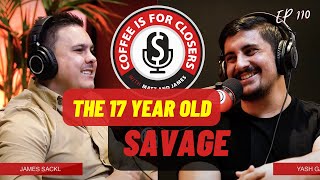
This is a YouTube video titled "17-Year-Old Sales Savage Shares Why You Are Never Too Young to be a Sales Rep!" published in May 2022. It features a conversational interview between James Sackle and a young sales professional named Yash, who shares his journey from starting sales at a very young age to becoming a top sales rep by age 17. The discussion covers Yash's early challenges, learning experiences, growth in sales skills, and professional development within a sales organization. The content is a detailed narrative about youth success in sales and personal growth within a professional environment.
Hey guys. Welcome to another episode of Coffee is for Closes. We have a very special guest with us today. Yes.
What's up, James?
How are you going, buddy? You ready to be famous?
I know, right?
Ready to be famous.
My career is made now. Yeah.
It's almost like when you see those, those young kids in young direction, they get up on stage at 12 million raving fans, all the young girls of the world just getting to the shows and loving them, you know, as Yash. So for you guys that don't know Yash, come to us as a 16 year old. And how old are you now?
I was 15 when I came.
15?
Yeah, 15 and a half. 17 now.
17. So two, two years in the works.
Right.
And what a two years it's been. So Yash, believe it or not, is an extraordinary young man who at the current stage happens to be one of our top sales reps at such a young age. And it's been, it's been a bit of a journey, hasn't it? So today we would like to talk about Yash, his progression into becoming a man and becoming a really good professional salesperson. No longer a little baby bird closer.
If you listen to this podcast, you will make your first million within three years. I'm going to repeat that. You will make a million dollars within three years of the first episode. You listen to. We don't want pikers. We're not here to save the manatees.
We're here to make podcast.
You really want this? You listen and review. Put that coffee down.
All right, so what I thought would be really cool is to. To map out Yash's journey because it's been a long journey. There's been a lot of ups and downs.
Yeah.
And to be completely honest, I was very hesitant at the start to bring on someone so young.
And I'll give you, I remember that.
Call well before this call. You know, I've never had this conversation with you, so it's going to be a little bit mind blowing. Yeah. So as the story goes, I one day get an email from this young kid with a very, very poorly photoshopped picture of himself speaking on a stage. Assume you are at a stage. Yeah, but you know, average editing is probably did that at school.
I didn't have 25 grand back then.
Yeah, exactly right. And I get this, this message in my inbox and I ignore it because 15 year old kid is offering to work for us and I'm like, yeah, no, pass. Thank you. And a couple of weeks ago by, you know, you sent me A few follow ups. I'm just like, stop, kid. This is annoying. I don't. We don't know. I don't even know if I can hire someone of your age. So I'd have to check with the lawyers and whatnot. Anyway, and I was on a call with Will Adams and he, he's asked me, he goes, hey, have you if you, as a young kid by the name of Yash applied?
Yeah.
I was like, oh, yeah, I've seen a couple of emails there in my inbox. And he's like, oh, okay, well, what did you think of it? And I go, I didn't even read it. Yeah, I mean, like, I read the first part. I haven't, I haven't watched the video you sent me. It's like, you know, it's not something I even considered. And we had this conversation and he basically said, oh, I think you should probably have a look at it. He's, you know, he's a bit of a prodigy.
He's.
He's been doing some really good things. We've seen him being quite successful for where he's at in his career. Yeah. In whatever circles, you know, we were referring to at the time. I can't recall. So I was like, all right, you know what? I'll. I'll have a look. We'll have a conversation. And that's when we, we got. And we had a call. I think we had a. Not an interview, but just a basic discussion.
Yeah.
About, you know, who you are, what you want.
Yeah.
Why I should consider bringing. Even entertaining the factor of hiring someone that's 15 let you know that's in school.
Yeah.
Has a full time at school in what, like year nine, ten?
Yeah, something like that.
Are you in school now?
Yeah, no, I'm in school now.
Still. Still in school. But you're in Australia. Cool. Okay, Makes sense.
It was such an interesting call because I hopped on with Will Odom's right. And Willem's so nice. He's like the happy uncle. Like, and then I hop on with you. I'm like, oh, okay. I was like, don't smile. Can't mess up a word right now. His name is James, not Jack. James.
Yeah. You call me Jack. I know.
I was, I still remember that. Yeah. I still remember I texted you. I'm like, like, my life is about to be over. He's gonna get mad, like, stressing out. Back then. I was like, freaking out.
That's funny, man. I was really impressed. And I gave, I gave Will a call back and said, yeah, you're right. This is an impressive young human.
No, yeah, exactly. Right. You know, I mean, that's, that's how the industry. I mean, most, many, many people, you're probably more qualified. You know why? You should buy from me. Even though I'm 10 at least I have the conviction to come to you. Did you have that right? So, yeah, I mean, like, I tried for years when I was like 9, 10, because I used to go to these events, right? So I tried, like viral Facebook videos. I tried so many different ways of doing it. And then finally I went to my, like, this one event where I'm like, I got to make at least $1,000. Like, if I do not make $1,000 in this event.
What do you mean by event? It was like Tony Robbins thing. No, no, no.
It was like one of my mentors in the past that I had paid 15 grand from all, like, I take a loan from my parents. Paid 15 grand to.
Yeah.
Didn't get results.
How old were you at this stage?
Nine.
Okay, so you're nine, and you've essentially gone and sought out some seed capital for your little business venture. Yeah, probably didn't even know what that word meant exactly. Essentially, you've. You've understood high corporate finance with that.
Yes.
Okay.
All right. So good, we did that. And so, by the way, the program didn't work. Surprise, surprise. That happens sometimes.
And so, I mean, to be fair, you were nine. Your mindset was 100%.
Yeah, right? Yeah. I'm not taking action, right? So. So I spent years trying to figure it out. And then I go to this event, I'm like, I got to make at least a thousand. So I go to the person where I'm like, who's the person? Because there's always that one person in the room that just wants to spend a lot of money, too much money on them, just wants to spend it, right? And it was a guy named Antonio. So I go up to Antonio, I'm like, okay, man, create some rapport. And then I sold him into a thousand dollar funnel design where I designed one of his funnels. Right? So I got that secured. I had another lady there, and I, I, to be fair, I targeted people I knew I could.
Did he buy that out of, like, expecting you to do the job, or was he just like, I'm gonna buy it? So nice kid up and coming. Let's.
Well, he bought it for two reasons. He bought it for two reasons. Because the mentor showcased me on the stage to get more sales.
Right, okay.
And he Positioned me as that guy.
Okay.
And the second thing is I told him, I was like. Because he, he was like into pitching. He helped me with pitching, so help people with like, pitches and stuff. And I was like, well, dude, if you're going to do that, like, if you don't have a way, way to drive traffic, man, like, what are you doing? He's like, oh, yeah, that does kind of make sense. I'm like, yeah, man. Like, what's the point in that? He's like, well, can I just get one made, like one of those templates? I'm like, you can, but it's like getting a pitch off of YouTube, like, would you tell somebody to do that? He's like, no. I'm like, okay, well then just have me design it. That's what I do. So it was, I mean, and it wasn't a lot of money for me. It was a thousand bucks, right? And so I did that. I did some funnel designs and then, you know, an idea woke up. I'm like, okay, I have momentum now. I think that's the hardest thing for most people is getting that momentum, especially when you want to go into a slump or you're going through a period where like, things are down. So I had that momentum. I didn't want it to stop. I sold a $600 package, met a lady in Panera right, where I like designed her whole funnel with her for like a whole day. And I was like, okay, this is not efficient. I need to figure out something else. So I was like, okay, I met another guy at one of those events, right, who ended up becoming my business partner. And both of us like, broke. Like, he literally like broke broke. We are. I'm not as broke. I'm in my parents place. But like, we both have zero experience, zero knowledge. We're just figuring this stuff out as we go along. But I was decent at sales. Like, I knew how to connect with people. I knew how to create some rapport and get people to buy. Yeah. Like I, I could, I could get somebody to like, trust me in the sense, like, I've built enough rapport about their product and stuff where they trust me. Right. I didn't necessarily know objections, but I just knew how to sell based on conviction and rapport. So I was like, okay, let's make a product together. So we designed like a five year end product within like 30 minutes, right? We get it going. And I was like, listen, you focus on building out the back end. Let me focus on the sales. So I reach out to some People on Facebook. I know, right? Two later, we have over 15 grand in the bank. Most money I've ever made. And I'm like, damn, this actually worked out pretty well. It's not a bad idea. And so then him and I ran that business for about six, seven months in between that business. So I spent years trying to figure it out. And then I go to this event, I'm like, I got to make at least a thousand. So I go to the person where I'm like, who's the person? Because there's always that one person in the room that just wants to spend a lot of money, too much money on them, just wants to spend it, right? And it was a guy named Antonio. So I go up to Antonio, I'm like, okay, man, create some rapport. And then I sold him into a thousand dollar funnel design where I designed one of his funnels, right? So I got that secured. I had another lady there, and I, to be fair, I targeted people I knew I could.
Did he buy that out of, like, expecting you to do the job, or was he just like, I'm gonna buy it? So, nice kid up and coming. Let's.
Well, he bought it for two reasons. He bought it for two reasons. Because the mentor showcased me on the stage to get more sales, right? And he positioned me as that guy.
Okay?
And the second thing is, I told him I was like. Because he was, like, into pitching. He helped me with pitching. So help people with, like, pitches and stuff. And I was like, well, dude, if you're gonna do that, like, if you don't have way, way to drive traffic, man, like, what are you doing? He's like, oh, yeah, that does kind of make sense. I'm like, yeah, man. Like, what's the point in that? He's like, well, well, can I just get one made? Like one of those templates? I'm like, you can, but it's like getting a pitch off of YouTube, like, would you tell somebody to do that? He's like, no. I'm like, okay, well, then just have me design it. That's what I do. So it was. I mean, and it wasn't a lot of money for me. It was a thousand bucks, right? And so I did that. I did some funnel designs, and then, you know, an idea woke up. I'm like, okay, I have momentum now, right? I think that's the hardest thing for most people is getting that momentum, especially when you want to go into a slump or you're going through a period where, like, things are down. So I had that momentum, I didn't want it to stop. I sold a $600 package Metal lady in Panera right, where I like designed a whole funnel with her for like a whole day. And I was like, okay, this is not efficient, I need to figure out something else. So I was like, okay, I met another guy at one of those events, right. Who ended up becoming my business partner and both of us like broke. Like he literally like broke broke. We are. I'm not as broke, I'm in my parents place. But like we both have zero experience, zero knowledge. We're just figuring this stuff out as we go along. But I was decent at sales. Like I knew how to connect with people. I knew how to create some rapport and get people to buy. Yeah. Like I, I could, I could get somebody to like trust me in the sense like I've built enough rapport about their product and stuff where they trust me. Right. I didn't necessarily know objections, but I just knew how to sell based on conviction and rapport. So I was like, okay, let's make a product together. So we designed like a five year end product within like 30 minutes. Right? We get it going. And I was like, listen, you focus on building out the back end, let me focus on the sales. So I reach out to some people on Facebook. I know, right? Two later, we have over 15 grand in the bank, most money I've ever made. And I'm like, damn, this actually worked out pretty well. It's not a bad idea. And so then him and I ran that business for about six, seven months in between that business. That's where I met Matt. Right, that's where I met you guys. And so we got into about.
What was that business?
The coaching business. Okay, yeah. So we got that business to about 150k, 200k cash collected something like. No in the total six months. Right. So we're doing about like, we like our months were super sporadic. Right? We had some months at 10 grand, some months 40. Yeah, pretty standard. Exactly. So that business went well, you know, it taught me a lot about the industry. Taught me a lot about things I had to get done. But during that time, that's where I met Matt. Because Matt, Matt had put a post out from another big guy in the space that I knew about getting salespeople. So I was like, I'll check this out. Let me see what it's all about. And so the big thing I realized after exiting in that business because it ended off like badly, like poorly, I just, I didn't know how to scale the business. We were working our butts off, Right. But it just made me realize I just didn't have the experience yet to run a successful business. Like, I can grind all I want, but I don't have the experience to know how to train people. I don't know the experience about to help other people do what I do. But also, I just don't know what it takes to go from 0 to 6, 6 to 7, 7, 8. Like, I just don't have that. So I was like, I need to go work for somebody. And I was reading Think and Grow Rich at that time. Right. So I just realized I was like, I need to go work for people who actually know what they're doing or at least have an idea. Right. Get really good at one scale. And then from there, in the future, if I want to launch a business, I'm actually an ability where I put myself in a position to do that successfully.
You know, I've never read that book. Never. Everyone goes on about how it's one of the best books ever. And I'm just like, is it, though?
Yeah, well, it's a. It's a good book in the sense, like, a lot of the stuff there, it talks a lot about, like. And what I took away from that book is probably different from what most people would take away. Right. But the biggest thing I took away from that book is experience is so key because all the stories Napoleon shares and think and grow rich has a lot to do with. I worked at this factory and that factory, and I learned this from that guy and this from that guy. And so that made me realize I was like, well, the thing I lack right now is experience. Because if I knew how to run a successful business, business, I would have already done it. I ran a business. Was it successful? Depends on what you. How you look at it.
I mean, in the grand scheme of things. No.
Yeah.
But in the context of what you put together.
Yeah.
With the level of experience and understanding at any given point in your time, I'd say that's more successful than most businesses.
Yeah.
That will ever come into existence.
For sure.
You know, like a business. The average. What, closure rate is nine months before a business fails. So I think that's, you know.
I know. Yeah. Like, it was good for sure. Right. And. But I just realized I was like, I knew I want to do bigger and better, and so I just knew I had to get more. A lot more experience before I can do that. Right. And so I was in the closing code at that point. Like, I was in the closing code and I was like. And like, I was the main guy.
Like, well, I mean, some would argue, all the guys that were in the closing code, you would argue that Yash was the only guy, because let's just say if there was a mic that got passed around, Yash would not pass it because he always had. Funnily enough, we created a bunch of awards at the end of the year. One of them I just made for a laugh. And the award was. Can I ask a question? Because that's the token phrase. Almost as token as road. I know you're watching, but alive and blessed.
Yeah, exactly. So I was in closing code. That's where I really got good at. I got better at sales. I was working for one account, and then I went to another one.
Did you. Were you working for us at that stage? I can't remember.
No, no, I wasn't. I was still in the closing code. You didn't want to hire me, so I couldn't jump in. You guys were still. You guys put me in the closing code so that I could, like, get better there. Because the hiring is like, we're going to need some time to figure it out. And I think you guys also wanted to see, like, hey, can you show up and do this? Right? So I started selling on, like, an Instagram offer that went okay. Like, my first month there, I was able to generate about, like, 40 grand in CA and in revenue, right? And so, and I was only, by all means, was only making three or two grand. Like, I was not making barely anything, right? And then in the closing quote, everybody's talking about a guy named Marco. I'm like, who's Marco? Right? Like, who. Who's the Italian sandwich? Who is this guy? Right? Like, well, yeah, no, what's. Everybody's talking about a guy with a thick accent that makes 100 grand a month. Like, you know what I mean? So I end up figuring out which company he worked for, which was another coaching company, and I'm like, okay, I'm going to schedule a call with this guy. Let me see how he does it, right? So I go to the top guys in the industry in the coaching space. I schedule calls with all their teams, and most of their team is suck. Like, I jump on a call with them. There is zero. Like, they just absolutely suck. And so then I hop on with Marco, and then he's like, hey, didn't I see you in the closing code? I was like, ah, crap. I was like, bro, I'll be honest with you. I want to see how you sell. I am in the closing code. Like, I BS my way through the Triager. He didn't get it, but Mark. You know what I mean? And Mark was like, okay, I'll show you how I sell. And he showed me a little bit about what he did. I didn't understand most of it, to be fair, but I understood the concept, right? And then that's when he told me, listen, I want you to work with Jeremy, right? Work with any pq, you'll get that. And I'll help you on the side as much as I can. And so at that point, like, because inner circle, like, I'd be pretty much paying my entire income every month to join that program. On the. On the payment plan, the biggest payment plan, the lowest.
We're talking money you earn from commission or pocket money.
Commission. Right? Because I'm only making I wish, right? And that's. It's funny. Marco thought. He was like, isn't your parents paying for this? I was like, nah, bro. This is my. Like, I'm taking control of this. I don't want to spend any more of their money. Right? This is my thing. And so every month, right. Figured it out. Then I transitioned into this other coaching company, and then my first two to three months there, I made about, like, three grand or so. That was before in pq. And then once I started getting in pq, learning, like, just learning the skills I needed to learn, right? As much as I could. I tripled my comms, or I became the top rep there. Went from three to ten grand a month, right? 1012 grand a month in commission, which was big. And so that was when, like, stuff started clicking a little bit. I was like, okay, I'm figuring this out. I definitely thought I was the big fish in the small pond, you know what I mean? Making ten grand, like, everybody thinks like, oh, that's crazy, right? And especially in the coaching space. But then I go back to the closing code. I'd be like, yeah, okay, There's. There's a lot more we got to get done here. There's a lot more potential.
And shout out to the guys if you want to join the closing code and be like, yes. There will be a link in the description. My name is James Sackle, and I have everything to sell you.
Yeah. So, I mean, it was good, though. It was. You know, I learned a lot from there. And then from there, I made the transition to going full time into snipers.
Yeah. Okay. What was the. The first account we put you on?
S P. Sports model.
Yeah.
Okay.
Yeah. It's interesting because I remember at one stage we're like, all right, well, I think you've done enough to be able to earn a chance.
Yeah.
You know, it's like, all right, we'll put you on something. But there was some. Some very strong conditions.
Sure. Yeah. Right.
And that was that you are. We obviously have a chat with you parent, and we set some boundaries, and those boundaries are around your schooling.
Yeah.
It's like if you grades start to go down, you're fired immediately. You don't. Your mom catches you not doing any homework, you're fired immediately.
Yeah.
But what I thought was more important is that for a young. A young guy who is probably going to have a really long and strong career, and whether it's in sales or whatever it is you decide to go in, no doubt you'll be successful at that. Is that we didn't want to bring someone on and be around a bunch of guys that have strong work ethics.
Yeah.
And then you miss out on a large chunk of your childhood because you're too busy doing work.
Sure.
So part of that deal was like, you must spend. You must assign X amount of your hours to actually going out, spending time with friends. And if you don't do that, you're also fired.
Yeah. Because. And just FYI, for everybody watching, the way James says it here is not the way he said it to me. How I said it, I'll never forget. It was like, yeah, man. And so. And here's the thing. You're talking about enjoying it, but you're saying it so seriously. So I'm like, do I think you were like. And you got to spend time going out to have fun. You may not understand it now, but it's going to be beneficial in the long term. And I was just looking at you, I was like, okay, yeah, he's serious. I got to have fun. Serious about this because back before then, I was working like, you know, 16, 17 hours a day, you know, make. I was still making decent money. Right. 10 to 12 grand. But I definitely didn't have, like, there was no, like, balance. Right. It was just work, work, work, work, work.
Yeah. Which is also why you're here in Australia having holidays.
Right? Yeah.
To explore the world, get an understanding. But yeah. Okay, so move through that. And then I. We moved on to some larger accounts. And part of the highs and lows is we had a lot of issues with yourself and professionalism, we acknowledge. And it's pretty normal. And one of the things that really impressed me is the way that you reacted and responded to this. We're probably not this hard on everyone else when we put these constituencies in place, knowing that, well, someone of your capability needs to be challenged and challenged hard to get the best out of them.
Sure.
Right. And there was a string of occurrences where you were missed appointments, you didn't turn up, you didn't do those little things. Right. Because. And I think it's easy for people with a lot of talent to get complacent. Right. Because you rely on your talent to get you through rather than setting up strategy for consistency and professionalism so that you don't have to rely on that. And we, we found you in a trap of complacency. Sure, you're still doing a great job.
Like, I was still closing deals, but I think it was more about that standard, Right. Of being the best you can be.
And it was setting that standard for you.
Yeah.
And that was something that you needed to get. Right. And if you were ever to match your potential.
Yeah.
That was something that needed to happen. So there were some lessons that you needed to learn and we didn't. You didn't achieve them. Right. The ball slipped and we. We parted ways for a little while. Not fully stayed in the ecosystem, but you went and worked elsewhere. Right. And from our point of view, is the right thing to do to. To teach a lesson very early on to someone with full faith that it was going to. To work long term for sure. Right. So at that stage, tell me, like, what was that like for you? When.
Yeah, well, I mean, it was like two or three months. Right. I wasn't making. I was put on cold calling for like two or three months where it's like, I wasn't making money in a nutshell. And it forced me, but I think it was productive for me for a few reasons. It kind of gave me a break because I think, like, you get to a point because back then, like, before that, I was doing like three accounts. I was trying to grind, like, stuff. Some stuff was working, some stuff wasn't. And like, you will automatically slip up on things, especially if you don't have the standards or the experience to manage that. Right. Yeah. As a result of that experience, now I'm put on, you know, some bigger accounts right now where it's like, okay, I know what I need to be done. I know how to manage my expectations and just what's going on. Right.
Yeah.
So if I wouldn't have had that experience, the way I'm going on my accounts now wouldn't have happened, right? And so on those accounts, that gave me a good time to kind of just take a break, kind of realign, okay. Like relax a bit and just figure out where I'm at, right? Like, what's going on. I know I'm working hard. I know I have the motivation, like, what needs to change now? Why stuff not getting done? Is it because I don't find it important? Is it because I'm stressed? Like, what's going on right now, right? So I think it was a good point because it gave me kind of a break to kind of step back. And I think that's sometimes important as reps or even as business owners. It's like taking a step back and zooming out, like, what's. What, what's happening, right? Because you're not. Not performing or you're not not doing your job because you don't want to do it. It's because something's not in alignment usually mindset wise. That's usually it. So it was, I think it was really productive because then three months later, right, I get put on a really good account and I'm able to come out right at the gate, right? Being one of the top three guys closing on that account, right? Within the first month. So you're not. Not doing your job because you don't want to do it. It's because something's not in alignment, usually mindset wise. That's usually it. So it was. I think it was really productive because then three months later, right, I get put on a really good account and I'm able to come out right at the gate, right? Being one of the top three guys closing on that account, right, within the first month. So I think it was really productive.
Yeah. So if, I mean, I don't remember exactly.
Oh, I think it was really productive.
Yeah. So if, I mean, I don't remember exactly.
So, yeah, I remember.
Take it with a grain of salt, right? To pretty major, major point in, in your life and your short career up to this stage. So yeah, I remember taking with a grain as a whole, right? It's a pretty major, major point in, in your life and your short career up to this stage where it was like, well, one, there was a, a major thing where you. One of the conversations we had is like, you need some maturity, right? And it was like, all right, go away. Go figure that out. Go work wherever you need to be to get that maturity. Get that experience where you're in charge of a team and, you know, you found someone to Take you on and run a team, lead a team and develop some of that maturity and a little bit of life experience.
Yeah.
You know, just a little bit. Not a lot.
Yeah.
And, you know, tick those boxes, come back, we'll gladly take you back, but we need to see XYZ happen before. Before that occurs. Because you need to. If we're bringing you onto a team, we can't have anyone lowering that standard.
Yeah.
Right now, the way you were performing with, like, those little things we mentioned, it's like, that's going to bring that standard down.
Yeah.
And we need to be confident that you're going to bring people up.
Yeah.
That's part of the things that you want to develop in leadership.
And I think one thing to remember is, like, when you guys say that, like, even for people, like, I was like, still making sales. Do you know what I mean? I just didn't have the standard. So I think that's one thing, like, key to remember. Like, as people, like, hear James and people talk about it, it's like, it's not necessarily just about, I think, the sales. Because if that was the case like that, and that was the issue when I transitioned from my previous company into, like, Snipers was like, I just made a, you know, ton of sales. Never did much admin, never did things like that because I didn't need to. Right. I was just making sales. Nobody ever told me, and it is my responsibility, but I was like, there's no consequence. Like, I'm good. I'm making my sales, doing my job. So that was like, the different thing was even though I was making a decent amount of sales. Right. You know, making more than most, it was like, well, you're not getting this stuff done, so we don't care about that. And that was a bit less important. You know, it is. Right. But I think that was the big, like, I was like, okay, this is different.
Yeah. So we tick those boxes, you come back on board, blue stuff out of the water.
Yeah.
And there's a couple of, like, minor things that probably weren't done well enough. But you've. You've done enough. Well enough not to be removed yet again. Right. And we, again, we put Will Hinkson in charge of doing some, some stuff with you.
Some.
Some one on one with that same, I, I thought process. Right. Okay. This is where you're at now. This is where we want you. Right. We want you to be in this position. You need to get this right, this right and this right.
Yeah.
A lot of that was perception based Stuff, you know, it is very hard selling people into an investment product or into some biz op where they're going to, you know, they're making small wages.
Yeah.
They're giving up their, you know, a large portion of their savings and putting huge risk on them when they have family and kids. And like, for someone at 17 years old, you. You can't relate to that.
Yeah, Well, I think it was just the skills weren't there. Right. It's like, yeah, it's definitely that experience key too. Like, I think that definitely does play a factor, but I think it wasn't the skill of being able to manage it. Yeah. When you get those responses, like, well, like now I can. Right now I can easily hand. But like a year and a half ago, two years ago, it's like when you get those responses, you know, for consequence of an inaction, like, oh, I'm going to feel like a failure. How do you probe on that? How do you make it like, where it's an effective conversation than saying you want to settle for that? Like, what's up, bro? Compared to like, what do you mean by failure? Right. So it's like, I think it was like a skill thing along with an experience thing of being able to match my experience with knowing how to handle those. Right. Yeah.
Because it come off weird. It come off really robotic, come off sociopathic sometimes.
Almost.
Right. And it's one. Because it's something you hadn't experienced but you hadn't yet been taught or shown how to kind of emphasize with that.
Yeah.
And therefore take that into your tonality. The responses.
100%. Yeah.
It took a while to get that right when. Which we have now and that's skyrocketed the success. Right. So, you know, we tick those boxes along the way. It was only this week that, well, it happened two months ago. We just hadn't announced it yet. And if you want that.
I know. Right. The one day I'm right.
And you know, we promote you to the highest level in our organization from a sales perspective, which is Alpha. And you know, that's been a journey of going from that Charlie, that Bravo to an Alpha. And in the space of one and a half years, I'd say, yeah, you, you know, you're close to turning 16 when you come on. It wasn't fresh 15.
Yeah.
So about. About one and a half years. And it's. I'm sure that's probably a proud moment for you. Is proud for us to be able to see. All right, let's take you through all these stages in. In such a rapid period of time. And you know, the. The man that you've turned into is whilst, you know, when I say men. 17 year old.
Yeah.
You're still a kid. You're a baby. And the eyes to a lot of the people here at the organization. But the maturity level is more so as someone that I would consider a man. And yeah, the way that you've.
No 100 and I, you know, and I think it's, you know, when you. And that's the good thing about when you're in an organization where you do have people who are older, who have more experience. It's like, you know, I've got certain people in this organization that I will think for the rest of my life and no money I pay them will ever be able to repay. Just the stuff they've done with me. Like the way Rose, you can pay.
Me as much as you want.
I know, Right, right. But like, even like. Like the way, like road. Right. Like when I first came into the company, took me under his wings, right. And by all means, like, that guy's been hard on me at times as well. Like when it's needed. But like throughout me through the ups and downs. Right. During the time where I kind of took that break off where I needed and you know, Hangston just spending every week with me dialing my stuff in.
Smacking your.
Right. Yeah, well, like Hingson does it like Kingston. Like with James, it is smacking around. With Hingson, it's a little bit more like comforting. Right? To be fair.
Really?
Yeah, 100%.
I would have thought.
I've been on. I've been on my boat. He's hard, but he's. He's like fatherly hard. You know what I mean? Like, he's like. He's like, okay, bro, like, how can I help you? How can I make this happen? So it's a little bit different, but like, individuals like that, Right. Even you. But like, just in general, like, that type of stuff helped because once I got that break where I was able to realign myself, I had all these people that helped me out. Then I was able to skyrocket because it's like I'm energized back. I've got my. My engines back right now. I can go up. And that's why, like, drive. Yeah. Like, even, you know, before two months ago, like for the past six months, like, like hopping on with like, Sean Ray every single day, right. Raising my hand up like I was the same guy that I was back in the closing code. Same guy in the training. Right. So I knew I wanted to develop quicker. I had the energy, I had the people around me, and so I just leveraged those resources to make it happen. Right. And so that's why getting promoted to Alpha is something that, like, I'm really happy about, I'm proud about, but I also know, like, I've earned my way up there through the highs and lows, but I've also, like, I've. I know what the lows are like now to where I know when that happens, how to deal with that. Right. Which is what an Alpha is in this organization.
Yeah. What are some of the key lessons that you've learned by whether it's from people or general that you've taken out? That's going to. Let's. Let's say you left tomorrow for whatever reason. What are some of those lessons that you could take into your next venture or the rest of your life? What are they?
I think one of the things that Rode always told me and I always take this away is like, you're not as good as you are on your best days, and you're not as bad as they say you are on your bad days.
Days.
Right. And I think that's so important because it's like, you're gonna have good days, you're gonna have bad days in sales, as a business owner, whatever it is. Right. Like, you guys have bad days. You know what I mean? I'm sure I've seen it in the office now. I've been here. Like, there's some days that are harder than others, but every day is just. It's just consistency. Right. And so one of the biggest things, I feel like everybody runs into business owner and reps. You guys don't run into this because you guys know how to handle it. But, like, comparison, like, that is Matt and I. Yeah, Matt always says that. And that's one of the things that I struggled with for so long. I hired a mindset and performance coach.
Shout out to Steve talking about this.
Yeah. Part of the reason I hired Steve. Yeah. So part of the reason I hired us for this thing, like, comparison is the joy of, like, it is that it takes away everything from you. But part of the reason why people have that comparison issue is because this game is about consistency. Like, you may make 10 grand in sales one day, somebody may make 20 grand the next day, you may make 30 grand the day after. Right. And so for me, when Rhodes said that, the reason why it's stuck in because Whenever I go on any account, because I go on any account wanting to be the top guy, like, I'm that guy. I will. I will never do anything unethical or anything, but I will outsell you whether you're 40, 50. Like, that's my job.
And so I think everyone in our organization comes in with that intention to, like, I'm gonna beat you. But it's friendly from a healthy competition.
Exactly. 100. Right. And so, like, I've gone into accounts, like, I'm on an account right now, right. Where there's an internal team. By all means, I'm gonna help them in the best way I can. But between this time to this time, man, like, this is where I make my statement. This is where I become the closer I want to be, that I want to be remembered for. And so my job is to be the best. And so that's good. And I think everybody has that. But at the same time, you got to remember that there are ebbs and flows, and you're not as good as you are on your best days. You're not as bad as you are on your worst days.
And for. For young people that are just coming to this industry, just starting, it probably is. It might even be the same piece of advice as you just said. What advice would you give to young kids? You know, maybe they're still at school, or maybe they've just graduated out in the world looking for a job. What advice would you give to them to be successful?
Like, in sales or in general?
Just in general.
I think the big thing is, like, two things. I think the first thing is, like, don't worry about money. That's one thing I've really realized fairly quickly. I could. I was saying. I was talking to you about this.
You almost swallowed that thing.
I know, but.
Swallow what she said.
I know I was about to say that, Sus. But one of the first things is, like, don't worry about money. That's one thing I realized. Like, I. I was talking to you about this. I could probably launch a coaching business right now and get it to, like, 50 grand a month. With the knowledge I have of business learning from you guys and sales experience.
I could start for tomorrow, right?
Yeah, no, exactly. Right. So it's like, I think especially when you're young, like, don't worry about money. Worry about the experience and knowledge. Like, that's big. You know what I mean? Like, I know a lot of salespeople that make a lot more money than me, but do not have the skill level I have Nor the experience. And I say. And I don't say that arrogantly. I say it because, like, sounds like it. I know it does. It does to an extent. I know. But I say it, like, in the sense, like, you know, they've got leads put on their calendar. They never have to work. Right. They're different situations, but it's like, they make more money than I do, but they don't have the grinding. They don't have, you know, the. The consistency. They need to. Where. If they were put on the account I was on, where they would be able to execute. Right. So I think money is important, but money is not needed necessarily to make a lot of, you know, you don't need to have the shoes, the cars. Right. Like, stuff like you see other people having just yet. Like, take some time to get the skills and experience, because eventually you'll get up there. And I think, you know, you look at, like, your career or matt's career or anybody screwing this organization. You guys, like, it's not like you guys started off 21, 22, making a lot of money. You guys have had a very long journey. You're as good as you are at your job because you spent 10 years managing gyms where you gained the knowledge of how to lead a team. How does leadership work? How does business work? If you didn't have that and you wanted to focus on just making a lot of money, you, could have probably figured something else out, Made a lot more money. But, yeah, because. Yeah, exactly.
If I wanted to make money, I would have joined an mlm. Which brings me to the next point, guys. If anyone's interested in a herbalife subscription, you, can click. I've looked at those business models. Yeah. Oh, it's so easy. If you don't have the ethics and. Or you've just fallen into a trap and someone has convinced you that, you know, maybe some of these products are. Oh, God, It's. It's. Yeah, it's easy to make a lot of money if you.
100%.
If you want to.
Yeah.
But I think what's important is making money in a way that's actually beneficial for other people.
Yeah. No. 100%. Right. So, like, I think that's first. I think the second thing also is just, like, you got to work hard.
Yeah.
Like, you're not going to get anywhere not working hard. And I think, like, I don't believe in the statement, like, outwork, everybody, work crazy. Like, I've been that guy, and, like, by all means, it's not sustainable. But you Gotta have a strong work ethic. And just like anything you try out, especially not. Not traditional, like, more like 9 to 5. Some you have to work really hard. But if you're going down more at the traditional path, usually you clock in and you clock out depending on what the job is. But, like, if you're gonna go outside, you just gotta really work hard. There's no way around it.
Awesome. All right, well, Yash, any last things you'd like to say to the audience? Maybe you'd like to get them to like and subscribe.
Like and subscribe. Turn on post notifications.
All right, well. Well, thanks, guys, and I hope you've enjoyed this. Another brilliant. Well, from my perspective, brilliant episode with. With Yasha of Coffee is for closers. If you could like and subscribe, that'd be great. If, you know, it's. To me, it's quite inspiring seeing someone of such a young age be. Be so successful and ultimately pretty proud that we get to be part of that journey. So if you want to see more interviews like this or anything along the lines with a lot of our sales guys and going through that process of. Of where they've got to where they are, let us know. We'll. We'll book in some more. And likewise, if there was anything that you found outstanding or one thing that you want to take away from today's episode, please put it down in the comments section. We can. We do read them, and we base a lot of our YouTube content from the comments that you guys put in where we can elaborate on some of those topics. So. So please don't be afraid. Get in that comment section, tell us what you liked, and say thank you to Yash. And here's one to follow for the next 10 years, guys. Thanks and bye. Good job, brother.
If they try it, figuring all right, you just wanted to do that.
You want to do it.
Yeah, I saw that as my, like, my fit, my favorite thing.





