Become a Million Dollar Mogul Like Ryan Serhant
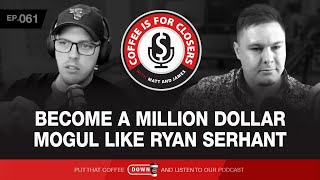
Ryan Serhant, a real estate broker and entrepreneur, talks about building his brokerage, sales strategies, and the mindset behind making millions. He covers how to build a sales team, navigate the real estate market, and apply those lessons to any business.
All right, guys, welcome to the episode of Coffees for Closers. It's me, James, and a very Special guest today, Mr. Ryan Sirhant. Ryan, welcome to the podcast.
Thank you so much. Thanks for having me. I'm very, very honored to be here.
Yeah, I'm sure out of all the many platforms this is, you know, don't get nervous. You know, we're only human, so I.
Know what it's like to meet your idols.
Right?
Yeah, exactly. They say never to meet them, but there you go. Yeah, sweet. All right, so let's cue the intro.
If you listen to this podcast, you will make your first million within three years. I'm going to repeat that. You will make a million dollars within three years of the first episode you listen to. We don't want pikers. We're not here to save the manatees. We're here to make podcasts. You really want this, you listen and review.
Put that coffee down.
Yeah. So for those of you don't know, we help with some of the sales for Ryan's venture side of the company, and we've been doing really well lately. And so, in turn, he agreed to come on to our humble podcast and help us kind of get the word out there. And just so you know, Ryan, this podcast is predominantly, like, for salespeople. I have a lot of guys who are just straight commission only sales reps. And there's a lot of parallels between their own business they run under the guise of, say, sales sniper, and then from there, we provide them with an account, which is essentially like giving them a building, and then they go and they sell the bejesus out of it. That's sort of the whole point.
Right.
And the account holder is like, the developer. So that's basically how our sort of business roles. But there are some really interesting, I guess, parallels. And, like, what I kind of wanted to talk to you about today, which I think would be super interesting, is like, some of the things that you think set you apart within the brokerage community or like the real estate community to be able to have such a, I guess a hockey stick, like, rise, because, you know, good business is not linear. It kind of rises like a hockey stick.
Right.
But it can also drop like that as well. And I guess I wanted to, like, know some of the mindset stuff because obviously you started real estate in a really difficult time, being 2008 in New York, which is one of the worst times that you could possibly be a real estate agent. But it's like, what do you think are some of the things that set you apart from the beginning, from the people who stayed in the saddle and the people who didn't.
I mean, something I talk about a lot, right, is that. And I didn't know this at the time, but my back was up against a wall. I didn't have the luxury of taking weekends or hanging out or being able to move home or having too much else to worry about because I was. I need to make money, you know, I couldn't. I was like living paycheck to paycheck by definition. And for me, it was commission check to commission check, right? Which was if I rented an apartment for $2,000 a month, the commission was $2,000 to the brokerage, and then 50, 50 to me, which was a thousand. And then eventually. And then I had to pay taxes on it. But I wasn't worried about that because who knew how much money I was going to make that year? So I just spent it, you know, so, like, my back was up against the wall and I was running from. At that time, it was the fear of failure, right? Because it was. It was that time, it was rant, right? I was running away from not being able to pay my rent. I was running away from the fear of failure because I was the one who said, I'm going to New York City. I'm going to make it work. And if it didn't work, then I'm the one who failed. And yada, yada, yada, yada, yada. I felt like I. Like I had to figure it out. And then slowly but surely, that fear of failure turned into a fear of embarrassment, because that's what happens after you become a little bit more successful and people start to recognize you. It becomes tricky that way. But those early days for me were my back up against a wall, my lack of money, which kind of leads into that wall. And the other thing for me was this was my first job. I had never really had a job before. I didn't have work burnout. It wasn't like I was coming from a 9 to 5 and then doing a career shift and then going from a biannual paycheck like clockwork, to no paycheck and trying to get over that mental hurdle, which, you know, for me now, if I went to a standard paycheck, it'd be weird. It would just be like I'd have to get over that because I'm so not used to it. And I think all of that combined just kind of allowed me to do whatever I needed to do just to keep Moving forward.
Right.
And it wasn't about getting to a certain point in a career. At the beginning of my, quote, unquote career, it wasn't even a career. It was, I have my real estate license to pay my rent. Let me see what happens with my life.
Yeah.
And just pushing that forward. And pushing that forward.
Yeah, for sure. I'm a big believer that, like, people. I think people run away from things a lot faster than they run towards things. And so it's like that genuine contemplation of failure is one of the things that really drives people to act. You know, like, people usually don't buy a new house just because it seems like a really fun thing to move. You know, like, there's usually some sort of pain point, and then it's the contemplation of that pain point. And I think one of the reasons why a lot of people don't act or don't act vigorously is because, like, you know, people don't really understand the consequences of their action or of their inaction. And I think, like, for me, like, when I got out of the military, like, because I was in special operations, and I basically spent my entire 20s kicking doors and then at funerals, basically. And so I was. When I, like, when I got out, my big thing was, like, I was super lucky to get out of that relatively unscathed. Yeah, I had a broken back and a few other things, but nothing that, like, nothing that can't be fixed, right. With some. With some gym work and some, you know, Pilates or whatever. But I came out relatively unscathed, both physically and mentally. And so I was like, I need to be able to do something. And I know that there's, like, I'm acutely aware of, like, the finiteness of time. And so for me, like, it's all about what do I need to do today to make sure that, like, when I go to bed, like, I know I'm doing everything because I know that, like, nothing is promised. And so it's that. But it's that genuine contemplation, I think, for a lot of people who don't act like, you know, and you said, like, it's that war moment. I've watched that YouTube video, and I've actually used that in sales a bunch of times because you have a authority, so I can use that to pull people forward. But it's that war moment. Right. It's like the actual contemplation, though. And I think for you, I think it was something about, like, the thought of going back Home, you know, it's not about, like just the concept, but it's like the day to day, the thought, the actual. This is the reality of what's going to happen.
Yeah, I've heard Ryan talk a lot about. He makes every decision and action based on future Ryan in 10 years and where he wants to be. So acting as if you are right.
What is the end state for you?
Good question.
So something that brings up a good point, actually. It's interesting to me when I think about why I make certain decisions, and I think about that a lot, right? Like, why do people make certain decisions? I wrote an article for Fortune, okay. About not listening to my gut, because my gut is in my stomach. And my gut's best interest is. Is to protect my body. So my gut's best interest is to protect me. And a lot of times what's in the best interest of my future is to go against what might immediately possibly harm me.
Right.
And your gut, remember evolution. Your gut's instinct to be scared, to be nervous, to take a step back, is because over time, we've spent a lot more time as humans being afraid of going out into that field because we might get killed by a tiger than we do now. Like, oh, man, should I start a podcast? Should I build out my social? Should I get my real estate license? Should I do this, should I do that? And your gut is still in, like, oh, preservation mode. There might be a tiger out there. We just haven't changed in 200 years. Our guts are going to be different. People are going to be informed in much different ways than they are now and then they were 100 and 200 years ago.
Right.
So we're kind of playing catch up, but our minds move much faster into the future than our bodies do. Um, and so I stay informed by my gut, but I don't always listen to it. And I don't agree. When people say, follow your gut, that leads you to enlightenment. There's a book by Malcolm McDowell, who's a famous author, huge, wrote Outliers, David and Goliath, Everything. He wrote a book called Blink, which is all about stories about how when people listen to their gut, they're more successful and they win. But I think that's only true when you find those particular stories, you know, and for me, I am informed by my gut, but I listen to the future. To bring up your point, James, I have written down more times than I care to admit what I want my future to be like and where I want to go and things that are true. Things that won't ever come true, Things that are realistic, things that are exaggerated, but mostly realistic. And I pay attention to that. So if I'm trying to make a decision, right, that is scary. And my gut says, don't do it. I'll look at those papers and say, okay, but what's my future telling me? Because what was Ryan in a more comfortable time, in a more level head, thinking about for his future? Because that's what I want to create. Case in point, when I started my own company last year, right? I've written for a long, long time about starting my own firm. One day, One day I'm gonna start my own firm. When the time is right, I'm gonna figure it out and start my own firm. That's what I want. I don't wanna work for another broker for the rest of my life. I do too many other things. I wanna lump it all together. I. The way real estate is bought and sold on planet Earth by the time I die, and I'm not going to be able to do that working for someone else. I got to do that on my own. And I wrote that down. Wrote that down. Covid hits and I'm like, you know what? I'm going to start my own company. But my gut and everyone I talked to said, don't do it. Don't do it now. Do it eventually. Just don't do it now. Don't do it now. It's going to be bad. The world's imploding. New York is on fire. It was literally on fire. Windows were broken. People were losing their minds. People were dying left and right. There were bodies on the highway. It was insane. But I. I followed the future instead of just following my gut. And thank God, because I wouldn't be here today talking to you with the success we've had over the past seven months and 10 days, to be specific. Had I listened to my gut.
Yeah. What was that time like? Like when you, you know, obviously, because you, you would have gone to your friends, your confidants, and, you know, potentially your. Your wife and all that kind of stuff and just been like, you know, like, what was the. Like, what was the sort of jumping off point? Like, what? Well, first of all, I'd love to know what the con. I don't know if you can talk about it. What was the conversation? Previous guys, and I would assume they would have saw it coming because you, you really outgrew the nest, as it were. But like, how? Because those guys, you know, I've been watching your Million dollar listings since season one. So I've kind of watched the evolution and then now being, you know, a more intimate part of it, like, it's very interesting, but, like, what was that jumping off point? Like, when you decided to actually make the shift? Like that night when you sat down, you were like, it's done now. Like, what was that like? Because I assume you had to give up a lot.
Yeah.
Probably more than what you thought you were going to.
Yeah, you know, it was. And I haven't really talked about it at all because I'm not really allowed to. But what I'll say is it was unpleasant, uncomfortable, felt unfair, but at the end of the day, I ended up getting what I wanted. And what I wanted was to get out. What I wanted was to leave with. What I wanted was to build something much bigger. And what my attorney said to me, and I'm so happy they did as they said. Listen, we represent a lot of high profile divorces all the time. And during the divorce, during the separation, figuring out that separation agreement, no one thinks about tomorrow. You're always thinking about today. You're thinking about the loss, you're thinking about the pain. You're thinking about, screw her, Screw him. He did this, he did that. And everyone's angry, angry, angry. You need to take a step back. You need to remember that every divorce client we've ever represented, one year after finalizing, they all come to us and say, life is so much better. It was so worth it. Thank God we did that when we did. Should have done it sooner, right? And at the time, you don't think that way. You're like, what are you doing? No, I'm leaving all this behind. I worked. I've got 12. My clients, my team, my. My buildings, all this. You're thinking about the money you're losing, which doesn't even exist yet. It's not even there, Right.
Potential. Yeah.
Yeah. It's just potential. And you're thinking about how much that person's going to still make all. How much they got to pay them. Right. Alimony, child support, all that stuff. And then, you know, for me, it was like four months later. It's like, holy, thank God I did that when I did it because I wouldn't be where I am today. Because there's a fire that gets lit underneath you when you're free.
Right?
When you're free. Like 12 Years a Slave. Like, when you are out and you're running free to be able to say, like, okay, now I can do whatever I want. That was a big, big deal for us, you know, And I have a lot more brand power now than I did before, like, a significant amount more. And that has produced a lot more business, which is very exciting. But that exit was tough, you know, and it came down to a significant amount of compromise. But I'd rather leave money on the table, make the other guy feel like he's winning, and I'll laugh all the way to the bank for the next 50 to 60 years, right? Like, you feel good now, feel good now, go for it. The good feeling you feel now is fleeting compared to what I'm going to do tomorrow and the next year and the next year and the next year. And that's that being informed by the future thing. It's just that I talk about it so much because I'm so obsessed with it, because it's. It's really freeing to think that way because it removes the pressure of the now, you know, it removes the pressure of the moment, the negative feelings, the anxiety that you feel about what you're losing today or what you worked on so hard to get to today. Because your biggest deal. And if most people who are listening to this are in sales, right? It's like what I tell everyone, you haven't even done your biggest deal yet. Like, isn't that crazy to think about, like, your biggest deal you've ever done? You haven't even. You haven't even met that person yet. And to talk about it as a hypothetical, like most people do, like, oh, one day maybe I'd love to sell something for $100 million is one way. But the healthier, the better, the more motivating way to think about it is, hey, pretty soon, and I don't know when, because no one's telling me, but pretty soon I'm going to sell something for $100 million. I'm going to meet this person, and they're going to be able to afford it, and I'm going to close that deal, and it's going to be in this newspaper. That's going to be awesome. I haven't done it yet, but I'm going to. And that's going to be crazy. I can't wait for that deal to close. And that way you get to walk down the streets and be like, is it you? Are you the one I'm going to go meet you? Maybe you're the one that's going to do that deal with me. Or maybe it's her. Let me go talk to her. And by the power of positive thinking, not by making it a hypothetical, but by making it a definite. You are doing that, making it a thing. You then force yourself to manifest it and it will just happen because you are going to end up meeting more people, you're going to take extra calls, you're going to do a little bit more work and eventually you're going to do it. You're going to be like, holy. I predicted the future. I knew I was going to do it. But you did it because you did the work. And I think that. Listen, man, I'm very also informed by athletes as well, you know, and it's amazing to watch like professional, amazing athletes that have broken records. And then there's all those YouTube videos and things where it goes back in time in college, you know, in their early days and they're talking about that they were gonna do and you're like, whoa. You know. Now obviously there's a lot of people who said that stuff too, who never did it. And that's fine, right? If they tried really hard and they didn't do it, hopefully that they got close. But a lot of people say, hey, I want to make a hundred billion dollars, I'm going to go get a steak. There's different ways to go about it.
I think actually athletes are probably the closest comparison for salespeople when it comes to business because it's a pure meritocracy. We have 50 interns starting today.
That's a lot.
Yeah, we had 100 and something applicants and so we kind of weeded through. We have a very particular purpose for them. So it's more of like a training internship. But yeah, like I told people, so it's like the first speech is like, this is a meritocracy. Like we will give you everything that you could ever require in order to do a really good job. At the end of the day, sales is one of those businesses where if you're good at it, you can make as much money as humanly possible. And if you're bad at it, you can make as little money as human. And so like don't, you know, make sure that you're not entitled to anything and make sure that you just put in the work and try your best and put your hand up and then you should do pretty well.
Right?
But I think like one of the things, sort of like going back to.
When you started the brokerage, what was the size of the team in the first place and where's it at now?
Small. I mean, when we started it was me. Cause I had a big sales team.
Right.
We were 65 people. And part of my deal was the team had to stay until they finished the majority of their business.
Right.
Because my past firm was not going to allow everyone just to leave on one day. That would be bad. So. But they let me leave, which is probably the bigger mistake. And so it was me, Yolanda, who'd been with me for 10 years. Jen had been with me for five years. So basically, Yolanda's operations, Jen's new development. We do a lot of new development sales and kind of just general help in building the company organization. Christina Rogers, who works for her. Kristen Capilla, who's graphic design. Lena Choi, graphic design. Natalie, who's our cfo, who was meeting.
With us last week.
Natalie Bates.
Yep. Yeah, she's awesome.
Yeah. And then my driver, Yuri. So there were eight of us, like, alone. And then we had to go and find new people. I had to go quickly. I had to find a new assistant, and we had to start finding agents and employees. And now we're back up. I think in total, uh, we're about 70 agents and employees. We bring on a new employee and a new agent or two every week at this point, by the end of the year, we'll probably be at a hundred agents and, I don't know, somewhere between and probably around 40 employees, which is a good spot for us. That's where I really want to get to kind of declare equilibrium in my head. I'm just saying, like, okay, this is a comfortable spot. We made it here. We did it according to our business plan. We did it according to our disruptive model. Did it work? Does it not work? What's working? Where should we go from here? And then I can start to expand and grow once I have a clear thesis. So I'm feeling it all out right now.
Do you have kind of an end state of what you want the brokerage to look like?
I mean, yeah, I am not just building a brokerage. My goal is to build an ecosystem, a real estate ecosystem that enables people to buy and sell real estate in a better way than they've ever been able to before. And where that starts is with the agents, a big part of that. And what we started a couple of years ago and that you guys are a part of is the course. Right. So where do things start? It's like, okay, how can I find great people? I find them in schools. Okay, great schools. Okay. Same thing for agents. I could find great agents according to deals, and that's fine. But I also really, really like the hunger that new Agents have and I like training them and if you train them, then that's what they know and then they stay.
Right.
And so I think you can build great loyalty that way versus just comp comparison. And so the training is a big part about building that ecosystem and giving agents all the resources and tools they need to be able to facilitate their sellers and their buyers better. And we power that ecosystem through media. And that's where the studios team comes into play. The ever growing studios team, which is exciting. And so one day we'll, we'll get there. I think we'll have a Sirhan house in all major cities ideally.
Right.
All luxury major cities. Sydney first in the United States and then outside the country. Yes. I need good agents. You know what's fun is like I keep folders. So anyone who's listening, I keep folders in my inbox from great agents in other cities who reach out to me who say, listen, when you are ready to come to Rome, you let me know because I'm going to help you build your company here. And so I'm not ready to go to Rome today, but I keep that folder. So if that person is still doing real estate when I'm ready, that's the first person I'm going to reach out to because I don't know anyone else. So I encourage people to email me all the time.
I'm going to get my real estate license. So as soon as you come to Sydney, I'll set that bad boy up.
Yeah, there you go. So you guys definitely know how to find people. So that's important and really understand the markets and figure out I want to be at the forefront of the disruptive model that is buying and selling through digital media in the 2000s.
Just going back to something that you said, selling $100 million, obviously I think you sold a house for 140 million.
133.
Yeah, 133. Do you treat that buyer differently than the person buying a $2 million apartment? Like what's kind of like, I guess. Do you have a different strategy for that?
I want to say I don't, but I, but I probably definitely do. Like I, I would, I mean I would drop anything for his phone call. I have to like there's no missing that phone call.
Right.
Because it's career change we're making and deals with people like that and I have a lot of clients like that. You know, we just did $104 million in deals with one guy. He just didn't spend it all in one place. He spent it in three places, but he did it all within a couple weeks. Like, that's also an equally important person. Those are three transactions. And so, you know, with those clients, you just have to understand that they got to where they are by being incredibly smart. But their relationship to money is very different. Their relationship to money is that money is a tool, okay? Everyone else, money is a resource. When you're that wealthy, money becomes a tool, becomes a tool simply to get you what you need to get. So they're either buying companies because they're trying to increase whatever, right? It's good business. They're buying, you know, investments to do X, Y and Z, or they're buying a house because it's a better trade off for taxes and for lifestyle. And that's what they want. It's not a resource to buy a house. They've got all the resources in the world, right? It is simply just a tool and they don't think about it as much. Like all the buyers that I have that are over, let's say, I don't know, over 30 million. The deals that we've done over 30 and above. A million here, a million there, doesn't mean anything, right? Because it's. It costs more to not have what they want than it does to spend the money. And so where those deals have affected me the most aren't just in legitimacy and credibility and being able to say to all of our course members, like, hey, you're learning from somebody who's sold a house two months ago for $133 million. Or, hey, you're hiring somebody that sells X, Y and Z. Okay? It's that it really informs the way I talk to those $2 million clients, you know, because I try to reason with them in different ways now where I'm like, you know, before I probably wouldn't have said, what's another 50 grand? What's another hundred grand? You know, I'd probably be far more sensitive to them. But now, like, listen, life is short. Like, don't. I feel like I'm much more blunt now. I'm like, don't lose this deal for $100,000. You're not going to remember, doesn't mean anything. And you're going to be so much more successful over the next couple years. You want to look back and remember that time you struggled and gave up a property for 100 grand versus that time you got to move in and not think about buying a house again for years and years and years.
Just the mental space of buying a House.
Yeah. And what is your. What's your time worth to you? Right. The time is important, and that's why people who have a significant amount of money waste no time and they spend whatever it takes because money is just a tool, and their time is by far the most valuable.
Absolutely.
Like, if you think about someone who's worth billions of dollars, what is their hourly rate?
It's like, not comprehendable.
Yeah, it's not comprehendible.
Right.
Their hourly rate is probably like, I don't know, $500,000, a million dollars an hour.
One of my friends ran private security for Bill Gates when he came to Australia. And Bill Gates, he told me what happened, and he was like, he was a great guy. They rented houses. They had all the furniture removed from those houses put into storage. All their furniture that they wanted to have bought moved into that place because they wanted to just be able to move in and relax. Then all that furniture was then donated to charity at the end, and then all there came in. He would fly back to the US From Australia twice a week on his private jet, which cost $350,000 each way. But he said he would lose money if he didn't go to those meetings in person, so he would lose more money than doing that. And then he wanted to rent a super yacht, but they wouldn't let him because he wasn't a resident or because it was such a big. So he purchased two of them while he was there and then had somebody stay back and resell them for $350 million a pop. And, yeah, they said he was a pretty good.
If you have a hundred billion dollars.
Right.
What's 350 million? I have clients who have, you know, who have super yachts. And it just doesn't. It just doesn't matter, you know, at that point, like, it's just. It's just a different world. And so my goal is to be associated with as many of those people as possible. I want them to be like, I need a house somewhere between 2,300 million. Great, let's go do it.
Would you ever consider getting Sirhan into other things, like super yachts?
You'd be. Sure. I mean, why not? Possibly. Totally. Totally.
Just a house on the water, man.
He's a house on the water. Yeah, I think it's, you know, I'm good with. As you see, right. Like, I am good with complementary businesses. And. And those businesses cater to the same clientele. The person buying a $30 million house also buys a yacht, also buys a private jet.
Right.
Also buys that Vacation property. And so I think if you can be, you know, all things luxury, then you can cater to that same clientele and kind of have it back and forth. Back and forth.
Yeah, yeah, yeah. Cause we're, what's the. We're looking at sales sniper at the moment. We're sort of looking because we've really taken a really good amount of market share within the coaching and consulting industry very, very quickly. Not, not too dissimilar, but on a smaller scale to what you've done with, with, with Sirhant, the brand. So, you know, right. Right now we're like, how do we diversify within other industries and still utilize our skill set?
Right.
Which is, which is an interesting thing because sales is sales.
Yeah.
I just want to go back a moment ago when you're talking about your, your goals are with the brokerage. It seems like you're utilizing that course to develop guys in the right way based around your ideologies around sales for that end goal so that they can eventually be recruited. And you're training people at a level to reach the standards that you guys have, which is sort of what we do with like our internship and bring people in. And it feels like you're at that level now where in the real estate industry, people know who you are, they know what you stand for, they know your end goal there. So it's attracting the right people to your company who want to work with you that share the same goals of changing the way that real estate is done. How much of an impact do you put on and time do you spend on building the internal culture within your brokerage to facilitate that dream to all of your staff so that they want to work towards the same end goal as you.
I try as much as I possibly can. You know, it's. It's not top of mind all day, every day, but I really try to lead by example. I try to have my agents follow, you know, my templates, follow what I do. I try to, I try to tell them all, I don't force them, but I, I should try to tell them to read the books, listen to the course, go through it, to really understand, like, hey, this is my headspace. This is my framework. This is how I work. Now you'll understand why I'm following up with you over and over and over right now. You'll understand why I'm doing this, why I'm doing that, because it works for me and everything that I've developed for sales and everything that I've built and everything we teach all the time I haven't developed coming from a place of success.
Right.
Like if you're already successful and you have a great network and you're from a certain area and you're good, then you could do what you want. If you want to step it up, great, I'm here. But you don't have to. But if you are starting from the bottom or starting from scratch and you have no idea what you're doing, then you're in the same exact position that I was. And here's how to start climbing. And that's what we created. And I think those people can become incredibly important. You know, there are a bunch of good companies that I know of, huge companies like retailers, right. Stores, shops, et cetera. And they have hiring models where they just go after hard working mid level students. So. And I don't know how you have it in Australia, but you know, the grading system at school here is if you're an A student, you're at the top, right? B, you're okay. C, you're in the middle. F, you suck. And so these companies go after C students. They want C students because they want the ones who had to hustle, they want the ones who are scrappy, they weren't the ones who had to fight. There is something interesting about that. To me, some of the best salespeople that I've ever brought onto my, my team before and now into the company weren't selling real estate when I found them. They were selling shirts, they were selling furniture.
Right.
They were selling suits, like selling high end suits. You can you turn that power and you turn it into selling apartments. The commissions are so much higher and you're not stabbing yourself with needles all day long from doing tailoring.
Yeah, I think that's a really interesting point because I can see selling real estate as being something difficult to get good at because it's difficult to get volume of interaction and the interactions are potentially worth so much, which is why do you recommend that people start out with renting as a way just to get interactions or.
Yeah, I mean I do. If you don't have to and you can go straight into sales and you know, you're part of a team like that, then great. You know, unfortunately a lot of people who work with me and who train with me, I don't do a whole lot of rentals. So then I have them working on sales pretty quick and it's like a shotgun. But if you can, you know you're going to get started in the business, you're not going to go after the big money clients, you're going to go after the lowest barrier of entry. So what is the lowest barrier of entry is bottom of the barrel rentals, things that you can personally afford. And so when I first started, that's what I said, you know, my rent was $1,100 a month. My clients initially were $700 a month rooms, $2,500 a month, one bedroom, stuff like that. And so there was no intimidation for me there. Like, I knew what those apartments were like because I lived in one of them. I did the application for one of them. They ran my own credit for that. I know what it means to get a guarantor for your parents. Like, so I was renting to people just like me who felt like they were working with one of their own. You know, a colleague appear. If you want to step up your game, you've got to appear like a colleague or a peer of the people you want to work with. And so you need to at least appear as if you could buy a $5 million house.
Right?
You need to at least appear like you are in the same restaurants, in the same positions as the people that can afford more. And that's how you slowly start to, to climb that price ladder anyway.
Okay, and then when you're dealing with the billionaires, what's your strategy there? Do you have. Because, so one of my friends is a very wealthy man. He's got four Lamborghinis and all that kind of stuff. And his company sells a lot of direct to China and Asia and stuff like that. And so they do research on the watches that the CEOs, the companies that they do, and then they have a vault of watches. And then whenever they fly out to go and meet these people in Japan, because in Japan you can. You really show your wealth a lot through watches because cars aren't really that usable over there and how. You know what I mean? And so they would literally like, if the guy likes Patak Philippe, they all wear Patak Philippe and stuff like that. So did you. I mean, I know it's a little bit granular, but do you have sort of strategies of how you kind of relate to the billionaires that you're talking to?
I should. That sounds like a really cool little detail.
That's a great way to get a vault full of watches to write it off on taxes?
Yeah, yeah, I have not done that before, probably because I'm mostly just representing clients and everything here. And when people come in, they want to see stuff that's very New York. So I kind of put on my New York costume every day, because that's what people expect, right?
What's the New York costume? What's that mean?
Exactly. It's what I'm wearing now. It's suit, white shirt, kind of colorful tie, boots, and an AP watch. Like, that's it. And you get an Escalade as your driver. The amount of billionaires that I have who have Escalades with their drivers, too, we all pull up, we got matching Escalades. You're good to go. You don't. There's no ostentatious cars in New York. Like, if you see a Ferrari, you're like, wow, that guy's from Jersey. You know, like, just weird. You wouldn't do it. There's no limousines in New York. I feel like at one time there was, but all those people left and went to either, like, the Hamptons or they went to la. In New York, it is understated wealth. And you show your wealth through, like, your name on the door of your company or in your penthouse or townhouse apartment. And so I get to those clients through their level of service. So those people don't have time to do anything, right? And so I go to them through their concierge services, through their tailors, through their private bankers. They have a certain level of service that they uphold and that they're used to and they're accustomed to. And so I make sure that I know those people and that those people introduce me as one of them. Like, hey, Bob, the billionaire. One of my other clients. Not like you, but really, really good guy, has done really well for himself. Ryan, he's in real estate. You should meet him. Oh, you work with him, too, huh? Interesting. And now all of a sudden, like, I passed that first test of, you know, we are at least connected through the circle of trust, even sartorial test association. Yeah, it's associated marketing in a way.
Right.
But it.
But it works. I mean, that's. And then it's just the. And it's. When you break it down, then it's just a referral business.
And did you have a different strategy in Miami and la? Cause you used to. I mean, do you still have teams in Miami and la?
I have agents in Miami, Palm beach, and la, but we have agents everywhere now. I used to have bigger teams there, but it was just difficult at the time because I didn't want to set up operations. I just sort of wanted to have groups of agents and run around and try to milk the brand. I Had and build up as much as I could. And it was just difficult, man. It is hard to manage and run operations from another city while you're in New York City and you're not traveling ever. It's just difficult unless you have the ops and you have the systems and everything in place.
Yeah. Cool. That's one of the things that we're running into. Cause I think we have, then we have 40 agents, as it were, at the moment, and I think only 10 of them are in Australia.
Probably like 52 staff in total. Like with our copywriters, support stuff, assistants, everything like that, which when we made.
Everywhere.
Yeah, everywhere. We have Dubai, uk, us, Canada, Australia, New Zealand. Yeah, New Zealand. Yeah, they're everywhere. And it was funny when we first met, we had a team of like seven.
Yeah.
Ten at the. The most.
Yeah.
Including everybody. So, yeah, I just. I just started running ads with me and your faces together. So thank you very much. That's more of a conversation for another day, but yeah. So, like, what, I guess, you know, this is sort of some. What is some sage advice that you would give someone who's starting out in sales? Probably a little bit, you know, generic, but what's the hustle? Muscle versus development versus mentorship. Like, what do you think is one of the things that you use? This is pure sales just to get better at influencing and persuading people to be able to get the outcomes that you wanted.
Yeah. So you, You. You have to mix training with learning on the job. When you're a beginner, it's kind of the same for your entire career, but especially when you begin, you need to mix every single day, some dedicated time to training. So it's being a part of a course, being a part of a training, reading manuals, listening to others, whatever you can do every day because you're new. And that, that should kind of be your. Your. Your M.O. for, you know, two to three years. Right. You have to remember, most people go to graduate school for three years. You can't just come in, get into sales and say, ah, I know exactly what I'm doing. Otherwise you're gonna be very, very frustrated. And you don't have to do it for 10 hours a day. Train for 20 minutes on Monday, two hours on Tuesday, because you have the time. Whatever works for you, make sure you're always doing it. Pro athletes, like we talked about, they train 80% of the year so that they can play in 20% of the games.
Right.
And so we shouldn't be any different. But in the beginning you want to be involved in as many client situations as you possibly can. If you're a new real estate salesperson, you want to be on a team. If you're any other type of salesperson, you want to be in a situation or where you can listen to conversations, you can be a part of those emails, you can shadow, you can have a mentor if possible, be a part of a group, right? If you are, you know, selling insurance, there's insurance sales groups, right? Maybe there's a team inside your own company. If there's not, maybe you can tell someone to create one and you could be on it and you take small amounts of money for great amounts of learning, right? And then it's all about building your book, building your client base, building your relationship base. All sales is relationships. You're connecting buyers to sellers, sellers to buyers, renters to owners, et cetera. Building that base. When you're in real estate, it starts with who you know. Real estate, cars really, so who do you know? Where did you know them? And build up that base. That's called your sphere of influence. So build up your initial sphere of influence, put it into your Gmail, contact tracker, Outlook or ideally some sort of CRM that you'll use forever because it will be a pain in the ass down the line to retroactively build one out because you'll be way too busy and you'll just be frustrated all day, every day.
Sounds like you start going to those people.
Yes. And so you start going to those people, just start going to them over and over and over and let them know what you do. And then you become the mayor, right? Anywhere you go, you're telling people what you do, you're walking down the street, you, this is what I do. You're looking for that a hundred million dollar buyer, right? So you're introducing yourself, you're introducing yourself to people. You've got your card on you, you've got your virtual card on you. You're getting people's contact information, you're getting their social media handles, you're making sure that anyone you come in contact associates you with what you sell for the rest of time and associates you as a good person. You don't want to just be associated as a salesman, you want to be associated as, ah, it's a really good person who sells X. And slowly but surely that work that you're putting in will take care of you. It just will by default.
I love it. Because that's the mentality we really try and drill home here is like because we really, we go after, we don't really try and recruit heavy talent. Like what we try and do is we try and recruit younger guys. And I'm very careful with like I don't want to take on people that have massive amount of financial responsibility because I take it very seriously that I want to really be able to provide for someone. But again, it's a meritocracy. So I'm like, you know, again, exactly like you said, it's a large amount of learning for a small amount of money and that in the beginning of sales that's what it's always like. And then try and give somebody volume. So we usually put someone in set of roles. Like we have two full time setters in your account for example. And those guys are in there having interactions at a lower level. And then those guys start to climb that ladder and then they start to get promoted into having doing their own deals in a smaller way and they start doing bigger deals. And then we teach them how to, you know, sell a speaking engagement with you.
Right.
And so like we, we, we, we, we climb the ladder. But it's, it's good to hear that like somebody who's achieved such a large amount of success in the realm of sales because I just see sales as sales. Like I don't think there's a difference between selling real estate versus insurance. It's like people have problems, there are solutions and we have to figure out what impact the problem is having and then how we can give them a solution based on our product or service.
Right, exactly.
And so that, that low, that like you know, start low, go for it, get a lot of interactions and then from there surround yourself with the right people and you have a good chance of being successful.
Absolutely.
Yeah.
I have one last question for you. I don't know, you might have have some more. Is you mentioned like go out every day looking for that person who might be that next big deal.
Yeah. Right.
Have you ever put any thought into that maybe you've already met your biggest deal yet and you just need to do more follow up.
I mean possibly.
Right.
But I follow up with that person all the time anyway. For anyone that's taken the course or gone through the book or know anything about me, you know that I follow up with people until they buy or die. Um, and some of my best follow up has been for five to seven years.
Right.
Like I met someone in 2012, I followed up with them five years, they never replied. He finally replied, said he'd been a little bit busy, but now he's interested and I've been on top of him. A couple weeks later, sold him something for $16 million in SoHo. The next year I sold him a place in the Hamptons for $40 million. The next year I sold him as in the next year. Meaning like last December, I sold him something in Miami for $33 million and very, very happy. I just bought him a $50,000 car as a closing gift because I needed to get him a closing gift, you know.
What'd you get him?
I got him a moke. I actually got two of them.
I know what a moke is.
Two very special mokes which are the electric kind of jeep cars for his beach house. And I got one for him and one for someone he referred me to.
Yeah, right.
So yeah, you know, I wait to.
Be able to give gifts like that.
Yeah, I, I actually, I tell that story because I think you, you, you, you told me that story and I tell that about a follow up. So enough when I was in Afghanistan. So you know the C130 gunships like the big Hercules, right. So they're the gunship version of that is is got everything right. And their motto is you can run, but you'll just die tired. And so I have, we have sales sniper T shirts that say you can run, but you'll just buy tired. Because our follow up is relentless. So I, I have to send you on.
Yeah.
Did you enjoy the rifle that we sent you?
Yes, it is in storage right now because removing offices. But I appreciate the sniper rifle.
Yes, that is a. An actual replica of the gun that I used. Same, same paint job and everything. I think we've gone over time, man. But I really appreciate you being here and taking the time and pleasure to do business with you and I hope that you're happy and all that kind of good stuff.
I've actually got a lot of thought provoking things to write down after this to the to talk about. So. Yeah, it's been great.
Good. Listen, you guys are the best. And Matt, I will talk to you tomorrow.
Okay. Awesome. Thank you, Ryan. All right guys, so there it is. Episode with my close personal friend, Ryan Serhan.
Yeah, best buddies. Just say that. You know, just say the gift he got me.
Yeah, yeah, yeah. All right guys, make sure you like subscribe to the notification bell. All that kind of good stuff. Comment. Any other super famous and wealthy successful people that you want to step on.
The podcast, let me know.
We will, we'll probably not organize it. Yeah, you just got to follow up.
All right.
Guys.
Maybe we need the mentality that they might be the next we can get.
We'll get Brad on.
Yeah.
Yeah.
Bradley, for those of you don't know. All right, guys, thanks very much for coming, and we'll speak to you soon.
Bye. Bye.
Put that coffee down.
Coffee's for closers only.





