Does Camera Gear Matter For Entrepreneurs
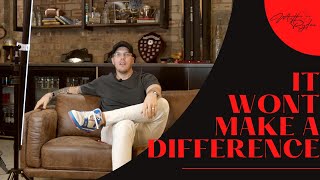
Matt Ryder argues that entrepreneurs obsess over camera gear when they should focus on message. He started with minimal equipment and found that engaging content beats expensive cameras every time.
Hey, guys. What's up? Matt here. Recently we shot a video about how we kind of shoot everything on an iPhone. I mean, this stuff is just. It's just shot on an iPhone. Do you know what I mean? Like, all we've done is just shot this on an iPhone, like it's no big deal. But the truth of the matter is, in today's video, what I'm going to explain to you is why gear matters, but it doesn't really make a difference. As someone who does sales and marketing for people for a living, I would much rather, dude, just spit and hot fire like Dylon on a Motorola razor flip phone from 1942, rather than just spewing hot garbage out of his mouth in the latest 12 16K Blackmagic Red Arri camera, right? Because at the end of the day, what matters in content, when it really comes down to it, is how good are the things that you're saying and how engaging is it to the people who actually watch it. And if you've got that part right, then doing it on this camera or this camera with this sound and this lighting will actually make a difference. But if you haven't got that part down yet, then save yourself the cash. Usually we film on two cameras. We have camera one and camera two. Right now, they are different cameras. They have slightly different use cases. This one is filming in 8K at the moment, and it's actually a much better wider frame than what you've been seeing. That allows us to do a bunch of different things in editing and make the editor's lives easier without having to change lenses and do all kinds of weird stuff. Now, the reason why we use a second camera is because I have really bad habits of saying like and stuff like that and not getting it right the first time. So by having a second camera which is also recording audio, it allows us to kind of cut in multiple shots and make it more visually interesting for you, the watcher, which is very important, especially because we're uploading this onto YouTube as a primary thing in visual inference, interest and engagement is all kind of part of the process. Right? Right, right, right. Like and like, like, right, right, right, right, right, right. That's that. That's sort of the camera side of things, right? Let's talk about the audio. Now, audio is arguably more important than video. People would generally tolerate kind of a crappy video quality because maybe they blame it on their Internet settings. If it's a lot, it's not great. But bad audio people will bounce straight off the video. So Generally speaking, we record two separate audio tracks. The first of all is this lav mic right here, which is connected straight to the camera that I'm looking down the barrel of Now. The second is connected straight into our secondary camera and it's the microphone that's right up here. Now, the reason why we have that is because this is a functioning office. People are doing their jobs. Thank you, sir. Right. Right now. And so I need to have backup audio in case someone starts typing, carrying on ringing bells, making sales, doing all that kind of crazy stuff. Right. And so we need to make sure that we have redundancy in our audio because I don't want to spend five hours on camera every single day retaking stuff because we get it back to post and all of a sudden there's audio artifacts that we can't fuck. Yeah, I just made another sale. Oh, shit. Sorry, guys. You know, the truth is, like the audio on your iPhone is actually really good. You've seen people do interviews in the streets and they just have their voice memo going. It's good. So if you don't have access to all that stuff and you can spit hot fire on this, it's going to be much better than spewing hot garbage on this. If you have great cameras but you have terrible lighting, it's not going to make a difference. In the same way, if you have, you know, phenomenal lighting, but you have like Garbagio cameras from 1942, it's probably not going to make that much of a difference either. But what's important is that you have a consistent lighting that makes you look good on camera, that makes you feel comfortable. So that when you see yourself in the editing suite, you don't go and you don't want to produce it. If you just film outside on a cloudy day, right, with this, it will probably come pretty good because clouded light is way better to film in. It's diffused. It's very, very simple. You have fantastic video quality going this way. Plus you've got a good microphone and you can hook a lab up to it. So although we have this elaborate setup because we like to control our environment a bit more at the end of the day. If you just went outside in a cloudy day with a lav, Microsoft and this, and you were spitting hot fire, it's going to turn out pretty good. Let's talk about somebody to set it up. Now this is a non negotiable. You have to have a videographer. No, I'm just kidding. You don't. You don't need a videographer, you don't need someone to do it for you. Most of the content, if you look back through the YouTube channel, which I very much encourage you to do, especially the monetized videos, you can look back through our podcast, you can look back through the YouTube, even the Instagram. That was all me. When I decided to start doing content, I bought a $25 ring light on Amazon. I had a like 99 do webcam. And then I run everything through Zoom because I didn't understand that you could just record locally on the device. But I ran it all through Zoom, heavily compressed, and then I imported into an editing suite on my phone because I didn't know how to use an editing suite that was on anything else. So I just did it all on my phone, edited, uploaded it, because I wanted to get my content out there. I think a lot of the time people hesitate a lot and they want to wait until they have the perfect setup, until they have the best cameras, until they have this. But the reality is, I couldn't afford any of this when I first started. What you're looking at right now is probably, I don't know, like, $35,000 worth of gear. And that's only part of the stuff that we have. And the reason why we do that is because we can. But when I first started and what built my businesses to multiple seven and eight figures was just me getting in front of a camera with a $25 ring light, using what I had available to me and doing the best quality content that I could. And so if that's what's holding you back, if that' what's stopping you from making content and getting your message out there, then just start, just say, yes. The amount of people that you hear that say, oh, yeah, I'm starting a podcast and never actually launch one. It's just, it's unfortunate because, you know, we need to get the knowledge from the people who have it to the people who need it. I remember I saw a competitor of ours saying they're going to get to 10,000 YouTube subscribers by the end of the year. That person hasn't posted on YouTube in three months. It's May. And so I think people are looking for the wrong feedback metrics when it comes to their content. They're looking for more views, they're looking for more comments, they're looking for more downloads and subscriptions and all that kind of stuff. And although those metrics are, I think, important and it's good to track those things, it's not what the intent of content is. And so when I started a Facebook group, when I started a YouTube channel, and when I started a podcast, the expressed intent was to enrich the lives and skill sets of the people who watch and listen. That was it. So if I have 10 fiercely loyal subscribers, I would take that over 10,000 people who barely give a fuck about what I say. And what I have noticed is that although my channel is quite small, at the time of filming this, it's under 3,000 subscribers. We get, you know, maybe a thousand views, a video, something like that. And there are people out there who have much larger channels who focus on virality. We don't care about virality. We don't care about our Instagram reels going viral, about our subscribers going up exponentially, or about our videos getting crazy, crazy views. Because I'm not talking to everybody. I'm talking to you, the person who is still here, who actually gives a shit about the things that I have to say. And when somebody hops on a sales call for one of our done for you marketing services, sales services, content repurposing services, whatever it may be, that person has gone through potentially 40, 50, 60, 100 hours of my content. And I know that because I get the feedback from the people who sell. And those people have decided that I know what I'm talking about. Because when you spend enough time on camera, everyone will either be convinced that you're a genius or a fucking idiot, and there's nothing in between. And I'm fine with all the people who think I'm a fucking idiot. That's fine. But it's the people who think that I really know what I'm talking about. Those are the people I want to focus on and I want to increase that incrementally. And when I see people go, I'm starting a podcast, I tell them it'll be three years. My podcast is only two years old, right? It'll be three years before you get real traction. Now we have decent traction on our podcast, but I know people doing much bigger numbers and they've been doing it for longer. It just takes time. And so I think it's like, it's just the incorrect measuring of success is what really holds people back with content. Because they throw up four or five things, it doesn't go viral, and they give up. But I know you guys are here for a real take home, tangible. And if you guys really want to know the reason of the success of all the companies that I've been a part of, whether it's seventh level lightspeed sales Sniper Sniper Media. It's having a one wheel for your videographer. It is a complete non negotiable. Actually it's a piece of. And I hate the fact that he always wants to use it. But hey, you can't win all your battles. So guys, just to wrap up gear matters, but it makes no difference if it's not being used to deliver a good message that's targeted towards the right people. So sit down, plan it out and just get it out there. And the more money you make, the more you invest, the more seriously you can take your content. Because the more seriously you take it, the more seriously you will be taken.





