How This Stock Trader 2xed His Income Through High Ticket Sales
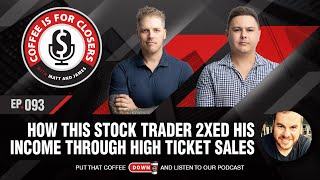
Matt Ryder interviews Stephen Andrews, a sales pro who moved from forex brokering to high ticket sales and doubled his income. They discuss sales strategies, managing teams in regulated industries, and why treating employees with respect matters in coaching and consulting.
Hey, guys, what's up? Welcome to the episode of Coffee is Foreclosures. Special guest today, Diamond Hands himself, Stephen Andrews. What's going on, Steve?
Been well, man. How are you?
I'm good. I'm good, buddy. So Steve is one of our sales guys, has a very colorful background in terms of business and sales and what you've learned and where you've come from. But yeah, I thought it'd be a good idea today to get Steve in and show us your wisdom in your journey. So, yeah, keep the intro.
If you listen to this podcast, you will make your first million within three years. I'm going to repeat that. You will make a million dollars within three years of the first episode. You listen to. We don't want pikers. We're not here to save the manatees. We're here to make podcasts. You really want this, you listen and review. Put that coffee down, Red.
Stevie, how did we get to be here today?
Good question. Matt found out about South Sniper. When was it? End of. Probably end of 2020 actually. I got involved with Jeremy Milliner and then as part of that, saw one podcast, one kind of meeting with Matt and I thought, this is a guy I should get to know. He knows sales and quite intriguing. So it's been a good journey actually.
Man.
Okay, what did you. Before sales?
Mine, I was in forex brokering. You know, been running brokerages, was selling in brokerages before that. Then I sort of graduated to running it and I've had all sorts of history there. So been a good journey.
Okay, so what was like, what was the, I guess, sales floor mentality like on sales forex brokerage firm?
Look, it's quite not the traditional sort of kill em, you know, because we've gotta be compliant. Right. So you had to sort of sell intelligently. Like you couldn't just blast everyone and, you know, sell with hype the way that most people try to tell you to do it. So you have to be quite, you know, strategic with your sales. You had to be compliant with the regulators that you're not overhyping a product because it was regulated. So yeah, it was quite, quite a different background than traditional, you know, pow wow, you know, hammer the sales. Even though there is some of that in that industry.
Okay. Because like my, my thought immediately goes to boiler room, spot on and that kind of stuff. Right. So like what, what were the specific, I guess, products that you were trying to get people into?
Basically you're selling the software to trade effectively or. And the software as well as the Brokerage itself. So you're selling the brokerage in terms of.
So I would, I would invest my money and you guys take the money.
And you guys know, invest with us and trade with us. You're selling the brokerage as a service as well. So come in here and you had to compete with other brokers, bigger, more established, come in here and why. So you had to sort of sell that aspect. So. Quite interesting.
So I guess forex is different to like traditional stock brokering.
Yeah.
Is it more or less regulated, I'd.
Say with the forex industry? People in the forex industry know this. I'd say it's probably more regulated.
Okay.
It's a, it's a derivative, it's a high risk, high play game. So the regulators are very sort of cautious with as they should be because you know there are, there are some bad players that they gotta be aware of. So.
Yeah, well, whenever you get DMed by a scammer, it's crypto or forex, right?
That's right. Comes with the territory.
Do you see any parallels between what's happening at the moment with crypto and I guess maybe, I don't know, like, I don't know much about forex. Was it like a golden age of forex, do you think that that sort of those, that money's passing or is it still just as lucrative?
That's a good question. And the answer is the regulators have come down the last couple of years and they've really tightened up the industry, which it needed to be done so to some extent for, for the bad players, the golden industries over in terms of high profits and all that. But in terms of, for the safety of the clients and the consumers, it's probably they're in a better spot now that they're not in a position taking so much risks with it, that the brokerage is doing the better things now because the regulators are sort of caught up with it. So the golden age in some respects has passed, but it's a safer environment now.
Do you think that will as well, that they'll do the same similar thing with crypto?
I do, I think that crypto would be one of the big talking points across the world. You know, we've already had, you know, American administration just last week talk about that and shaking the market as we.
Can see, huge blood and guts everywhere. Yeah. And you were the cfo CEO. CEO of one of those large brokerage.
Few of them actually, over my time, yeah.
Okay, so how did that. I guess like you don't have to Go through the series of events because I'm somewhat familiar with it. But I guess like, what was the point where you were like this? I'm out. I want to get into something where I have more control over.
Yeah, well, again, it stemmed from, you know, I was pregnant with my first child. Me myself wasn't, but my partner Arisa was. And it was really hot at that time. The market was hot. There was a few things going on in general with the industry and it was time for me to say, well, look, take a step back. You know, I'm still involved in some respects, in other ways with it, but it gave me time to sort of reflect and say, what other incomes can I earn with something that I enjoy doing, something that can contribute a little bit. And sales was always my background, so it naturally made me say, well, what's available? Take sort of taking a look there. Not to say I've turned my back on the forex industry. I'm still involved somewhat, but not as active as I was.
So what was your first high ticket gig?
So high ticket gig was really, if you're talking about high ticket sales, it was probably, you know, when I came on selling sort of E commerce packages and you know, high packages in that way. Before that it was selling the brokerages and before that I was selling alarm systems back in the day, like I think a few of us did.
Yeah.
Bought it all and then selling Xerox. So high ticket over the phone. Yeah, it's more in the last couple.
Of years, you know, one of the funniest conversations that I think I ever had with you is we all went out to lunch one day and I was talking about how you can tell you're selling a scam. This is, I think before you were sort of just starting with us and you had other accounts and I remember I started listing all the things that you can tell and we all looked at you and you were like, huh? I was like, I think Steve just figured out he's selling a scam.
I come into things genuinely wanting to help people.
Yeah.
And you know, when you find if something's not right or if it's delivered not right, you know, you don't want to be, you know, you want to be in help, you know, helping people. You know, you want someone that buys a product that you know is in a position to do it and they're ready. And I think if you've got that alignment right, if you've got that, that you believe in what you're selling. I don't know I think it's more congruent and it allows you to have a better response and a better outcome for everyone.
Yeah, man. Cool. And so what was your first, your first product was like E Com done for you or was it?
Yeah, effectively.
Yeah.
Yeah.
And then I think you moved on to an Amazon offer.
Yep. Right.
And so I guess like, I guess like where are you headed? Like what's your, where do you want to be in terms of your sales career? Because like I know a little bit about you. You don't need the money, right. Because you've been good with your investments. So like what's the, what's the driving force behind wanting to one, like why would you invest, you know, 30 grand or 40 grand or whatever it is you did in your sales training when like you're very comfortable and you, you have a skill set being forex trading and crypto trading where you could probably just do that full time and make a good amount of coin.
Yeah.
Right.
So why, why go so deep into the skill set?
I think it's probably one of the most important skills you could learn really. And it's important to keep diversified, right. Like markets come and go, things come and go. And I think if you not diversified enough, if you specialize too much. Some people argue the point that you've got to specialize and master something completely. But I was in a point where I reached a certain point in the career. You know, I've been there before, been in the corner offices in the city, you know, 27th floor on, you know, Barangaroo. I've done some cool stuff. But going back to the roots and having a skill set that you could have a bit of freedom, it came down to really flexibility and the ability to have freedom that you could pick up and say, right, can I speak to someone today, potentially make a good amount of money and then choose what I want to do the rest of the day. It's not just about working that grind, grind and you know, eight till six and you know, missing out on your family growing up, it's having that ability to have freedom, you know, while also being able to command another, you know, another income level whenever you wanted to. I just thought, I've always liked sales, I've always been decent, or so I thought before I came here. The guys level of salesmanship in here is insane. But I always enjoyed it, just put it bluntly. Really?
Yeah.
What do you think was the difference between I guess like NDPQ and the sort of style of sound that you did?
Oh, it's Way more with the. It is still way more with human behavior, as Jeremy always says. Right. Like before when I used to sell, there was always that sort of element of tension in the phone and you know, the ability that you drag them over the line almost.
Right.
So that, that was always still there even though you had to do it in a compliant way. Whereas with npq, you know, when it, when you do the right and you follow the steps correctly, you kind of. It's a collaboration and it's a conclusion that they say okay, well what's the next steps? Or how do I proceed? You know, more often than I was getting before. So that's a fine of biggest difference.
Yeah, that's one of the things I found. It becomes an easier way of selling because like it's just combative. Selling is just tiring. You know, like I just found like I was just like beating people up. I wasn't. Industry where there's really much compliance selling business coaching dollar you want. It's a super unregulated industry, you know, I mean because like, because like it's, it's funny, right? Like because biz op is fairly heavily regulated.
Right?
Because you're, you're, you're selling, making money. But for some reason business coaching has sort of fallen under the radar of like education. But it's not.
Yeah.
Like it's how to make money.
Yeah. Right.
But it, it's in this education realm where it's like super unregulated now. It's very interesting and I think what one of the one thing the salespeople forget is that they're liable for their words. And the funny interesting thing about coaching programs is that you can never say a result in a coaching program. It's the same as you can never do that with biz op. Right. Like to be very careful with those things because if you say a result and you're like, yeah man, for sure. Over the next 12 months, you definitely get your business to 30K a month. If they get their business to 2999 9.
Yeah.
Full refund.
Yeah.
They're entitled to a 100% refund, you know, unless obviously contractually. But like if they have proof, the salesperson said that they're cooked and the salesperson is the one responsible for that. Like not the business. Because like the business didn't tell you to say that.
Right.
If the business did, then they're going to be in trouble if you have proof of that. But like salespeople needs to be aware that like they are like even Though it's a relatively unregulated industry, especially coaching and consulting, which I think will change, especially as it starts to get bigger and bigger and bigger. And Facebook and Instagram and they're doing their own internal regulations essentially, but in terms of like a sales process and delivery mechanisms, like, it's pretty rogue. And so like, salespeople, if you're watching fucking, be aware you're responsible for your own words.
Right?
And that's exactly.
And you. And you've had regulators come down on you and you've had to fight the fight.
Oh, yeah, yeah, we've had big things. Right. Well, I don't want to go into specifics, obviously, because of it, but, you know, there was nothing on. But they're very on top of things. And your word is your word.
Right.
I always say one of my favorite history, like, sayings is you can't fake your history.
Right.
People know, you know, if you're a good guy 10 years ago and you help someone, they're going to remember that, same as if you did the wrong thing. And that's with clients. And that too. That's what I was saying earlier, being congruent with the product and believing it and having a good product to sell. I think that's, you know, 20% of every salesperson's battle. Find a good product that you can trust the person to do the right thing and you're going to have a better result for your people that you've. They've trusted you to send you money. It's a big thing for me.
It's a big problem. Like, salespeople really struggle to spot poor programs because generally speak. Generally speaking, you're going to protect your salespeople from complaints.
Right.
Which is a good idea. Like, I don't think that's dodgy. I think like, like, no matter how good you are, there's a percentage that will complain. And for bored a lot of time for ridiculous reasons.
Yeah, Right.
So you need to protect your sales staff from that because your sales staff need to be like, pure champions of what you do. But in saying that as well, like, if you spend eight hours a day, five days a week convincing people this is the right move to make, then you have convinced yourself you can't not. So, like, that has a couple of, like, downstream effects where, like, salespeople are more likely up on the phone because, like, they are so confident in the program because everything they see is unicorns and rainbows.
Right.
But also, like, they're loyal to a fault, like, to where, like, they Take the shit into the stick because, like, they're like, oh, this is the greatest program. I'm lucky to be selling it. And then business owners take advantage of that. And I've seen a real shift in the last probably year of like higher level business owners losing lots and lots of stuff because, like, they're just being greedy. And I think like Ryan sir, I did a podcast with Ryan Serhand that will link somewhere below. I did a clubhouse with him and he was telling me how like a really, really great lesson was, like, when he was building one of his sales teams, he had a team of like 80 or 90 people at the time. And he was building that up. And then all of a sudden he had like a mass exodus. And it was because, like, he got two extra TV shows. He's on three TV shows, right? He was on Sell, like Sirhant. He was on the Sirhant something or other one. And then he was on Million Dollar Listing. So three TV shows. And he started to get in mentality and he said this openly and he's changed this, fixed himself on it, but he was like, well, you guys are only getting these opportunities because of my name, right? But then the sales staff are saying, yeah, but you only get. You only make the money because we do work and that frees you up to get those opportunities. Right? And both are both simultaneously right and wrong.
It's so funny you mentioned this man as someone who came from a sales background in the forex brokerage industry and then came into management. I couldn't agree with that more because it's always that. It's a push between management treating employees not as well as they should be and employees thinking they're entitled to more than they're worth.
Right?
Yeah, that's what I find. And it was always that balance. But having seen both sides where you're right, people are losing people because they think that the business is bigger than the people. And that's not the case. You know, without the people, everyone walks away from the business. You've got nothing.
But also without the brand, without the brand, they're both equally as important.
Both equally. It's a tree and branch, but they're both equally. It's. It's a synergy.
Right.
And they both have to. You know, it's almost a difference between politics, left and right. You need the center, you know?
Yes.
Yeah, you can. You can go spend a whole podcast on just that.
And there's probably times where the brand relies on the employees, and there's times where the employees have to rely on the brand. You know, like if, if we go through a spot where, you know, 3 or 4 of our account team the bed and we don't get sales and we lose those and we're going to rely on my branding to get us more accounts to be able to feed them. And there'll be times where like the only reason why we get those accounts is because our guys have done such a good job.
That's right.
So it's like, you know, there's a back of, you know, we had a team meeting today and I just said like, like everyone needs to know that first of all, like decision making processes I think should be somewhat transparent. And I think that's a big mistake. A lot of business on the first, paying on the first and getting paid for that invoice three weeks later.
Yeah, right.
So like we're putting ourselves in a, you know, a million to $2 million cash flow shortage every 30 days.
Right.
Which is like problematic because it makes it difficult to run the business. So whereas like, so how do we. But like we did that in order to pay the sales guys as fast as possible to make them as happy as possible, but we did it at the massive detriment to the business. So now we're like, okay, well let's mitigate that detriment by having a mid month billing cycle. And then we know we get everyone paid on the day of the 15th, right. So it's like bang, good to go and we have a transition period to get there. But it's like that's like that's the best balancing act we can do. Best case would be 30 day payment terms. You send me an invoice, I have 30 days to pay it. That would be best for the business, but it's kind of around for the sales guy, you know, because then technically if you do a sale on the first of the month, you're not getting paid for that for 60 days.
That's wrong.
Which is, you know what I mean? Once you're in that cycle, it becomes fine, but getting into that cycle becomes a right. So. So mid month is where it will stay.
And what, what you just said then I think if people on the in the team know why you're making decisions, this is not a decision in a vacuum. Because what I found firsthand when things were said and those decisions from higher up and it didn't make sense or they didn't know why, that's when you cause people get a bit uncertain, creates friction and bitterness. Whereas if you sit down and say, hey, you're open about it. The reason they're doing this is this. There's a short term hit, but it's for the long term. It's kind of people get it. Right. Most people, you know, 90% of people that you deal with, 95, hopefully more, are reasonable.
Right.
So if you're reasonable with them and the people who are, you don't want them around anyway because they're going to cause another trouble with something else down the line.
Yeah.
So if you're transparent with them enough and you don't need to tell them everything, you're not going to tell them the bottom line of the business or really sensitive stuff. But transparency, I think, always works because it just gets people on the same side that we're all on the same boat, paddling the same way, I reckon.
Yeah, yeah. Like, I think, you know, and, and so also the, the one of the other core tenants is that like, regardless of your position in the company, your value is the same.
Right.
So, like, you should speak to me the same way that you speak to Joe Setter.
Yeah. Right.
Because if you don't, like, what, first of all, what's wrong with you?
It's an elitist thing, right?
Yeah. That always. That's what really me about, like, the special ops community, especially snipers and snipers thought they were so cool. And I was in snipers and it was like, thought we were cool. It's like, guys like, your job and your rank does not dictate your value as a human. So, like, let's just treat everybody with respect and we'll all be fine. You know, like, that's.
That.
That should be the default.
Right.
And so, like, I had a real problem with that. And I was like, we're not that cool. I was like, we're just, you know, people. People like to martyr themselves. Right. I'm doing this for the good of the country. You just like doing it?
Yeah.
It's just fun.
Pretend that it's something jumping out of.
Planes and fast roping on the buildings like it's every little boy's dream. It's fun.
Yeah.
Like, yeah, you have. There's chance you might die, but I get some cool stories. Right. So there's a lot of upside.
Right.
So I think, like, it's important to remember that stuff. And I think for me as like a manager of a lot of people, like, I can see the frustrations that must have come from, like, managing a highly motivated group of young men in special operations. But I can see a lot of the frustrations are self manifested because of a complete lack of transparency. And it's like if they would have just gone, hey, you guys are doing this for this reason. People go, oh, instead of all the diggers going, it's so simple. Yeah, stupid concert, you know what I mean? Which is what you end up the conversation of having.
Yeah.
And you just think your entire hierarchy is incompetent because like you're, you're looking at it through this lens. All they have to do is open it a little bit and you go, oh. It actually makes a lot of sense. Although I'm eating a big fat.
Right, like.
And I don't necessarily want to. We call it the pineapple. You know what I mean? In the army, if I can bend over, take the pineapple backwards, right? It's like called pineapple. You know what I mean? In the army, if I can bend over, take the pineapple backwards, right? It's like, although we're getting the pineapple, it kind of makes sense why. And although I don't like it, I get it. And I think that's, that's lacking in a lot of. I think a lot of business owners, they just think they're so cool and that there's some sort of like visionary, I don't know, guru. And they believe their own because they're surrounded by people who are going to like, especially coaches.
Right?
Because coaches are like, they're the God king of their little universe and it's like, it's just such a way to be. And it makes you the worst boss.
Well, exactly what you said, mate. You look at it where people are sitting around, it's when you get to a certain level, you gotta remember where you came from, right? You got. It's the people that get you there. And exactly what you just were mentioning, you can't just expect. All of a sudden you're at this elite stage and then to treat other people bad. And it comes down to what you're mentioning about. You've gotta be a good person no matter who you're talking to. And people lose that when they get to a certain level. They never understood it because might not have ever been there. A lot of people in positions of power and privilege have never had to struggle. They're sometimes the worst because they've never seen the other side. That's why you got to always, I think you always got to stay humble, treat people the way you want to be treated, right?
Yeah. And I think like people just, I don't know, they start to believe their Own and I think like specifically in the coaching and consulting industry, which is the industry that we're sort of in, there's variants left and right there of like biz op and stuff like that. But essentially it's people teaching other people.
Right.
I think people really do get stuck in their own vacuum and it ends up being just a really, really like I'm, like I'm. It just ends up being a very, very negative environment for a lot of salespeople. And what I'm seeing industry wide is very unhappy, highly commoditized salespeople. And they're coming to us because we don't treat them that way. And they're coming to us a lot of the time for a reduction in percentage because, because we're an agency, like we can't pay as well as going direct to the account. We just can't because we have infrastructure costs, right? So like if similar closer can be 20%, like we might be able to bid at 23% and get it because we cover a lot of stuff. But like that 20% would all go to the sales guy if we did that, we'd go broke. Like we have to take 50 to 60% of that. Like we're very transparent about that because it's like, man, like we need like we have so much infrastructure cost because we're training everybody, we're writing everyone's scripts, we're providing CRMs, we're providing follow up people for the closers, we're got setters and every, all those people are on fixed wages.
Yeah.
You know, and then we've got a cto, a cmo, a CEO, a cfo, two bookkeepers. We've got this, you know what I mean? So like in all to make sure that the like you guys as salespeople can just sell.
Right?
And like because for me, like I was never in, I never allowed myself to be in an environment that wasn't good because I just, I relentlessly stand up for myself. Like I won't take my tolerate it. But like, like, and I'm not gonna be a dick about it but like if like I remember when I was selling for an account, he's like, hey man, we have a retreat coming up. I want you to come out for two days and teach. I was like, yes, sweet. What's the pay? Like, oh, we don't pay sales guys for that. I was like, what do you mean? I was like, my cost of opportunity. I was like, I have a, I have an 80% close rate. I have a 80% show up rate. I do, you know, eight sales a week. So let's say I average two sales a day because I don't really work Fridays. I'm like, I make $2,000 a sale. You're stopping me from making $8,000 enough for me zero to come and I have to leave my family.
Right.
Go to a bunch of people that I don't know or particularly give a and teach stuff that I spent money learning. I was like, it's not very appetizing, mate. I had to break it to you. Like, it's just not very appetizing. And so they're like, oh, we'll cover your flights in combination. I was like, no. Like, unless you pay me for it, mate, I'm not doing it. I don't expect you to pay me the eight grand, but I expect you to come to the table with something. And I go, I am a commission only sales rep. I'm not an employee. None of the contract that we signed stated that I had to do anything outside of sell people. And I do that really well. If you want me to do something, then you can come up with an agreement either short term or long term. And I'll do it if it makes sense financially.
The fact that they even said to throw the flight and the cost down.
It'S like, was that ever? Yeah, yeah. But the other guys just did it. And I think they paid for their own flights, right? And I was like, so I was like, I'm not doing that. So I ended up getting paid flights, accommodation, and I got paid for the whole thing and it was fine. But yeah, it's just like. And, but people don't understand after themselves like that. And it's like, that's why I'm a big believer of. And I say it a lot is like, your employees do employee things, your contractors do contractor things. But if you ask your contractors to do stuff, you kind of have to.
Pay them, you know, it's beyond the scope of what they do.
Right? Yeah.
You know, it's like, hey, if I ask you to train four people for two hours a thing, I'd be like, send me a rate. You know, like, ask you to train people for free. Makes no sense. Like, it's crazy.
Not a corporate guy on thing. It's just part of the job. It's not part of us.
Yeah, yeah.
So I think, like, people don't get that, you know, I know one of the biggest sales and marketing organizations, like, recently did a massive pay drop for everybody, probably because they're positioning to Sell, I would assume. So they're increasing margin. Yeah. And they had like a bit of a mass exodus. A bunch of them came over to us and like getting an insight into. And this isn't a one off. Like, I've heard this a lot. Getting an insight into, like how those people are treated. Like, I actually got told that people are getting yelled at, like, actually yelled at for not hitting a KPI. Like, do you know how badly you have to fail as a leader to yell at somebody? Like, even in the military, like bags yelled at people.
Right.
Like when I was in regular infantry, they would scream at everybody for everything because they're worthless, man. Like, and sorry if that offends you army people. Compared to sf, it's absolutely worthless.
Right.
And then I get to SF and people be like, hey, man. And they would sit you down very sternly, but they would go, this is what's happening. This is what's wrong. This is why it's wrong. This is what I need to do to fix it. And you go, yep, sounds good. And there was no grudge. The best manager of men that I ever had was a terrifying dude named. I won't say his name because he's still in. But he was a sergeant, I think he's a warrant. He's way up for that now. And he was a sniper platoon sergeant is giant man who was like a 10th degree black belt in 17 different styles. Like Savage, bro, savage. And he ran my sniper course. And he was a really good guy, but took it seriously, as you should. It's a serious job. But like if you up, he would go harden the pain on you and then that was it. You wouldn't yell at you. But he just like very serious. And he'd go, yep, sweet. And then you'd go, fix it. You'll never hear another word about it.
And he stuck to that word.
Oh yeah. He never held a grudge. You could never held a grudge.
Right.
So you never treated differently based on previous behavior, unless it became persistent, inconsistent, but then you managed out anyway.
Yeah. Right.
Because you're just not right for it.
Yeah.
And then one of the things that he came in and he said, like, there's three things. And he said this conversation, everybody. So he'd bring him in and goes, okay, there's three things that you need to know. There's three important things. There's your job, your career, and your family. He goes, family is first. It's the most important thing. If you ever need anything family wise, you just tell me you do It. I will make it work. If you ever use that and lie to me, I will destroy you.
I see where you got that from, because you said that. You said that.
Yeah.
So it's like you have a family issue. Fine, man, do your thing.
We'll.
We'll cover it.
Right?
It's not a problem. And then he goes, then there's your job. All you have to do do is be good at your job. So focus on being good at your job. And then I'm happy. And then there's your career. Let me focus on your career. And I will sometimes have you do things that you don't want to do, but just know it's in the best interest of your career. So you tell him where you want to go in your career. I want to do this. He goes, sweet. And he'll map that out for you. And then from there, he might get you to. He's already done it. So he knows the things, the skill sets you have to have in order to get to where you want to go. So he might give you jobs that you perceive to be or meaningless, but they're designed to help you get to your goal faster.
Something popped in my head, mate. Makes me laugh. The Karate Kid. Wax on, wax off. He keeps doing that.
Exactly.
What am I doing? And then when it came time to do it, it was for a reason.
But, yeah, so I think, like, you know, there's like a. And he's a great manager of men, and his retention rate for people is really high because, like, he. He understood how to be transparent and communicate with people. And I think, like, that's just a skill set that is, like, very missing in the coaching consulting industry. And I think, because a lot of them are very young, you get a lot of these guys, 28 years old, they're making a million dollars a year.
King got their fans, got everyone.
Yeah.
Buying a Lamborghini or whatever. And they just don't have enough life experience to manage people effectively. Like, I'm 37. I'm turning 38 pretty soon. I think you're around the same year. Yeah. And it's like those years, like, I would have been a terrible manager at 25. I would have told people to shut up, put their head down and get the work done. Like, totally unproductive way. And I even look at, like, God bless him, like, Marco. If I look at him 18 months ago, when he was managing people, it was ruthless. Ruthless. And he's come a long way and a lot of that. And I can see people in that like trying to make that shift of like compassion. Good management is a lot about compassion, right. You have to like understand not everyone has the same goal, not everyone has the same abilities, not everyone has the same desire.
Right?
So like if I'm. If I want to be a billionaire and I make all my decisions based off the fact that I want to be a billionaire and I speak to someone who doesn't want to be a billionaire, their decision making process is so different. If I start espousing my beliefs upon to them, I will be so frustrated with that person. There's one of our sales guys in particular who I speak to. He's probably listening. I speak to you about this a fair bit because that is the biggest hurdle he's trying to overcome to become someone who can manage people. Right now he's basically incapable of management because very, very stuck in the head that this is what I want, this is what everybody should want. And if you don't act the same way I do, an idiot, right. And that you kind of get stuck in that zone a little bit with salespeople because like you're selling the same thing. So you're having the same conversations. Especially if you're selling salespeople because salespeople want to be more successful salespeople. So if you want to be more successful salesperson then than just do what I do because I'm doing it right. But that doesn't really work because people are so different.
It's so funny, a manager said to me one in a previous life, there's a difference between management and leadership. I thought that was a pretty interesting comment because it's true, you know, you can be very good and you can be a really good sales guy, but it doesn't always translate to being effective management unless you learn the skills to do that. And sometimes, and this is the thing I find it holds people, some salespeople down. In a lot of industries, if you're the best sales guy in the industry, they don't want to put you up the ranks into management on that because.
They want to hold revenue, they'll hold.
You back, they'll, they'll promote other people. And then that salesperson gets frustrated and goes somewhere else. And that actually happened to me at one point in time, you know, so I've lived it. I know what it's like, you know, so it's trying to harness that balance of what you said, the job, the family, the job, the career. Brilliant. I'll work on the career you make. If you do the best job, you Can I'll help you get to career. Because no one should hold people back from where they want to go.
That's literally the reason why I probably got three of my four best salespeople was because when I had the conversation, I said, I will never pigeonholed you in a sales position just because you're making me money.
Yeah.
And that goes a long way.
That was Anthony. Anthony, Right. Because he got pitching excellent, Marco.
Yeah.
And I can't remember another person but like for example, Marco, best sales guy I've ever met. Besides, Jeremy doesn't do sales calls anymore.
Yeah. Right.
Except for the sales calls to sign up done for you clients.
Right.
And some B2B stuff. But he, like, if I had him on crypto account, for example, he'd make us a ton of money. Like a ton. I could put him on there and I could pull in hundreds of thousands of profit every month just from his calls.
Right.
But it's like that's not really progressing him in any way, shape or form. It would also, like, you know, counteractively would have a massive detriment to the business. But let's just say he wasn't as proficient in all the other things that he was. Like, I would, I would not allow him just to be stuck in sales land. Which is why, like he was out of sales within. Within two years. Yeah, I think so.
It's a really good guy.
Yeah. Like he did sales. He's still in sales, don't get me wrong. But it's very different. He's not on an account per se. He sells for sales sniper.
Okay.
Right.
And he sells four seventh level. So he does some high level B2B stuff and he sells the accounts that want to come in. So if you wanted to be. If you want us to do your sales, like, people don't reach out to me about it. People reach out to Marco. And we have a website form on the website and that gets like 30 leads a month. That's where they come from. From here. Yeah. Yeah.
People who pigeonhole salespeople, they eventually they try to protect what they've got in the sales guy, but they end up with none anyway, the salesperson will go, they've lost someone with a lot of brain. And you sometimes, if you're trying to focus and you've got a sales guy that's doing a lot of your sales, you don't want to. You got to diversify, make sure other people are getting better. Otherwise that salesperson goes or gets hit by a bus, your business is in trouble. There's a lot of business out there that are relying on one or two sales guys that you probably.
Especially if you have rock stars. Yeah, terrifying if you have rock stars. And if you don't identify that you have rock stars. If you just think that you're marketing. One of the biggest things that kills coaches is that they think that they are the reason why they're making sales. Like, oh, my content, my product, my service, my marketing is so good that anyone can sell it. And I slap back on clients pretty hard when they're like, oh, you're amazing. I'm this and this and this and champ. I go, they're probably not. I go, your lead flow is probably half decent. Your leads are okay unless you're actually famous. And even then like we sell for Ryan Sirhan. It's not, it doesn't make it any easier. We sell for the number one most recognized real estate agent on planet Earth.
Right.
Literally. And like statistically that's the case. It has the most recognized real estate brand on the planet. And that is difficult sale.
Right?
It's a 10 and 24k coaching program is difficult, man. Like we have top tier sales guys on there and we are constantly war gaming. We did an hour with Ryan today to try and get some more insights so we can tweak it and adjust it even more.
Right.
We've been on that account for two years. And so like that's when I was like, oh, myth busted. I was like. Because when I got on there I was like, oh man, these are going to be lay downs. No way. We do Brad, we do sales for a Bradley program. Again, makes no fucking difference. It just makes it easier to get leads.
Yes.
That is honestly what it is. Like the more known you are, the more people you have booking in just because of your name. But they're not qualified, qualified or relevant. We had to have a whole mechanism in place just to stop people who just wanted to chat to Ryan.
Yeah.
Like so, you know, and like you're ideally, you have good sales. Like you have good sales guys. Not rock stars, just good effective sales guys. And you have good marketing.
Right.
If you have rock star marketing, you end up with a weak sales team. If you have rockstar sales. You know, we've marketing, I remember we were doing, we were working with a coach and he goes to me and goes, oh, our problem is we had too many good leads. And I went, I went, first of all, shut the up. I was like, what did you just say? And so he was like, well I've Gone through. And I saw the quality of leading DMs is amazing. These people this. And I was like, all right, let's pull up some sales calls right at random. Pulled up sales calls. And I was like, you think? And Marco was the sales guy. And I was like, your problem is Marco is closing everybody. And I was like, you need to realize he is a generational sales guy. Like he is so good at selling this particular thing that if I put anybody else in there, they will not make any sales. I was like, Marco is getting people to sell their parents cars, right? Like he's getting people's mothers on the phone to give their credit card from their parents and selling the parents. And these are 30 year old men, right? Yeah. I mean so like crazy, crazy ninja wizard stuff. And I was like, I was like, you have a rock star. And I was like, it's really dangerous to not identify that. And if you don't identify it, I go, this business will sink because anyone else will not be able to like replicate this. And so he didn't believe me. They took back over the sales process for a month. Their revenue dropped by like 80% and then we took it back over.
Probably clown. I would have been a fly on the wall on that call.
Yeah.
Went from 300k a month.
Right.
And about half of that was front end revenue and half of it was recurring. And then it went down to like 80,000 the next month.
Right.
And then we took back over 350.
350.
And it was just like, like that. And it was just because, mate, we got a rock star salesperson on here. So it's like you need to build out your business knowing that you have that. So you need to fix your marketing. So Marco's telling you their lay downs. Yeah. And then every now and then you get a rockstar marketing. Rockstar sales team. Like we have in one of our like crypto based accounts. Crazy. Like it's madness. We have a 25 times return of ad spend.
That's just, that's.
Yeah.
But their internal team is on the average in like eight.
Right.
So eight. Still very good. But our is so much higher that like it shows you like that next level of salesperson with the same leads can produce such a better result because of the processes and the systems and all that kind of stuff. So yeah, we've been averaging over 22, I think X return of ad spend. So they put $10,000 in, they get $220,000 back in cash. So they just spend money all day, mate. Like that.
Yeah, well, that's if you found the tap. You just keep turning it up and then, yeah, reach the capacity point.
If it's raining, grab a bucket, you know, And I always tell the boys, like, I don't know how long this is going to last just because, like, you never know how long good marketing will last. You just never know. So it's like, let's just. With the knowledge that. And I've done this on many accounts and you know, it's like, okay, lead flow is really, really high. Let's not forget our pipeline and our follow up because like, this tap could turn off at any day and we need to know that and we need to not panic when it does because, like, it really will get turned off. It's not if, it's when.
Right?
It's nothing. Size forever.
Yeah, we've had heaps of accounts that like, I remember I had a guy and I was like, okay, so we'll do this for redundancy in case your ads get turned down. He goes, oh, that would never happen. I said, it will. Guaranteed it will happen. He's like, no, we have this, this and this. I go, mate. I had a client with 16 backup accounts.
Okay?
Every single one got blocked. I was like, so it's not a matter of if, it's a matter of when. If you don't realize that we are not a good fit because that means that you're playing the best case scenario game and I can't play that game. I have to play the worst case scenario. So it's like, let's set up structures and systems and alternate lead flow mechanisms that give us redundancy when the paid ads go down. So, yeah, logical. All right, guys, if you like that kind of content, make sure you like subscribe notification, but all that kind of good stuff. And yeah, head over to closing code Facebook group. If you want to learn more about pure sales training, you can over to sales Revolution group and then you can hit up the sales revolution, which is our seventh level side. If you want to work for us or work with us, you can just go to SalesSniper.net and go to the work with us work. I think the work with us section and the done for you section. And we have some stuff to fill out. But any, Any final words of wisdom?
Oh, you know what you just said? Like, it's. If you're wanting to get better at sales and you want a good group of people to work with, I couldn't recommend it enough. You know, it's. It's I've never seen a place like this. And I've been around the traps a bit to know, you know, for sure. So.
Awesome.
It's good to be here, man.
Awesome. All right, guys, have a good day. Bye. Beats that one. Get up. Sweep the leg.
There's a new. Whole new show on it where people are like, he's a real Karate Kid. Yeah. Cobra Kai.
Oh, mate. There's a real. There's a real good case to be made that Daniel in that Karate Kid was the bad guy.
Yeah, yeah, absolutely.
Yeah, yeah. Real good case to be made.
Absolutely, yeah.





