How to Make ANY High Ticket Offer Seem Cheap (Psychology Trick)
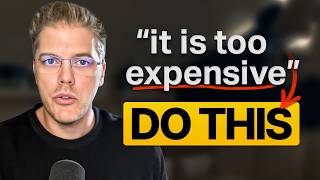
Matt Ryder shows how to prevent sticker shock by setting price expectations early. Give a value-led range first (like $50 to $400 a week), anchor with examples of what each tier includes, then state your price confidently and fast. Works best when prospects haven't seen high prices before.
Chapters
Have you ever been on a sales call and at the end of it they go, oh, man, I just didn't think that it would be that much or had someone be like, oh, okay, I thought it would be a little bit cheaper. Well, that is an objection not many people talk about very much. But it's called price shock. And in this video, what I'm going to do is break down exactly where it comes from, how you can identify it before it becomes a problem, how you can pre handle it, because handling it just doesn't really seem to work that much because you have to go through all kinds of weird stuff, arguing. At the end of the day, they're just shocked at the price. And sticker shock is a difficult thing to overcome. When I used to sell a lot of fitness, and, you know, people think that fitness can cost like 10 bucks, like a month, and you get free pizza on a Thursday, like Planet Fitness style. People just don't really know how much it costs. And so over the course of, like, 10 years of selling fitness, right, Whether it be, like, gyms or personal training or whatever, I kind of got sick of it. And so I developed what I think is my own. Somebody might have done it before me, but what I think is my own sort of way of dealing and handling this, which is a pre handle. So it's very difficult thing to handle. So I'm not going to go into that because, like, sort of, you're much better off just figuring it out and then having some way to pre handle it to give yourself the ability to lessen the blow. That's where. And I'll give you a really good kind of analogy for this, and it's. If I put Jeff Bezos at a Bugatti dealership and said, jeff, this is a $4 million Bugatti, like, he wouldn't blink. He's Jeff Bezos. He can afford it if he wants it. And then. But if I put him into a Toyota dealership and was like, hey, Jeff, this is a $4 million Toyota, like, he would shit his pants and he'd be super shocked, and he would reel back from the price and go, whoa, geez. Right? Because this, the context doesn't make sense. A $4 million Bugatti standard, right? What color is yours? $4 million Toyota doesn't make any sense, right? So what that is is, like, there's an expectation of pricing that that individual brings in, and we have way of seeing if they have an expectation of pricing, because if he'd paid previously $4 million or he'd seen a 4 million dollar Toyota, then that wouldn't surprise him the second time around. And so we want to figure out like how we can gauge this. So what I'll do is I'll give you a quick example of how I used to do this in fitness. Okay. And so I'm going to roll it myself. It's going to be really fun and going to go. Okay, Matt, so do you have any experience in the fitness industry? You've had a personal trainer than that before? No, Matt, I haven't. Okay, cool. What might help you is if I just kind of break down, I guess, you know, a couple of ways the industry usually does it so that you have, I guess the ability to really kind of see what it is is out there and then how we do it and then that might give you some more context. Is that cool? Yeah, sweet. All right, cool. So unlike the, you know, there's three main ways of doing it, right? There's like outdoor boot camp, what we do, like small group personal training and then you have like one on one pt, okay. All of which are great. I'm on team fitness, right? Whatever gets you rocking and rolling, I'm for it. But I just kind of want to give you the context. So on like the kind of cheaper end of the spectrum, like cheap and cheerful, you got like outdoor Pookam. It's 50 people outside running around having fun. It's good for fun and fitness. It's not great for like specific fat loss or individual problems like that, you know what I mean? But hey, if that's all people can swing, then I'm all for it. Get out there, whatever gets you moving, a groove for on the other end of that spectrum, right? You've got something like a one on one pt, okay. Now it's a fantastic way of doing it, but you might be looking at something like, you know, 2, 3, $400 a week, right? Because you got that person one on one. It's personalized, they're there with you, right? You know, it's kind of like having someone hold your dick at a urinal. It's like you don't need it, but it's nice, right? Hey guys, what's up? Matt here. And I've noticed that a lot of you are not subscribed. So what I want you to do is like go over and hit little subscription. It really helps the channel out. And if you like the kind of content that I do and you're like, hey, how can I get similar content but pay for it then I have a membership. You can go over and join that at any stage that you want. It's like $49 a month up to about $200 a month. And we do like, and as we have a coaching call nearly every single day and there's like well over a hundred videos and I upload like sort of private trainings and stuff that I do all the time. So if you want to check that out, go for it. You know, sign up through YouTube, cancel anytime, all that kind of good stuff. And anyway, back to the video. Bye. So and then what we do is we do like small group personal training. So we try and get you the, the like the benefit of the one on one, but with the community of the group. Does that make sense? Okay, cool. Now what I did there, okay. Is that I never said the price of the one in the middle. Okay. But what I did is I put the value towards the top. Like, you know, I mean, and then I gave them a pricing bracket of like 50 bucks a week up to 3 or 400 bucks a week. Okay. So that gives them a pricing bracket where now they know like this is what I'm roughly looking at. But it's done in a way that doesn't really invite a lot more follow on conversation. But also it doesn't put any of it down. Okay, but it's so cheap and cheerful, right? Like I'm still saying, and I'm saying, hey, whatever gets you out there moving and grooving, right? It's great. Okay, so that example, it's very, very specifically worded and I encourage you to kind of go back and listen to it. But you know, you want to figure out like what is the bottom, what is the very top possible option. Right. And if you are that I might do another video if you comment down below on how you can phrase it so that you are the very top option. But it's a similar sort of thing. You just got to go with more value based stu. But the key is to never say your price. But you want to give a price anchor, right? Because what are they doing? They're coming in, they're just surprised, right. So if I can say bottom is 50 bucks a week and the top is 300 bucks a week, right. Then at least now they have a gradient. And then what they're going to do when I do my pitch is they're going to be like putting it into that gradient from a value perspective. And as long as I can bump the value up nice and high and if I'm lower than that very, very highest price, then it actually seems like pretty good value, even if it's more than what they had initially expected it, but it significantly lessens the blow. So now, what are the things that you should not do during this? All right, first thing is never put the other options down. All right? You don't want to do that. Like, cheap is a very, very nasty word. And so that's why I say cheap and cheerful, okay? Because if you're like, the cheap option is this, and then you put it down and say it's no good, then, like, you know, if that's all they can afford or if that's what they've been doing, you know, I mean, that. That might not bode well for you because, one, they might have got a good result, they might have enjoyed it, but also it's just kind of unnecessary, okay? And then you don't want to make the top option seem like it's over the top or unnecessary as well. And, you know, in the case of, say, like, a medical type thing, I work with, like, a neuropathy clinic, and they're kind of at that 7, $8,000 mark, and the top one would be surgery, say, 15, $20,000. But we say, like, hey, listen, it's a really fantastic and, you know, like, effective way of doing it. However, if we can avoid people going under the knife and the unnecessary risks that do that by putting in a plan that helps prevent it happening in the first place, then, you know, we feel like that's a net positive for patients. Okay? So again, like, I'm not putting it down, but there is an associated risk of which I'm just saying that's one of the reasons why we do it this way, right? You don't want to then allow probes to come in and because you don't want it to turn into an early pitch. So it's important that this is a very well rehearsed part of your script. You notice that when I did it, okay, there's no real ums and ahs and stuff like that. It's just. I've done it so many times that it's sort of just off the top of my head. Hey, you know, on the one end of the spectrum, there's, like the cheap and cheerful, right? There's the boot camp. It's like 50 bucks a week. It's great for fun and fitness, okay? There's no accident as to why I said the exact same way every single time, because it's very, very rehearsed. If you cannot do that really smoothly. Okay, then what you're going to do is you're going to invite like all these unnecessary questions about it or they're going to be like, well, what do you. You know what I mean? Like, what do you charge? You need to be really slick with it and quite quick. And then it's just going to end with. Does that make sense? All right, cool. And then you're going to go straight into the next part of your script, right? You're just going to slippery, slippery slide right into the next part of your script. O Because my last thing is if you go too slow, this is going to trip you up. This is not like a super beginner. Like, first day at the job, I'm going to. I heard it on the YouTubes and I'm going to have a crack. Okay? That's not how this works. This is a like, break. In case of emergency, you ask someone, hey, do you have any experience in this? Have you ever encountered what I yada? And they go, no. And you go, all right, cool. Now I'm going to do my price shock. Because, like, they don't have any context. So when I go and drop a 50k warhammer on them, okay, they're gonna lose their mind. But if they're like, oh, no, no. I've. Like, I've had high end consulting before. Okay, cool. And what was the experience like? Right? So now I don't need to do it now. So there are certain parts of your script that are like arrows in a quiver, right? You use them when you need them, but you don't always need them. And this is one of those things. All right, so listen, guys, I hope that is helpful because for someone I've been selling for a long time, I've never heard anyone really talk about this, right? And it works very, very well. You do have to rehearse it, you do have to write it out, and you do have to really think through it. And before you're like, hey, man, what. What would you do for this? I'm not gonna answer your question in the fucking comments. Like, I don't. I'm not thinking it up for, for you. Like, this is not the channel for that. Go to somebody else. I. I want you to figure it out yourself because then you'll actually understand it. I gave you an example that I use, okay? For that I've used for years. And the whole point of it is that it's, it's specific and rehearsed enough to where it elevates your product. The higher part of the value ladder, but gives them a good bracket and allows you to move it forward knowing that you've done what you can do to prevent sticker shock. All right, hope that was helpful. Make sure you like subscribe Hit notification Bell. Join the membership for goodness sake.





