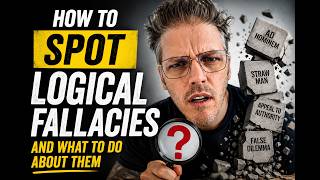
Matt Ryder breaks down six common logical fallacies you'll hear on sales calls: false dilemma, hasty generalization, correlation vs causation, ad hominem, appeal to popularity, and circular reasoning. For each one, he shows a real example and a question that exposes the flaw without triggering defensiveness. The goal is to catch weak reasoning and steer the conversation back to what your prospect actually needs.
Chapters
In this video, I'm going to be going through logic traps, different types of logical fallacies that you're going to be seeing on sales calls and in communication in general. And I'm going to be teaching you what they are, how to identify them. And then from there, you should be able to much easier, I guess, be able to handle objections because you can see what the person is doing. Most people are not trying to be illogical on purpose. What they think that they're doing something logical. However, once you identify what they're doing, then it becomes much easier to be able to actually handle it in real time. So first of all, it's like, what is a logic trap? A logic trap is a conversational setup that exposes contradictions, weak reasoning. It exposes emotional thinking that's disguised as logic, right? It's not manipulation, it's just sort of— it's pressure testing an argument. Now, why do logic traps work? Because people want to protect their sense of identity, the sense of self. They want to avoid discomfort, and overall they want to stay emotionally consistent. And they will usually, in the hierarchy of things they want to do, they are going to prioritize those things over staying logically consistent. And that's why people use fallacies without realizing it. So what I'm going to do is I'm going to show you— these are the most common fallacies of which you'll come across, and I'm going to give you some little examples, okay? The first fallacy is the false dilemma, okay? I only have two options. I either— when I do something, I do it 100%. It's like, well, like, that's a dilemma of 100% or zero, but there's a large spectrum in there. And so what you want to do is you want to point this one out, okay? Which like, is it possible that like that there's a middle ground? Okay. Can you really do anything at 100%? You ever tried to lose weight? But what do you do? Stop going to work? Stop having a family? Okay. Again, so pointing this out with a question is usually the best way to expose. It's just a big exaggeration. The next one is a hasty generalization. This is where you take something. It's like, oh, I tried ads and they didn't work. It's like, well, okay. Was it the ads that didn't work or was it the execution of that? Like, does advertising not work in general? Can you, can you help me understand that? Okay. So once they hear their own logic, they're usually like, oh yeah, that kind of makes sense. Now you don't want to come at this from like a really aggressive standpoint because when people are called out for being logically inconsistent, they do get a little bit, uh, angry sometimes. You want to ask that question quite generally. Another one is correlation versus causation. This is a really common logical fallacy. It's like this happened after this, therefore that made it happen. So a really sort of common trope one is that as a population increases its ice cream consumption, shark attacks go up. There's tons of correlative studies that have been done on that. But again, correlation does not equal causation. It's simply because, uh, there is a direct causation of like when things— when it's summer, it's hotter, right? And then people eat more ice cream. People also go to the beach when it's summer more, okay? So they're, they're having— it's summer, ice cream, beach, in the water. More people in water equals more shark attack, okay? You understand the words that are coming out of my mouth. You could logically make the argument that if you want to reduce your risk of shark attack, then you want to reduce your intake of ice cream, but it's stupid. Okay. And again, that would be a logical fallacy. The next one is an ad hominem. An ad hominem attack is where you attack the person instead of the actual argument. Okay. So it'd be like, ah, I've been sold, uh, like NEPQ is a sleazy sales style, for example, you could say. And it's like, well, was it, was it the process that you didn't like or was it the execution that the person actually did? You know, do you think every single NEPQ person is lazy, etc., etc.? There's a huge distinction there, right? The next one is an appeal to popularity, where it's like, everyone says cold calling is dead, everyone says this, okay? It's like, uh, well, popularity determines truth, then like, wouldn't all businesses be successful because everyone could just hop on YouTube and do the same? And it's, it's like, it's super easy, right? Like, it's a very easy thing to point out when you ask a question. The next one is circular reasoning. This is where it's like, I'm not confident because I'm not good at sales. And so it's like, well, how do you become good at sales before you can be confident. The conclusion is being used as proof. All right, so here's some sort of examples. Like, solar is a scam. It's like, well, is the technology that you don't trust, or is it just the sales process that you've been through with people? Like, repair damage. Like, oh, I think I'll wait. It's like, okay, well, does damage get— does damage usually increase and get cheaper over time, or does it get more expensive? Does the damage increase, or does it just magically kind of fix itself? Okay, those are really common logical fallacies that it's good to be able to understand, interpret, and then be able to sort of hear the alarm bells, because they can sound very logical, but they're just not. And it's very easy for, for them to take the frame control that you hear about a lot if they're able to sort of consistently have these logical fallacies go through. Most people don't identify these well, and most people think that, you know, debates or sales, whatever, is all one with the facts. But really what it's, what it's won by is like framing, emotional positioning, certainty, and like the perception of authority or the perception of being correct. It's why a lot of smart people can still lose arguments It's because like they're arguing with facts while the person is arguing over like perception, right? Which is a lot more persuasive. Okay. So here are like some common objections. So I need to think about it. A really easy thing to say is just what specifically do you need to think about? Right. Or what specifically do you need clarity on? Again, super easy question to ask. And it seems very, very obvious, but what it does is it really makes the person sort of be super clear and then you'll be able to get the actual concern out of it. Another one is this is just too expensive. And then the easiest one is compared to what? Right? Like that's very, very simple. Is the issue the price or the uncertainty around the ROI? Again, you want to isolate the real problem. Another one is I need to talk to my partner. A really interesting question that you can ask people, and again, you do this sort of more towards the bottom of trying to handle it, right? Is like, is your partner usually involved in decisions because they help you kind of evaluate this or because they help you feel more certain? It's subtle. It's not aggressive. It's a really good question to ask sort of towards the bottom when you're sort of exhausted. A lot of your partner objection stuff. It's like, uh, I'm too busy, right? Is a really, really common one. It's like, uh, so would solving this problem create more time or less? Again, these are really, really easy low-hanging fruit questions that you can ask. Now the dangerous part is that when you bring in logical on— when you're calling someone's logic into question, they can tend to get a little bit angry, a little bit shitty with you. So you want to make sure that any questions that you're asking, you're asking quite Uh, I guess quite curiously, otherwise they're just going to kind of get pissed off with you. All right. So now you know how to identify, uh, different logic traps that are being used. Uh, you can also set a few your own. Really what it's about is just kind of understanding the logical fallacy that people are using and then being able to internalize it and understand like they think it's logical. So then you don't get into some arguments with them and you can start to kind of bat them out the way nice and early. I hope this video is helpful. Make sure you like, subscribe, notification bell, and comment down below if you want more of this. Bye.