Interview with 7 figure phone sales rep: William Odhams
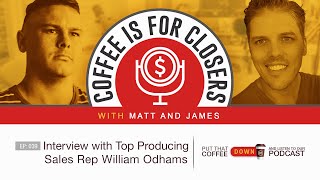
William Odhams, a seven-figure phone sales rep, talks with Matt Ryder about closing deals, sales psychology, and how he built his career. The conversation covers training programs, personal stories from the sales floor, and the specific techniques that work on calls.
All right, guys, welcome to another episode of Coffee is for Closers. Today we have a very special guest, Mr. William Odoms.
Special indeed.
Happy to be here, guys.
It's awesome.
As his mother says, long time overdue. So, yeah. So today what we're going to go over is the journey of Will and how he's gone from, like, not being a closer, to being a closer, to being a closer in black, to then to then being a sales sniper and all the things in between.
If you listen to this podcast, you will make your first million within three years. I'm going to repeat that. You will make a million dollars within three years of the first episode you listen to. We don't want pikers. We're not here to save the manatees. We're here to make podcasts. You really want this?
You.
You listen and review. Put that coffee down.
Mr. William, how are we?
Most excellent. Stoked. I've been listening to this podcast this whole time, so I'm happy to finally be a guest.
That's good, because you finally given the fans what they want. We've got so many recognition.
There we go.
Give the people what they want, Right?
Yeah, exactly. So, yeah, man. So let's just sort of dive straight into it, like, I guess, first of all, when did we start working together? How long has that been now? A year, right? Just over a year.
About a year.
Just over a year ago. Yeah.
Times have changed.
Just actually reaching out randomly, I think, on Facebook messenger, and just trying to actually look for kind of more opportunities and get more balls in play. But I actually thought you were an influencer yourself, actually, when I think I was first introduced to you. But then I realized you're just another sales guy. But that wasn't quite the case. Right. So, you know, and kind of started to create some new opportunities, and now we're here.
What was your first account? What would you do?
I was fitness business coaching.
Oh, yeah, that guy.
I thought it was someone else.
No, we did that. And we also did the chiropractors and physios as well. But we kind of get more into fitness business coaching and then just selling. Kind of selling like more of like that 20 to 30k product opposed to the 5 to 10.
And.
And a little bit more of a sophisticated buyer, which was obviously an interesting learning curve as well.
Yeah, because you were raising some capital, right?
Well, yeah, I was different. I was used to closing people for about 2k. Not people that had already had a multimillion dollar business practice and were looking to scale it. So it was a bit of a different type of conversation, but still it was interesting to kind of see the commonalities between them too.
Yeah, absolutely. So let's just kind of dive through like what is it that got you into sales?
For me, it was almost kind of like, I'm not surprised that I end up here now because of given everything else. Because the common theme for me has always been in trying to figure out what I want to do is like people.
Right.
And helping people. And I've done a variety of different activities, but then with a degree in psychology, I didn't really figure out like what that was actually going to equate to. But now that I'm in sales and dealing with people all the time and working in communication, it makes pretty good sense. But I think I kind of got more into sales as a way into entrepreneurship because I was very curious about it at a kind of like post university. I was like, you know, I don't really feel like the corporate past for me, but I didn't really have a business idea. So I did go to these entrepreneur business conferences and one kind of a couple people actually shared with me, they're like, okay kid, you have no idea what you're doing, but that's fine if you don't have your own business idea right now, work for small startups and, and learn all the things so you can then when you do have your business idea, go forth and get after it. So that's kind of how I got into sales is I pretty much took like a business development role, ran my own territory and figured out what I didn't know and then kind of like started to figure out, oh, I just talk to people and take orders. This is pretty cool. And yeah, it gets kind of more fun from there.
Yeah, man, for sure. And like your first foray into sort of like closing was through like Dan Lok, right?
Yeah. Because I had kind of then kind of gotten into personal training and gotten that career up and off the ground. But as I'm sure a lot of personal trainers know, like you, I was doing well, worked my way up to management, but was working like 50, 60 hours a week, making about 3k a month Canadian. And was thinking, I'm like, okay, what's going to really happen in the next three years? Like, I'm not married, don't have kids, how am I ever going to have that? And there was only like two weeks holiday allowed. So I started to kind of figure out how can I transition to something. But there are these sales trainings and I Was actually homesick with laryngitis. And so I was like, oh, like, let me just check this out. Worst case, I probably can get like 2,000 bucks worth of value in the next couple of years in sales. So I was like, oh, I'll just wing it. Because I was like, I had no idea that you could close deals online over the phone. And so when I actually kind of started looking at that and I said, hey, like, I actually can make more in a couple hours than I did in a whole month, I was like, that's worth exploring. And the further I kind of went into it, I started to, like, about three or four months after the program started to literally make more, like, more working half time on the phones than I was full time at the gym. And I was at that point, I was like, all right, time to go all in and see what this looks like when I rep my craft.
Like, it's an interesting one, right? Because you hear so many people whinge and fucking bitch about Dan Lok. And, like, I've never done his courses. Like, I did a YouTube video, which we'll put in the description about, like, what I think Dan Lok did well and what I think he did poorly. And, like, I think the thing that, like, he was a brilliant marketer. I think his sales training, you know, from what I've seen and what I've heard was just like, pretty much like sales when I won. Yeah. I mean, like, sort of repackaged, but, like 20002500 bucks. Like, everyone who did that course would have gotten that much value out of it, for sure.
Yeah, he covered a lot of mindset.
And kind of fundamentals.
And like, little did I know, you.
Know, some of it, maybe I'm kind of like from. Drawn from other sources, for sure. But as far as somebody who had inspired regardless, like, for someone who didn't have a lot of clarity over kind of some of the mindset work that maybe some people didn't have in their personal development journey. And then just that basic way to kind of go out and get after it. I think the like, almost the contrast and the difficulty is he did a very good job at inspiring people to literally, like, good. You put on a suit. Yeah. You go talk to a multimillion dollar business owner, even if you are 20 years old, like, a lot of people would never do that. So that created a problem in and of itself. But the fact of the matter that people were getting outside of their comfort zones, like those who then recognized with common sense to hone the craft and actually show up professionally. There's a lot of doors that you could open because I didn't know that you could just go talk to those people or. I didn't think about it that way until you did.
I think $2,000 for that skill set alone, it was just the confidence that you can actually go and get after stuff from a mindset of view is well worth it. Even if you didn't do it.
How else can you make your investment back? And like, I think what I made 2,000 bucks back probably in like three months or less.
So it's like, that's a pretty good.
ROI compared to most investments and other things out there. And I had to draw from, like, I didn't have the money to take the course too. Like, I was kind of that people. That was like, let me think about it. I really don't have the money because I didn't. I was making 3k a month, and that was paying the bills. So I drew from the investments my grandma gave me that said, don't touch these until you're 40. So. Okay, 25. Not bad.
Yeah.
What do you know? Yeah, man, that's. Yeah, it's super interesting. Like, I think the. My first foray into sales training was with tj, so with Travis Jones. Right. Which was really sort of heavily inspired by Gulliver Giles, who. Which I haven't. I don't know who. Whose stuff he's sort of basing it on. It could be sort of his own stuff. Like, a lot of my stuff is like, it's a lot of Jeremy's stuff. But then it's also like the real nitty gritty stuff that we teach is very much like stuff that we've developed, like, through all the sales that we've done. So, like, it uses like that NEPQ framework, but then like, all the hooks and anchors and objection handler. That's all our stuff. Like, that's all. Not that I'm going to call it proprietary because it's just fucking words that you say from your face, you know, Like, I don't think you can really. Proprietary words. I think you can. But, yeah, like, it. It's super, like the first style that I learned, which is probably, like, more damaging in the long run compared to, like, I think Dan has a very consultative doctor Frame. Is that right? Like, that's kind of the framework that he tries to set up.
It's a bit more authoritative. And actually what I was thinking the other day when I'm hearing other sales reps kind of come through entry level programs with the script is, in a way, he was very much saying, like, hey, like, don't follow a script. Like, here's the framework and start figuring out how to ask better questions, actually how to listen. So those who actually, like, took to heart what he was saying, like, it forced me to. How to figure my way out, how to kind of navigate that conversation and be more flexible that way from the get go. But I think a lot of people could have benefited from having a script that works. And I know you said that. It's like, well, sure, you hadn't used a script either, but that's because we never had a script that actually worked. So perhaps maybe that was the reason too. But it did force me initially to get a lot of those reps in and just kind of fail forward. It's like, fall flat in my face. Figure it out and keep talking and keep going.
Right.
So that. That's important, too.
All right, cool. Yeah, man. So, like, I think. I think he would have benefited from a script, but probably doesn't have one. Like, I think Dan, from what I've seen, is like a brilliant marketer, and I'm sure he's probably a pretty decent salesperson in his own right. But it's sort of like. Sort of like Cardone, you know, Like, I don't think Cardone is like the most skilled individual salesperson, but what he does have is a bull in a china shop mentality. And I don't think he's going to take no for an answer. And he's done so much authority building over the years, I don't think it matters what he says, you know, like, he's done the selling for himself already. So is he a great salesperson? Absolutely. Is he. Is he a master tactician of sales? Probably not, you know, but like, Belfort, dude's a fucking master tactician.
Yeah.
I don't think there's any way of denying that that dude absolutely knows how to manipulate and persuade.
Yeah.
You know, there's tens of millions of dollars of reasons why. What's that?
I'd put Dan in the same boat as Gran in. In that space. Yes.
So would I. Yeah. And then I'd take Jeremy. Like, Jeremy's a master tactician. You know, there's a big difference between, like, someone who can really tear down and sell someone who has no idea who they are. Because if you can sell someone who has no idea who you are, like, that's. That's persuasion in its truest form, which is like, that's what I like. I like that. But then I'm also like, all our strategy around the podcast and the channel, it's also to like, I'm trying to get the best of both worlds essentially. Like, you know, do the pre selling, right?
Like, you got to take it from square one. They know nothing about you could be just a random person. You got to discover the need, you got to build a case. It's like, I kind of like it like that sometimes as well too.
That's why I like selling other people's stuff because, like, selling our stuff is so easy. It's sort of like I think you lose. I think you lose a lot of your ability to be like that tactician. Which is why most sales trainers, like, all they do is sell their own program. Like, but Jeremy doesn't even sell his own program. He sells the other stuff. So, like, for the company that he consults with, he takes sales calls every week, you know, and he actually gets commission for those and then he gets the override and all the commissions and he does the management stuff. I think he earns about 2,50,300,000amonth just from one client because they're doing like $8 million a month in sales. And he's the one that runs the whole team, right? So like, you know, he's still doing that stuff every single day. Whereas I think one of the big mistakes that a lot of the sales guys out there make is like, they just start selling their own shit. And like, selling your own shit is too easy. Like, dude, when I hop on a call to sell, like my own sales training, it's like a 20 minute call. Just like, you know, like one of the guys, one of the guys shout out to Drewy Wilson, like, he messaged, tell him what you drew me will.
Be listening to this as well, no doubt. Drew me works for Ryan Stuman. He runs closer memes. And he sent me a message the other day saying, hey, man, I think it's because I invested in his apex and gave him the easiest sales. Didn't even have a sales call, just like, hey, send me the payment link. I'm in, man, let's get you some commissions. And he messaged me back, probably as a return of favor, saying, hey, I think I'm ready to start upskilling and take things to the next level. And I just wrote back, I sent him a meme and said, are you sure you want to have this conversation, mate? It's going to result in you passing on your credit card details. And he was like, yes. I'm like, Great.
And then I sent him. I sent him a gif, which is like sliding into DMs. Like, hey. And he's like, you must be here to get my money. And then I wrote, I get a golem, mean it's mine. And he was like, take it, it's yours. He's like, how much time you need to sell me? I said, I don't know, 20 minutes, depends how much of a fight you put up. He's like, yeah, sweet, let's chat tomorrow. I was like, cool, man. Sounds good. That's the power of content, right? That's the power of, like, authority building. Like, you know, I can just tell someone, hey, bro, as long as you're cool, like, you're going to buy. So if you want to hop on the phone, we can hop on the phone. You know, you can. We can go through the process if you'd like. But, you know, I love that guy.
He's hilarious.
He's awesome, too. I'm actually wearing his hat.
Oh, nice. I'm so glad we're working with him again.
Oh, yeah, yeah, yeah.
Nice. Yeah.
Crush the day, baby. Crush the day. This took like eight weeks to get here. I bought the last one. I'm the only guy in Australia with this hat. Exclusive.
Worth it.
So, yeah, it's a great hat.
Fits well.
You know, we got some merch coming out.
More than just the mug.
Say, did you see the designs, Matt, yet?
Yeah, yeah, I'm getting some other ones made too. I'm going to compare. I got like a vintage T shirt designer. You know me, I like spending money. So anyway, it's gonna be, you can, you can run, but you'll just buy tired. That's gonna be the tech and.
And for the guys listening, in due time, there'll be some, let's say, some payment gateways set up where you can purchase these said products from and enjoy them.
I mean, yeah, there's no lack of money. The velocity. So anyway, let's kind of get back to it. So the tactician side of things. Yeah. So, like, I think, you know, like, for me, kind of going back to it, I learned from Travis Jones, who I think still does. I don't think he does much sales coaching these days. He's more of like a business coach. And yeah, anyway, we won't go too deep into that. And then, yeah, he learned his stuff from Gulliver Giles. And I also did Gulliver Giles stuff. And Gulliver has a suit. Like the most aggressive form of sales I've ever seen. There is like I have never experienced anything on the planet that is more aggressive than his.
That was almost your first experience, right?
What was that?
It was like your first experience too. So you, you would have come in thinking, oh, this is what sales is.
Oh man. He, he's called Thor the sales warlord. And like shout out to him. I mean we disagree on a lot of things and we've had some disagreements in our day, right. Both personal and professional. But like nothing but respect for the man. He is a absolute fucking savage. Like and he is a master. What he's really good at is picking up what, what someone's ego needs to hear. Like really good at it. And he sold me and my business partner at the same time brilliantly. And he was able to individually pinpoint what emotional driver each of us had and then create the sales call around his emotional driver which is a need for numbers and certainty. And my emotional driver which is like ego and status. Right. So he was able to identify that, pinpoint that and pitch both of us the same product in two different ways at the same time. It was absolutely masterful to the point that when, when we got on the upsell call to do the next program, we didn't want to do it. We didn't want to just not have the call. We had to develop a strategy beforehand of why we couldn't buy and write it down. That's how good that guy is. Now does that translate into like other guys abilities to sell that way? I don't think it translates that well because he's got, he's selling his so like the amount of authority and that he can drive home. And it's like when we sell sales training you're. You can use your sales skills as the pitch and your ability to stay in the saddle and smash and just do stuff like. So I don't know how well it translates for non business owners. Whereas when you're the guy on camera you can sell that way. And I think it's a really good way to sell. If you're the guy on camera, I think it creates some issues on the back end. I think you're going to have a higher refund rate, you're going to have some issues there. But that's how I learned how to sell which I think was great because like you really lean into objection handling. And his philosophy is they buy or hang up, there is nothing in between.
Zero.
There is no, they do not allow follow ups. So when they do management consulting, if somebody does a follow up like they get in trouble Right.
Even if they.
But it does make for killers on the. On the first call. Right. So there. There's a. You know, but I think it destroys a business in the long term. Like, when we took over sportsmodel project, they were. They were doing the sales for that, and we doubled their sales and doubled their income, and they started getting a lot more happier clients and a lot happier sales, because it can destroy a salesperson as well when you sell that way, which is how I sold for, like, a long time. Like, a slightly softer version of that. Like, it's really tough to do mentally. Exhausting. Yeah, it's really, really exhausting. Like, you end up just being really angry every time someone doesn't sell because you feel like you've lost a boxing match. You know what I mean? So, yeah, it's. It's just. It's tough mentally. So I think, like, the authority. That's a real authoritative frame, but it sounds like it's kind of a softer version of what Dan teaches.
Yeah. And, like, for me, what was interesting, like, kind of coming more into your world and kind of being drawn more to wanting to work closer with you and expand that relationship, is the fact that, like, I had done pretty well and done on some different projects, and I thought I was doing pretty good because it's all about kind of environment, like, compared to others. I was closing 25, 30% pretty consistently. And that was. I thought I was like, oh, well, pretty sweet. Like, I take calls. And 33 out of 10 close. Like, that's not bad.
Right.
And I was still making more money than I ever had. So to me, I was winning. But then when you kind of started to post some of your numbers, and it was more. It was less. Like, logically, I knew different offers, different commissions. That was relative. But I was like, the percentage at which you were closing, I was almost kind of like that Robert Bannister kind of moment for me. I was like, you can close at 65, 70%. Like, okay, I'm interested. Tell me more. Like, they got. They got to be doing something.
Right?
And then I was like. Then I met you and Marco, and I was like, okay, one. These guys are just like. They're not getting off the phone. Like, they're just not taking. No. And so that was kind of a different style that I was like, I wonder. For me, with personal training, it was the same thing is like, can I borrow from everybody?
Right.
So I was starting to be like, okay, like, I don't have Marco's personality. I don't have Your personality. But I like little bits and pieces. And then I started to kind of figure out, oh, there's like logic to this as well.
Right.
And so that's kind of like, that.
Brings up a good point in mistakes that people make is trying to like emulate a person. Like, one of the biggest reasons why. Yeah, yeah, like you can't, you can't do it. Like, you have to have your own style. That's something that when I'm teaching people, like, I'm very, very acutely aware of, like, don't sell like me. Like, take some of the principles and concepts that I use and then apply them to your sales calls. But I was like, if you try and be me, you're gonna fall flat on your fucking face in the same way that if I try and be you, I'll fall flat on my face. Like, that's not a place of like arrogance or authority. It's just like, I'm not you, you're not me. Don't be me. And I think one of the reasons why, like when people start NEPQ style selling in particular, which I think we saw, some of the teething issues that they try and be Jeremy and they fall flat on their fucking face and their close rates plummet in the beginning and then they skyrocket. But there's a way to mitigate that where, like, you just gotta realize like some of the stuff that like a really high level salesperson does, like intentional self deprecation, you know what I mean? To like lower your authority. But it's on purpose and it's to status align. Like, if you want to go into the technical aspect of it. Like, if you listen to like something like Flip the script by Oren Claf, who's a brilliant salesperson, that status alignment, frame is really important. Like when he's talking to the valet, he wants to have status line with the valet. When he's talking to a billionaire, he wants to have status line with the billionaire gentlemen. Because people want to be on the same level as other people. You don't want to be above or below. You want to be the same. So like, you know when Jeremy does like, hey. He's like, hey, what are you doing? Nothing, man, just being boring. It's a brilliant opener because it's like self deprecating and it automatically puts the focus back on the prospect. Like, there's so much psychology behind the little things. But if you don't understand.
Poor in a way, that actually makes him more human. Especially from his frame too, because they're like imagining that he's probably sitting in his castle and his mansion and who am I?
Right?
So it's like, oh, just being boring or just taking the dogs for a walk. It's like, oh, that's something that everyone does. You're human now, right?
Yeah.
But it allows you to just count.
My money, Scrooge McDuck. Yeah, just swimming in my money bin. What are you doing? Yeah. So, you know, I think it's important that, like, but you have to understand, like, what you're doing. And so, like, just going out there and doing these things and trying to emulate what somebody says, like, specifically is a terrible idea. Like, you have to understand the concept and then apply the concept.
Yeah, well, we've been coaching around it too, from a little bit more of, like, a theme of identity. Like, oftentimes, okay, people are getting more into nepq. To me, it's like, don't become like an NEPQ salesperson. Become like, will the NEPQ sales person. Like, don't lose yourself and who you're trying to, like, model off. And so to me, I always see it as like an expansion. It's like, what got you here is what you're already doing. Let's add to it. It's not replacing or washing away. It's like, let's stack more stuff on top. Because now I got more in my bag of tricks to kind of start utilizing and pulling from in different situations. Because some type of prospects really work with any pq sometimes they need the beat down.
Right.
And if I can do both, then I can play more effectively.
Absolutely. You know, so I find, like, most of my sales call end in a beatdown. Yeah, right. Like, that's just because of the level of prospect, you know, But I get all the information that makes the beat down effective. And by beat down, like, like, it's not, you know, the people probably getting the wrong example of, like, everything is still very low key. Like, my. My tone and my temper never really changed from how I'm talking right now. Like, it never changes. But like, you know, you say you give people more and more doses of reality real time. Like, yeah, it's. It gets more and more real. So it's like as we go through an objection handling cycle, like, you have to kind of build on that. You know, it's funny, like, I was talking to Yash today in a role play that we ran. And for those of you, like, Yash is only 16 years old and he's got great sales prowess, but most of that is going to be reflected. And if he's listening, I'm telling. I told him this, like a role play is no different for me, is no different for Will or James than the real thing. It's no different for a 16 year old. It's very different, you know what I mean? Because like, you haven't had that level of experience. You don't have a level of confidence when you're speaking to someone because like, there's something in the back of your head that like, oh, you know what I mean? Like, I can't really challenge this guy. He's 35 years old. You know what I mean? But in a roleplay scenario, you feel comfortable to do that. And so, like, it's a hard one. Like, what would. He goes, what would you say in the situation? I said, well, what I would say is borderline irrelevant to you because you can't say the things that I can say. I say so much raucous shit on a day to day basis to all kinds of people. And it just goes down. Well, I have like, I'm lucky. I have like, I must have a nice face or I'm good at doing small inflections in my, in my smile or something that lets people know that I'm not taking it seriously. Like, I'm just joking. But if you can't do that, don't like, don't do that. Like some of the shit that I say to Road or fucking James or whatever, you know what I mean? Like, I say horrible shit to people, but everyone knows that I care about them. So it's like. And when I say talk to a prospect, that's why I love Zoom so much.
Did you just say you cared about me? That's cute.
You're a piece of shit. You called me your mentor. Mother day, motherfucker.
What did I call you?
You called me. You said, I'm your mentor.
Yeah.
Oh, you, you used to be.
I hired you as a mentor Comment ever.
I've outgrown you, bitch.
Yeah, yeah.
It's like you never outgrown a goddamn thing. Nice.
That's a good. That was double edged. That was good.
Yeah, but yeah, like, I love Zoom. It allows you to get away with so much more because, like, you can.
Say something fair body language pays a huge homage.
Yeah. And then you can just be like, you just smile and they, they know that.
Like, but, but also I know that, you know, pe. You get away with it because people know that you're sad on the inside. And you're only saying that to make you feel better. So they have sympathy. Like, we get it. It's fine.
I'm super sad. Yeah.
But anyway, back on track.
Yeah. You see my wife.
Yeah, yeah. You're punching.
Punching well above my weight. So, yeah, I'm good to go.
Dunn, Bradman. Average. Right. One of the things that I found really interesting for you is your background from a AM Study level.
What.
What have you taken out of your psychology degree that you've taken those skills and are able to apply on sales calls that make your job easier? And we'll ask the same question again for managing people.
Yeah, great question. I think for me, like, I've got a bachelor's of science in psychology, but I started in biomedical engineering. So I have second year university completed in like eight different subjects.
I don't know what any of those words mean.
Huh. What?
I used to shoot people from long way away.
The point is though, is like, if you look at like what psychology is, it's the study of an individual opposed to like sociology study groups of people and things like that. And so to me, what I've taken away with it is probably like my fundamental ethos in sales, which people have heard me say is play the player. And what I mean by that is like, we are all so like uniquely different on the surface. But at the same time, there's a lot of common themes, values and issues. There's only so many problems we can go through in life. So what I always like kind of do from a psychology background is it's like I want to figure out kind of the Venn diagram, like what they fall into the stereotypes. And then also where are they uniquely different? That's only them because that's kind of where that magic is. And if I can kind of find that on a call, that's what I start to integrate. The other thing from your answer is kind of probably more from a motivation and goal psychology, like understanding, like approach and avoidance goals. Understanding literally how like, you know, delayed gratification, like just those like obvious concepts play into people being in a sales situation or people making a big commitment or a decision to their life. So when you're able to kind of fundamentally look at it from kind of more of a. Okay, like this is like we all go through this, but what's the like unique difference this time? I find, like, that's kind of an angle that really allows me to see like that gold nugget for that conversation.
That'S going to be unique.
Can I ask you an interesting question? Do you think it hurts you anyway.
In, in what way? How do you mean? Does what hurt me?
Do you think that like sometimes when you know how the cake is made, the cake doesn't taste as good?
I think what, what comes up for me is like, it's a question of novelty. And because I found myself going through phases of like complacency, like, it's like I already know what's going to happen in a few minutes or a few moves, that it's like, it's easy to kind of look at that. But then to me that's exactly. It ties exactly back to what I just said is like, to me, as soon as I find myself, oh, this is another one of those people that has three kids and no income. Like all I started forming these assumptions. I'm immediately like, what's that unique little difference that I don't know about them yet? And that's what I start searching for. It's like actually how I come back to refocusing is I'm like, where is that? Because there's something that makes them unique. Let me find it, right? Especially those people that are super dry aren't giving me any emotion. I'm like, nope, I'm gonna figure a way out in this onion. So like that's how I kind of like re engage.
If that's so, what do you think? Because obviously we have similar but very different styles. Like I'd say me and Marco are probably more similar. Me and Marco are much more of like one call, one close. But we don't get that many follow up sales. Do you know what I mean? We still get follow up sales, but like, you know, they're saying yes on the phone. So what do you think? Like, what do you think the difference is? Because you're much more of like a, like a, you can correct me if I'm wrong, but you're much more of like a 2, 3 call close person. You still get like equivalent number of sales. Like it's not, it's not an output issue or like a numbers issue, but you tend to really put people into processes and farm them over a much longer period of time. Or like don't necessarily get all the commitment on the phone, but the people, you build enough rapport and you build the need enough to like get that person through a process where you get them like at the end of the week or at the end of the month.
You're also like significantly well ahead of everyone else in our company and your ability to, to farm and develop the processes to get people into buyers that weren't initially buyers.
Well, and this is interesting. That actually ties into the psychology. Like, the background is like, to me, I like thinking, like, everything I do is reverse engineered. It's like, if I want a better answer, what question is gonna give me those type of answers? Or if I wanna get a text message to somebody to respond to me, what would I respond to?
Right.
Like, certain things like, that I'm kind of playing with. I think, like, from what you guys are getting at is I feel like my style comes a little bit more from, like, a coaching background a little bit. And there are times where I have also learned to play my strengths.
Right.
And that's the thing is, like, with. Listen to, like, Matt and Marco, I had to come up in my objection handling skills. There were times when Matt said, like, you know, go burn a bridge and see what happens. Like, have you ever had that, like, where you just don't hang up? But I'm like, no. I'm like, all right, well, let's go find out.
Right?
So, you know, but for me, sometimes it's almost like I'm good at reading people in the sense that I understand, like, the path of least resistance. And I'm like, hey, like, it matters less right now whether I get dollars and cents on the first call and more about their commitment to change. And I kind of drill way deeper because if I can get them leaving the call, stoked about their life, stoked about what they're going to do, and kind of acting as if they're already in the program, that's when I create a container around following up. That's entirely different about, hey, do you have the money yet? It's like, hey, how are your goals going on your life? Because we had that type of conversation. We didn't have, hey, are you doing.
This program or not?
Hey, like, what are you committed to being in the next year? And how can I best support you? Or how can best me and influencers.
Support you in doing that?
It's like a. It's a. They. It's like, it's not.
They don't.
You don't get friend zoned, but you do kind of continue that trusted advisor frame past the initial conversation so that you then can kind of develop that. And then that also then snowballs into referrals, snowballs into actually, like, people getting good results and good results in the program because they actually feel empowered instead of, like, coerced. And there's obviously ways to do that in one phone call with certain types of people, but other types of people, you can just sense that they're not going to go on the day. Sometimes you can tip them over, other times it's in your best interest to build that trust factor. Because a lot of the times that's probably the objection that they don't close is when they are just new, they just don't know. So you know, just like when anybody's taking a serious decision, good, take a week, but like then do something. And what I do is I decide to govern that process. It's like if you're going to spend three days, if you're going to spend a week, then we're going to figure out what you're going to do in that week together so that I'm still included. And that's kind of how I kind of come into the follow up game.
And create containers like that.
It sounds like you take a little bit of like that therapist role as a long term solution when I. Sorry, therapist role isn't probably the.
You're like, you're like, you're like facilitating the change.
Yeah, exactly.
Yeah, well, because a lot of it is like that's the thing is a lot of this is real talk around fundamentals. It's like focus on the actions and the outcomes will produce themselves. That's what pretty much true of anything. So more or less a lot of the common themes that I find in all of the conversations I've had is people aren't just taking enough action. So if anything else, if I can get them off the phone taking more action, I know they have to be ahead. They can't not be further ahead if they do something after getting off the phone with me. So it's that like yes, I kind of force facilitation because that's, I just assume that's why they reached out to me in the first place is sometimes people just need a nudge. And if I hear, that's the thing is if I hear their commitment to change, then I will hold the line and kind of like be like, all right, well if you're committed to change the wheel, the bus leaves at nine o'clock tomorrow.
You're going to do this.
Here's our itinerary. Let's do it.
Yeah, I think like, you know, I think you said something good there. It's like leaning into your strengths. Like my strengths are not detail, like admin, stuff like that. So like, like I'm, I'm good at following up with people like because I follow up but like I'm never going to have a comprehensive Follow up structure that I, that I personally follow. And I think like I've never really had to develop that because like that, that skill set because like I'm good at following up. So I'll schedule all my follow ups. Like I'll schedule it but like I said, the level of detail that you go into in your follow up I think is much better. And I think that like to the. And there's good parts and bad parts for both. Like for me, I know my personality doesn't allow for it, so I close it. I close most people on the first call, right. Or I schedule a very quick follow up. You know, it's like we're speaking tomorrow. Right. But for you, because that's how your brain works. You work well so you can facilitate people over a longer period of time. Whereas I know that I would just like, because even though like I don't actually have someone to help me with follow ups, like I just do everything myself because I don't really do like that high a volume of selling. Do you know what I mean?
You, you rely on your strength of. All you need to do is get the person on the phone and you win. Will relies on his process to get that person on the phone to win.
It's like leaning into your personality, not trying to emulate somebody. But if you have a process that you know, works, just fucking do it. Like if you close 90% of people in three calls, just do three fucking calls. Like what? Who cares? Do you know? I mean like it doesn't, it doesn't matter. Like as long as you like, like a lot of people, you know, will come to us and go like, you know, is the goal more money is more, more sales more money or high close rate? Like what is it? What's the goal? Because like there are different ways to skin the cat. And for me personally I don't care about the close rate really like, because it might not be an accurate reflection of what's actually going on.
Yeah.
You know what I mean? If it, like if it's abysmal, we need to have a look at it. Right. You know what I mean? There are some actions that need to be taken. But if we're just like, you know, especially like for Sirhan, those sales are like not many of them are signing on call one. I don't give a fuck what you do. Like unless you start dropping serious hammers. But then like there's no way that again, you know, you, you cross that line where you're not going to get follow ups. So it's like, if your goal is to make the most amount of sales over the longest period of time, is that really the best way to do it? You know, I would say sometimes yes, sometimes no.
Like, that's, that's, to me, that's what I laugh about. I was like, I somehow wrote an email. We're writing them and it's, it's like literally things are happening. So it's like we've been refining that process. But you're right, like, there is a bit of a buyer's journey where we need to respect that process as well.
Yeah. So what, what do you think the key things are for the guys listening of how they can get better at follow ups? Because you are the master at it. To get more sales and to nurture people into sales that have potentially gone cold or they've allowed to go cold because they don't have the process in place. What, what are your, what's your best advice?
To me? I guess what I've been thinking about is kind of using the. A garden as an analogy. And so you've got trees, shrubs, annuals, ferns, you know, different types of pots and things like that. Vegetables. It's like. But every type of plant or thing in the garden requires a different type of care at a different type of frequency by a different type of kind of method.
Right.
So if you can start to either combine that analogy with like sports, what I'm looking for is like those, those patterns. That's what I'm looking for. It's like, oh, this is this type of lead. I'm going to run this type of play. So all I do with my follow ups, it's like, yes, it's play the player. But that's also because, hey, there's only so many different types of versions of following up. So it's like I come up with plays. So then it's really not that hard to like adjust it slightly for the individual and then manage it from like a logistical point of view. Because I've spent time like tinkering the play and then once the play set, then it kind of falls. So what you're trying to do is kind of match circles with circles, squares with squares. You're like, okay, a prospect that matches these type of things would kind of fall into that assembly line and vice versa. And so you can kind of start mapping that out. And the basic categories would be like, obviously someone who knows shows. Obviously someone who says, like, this is not going to happen for at least three to four months. I have no money These are. Then there's like people that are, you know, fire hot, closing in seven days kind of thing and everything in between. So you can start with general categories and then get more and more specific if you so choose. Does that, does that take away a bull?
I'm not sure I really like the analogy.
Yeah, I think it's good. I think it's important for people to like if you're a full, if you're a full time sales rep, like and you don't have those follow up processes in place, like you just severely limiting your income massively, you know, like, because follow up is like, you know, when I was, when I was just full time selling, like my follow up game was tenacious and I would follow up with everybody else's no sales and then I would cold call the list of people who had opted in over the last six months but not showed up to a call and then do my no shows. Like you've got to have like those set activities, you know, like what happens if somebody no shows. First of all, you have a no show process for that person. But then you also have a process for yourself as to what you do with that time. Because like jerking off and watching Netflix is not a really productive use of time, you know, I mean if you have two or three no shows in a day, I mean, Jesus, you know, so like. But there's a lot of things that you can do in that time that are really, really productive that are going to be revenue generating activities, you know. And that's why I like when like the guys have got Facebook groups. Because you could spend an hour in a Facebook group. If you can do an hour in a Facebook group, you can buy, book one to two sales goals for sure if it's a nice active group. But you take like the closing code group Lincoln description, super active group. We have like four or 500 members. And I think like it's like a 98% like active rate. So 98% of the people are interacting in one stage. Like if we did lots, if we really wanted to and we did lots of sales coaching, somebody could be let loose in there and they could probably do two to three sales a week, you know, based off the amount of activity that's in there. Because like we're providing value to people for free. So it's like, hey, we provide more value if you give us money, you know. So having, having things like that that you can do and then looking at things from a proactive level. Like I think the two things that have the Things that the one thing that's taken you and Marco to the next level is like, responsibility and ownership and so, like, giving. Like, Marco used to whinge and about everything, like. And I've told him that, and this is not a secret. So Marco's very aware you used to whinge and complain about everything. There's no leads round. It's like, I did, well, you know, let's control what we can control. You know what I mean? But then as soon as we gave Dan for him to develop, Dan started giving him the same bullshit winching that he gave us. He's like, oh, this is unproductive. We need to just find a way to fix this. So then he started coming to us and saying, hey, there was a lack of leads. So I did this like, fantastic, you know, and similar sort of thing with you. It's like, as we grow a little team under you, like, we're no longer just going, I have this problem. We're getting told I had a problem. This is what we're doing to solve it. And I go, cool, this is my take on that problem. Feel free to do whatever you want with it. I don't really care. Just get it done.
Well, the other good one is, this is the problem. Here's what I thought is best. Can you have a look over it and maybe give some advice? You know, this is perfect. There's problem solved.
Yeah. And most of the time it's like, yeah, that's what I would do. That's sweet. And I think, like, that's why, like, sales snipers is such a good name. Because like in the military, the snipers are the only ones that do not get told how to do something. It's the only element in which there is no plan given. Because usually, like with salters, they go, we're gonna go from here to here to here to here. Charges are set here. This is how it's done. That's all set from like a high level sergeant below. But like a sniper team is like, hey, we need you guys to do this. And we go, okay. And it's just done. Like, that's it. Because like, they don't really understand what you do, how you do it. So it's like, let's just give you an outcome. You guys are big boys. You can figure it out in yourself. And then we just create an own internal plan and then we just execute it, right? We don't have to tell them what we're doing, where we're placing charges, where people are going to be we just go out there and do it. And so like, that sort of mentality, I think is super important. I think it's one of the reasons, like, as people kind of rise through the ranks of the, of the business, like, people are becoming more and more independent and more problem solving and more solution based. Because, like, if I have a problem, like, there's really no point whinging about it. It's like, okay, we don't have leads. Okay, fuck. Like, if I don't have leads as a salesperson, what do I do? First of all, set myself up so I have redundancies. It's not a problem. So like, I don't want to just work on one account. If you're out there and you're a salesperson working on one account, you're leaving yourself wide open. There's a real problem there. Like, and it's a problem that, like, I don't want my family's ability to eat, relied on one guy's ability to get leads. That just seems like fucking stupid to me. Right. I don't care who they are. So give yourself some redundancy also. Then find all the pools of influence that you have at your disposal. Like, if someone is an influencer or a business owner and they're doing the right things like they should, like, for me, like, I mean, how easy would it be to be my sales guy? Like, I have a YouTube channel, I have a podcast, I have an email list, I have a Facebook group. I have a personal Facebook. I put a post up yesterday on my personal Facebook page. It got like 300 comments in like 12 hours. I was like, man, that's like 300 leads. Go, go do your thing, buddy. They're all people who want something from us. So it's like, that's not hard, you know, so like, I'm trying to do my thing. I mean, we don't really have a sales guy for us. It's just kind of like whoever. Whoever. Fucking whoever. Who, Whoever reaches out to us. Yeah. You know, James can be our sales guy, right?
Sure.
Well, you out pitched those other people the other day.
I did, yeah. Not just you, that I out pitched.
And. Yeah. So, you know, having those things, I think that's, that's, you know, something that, you know, the more responsibility that people get and the more like ownership they take over the problems and the more like solution focused they become, the faster they can take responsibility for their own shit and just start getting stuff done.
Yeah, it was a pattern recognition thing for me too. Like, I started to get like in the last couple months because I've been not only taking more calls but having more people to manage. I've been listening to way more calls and reviewing them and it's like because I'm getting so much more input and seeing so many different types of prospects, I'm learning so much faster and then able to help with a lot of more situations faster as well. So that's also kind of creating that lift too. It's like, hey, like I got to stay tip of the spear. Just like, you know, like as we, as James talks about like all of our values, like from top to bottom, we can all hold each other kind of to the same standard.
Right.
So I've got to be doing what I'm asking everyone else to. Just as much ownership as they're taking up as well.
Right.
So absolutely, yeah.
One other thing I was just thinking of real quick on the following up side of it, sorry. Was to do with like what James was talking about is it starts on the first call. That's probably the biggest thing that I would say with my follow up process is if it's not closing on that day, like I'm ready to sit for another five minutes. Like I was. Objection. Handling but tying it down. Because when the leads dry out, that's when you actually have all of those good relationships to go and talk about. But I'm really doing like not only setting the follow up script in the game kind of on that first call, but as soon as that call's over, give yourself like two minutes to write down all the notes and put that in your CRM. Because then when you are doing that follow up you save yourself time on the flip side of like what did I say to that person again? Or things like that. So you can really kind of be more effective with insert personal token into the email that you came up with. You're like, oh yeah, family with the kids, right? So you can have those bullet points readily available as well.
That makes value based follow up way easier as well because they're struggling with like sales or lead gen or something. Then like your influencers done a particular piece of content on that, like you can then send that to them and go, hey, like I remember during our talk you were struggling with some branding issues. Here's a great video for you to watch and then that gives you a reason to follow up. So like you're giving yourself reasons to do stuff like hey, how'd you go with that video?
Exactly. So I call it using a different container for following up, right?
It's like, change the narrative.
And your note taking is incredibly detailed to be able to have those points to speak about later on down the track.
Well, see, what I do is I dictate a lot of them. So, like, I like taking them on paper, but because typing is loud at times. So what I'll do is at the end of the day, I'll just sit there and dictate them all, and then I'll just drop them in the client files. And then they're always there because that way. And I usually write bullet points because combining the bullet points with hearing their voice again, I immediately can kind of bring all the contextual stuff back up again. Because I. If I can, I always listen to the last two or three minutes of like a triage call or the call that was done prior and review the whole client file because then I'm just going in with the right energy. I remember, like, how it was left and that's how that's like. It's information's there. It's kind of like body language. Like, if you're not paying attention to it, it's like it's free information.
Right.
So on a zoom call, if you're not listening, did they sound distracted? Like, this happened today is like people were even watching me too. It's like I was on a call and like you could hear halfway through the pitch, they were ruffling or something. And so then I asked a question and I broke my kind of like, flow and I brought them back in. And then it's like, okay, now we can kind of reestablish. But it's like you gotta be kind of using that sensory information to be able to kind of have that feedback, because it is a two way street.
Marco kicked a guy off a sales call the other day because he was rolling a joint.
Oh, really? He didn't tell me about that one.
It's like, hey, bro, you're clearly not taking this very seriously. I'm out.
How bizarre.
It's just sick of weed. All right, it's a good time to stop. It's. We're about 47 minutes in, so it's a good time. Okay. I hope that you guys got a lot out of this. And, you know, Will has come a long way. He's making great money, you know, being a really, really productive and valuable member of the team. And I pay the invoices, so I know he's doing just fine.
He's doing very well.
Got a nice new watch as well. Nice little racer.
Yeah.
For his One year anniversary gift. So pretty sweet. Yeah. You know, I think the important takeaways for today is that like, if you're a sales guy, one have a really, really strong follow up system in place and have those pools and, you know, farm that garden, as it were, and then take away some of the points that Will said. But also then like, just like some of the stuff about training is just, you know, don't try and emulate somebody, but take, learn from someone who is better than you or better than you at a particular thing. Right. And don't try and like necessarily emulate it, but take the principles. And that's why coaching is so good, because you can ask, what were you doing? What were you thinking? And that's how you start to create your own internal processes where you can start to be ahead of the game. And like Will said, like, I'm doing this to set up this. I'm doing this to set up this. And when you can start actively doing that in the sales call, that's when you start closing like nearly everybody because you're playing chess against someone who doesn't know they're playing chess. And like, that's how you win. So. All right, guys, don't forget to like subscribe, do all that kind of good stuff. Join the closing code. Give us 25 bucks and then 50 bucks a week after that for your six role plays. One of the role plays or maybe two of the role play roleplays is even done by Mr. William himself. One of them is done by me. One of them is done by Marco.
Oh, sorry. If you've had any questions from anything we've said today, just post them in the the closing code group and, you know, tag Will and we'll get around to answering them. Either myself or someone else on our team, Will. So it's a really good resource. Take advantage.
Don't forget to check out Our website sales sniper.net if you want to go forward, slash free resources. A bunch of stuff there. And we'll put the link to the closing code and also the free Facebook group. The closing code. Facebook group. If you want some good fun sales banter. All right, guys, thanks very much and we will speak to you soon.
Put that coffee down.
Coffee's for closers only.





