My Step By Step Sales Process To Close More Deals
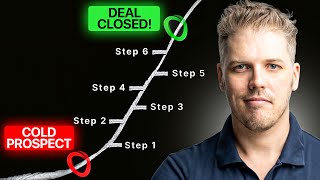
Matt Ryder walks through his six-phase sales process: problem, what, why, consequence, commitment, and action. Each phase builds toward closing deals by moving conversations from discovery to commitment to concrete next steps.
Foreign. Hey guys, what's up? Matt here. And today I'm going to talk to you about the six phases of a sale and how I can take any sort of conversation and turn it into a successful sale. Sales. Conversation. All right, guys, so make sure you, like, subscribe. Hit the notification bell. All that kind of good stuff that helps the algorithm, helps to boost the channel and do all that kind of good stuff to help me out. And cue the intro. All right, guys, so we have six phases of a sale. Number one, if we, if we have a look at it as a waterfall. So picture, if you will, a beautiful cascading waterfall. Hear the birds chirping. Can you hear them? The beginning of the waterfall is the problem. And the end of the waterfall where you see the beautiful rainbows and the unicorns and all that kind of stuff. Big splashing water is the actual sail. It's the action itself. We need to have a, figure out a way to consistently push people through all the way down to the water trickles all the way down and makes the big beautiful sail at the end. Okay, so the first thing we have is the problem. The next thing we have is the what. The next part of the sequence is the why. Then we have the consequence, then we have the commitment, and then we have the action. You cannot have action without all of the preceding steps, okay? It's very, very important. We have to have every single step. And that's why having a sales process is absolutely vital. Without a step by step process, all you're going to do is just miss things along the way. And when I coach people, I see it all the time. They're like, why can't I handle objections? It's like, well, like, yeah, you want to be able to handle objections and you want to be able to have those loops and those hooks and those reframes there at the go. But like, at the end of the day, like, if you haven't done the work, if you haven't built the scaffolding, then you can't get up there. Okay? You need the foundations. When I say problem, like, what is it? By this I mean, like, it's the main obstacle that's in the way of the person achieving their outcome. So what's the biggest struggle? What's the problem? Once you have that, then you can really start selling. Like, I was doing a role play of the day in our, in our Facebook group, which is free, which just hit a thousand members. Yay. So make sure you go in there. I'll, I'll put the link in the description, it's called the closing code. But I was doing a role play and I do like an hour or two hour role play once a week, right? Just all for free. And then the guy was like, okay, all you need is a problem. So I was like, everybody raise your hand if you have a problem. I was like, you, what's your problem? And then he was like, ah, need to overcome objections better. What objections do you struggle to overcome? Let's think about it, okay? And like what if anything have you been doing in order to help yourself get better at overcoming objections? Do you like the way that you are learning? So all I needed to do is grab a problem and then I literally sold him live into a program on the roleplay. And I was only able to do this because I understood the problem. And then I had the cascading series of events that happens when you want to get a sale. As soon as I get a problem, I can immediately go straight into my process. So once you have the problem and it's got to be the real problem, and that's sort of the big caveat on this, is that it's gotta be the real problem, then you can move on to the what. Okay, the what is the tangible tie down that you get when you solve the problem. Let's say it's I want to, you know, exit from my 9 to 5 and become a, you know, online entrepreneur. It's like the problem is a lack of knowledge, a lack of realizing or lack of knowing how to do it. Okay, the what is okay when you are able to do that and you're able to learn the skills and you are able to actually become an online entrepreneur. And then what happens? What's the tangible tie down? Well, I'd be able to spend more time with my family. I'd be able to have more freedom. Okay, that makes sense. You know, it could be a dream home, it could be whatever, but it has to be something tangible that they actually want. Okay, once we get the what, the actual what and might need a little bit of digging or to get there, then we're going to go for the why. So the why is like the emotional tie down that happens when they get the what, what actually happens? How does it make you feel? What does it do for you if you are able to obtain that right and you can see how it's cascading because like that why is not important to them unless it's the real what. You can't get the real what without finding the actual problem. And this is why? It has to be a process. And then it's like, so how would it make you feel to be able to get the dream home for you and your family? Right? And tonality and all that kind of stuff plays a key. But, you know, you get the real answers when you hear the tone. You're listening for genuine responses from them. And then as soon as you get the genuine response, you can dig a little bit and then move on. Once you get the real why, and I've said before, but when you understand someone's why, they're walking in or towards their purpose. So it's a far more impactful conversation. Once you understand that, then we go after consequences. Now, the consequences is probably the most crucial part of any sales process because it's what creates the urgency to act now. Act now, act now, act now now. But without the real why, we cannot create real urgency. Without the real what, we cannot get, the why is meaningless. Where am I going this? Right, so the consequence phase creates urgency. And then what happens if you don't get the what? Like it. It. It's. The consequence phase is like the battleground of the sale. It's where, like, it's where it's won or lost, in my opinion. And you have to have a scaffolding. You have to have everything in place in order for that consequence to actually mean anything to the prospect. What we're looking for when we get the consequences, consequences is like, so what happens, man, the next two days, two weeks, two months, two years, two decades, you. You haven't achieved xyz. Like, what happens then? The person's going to want to go, well, yeah, it's not going to happen. I'm going to do everything I can to get. It's like, okay, but, like, what happens if you don't? Because, like, in order to truly accept success, you must explore failure. I think that's a really important part of life. I think if you're not really deep under the consequences of what happens if you don't achieve your success, I don't think you necessarily have enough motivation to run towards it with enough velocity and veracity required. Okay, because if we take. If we take a big bear, right, a big old bear running towards a deer. Deer's just sitting there looking all cute, right? And it sees twig break, right? And then it sees the bear and it's running towards it, and then that little Bambi just takes off, right? Who gives up first, the bear or the deer? And the answer is usually going to be the bear, because the bear is looking for satiety. It's looking to become satisfied. Whereas the deer needs to live. So the consequences of the inaction of each animal is not equal. So that deer is willing to jump off a cliff, do what it takes, run through fire, broken glass, whatever it needs to do to not be eaten alive. But the bear will probably end up just going, ah, fuck it, I'll go eat something else. So that's what we're looking for. And you'll know you got there. When you hear what I call like the contemplative side, it's like, yeah man, that's, it's not good. Like, what do you mean? Okay, that's when someone's truly thought about failure. And I think it, thinking about failure is important because what's, it's what gets you to act. No one's ever like run out of a burning building, got into the front door and stopped, right? They just keep running. Sales is a process driven activity. Whether it's a consult or a call or whatever it may be. Like you have to have a process to create consistency. And any way you can get better at something is to become consistent. That's my process. Essentially it's the problem, the what, the why, the consequence, the commitment and the action. Alright guys, I hope that was helpful today. Make sure you subscribe, make sure you slap, like, make sure you tickle the notification bell. And I encourage you guys to go in the comments, to go in the description, sorry. And then join the closing code, the Facebook group so that you really can kind of, I guess, become part of the community. Make sure you have a look at the podcast which is called Coffees for Closers. And yeah, guys, I appreciate you and have a great day.





