Scripting Frameworks and Congruency
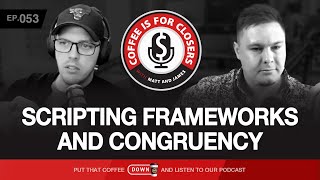
This is a YouTube video titled "Scripting Frameworks and Congruency" created on April 5, 2021, featuring a conversational podcast-style discussion between Matt Ryder and Eli. They discuss sales training, scripting techniques, the Congruence Academy program, and strategies for improving sales performance and mindset. The content is informal and instructional, focusing on sales processes, storytelling, and coaching methods.
Hey, guys. Welcome to another episode of Coffees for Closers. It's me and James today. I apologize if the audio isn't up to scratch. I am moving house right now, so it's been a little bit crazy. I'm actually sitting in my car recording this on my phone.
Yeah, I'm in my regular spot, but decided to switch the camera off as well since Matt's got his off, so you don't have to look at my head. As my mustache is currently back, this.
Will probably be our highest rated episode on YouTube.
Probably right, because you can't see us. It's funny. My mustache sits back for no other reason than with my thumb or injury. I'm just not confident shaving with my left hand yet. I think I needed probably another week or two before I got the balls to do that.
I haven't shaved for years. Yeah.
But I get no facial hair outside of the mustache, so it's probably not needed at this stage, you know? But, yeah, it's funny. So.
Alrighty. Today's episode, what we're going to go over is scripting and sort of elements that we think are important in scripting and then talk about one of the programs that just finished that we just did called the Congruence Academy. So if you guys want to stick around. Hear that? If you're listening on YouTube, don't forget to, like, subscribe. Hit the notification bell. If you're listening to Spotify or Stitcher or wherever else, please don't forget to give us a sub and make sure you comment or give us a review. Just do something. Do some engagement. Let the algorithm gods know that you're. That you are with us. All right, guys, Appreciate it. If you listen to this podcast, you will make your first million within three years. I'm going to repeat that. You will make a million dollars within three years of the first episode. You listen to. We don't want pikers. We're not here to save the manatees. We. We're here to make podcasts. You really want this, you listen and review. Put that coffee down. All right, so let's talk about the Congruence Academy.
Yeah.
Yeah.
Well, I mean, where do we want to start? You know, toot our own horns with some of the amazing results we've been getting or just give guys that weren't involved a bit of a baseline on what we covered?
Well, the Congruence Academy was essentially an idea that we had to pay for the office.
Yeah, we did just that.
The office is going to cost, like, 150,000 bucks. And I was like, man, I really don't want to not take dividends, so, like, let's just figure out a way to pay for it. And we honestly came up with it in, like, what, like, in a couple hours? And we're like, yep, sweet. Let's do this. Then from there, I reached out to Eli. I was like, hey, we're going to do this thing. Do you want to help us, like, do the events? And I was like, we'll sell it at an event. We'll do this kind of stuff. I was like, I've developed a lot of social clout over the last year. I think I kind of ran a bit of a dry, to be honest.
You what? Sorry?
Kind of ran a bit of a dry. It's how social clout works, right? Like, you do a lot of good things for free for people, and then you can kind of cash that in. You can cash it all at once, or you can cash it in jibs and drabs. I think we cashed it in, all of it in. I think we went everything on black. So, yeah, sort of cash that all in. And then from there, we're able to generate, like, 150,000 bucks in about five hours, which is great. And then we delivered that with 12 hours of content. So we were paid, you know, roughly $12,000 an hour, which is a great hourly rate. It's a living anyway.
It's almost my hourly rate, so.
Yeah, almost. Yeah. I mean, we took a bit of.
A hit, but, yeah, it's.
Yeah, but basically, that was. Yeah, that's basically how we work, too. Like, whenever you want to do something, we just sit down and go, okay, like, what do we need to do in order to fund that? And then we do that. Yeah.
I mean, it was either we do that, or we go with my idea and walk into the casino and put 50k on black. So we didn't think that was overly.
Down for doing that as a YouTube video.
Yeah. Okay. All right. When we've got 50K that we can just throw around, probably do, like, 20.
I'd be down for going and putting 20 on black. Fucking see what happens. You know what I mean?
Yeah.
All right. It's for a ridiculous video.
So what are you guys willing to buy to pay for it?
Yeah. So 20 grand worth of T shirts, and then we're good to go.
Yeah, sweet.
Yeah. No, but the congruence academy essentially was, like, the one thing that I think that we've done particularly well. That separated me from a lot of the Other sales trainers or sales guys is like the way that I tell stories and the analogies and all that kind of stuff. Like, it's very natural. It's kind of how I talk. Anyway, I liked it because I'm a very visual learner. So I like to give visual references to people in order for them to help them learn, because that's how I learned. Right. And so because I was doing lots and lots of sales calls, I was obviously like, the key thing with a sales call is like, you have to get the person to shift their perspective, like if they're stuck in a rut, like, especially with fitness. So it's like if they live a certain way that causes them to be overweight and unhappy and unfit, it's like that's every single decision that they've ever made has caused them to be that. So in order to get them to not be that, we have to change their perspective on life. And so it's like, how do I do that without going, you're the problem.
Yeah.
Right. Because as soon as you do that, it becomes a very unproductive conversation.
Yeah. And they just feel like they're being attacked. Yeah, yeah.
And so I developed a lot of methodologies where I could get people to understand what they were doing. Rather realized they were the problem, but through having like an aha moment, that's what I'm doing. Right. But like, very non combatively through stories and all that kind of stuff. And then as I got into high ticket, it seems like nobody else is kind of doing it. And so it kind of became one of my things. And it was like hooks and reframes and stories and analogies. And so we just created a course around it that went for six weeks. And it seems like the guys, or most of the guys have had a very good result.
And during that six weeks, we really had the intention to one, not just give people the stories that we utilize in our scripts and analogies, but allow them to develop their own and go through the process that we go through on each account to build specific stories, specific analogies, each designed to pick and choose when to use the situations for them to overcome a specific or, well, to pre handle a specific objection that.
Really what it broke down to, it was just a cheat code of like. Well, if I say this at like, this point, it usually puts me in the best position to be able to handle this at this point.
Yeah. Because they're stuck in a logic trap. They've got a different perspective on how to look at that, and they're involved in the hero's journey and want to be the person in that story who overcome the problem that they currently have.
Exactly. Like when you watch Thor, you're like, man, if I was in Asgard and I'd be Thor. You know, it's like you put yourself in that position. So it's just really about. Yeah. And so anyway, without getting too deep in the weeds, I have heaps of YouTube videos on that. And yeah, you know, you can go the closing code and you can then there's a bump sell on the closing code for like 50 bucks and you can literally buy a five hour masterclass about me talking about it. Right. So there you go. So yeah, you can just go do that. But yeah, so. And I think we have like four podcasts about that particular subject. This one called Stories Reframes Analogies. It's like our second most popular podcast of all time. Go, go and look at that. But anyway, so we developed a course.
Forget what we talk about on here. Right.
I know in like two years it'd be like, that's a great idea we're doing on stories and analogies. Anyway, so. So yeah, so you can go see all that stuff. But yeah, so we just developed a course around that. It was a six week curriculum where it was like, we'll teach you how to. Right, you're hooked. Now. We've now got that curriculum. So I'm pretty sure the plan is now we're going to have that as like a bump sell off the back end of closing code so people can buy that as like a, you know, a two $97 one off or something like that or a four, nine, seven, whatever, we'll figure it out. But. And now we're going to the next phase of it which is like well, scripting, which is. So that's a bit of context. On the congruence academy we had people that went from having like two sales a month to having like, you know, one of the guys was fucking. I don't know if you heard this this morning, but one of the guys, Brian Savage, great guy.
I came in a little bit late this morning, but when he did the.
Program, the first payment he put down like a thousand bucks. It put him into negative.
Ouch.
Right? He today has 25 grand in his bank account.
That's. That's mental. That's a big result.
Like, and he's been doing this for a while and he's been living, he was living with his mom and all kinds. So like he's been slogging through this. And he sells his own program, like he has his own coaching program and stuff like that. I don't know what, I can't remember what it is off top of my head, but. But yeah, man, like he's been trying this for a while and it just hasn't been able to crack it. And it's like he came to the mastermind, like, put balls to the walls. Fair play to him. Like full balls to the walls. I think it was like, might have even been 700 bucks and it put him in a negative. And now six weeks later, he's got 25 grand in the bank. I was like, man, that's fucking awesome. That is so good.
Yeah, yeah. And that was really the intention because part of that congruence academy was not just the stories and reframes, but it was also. That's one of the major things that we teach at Sales Sniper outside of other sales trainers. But it's all about becoming congruent with, with oneself. And you know, we had James Cannon talking about health and fitness and stuff like that. And a lot of the stuff revolves around how to, to one get consistent on those sales goals, but by applying the little things in day to day life that are going to allow us to turn up to each call with the best ability to replicate one of those scripts and replicate the results time and time again. And I think that was like, outside of doing the stories and stuff, that was the biggest thing for a lot of the guys, at least from the feedback that I've got directly was it was getting out of the ness and not being baby birds and getting after it, getting those referrals, really following up old leads and getting them back on the phone just with that tenacity to get more bookings into the calendar to make more sales.
Yeah. And a lot of it was just like, I think sometimes people just need to know it's possible.
Yeah.
And so like a lot of the time just by like. And man, like if there's a. I would love to see. I would love to hang out with like the guy who's running a better sales team than our sales team. Like, and I'm sure there are, like, there has to be.
No doubt.
Yeah. And I would love to meet that guy and be like, what the fuck are you doing?
Yeah.
Right. Because like I just looked at the new sales form notifications. Like we've. We're averaging 10 a day this month.
Yeah. It's current. It's getting crazy. Yeah.
Right. And so like it's between 200 and $250,000 a day in sales. That's what we're averaging. And so it's like, okay, outside of.
Sales sniper stuff, right?
Yeah, yeah, yeah. Because we don't have a new cell phone notification set up for that yet, so. So that's just like, that's all the new sales coming through. And I'm just like, holy shit. I was like, man, like, sometimes, like, people just need to know it's possible and then their whole perspective shifts and they start doing other stuff. So when I tell sales guys, no, you can make your own leads, they're like, what? I'm like, yeah, that's how you do it. They're like, oh, oh, I didn't know that. You know, it was like Angelo. And again, I want to my own home. Angelo went from 12k a month to the third. After the third month of me coaching him €73,000. And it was because, like, he learned how to go out there and just get it done. Oh, no, I don't. I don't need. I don't even need leads. Like at seventh level, like, we did the sales for Jeremy, Right. And we also own part of that company. So basically, like, we are seventh level, but, like, we don't get leads. We don't. I wish we did. Don't get me wrong, we're paying to get someone to get us leads right now. It's just not working. So we haven't had consistent lead gen for months, but we're making more and more and more and more sales every single month.
Yeah, we had a record month this month with like four book calls through. Through a funnel, which is. Yeah, it's really just testament and perspective that sometimes marketing doesn't work and would you rather not get paid or would you rather get after it and make it happen? You know?
Exactly. Right. Like, yeah, you can sit back and fucking bitch about the lack of leads or you can just go out there and fucking figure it out. And like, I know for me it was like, I think when I was doing full time selling, I think like the consequences of me not selling were drastic because I was funding the whole company. Like, I was funding everyone. And so, like, yeah, other guys were making sales, but like, there was one point, I was easily 80, 90% of the revenue. Yeah, Right. And so it was like if I didn't figure it out and if there wasn't many leads, it was like, fuck, I better figure this out. And so I just started dialing people.
Yeah, I remember having many phone calls with you through the day. How Many sales you made today? None. Okay, we'll get some fucking leads, start calling, doing follow ups. Because we're relying on this, you know, like if we're gonna make this happen, like we have to start somewhere and this is a place to start. So let's figure it out. And then we could replicate that for clients.
Yeah, man, it was like, it was crazy. Some of the invoices we sent were pretty big.
Yeah. Some of them were also very small by comparison to what the ones we sent now.
Oh yeah, the ones we send now are much bigger. But, you know, wasn't just me by my lonesome, but yeah, man, so I think like once people kind of figure out, like, hey, you can go out there and get off that you don't need a degree in marketing, you don't need to know how to do paid ads. Like, there are spheres of influence in which, you know, the, the business that you have has whether no matter what type of business, like there is pools of people that know about it. Yeah, that's all you need. Then you just got to go out there and find a problem and then bang, you're good to go. But I think, you know, in segwaying into that, it's like, then once you get them, you got to have a good script.
Yeah. Before you do, I just want to touch on one more point to give perspective to people. You can also build a team, right? Because now Matt is probably contributes to about 5% of our income. Let's say if I didn't factor in the ROI from the videos and the content and stuff, but from directly making sales, it'd be 5% or less of the income is generated by you now because we spent the time to figure stuff out, put the systems, built the infrastructure and built a team and focused on team first. And literally anyone on our team could replicate that for themselves if given the time and direction correctly. So it is possible for the guys listening that have teams or have small teams that want to grow it like in 12 months it can be a very, very different story. If you strap the boots on and tie them up tight, you know?
Oh yeah. I mean, fuck, dude, you can mediocrize. But that guy that we're talking about today who we did business with like a year ago, and he was like, no, bullshit. Those guys don't know what they're doing and they're not successful because he always hadn't been following us and showed the videos and was like, oh, fuck.
Yeah. So I had a good laugh about that.
Guys are killing it. And there's a long way to go. You know, we are meeting with Bradley today because we're going to start doing some sales for him, which is fucking crazy. Like, I mean, what was he, like, the second most influential person in sales? It was like Grant Cardone, Bradley, Jerry, AKA for the top three, and then Jordan Delfor was number four.
Yeah. I mean, I don't remember off the top of my head, but it seems pretty. Pretty correct, I think.
Yeah, yeah. And it's just like, it was just crazy that, like I was telling. I was showing him stuff that he'd never even thought of. I was like, no, this is how you do this. Yeah, yeah, that's how you do that. I was like, yeah, yeah.
That's just business acumen. It's not often that you get, I mean, and I don't mean to disrespect anyone, it's not often that you get top of the table salespeople that are top of the table business guys and, and top of the table business guys that are top of the table sales guys. It's. It, there's a lot of it out there, don't get me wrong. But in most cases, most people develop one of those aspects better than the other.
Yeah, for sure.
It's a different personality type, sort of stronger and.
Yeah, no, I tell you. Yeah, 100%. But yeah, like, sort of going back into like the scripting component, it's like the next part of congruence academy is all gonna be at scripting. If you guys do want to know and you listen to this, you know, you can send us an email, you can go onto our Facebook, you can go on Instagram, dm, slide into those. DMS guys can figure out how to get in contact with us. Right. It's like, it's not that difficult. And then the next part is gonna be scripting. Now I like, scripts are important, but I don't. I have a little bit of a different view where like, I'm not as fussed about the words and I don't want people to like memorize the words. Right. It's. I want them to understand the principles and the concepts behind why it's laid out the way it is and what you're trying to get out of each question and section.
Yeah. So. So the intention behind.
Yeah, the intention is so much more important because that's what stops you from getting lost.
Yeah.
So like, if you memorize a script and someone throws you a curveball, which is every single sales call, then you end up in this position where you either sound like a robot and you're trying to get back on track, and you're like, doesn't compute. Right? It's like, it's not a one or a zero. Or you just end up abandoning the script, going off tangent and then getting an objection. Like, think about it at the end. Or money. Or partner. Because you haven't locked anything up tight enough because you're just going rogue.
Yeah.
And so that's really what happens. And, you know, too many people. Too many people want me to write their scripts. And it's like. Like ryan. Like Ryan McCormick. He's like one of our sales guys. He's like, hey, I got a bunch of people who want to pay you to write their scripts. It's like a few grand. I'm like, no, I'm not doing that. It's like. But like, it's like taking, like 20 minutes. I was like, yeah, I know. But like, yeah, it's great. Twenty minutes. Three and a half grand. Like, I'm all about it, but it doesn't do anything for them. And then all they're going to do is say, oh, I went to Matt Ryder and his script doesn't work. Right. It's like, well, yeah, of course. Because you don't fucking understand the things that you're being asked, things that you're being told to say.
You're just copying words off paper without the context behind them.
Yeah. And like, you know, don't get me wrong, it's probably better than not following it. Right. But it doesn't really benefit me. Doesn't really benefit them, which is the really important thing. Like, yeah, it benefits me in a way that it gives me money for doing something I find very easy. But, like, I just don't. It's like, teach a man to fish and you'll feed them forever. I'd rather spend the time like, it's gonna be fifteen hundred dollars a month, Aussie. It's two sessions a week. So it's like, for eight sessions, you get fifteen hundred bucks. Or you can just pay me two thousand dollars for one session. Like, you're better off doing it this way. Right? Like, you'll get. You'll get more information out of me, I guarantee it. Because the way that I teach scripts is, like, ubiquitous across all offers. Like, I'll teach you how to do it, but, like, very little of it will be talking about your offer, because I don't really talk about the offer very much in the script. Right. So it's like, it doesn't matter what matters is understanding the journey that you're taking someone through.
Yeah, totally. And context is super important. The context could get you in a lot of trouble either way. And that written on paper without the context of the way that you said it and without the pre emphasis and the post emphasis makes a very, very large difference and could land you in jail with a. You know what I mean? And that actually brings me to another point. I had this discussion with someone today where they pull out certain phrases or a certain paragraph within a script. They nail that part, but they don't realize that just adding in that particular aspect of a script to that call doesn't do anything because the intention is not there. But what's important is, let's say if you have a sentence that you structure, then the major important things of having that hit home and having that get the desired outcome for the reason you ask that is the pre frame question that you ask right before that paragraph and then the post frame question that you ask right after. Because the three sentences together or the three questions that you asked all gelling together creates a further elicit and gets the response that you designed those questions to do. But if you pick either three of those specific questions and ask them on their own without the relevance of the other two there, it doesn't make sense and it doesn't come across. Right. Because it's like it's the, the epitome of just like taking a random book, reading one paragraph from a random page in that book and not understanding what happened to that story.
Yeah. And so like, that's why like I'm very, when I teach it, I try and get very conscious of not going to in the weeds.
Yeah.
Because like I've actually found that the more I understand it, sometimes I find it more difficult to articulate what I'm trying to say.
Yes, yes.
Like I can actually see why some people that I know of don't teach it very well because their understanding is like they're trying to convey what is very complex things simply. And that's just not always easy. So that's why I like one on one with experienced guys because I can go very, very meta and very detailed and they understand what I mean. Like when I code Shawn Ray, I might even ask him, I don't even pay him something if I can like release the 12 weeks of coaching that I've done with him because it's like it's a sales guy with 10 years experience who's good at what he does, who understands it and is intelligent and who wants all the nitty gritty stuff. Like, he wants to understand the psychology behind every question and the intent behind every question.
Yeah. Yeah.
And so, like, my conversations with him are very, very technical. It's like listening to two mechanics talk about an engine, you know, like, that's what it's like. And so, like, it'd be really interesting to use some of them because it's the most. It's the most fun I've had coaching somebody ever.
Yeah. Nice.
It actually gave me a much better understanding of some of the things that I was doing because he was so good at asking questions about what I was doing.
Yeah.
So, which is when I actually realized that, you know, how I was talking about the bridges with the objections. It's like, don't. And everything was our previous podcast. It was like, don't worry about the objections. Like, just worry about being good at getting people to give the objection that you want. Yeah, right. And I didn't realize I was doing that until he really programmed it out. I was like, well, this is what I'm. Well, no, he just asked me a bunch of questions, and I was like, well, this is what I'm trying to do.
Yeah.
I was like, oh, that's what I'm trying to do. You know, they're like, oh, yeah, that's what I'm doing.
You gave something, a title to a concept that you had that you never articulated because you never thought about it.
Yeah, exactly. It's just something that I always do.
It's like, I do it all the.
Time, Same bridge, you know? Well, that makes sense because we all make decisions based on our perspective. Like, I say that in every sales call because it's just like, oh, well, now I know where I'm going.
Yep.
Like, it's a good reset point for me. So, yeah, so that was really interesting. But, yeah, so we're scripting, like, what. What we plan on doing over that. Over that 8 to 12 week course is sort of. I want to go into each phase and probably spend, like, a week in each phase.
Yeah.
Just really understand, like, the first week will be going over the entire script as an entirety. So people can kind of see, like, what it is when you put the whole thing together and then do that alongside a live sales call, like, you know, like. Like a recording and go like, okay, like, can you hear the transition? Can you hear why we now. Transition? Can you hear if that. Is that the real answer? Is that the fake answer? Like, learning how to listen for if people's answers are genuine, not if they're lying. But if it's like, you know, if you ask someone how much weight you want to lose and they say, I want to lose 10 pounds, but really want to lose 20, they're not lying when they say they want to lose 10.
They just don't understand that they want to lose 20.
Yeah, they just. They need to realize they want to lose 20. Or they know they want to lose 20, but they don't feel comfortable saying it. But it's still not a lie. It's just like. It's just a partial truth.
Yeah.
You know, and so it's.
It's a lie. Coming from a place of misinformation on the. The prospect's behalf. Yeah.
You know what I mean? Because if you tell someone your real goal, then all of a sudden you become vulnerable, and then they can become uncomfortable. Also, when you say your real goal, you're more likely to be held accountable to doing it, which not all people want. Right. And so being able to hear that tonality and then being able to know when you're not going to get it, when you think you should get it, and knowing how to get it later.
Just a thought idea that I had. Sorry to interrupt you there. It would be really good as well. Going in, listening to those calls and saying, hey, the intention of me asking this specific question was this. Let's see if they gave me that response that I was looking for. If they did, great, here's why. If they didn't, what could I have done to improve that? And that's like a learning tool that the people that we coach like, I ask them to go into the perspective of when they evaluate their calls is ask those specific questions. When they're doing it is like, did I get the desired outcome from asking this the way that I asked it with the specific words that I used. If the answer is no, then figure out why and change it until you get the desired outcome most of the time.
Yeah. Yeah, absolutely. Yeah, that's. It's. It's super helpful and insightful. When you start listening to calls and then asking about intent for each question. And because, like, the thought process, like, I can tell when someone's going to be a good salesperson simply when I understand, like, they're. When I. When I know where they're going with it. If they start. Because execution is one thing, thought process is another.
Yeah.
So if somebody asks the right questions, but they asked them in a stupid way, that's so easy to fix, if their thought process is wrong, that's Going to take so much longer to fix. Like, we took on a guy, Stephen, and when I listened to his call, I was like, oh, I know exactly where you're going. Like, your thought process is perfect. There's like, your tonality sucks, and it's good now. And, like, that's really hurting you. And your execution is not eloquent, but that can easily be fixed. Right. And so, like, this is going to be a fucking breeze. And that Dude's doing about 55,000amonth.
Yeah.
Right now he was doing about 35,000amonth. Now he's on about 55 to 60,000amonth in comms, and he's based in Australia. So for your Aussies out there whinging and bitching, there's no money here. There's plenty. Right. So, yeah. And so it's just like. But sometimes I listen to calls and I'm like, where are you going?
Yeah, yeah, yeah, yeah.
It's like, I don't understand, like, why haven't you heard that? Why haven't you picked up on that? And why are you not trying to do this? And it's like, my way is not necessarily the only way, but it's like, if I just cannot fathom where you're going with it, like, that's when it's like, I have to try and retrain this person's brain to be able to, like, listen.
Yeah. You need to train the thought process as opposed to the skill set. Right. And it's funny because right now, like, I can listen to people's calls and majority of the time, let them know what objections they're gonna get.
Yeah.
Like, before we get to that part. And I know you can do it, too. So it's. It's interesting to teach someone how to grasp the thought process and the attention as opposed. And that's why I think, like, word for word scripts don't work, is because you miss out on the conversation because you're focused on the specific words that you have to say in the way that you have to say them rather than having a conversation. And that's why scripting for intention and. And process as opposed to word for word works better. And a lot of the people that are fully against scripts would be far better off if they had scripts. But scripts in the way where it was more of a process and a guideline as opposed to a written. Say exactly this.
Yeah. And, like, there's. There's. There's a combination of the two. Right. Because, like, when I write scripts, obviously, I want them to Say the words on the paper. Yeah, right. Because the words on the paper is the most efficient way of conveying what we're trying to convey. Yeah, right. And it's like, if you just push them down that script, man, it'll be much easier. But, like, I need to. The first thing I'm going to do is I teach people and I try and get them to spend about two sessions just understanding the script.
Yeah, right.
Then we go through and rewrite it for their offer, which doesn't take very long because doesn't really matter, to be honest. And then we go over, we role play, and then they go out into the world, they do it, and then we just critique. Right. And then we spend about eight weeks critiquing their calls and doing role plays. And so I need them to know the words on the page and use them because they just go off script. It's just going to go fucking rogue. So it's like, try and push them down, easier transitions. But, like, as long, like, if their thought process is correct, like, then people can throw them curveballs and then they can still push them down without saying the exact words. But the intent is there behind the questioning. And that's the real issue. That's the real thing. It's like, you don't have to say, is that having an impact on you? You can say, oh, and how has that affected you? Right. Like, that's a different question, but it's the same question and people. So, like, the intent of that particular part is what is needs to be conveyed, not the exact words on the script. Yeah, right. It's just that you know the exact words in the script. If you can, then if you can do the combination of understanding and memorizing that, that is a lethal combination. Because then, like, you can go off script, you can stay on script. You don't think about it. Which means that the real benefit to memorizing a script is that you don't have to, is that you know it so well. All you have to do is listen. Yeah, right. And then you pick up on everything. So you probe on the right things. Because the reason why people don't make sales mainly is. Well, there's a lot of reasons, but one of the main reasons is because they don't listen properly. So they miss out on so much important information which they don't clarify or probe on. And then they skip over certain things and then they induce into objections because they're not really listening. So they say shit that makes the person actually give an objection at the End. It's like, well, that was your fault. You set that up at minute 14.
Yeah, yeah. You know, and it's funny with our script how. And, you know, the specific words and other things that we still are developing, and they will be different again and more refined and better in six months. I had a conversation with a guy today where he's like, we did a role play. And I said, oh, you know, I don't like the way you. You did that there. But I understand if you've just started watching our content and you've gone through it from video one to video, however many we're up to now in the closing code, I can understand why you would have said that. But he's like, yeah, I noticed that. And then in, like, some of the later videos, you don't go down that path. And I go, well, here's why. And we continuously update and develop our stuff. It's the only problem is I don't.
Have time to continuously update, develop, to.
Go back and delete ones. Yeah.
But also, like, there are stages in. Just to. Just to talk on that.
Yeah.
Like, there are stages of selling, and some methods are far more technically demanding than other methods. So it's like if you're a business owner who has no intention of ever being the sales guy for your business long term, there's that lure of, like, diminishing returns. You just need to be good enough to get a job done. You don't have to be a master at it. Like, if all, you know, if you're doing jiu jitsu and all you're ever gonna do is just roll with the occasional person, you don't need to be a fucking black belt. A blue belt's fine. Like, you're gonna be able to hold your own. Right. You know, but if you're a sales guy, fucking, you need to be a ninja, because that's your job. So, like, in the closing code, it's kind of like, there are kind of, like, levels in there, but I should probably sort of make that more obvious. And it's like beginner stuff. It's like, this is good for people who don't need to be Jedis.
Yeah.
And then it's like Jedi stuff. This is the stuff that, like, can really. It's very technically demanding, but has a, like, a high level of efficacy when you can get it right. But if you do this stuff and you don't understand it, you'll make no sales. Like, if you try to sell how I sell without the understanding of what to do and Because I leave myself so many doors. Like, I mean my closes. Would that be appropriate? How would you like to proceed? Like, that's a. That's not a good close. If you're a beginner, you'll fuck that up every time because you don't know where it's going to go. You have to know the answer to every way that can go. Otherwise you're just going to end up going, oh, okay, awkward out. And then boom, follow up. Ghost. There's just different methods and levels like logic traps for specifically is a very, I think simple way of objection handling that is a little bit combative. Like the actual, like pure like logic trapping. It's easy to do, but it creates refunds because you're making the first and feel stupid for not moving forward because you just put them in a box logically where it's like, you know, every answer that they've given can only have one logical outcome. Right. So they almost feel stupid saying no. So you can kind of bully that person into doing it sort of. But the way that we sort of do it using different methodologies these days, that's been refined over the last year. It's much harder to do, but far more effective.
Yeah. Yeah. Okay, well, we're about 35 minutes in. If we could leave the guys with like a bit of a guideline for scripting, I guess a little teaser for the King Cron Academy, as you might call it. What are. If you could just like define the major parts of your script that you go through.
So it's called sales process. If you want to look it up.
Easy, we'll link it in the description.
But it's. Yeah, but it's basically the problem is the first thing. So it's like the problem. You have to find out the real problem. That's first and foremost. Like that's the most. One of the most important things has to be the real problem. Then from there you find out the what. What do they get when they solve that problem? Pretty simple, right? And then from there it's the why what? Like what is the emotional driver? Why is it important to them to get the what once they've solved the problem? Then from there, like that's all future pacing. Then from there it's the consequence. It's like what's the consequence of not getting the what? And how does that make you feel? And then from there it's the commitment. So you make a commitment to change that. The consequence doesn't become a reality. And then from there you get the action which is the sale.
So that's.
That's. That's the phases that I take.
I imagine we could probably, if we wanted to do a podcast episode and go into detail on each and every single one of those phases, I could.
Do like four hours on each one.
But we're not. Because we'll be doing it in the congregation academy.
Yeah, exactly. So if you guys do want to find out more about this stuff, the closing code or whatever, you can join our Facebook group. And then, yeah, if you ever want to, like, hey, is there any resources or anything, any help that I can get, any way that I can give you guys money? What you got to do is raise your hand, say anything, comment on anything. You know, think about liking something, and we'll probably hit you up. So now we. Again, again, we do do about six live streams. Seven. Six or seven live streams in there a week. So there's lots and lots of free content and stuff like that in that group. It's called the closing code.
Yeah. Where Marco is at a stage where he's in the matrix right now, where even if you just think sales training, you are now a lead. Like, he's already. He's already got you.
I'm pretty sure he's. I think he's close to 100% for the last four or five weeks.
Yeah, it's getting. Getting pretty ridiculous. We've created a monster.
All right, well, we really appreciate you guys being with us and yeah, thanks for, like, subscribe, hit notification bells, do whatever it is that needs to be done on whatever platform you're listening to this on. Yeah, we appreciate you taking the time.
Thanks for bearing with us for a couple of weeks of not perfect audio and video as we're moving into the new office and there's a lot going on in the background. So thank you very much for sticking through that. Appreciate it.
Yeah, we'll have some cool looking background soon, I promise.
Very good content coming out in them quite soon. Thank you.
All right, guys. Bye.
Bye.
Put that coffee down. Coffee's for closers only.





