The Science-Based Method to Building Irresistible Sales Skills
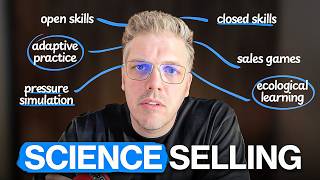
Matt Ryder argues that sales training focuses too much on rigid scripts that don't work in real conversations. He proposes ecological learning: mistake-tolerant practice environments where salespeople develop adaptable skills through structured games like 12-minute speedruns and objection sparring, not memorized rebuttals.
Chapters
Most reps are practicing sales the wrong way. And honestly, it's not even your fault. You've been fed the same guru garbage for years. Talking about rigid scripts, frameworks. Objection. Handling drills, tonality drills. And really, these things only work on prospects that have been, like, lobotomized prior to the call. It's like someone handing you a guitar, giving you a chord diagram, having you stare at it for six months, and then going like, all right, dude, shred me a solo.
That's basically how most sales training works these days. But here's the truth. Those are closed skills. And you just practicing that crap over and over again isn't going to make you better. You can obsess, memorize, do everything, but in reality, that's only like 10% of what actually matters on a call. Right now, you're trying to perform open skills, artistic kind of chaotic things, and you're training it in a closed sales drill environment. And those things just don't mesh in reality. Because what I'm going to do is I'm going to show you how to actually train sales. I'm going to show you how musicians, athletes, and true professionals actually train things to get better and go from that kind of rigid, mechanical type vibe where maybe you're only good on role plays, but you can't translate it into actual freedom, expression, fluidity, and how to be comfortable on a sales call. Okay? So if you give me a few minutes, this one is a little bit in depth, but I'm going to show you how to actually train sales so that you can get better. And after today, once you realize this, it'll never be the same for you again. So let's get into it. So in this video, I'm going to be giving you three big ideas or concepts that you can use in order to massively increase your ability to make sales.
So let's start with big idea number one, which is going to completely change everything for you and kind of give you a couple of aha moments. All right? It's the distinction between closed and open skills. And these are like, scientific terms from motor learning. Okay? Closed skills and open skills are two completely different things. You can't train them the same way. All right? Closed skills, the goal of them is to repeat the same action in the same way every time. So think of sports with no opponent, like shooting at a gun range, right? It's a fixed environment and it's very controlled, right? So think of word tracks. Think of, like, rigid, like, reciting rigid frameworks. Think of memorizing you Know, memorizing exact rebuttals. Right. If you've ever been told like what to say when you know what I mean, say this. If they say that, that kind of stuff and it's practicing lines which kind of no pressure. So what these are, these are controlled, predictable and safe. And closed skills make you really prec. So again, it's not that there's one that's worse than the other or one that's better than the other. It's that these are totally different types of skill sets and we can't train in the same way. So then we have open skills. The goal of open skills is they're dynamically and constantly changing environments. Okay. And so think about instead of being in a shooting range, it's shooting while being shot at. Instead of being in a range in a controlled environment, you're on the side of a mountain. I used to be a sniper in Special Forces. You're on the side of a mountain shooting north down a hill and the wind's coming out. You have a lot of, like a lot of environments that you can't necessarily control. Plus you have a lot of pressure. Okay? So you can see how there's a real distinction there between like sales training and actual sales. Like, just because someone is great at a range doesn't mean they're going to be good shooting in a war zone because there's a whole different pressure and levels of variability. And there is some. Although you need those closed skills, if you never trained outside of that, then you wouldn't be good in war or at least you wouldn't have an idea and you wouldn't be able to put all of those skills together all at once to be able to be successful. Okay. So only training closed drills. Right. Does not help you adapt that into a real life environment. And most role plays done in sales training are a closed skill because they're very simple. Right. And what it doesn't help you do is sort of put a lot of the connecting tissue together. Okay. So some of the things that I've done is like a 12 minute speedrun role play. You have 12 minutes to get through the whole thing, but you can't talk too fast. So that teaches a bunch of things, which I'm going to go in later in the video. We're going to break down exactly what some of these exercises do and what skill sets they increase and what they don't and when you would use them and why. We've also got like a king of the ring objection style sparring. Right. Where you just go through a bunch of different people and then you've got like improvising with imperfect information, which is really important because you don't always have all the information. Okay, so closed skills are designed to make you precise and open skills are designed to make you elite. Right? Both are important. However, you train them differently. And if you are watching this, it's probably because like what I see in my programs at least, and what I've seen, sales training, other people that I've done, is that people struggle at mastering the open skills. Okay, so the big idea kind of summarizes that closed skills and open skills require very different training methodologies. So after being a full time rep for over 313 years, running some of the largest sales training businesses on the planet, and training tens and tens of thousands of reps, what I see is that most sales training companies are using methods that teach closed skills and pretty much only closed skills, because to be fair, it's a much easier thing to coach in practice. But this is also mainly because coaches themselves are generally people who are at least fairly good at sales. Right? And what this means is that you're being taught by people who are generally high performing sales reps. Now that's not necessarily a bad thing because I don't think you'd want your coach to be a bad sales rep. However, I want to explain to you why that can be an issue. So I'll give you an analogy. Like if you look at like guitar, for example, okay, Just because someone can shred like crazy doesn't mean that they are going to be a good guitar teacher. In the same way where just because someone's great at sales or gets a good outcome in sales, it doesn't mean that they are 100% completely aware of all the things that they're doing in order to be good. Like Messi might not be able to describe exactly what he's doing to get the perfect shot every time, or to know exactly where people are going to be because he's just so talented.
And that doesn't take away from the hard work that it takes to be good. But if you are someone who got good quickly, you're probably not going to be that good of a coach. People who are get good at things quickly. People who get good at sales quickly generally don't become great coaches because they don't have to sit down and try and pull out and clearly articulate everything that they're doing. And there will be some things in which they're doing which are causing successes and removing Certain problems of which they don't even realize are happening because they're a byproduct of just being good at the thing naturally. Okay. So if you ever wonder why you're struggling to put all of the pieces together, it's because you're only being taught closed skills and by people that have natural talent. Okay? So if you sell for two years and you become a sales coach, the chances are that you got good enough to be considered good enough at sales to be a sales coach that quickly. There's a level of. High level of natural aptitude there. Okay. And also, given the fact that sales has a really high attrition rate, people don't stay in sales for that long. You know, it's a high turnover kind of industry. That means that the people who get good that quickly, who want to become coaches, okay, they rise to the top quite fast. And the people who took forever to get good either, like, just gave up long before they got good enough. Right. Or they might not have the demeanor to want to coach people because what they had to do with themselves to get themselves that good was just too much to kind of try and translate to other people. Okay. Now, for me, I was terrible at sales. When I say suck, I mean I sucked. And I'm gonna cut away now to a real sales call of me after five years of full time selling. Yeah. All right, man. Would you want to. Have you got a few minutes to chat today, junior? Yes. Yeah, man. So, like, what sort of sparked your interest? What are you looking for at the moment? Not sketch it, really. Okay. Yeah. All right.
Okay. And what is, what does fitness mean to you? Is that like, you want to be able to run 5Ks faster or do you want to have a six pack? Or, like, what does it mean straight away? The tonality is not very good. I don't understand. I can know what I'm talking about. It's very flat and like forceful and just not overall very, very good. Pretty much all about that matters three times a week tonight, but probably just looking for something a bit more fast, fast paced.
Probably see results or faster, I suppose. Okay. And like.
Okay, that's perfect. So do you have. Is it, Is it perfect? See, I sucked even after five years. So anyway, back to the video. So as you can see, I was not good. These guys on Instagram who have been a sales guy for a year, two years, three years. Okay. They are so much better than I was at that time. Now, granted, I coached half of them, but, like, they had such levels of natural acumen. That they don't understand all the things that they're doing. And so when you go into a program, they're teaching closed skill environments because all they had to do was learn the closed skills and then they are naturally putting the chord progressions into beautiful solos. There is a natural acumen to that. Okay, so. But me being so bad for such a long period of time, it forced me to do my own methodical development plans and create a system that I could use to get better and break down and articulate what I was doing well and what I wasn't. This is what gave me the understanding that I have today and why me as a coach break things down into concepts that I think are appropriate for the skill level of the person, where they're at, what they're doing, what they're selling. And I try to give a method for them to uncover the solutions themselves so they can start to learn the problem solving process. Because what truly makes you good at sales is having an understanding of what you're doing. And the deeper understanding you have, the better you can articulate it, the better you can solve the problem yourself. You get past all the low hanging fruit quickly. Okay, now I know there are going to be a bunch of people in the comments saying like, oh, close and open skills, like these things translate. I'm talking on broad things, right? Anyone who says you don't need a script is an idiot. Anyone who says you have to have a script script is an idiot. Not all things are entirely open or entirely closed. And there are no really definitive right and wrongs in sales or just whatever works that's going to be slightly different for everyone. Right? But what I like to teach is a, an open skills framework with like closed skills training involved in that to get good enough to be able to adapt them and then focus on the adaptation into real world scenarios. I'm going to get to big idea number two, okay? But I have to kind of recap. You cannot teach or learn closed skills in the same way that you do open skills. If you're at this point in the video, okay, and you've stuck around so far and you're sick of being lectured by gurus who have, you know, haven't sold anything or industry for a year or two. I have an affordable membership, it's called F the gurus because I was bad at selling, so I wasn't a guru. It's real training, real advice. It's like 50 bucks a month. It's a really affordable low ticket way to get in there, get some Skills. And in our like 150amonth and above, we have a whole bunch of different sales training sessions that you can attend that do both closed and open skills. But let's keep going. Big idea number two is all about ecological learning. Okay, so this isn't a science lecture, but ecological learning basically means that you learn by doing and experimenting, not by memorizing word tracks in isolation. Okay? We build by interacting with challenges that reflect the real world. It's not repetition, it's interaction. So a really easy way to think about this is the difference between how kids and adults learn. Okay? Kids, they, they learn by playing, experimenting and making a ton of mistakes. Okay? They're really curious and they don't care if they look dumb. Okay? That is a really, really big thing, not caring if you look dumb. Okay? When kids want to learn guitar, they just kind of like play around with it all the time. And when kids want to learn a language, they'd play around with it all the time. And so they discover things by accident and they poke holes in things and they make a lot of mistakes really quickly. Which is key to getting better at things is making a ton of mistakes. You contrast that with how adults learn and adults overthink everything. They want the perfect script, okay? They avoid making mistakes. How many times have you. I've seen sales reps so many times that have done two outbound dials that day, but done four hours of sales training. What they're doing is you're avoiding making mistakes in exchange for trying to find perfect process which doesn't exist. They avoid the open environment entirely. It's the equivalent of like a 45 year old guy watching 500 hours of YouTube guitar tutorials, but never actually picking up a guitar. Like you can have all the theory that you want, you're not going to be able to put it into practice. Okay. Which then takes me to the difference between fast learners and slow learners. So slow learners tend to study, prepare, rewrite, and they over prepare. Okay? Now that's not to saying that studying and preparing and writing is a bad thing, but fast learners will make a thousand dials, make a thousand mistakes and then adjust. And I think that there's a really nice equilibrium which can be done there. Like if you make a thousand dollars, make a thousand mistakes, then go away and do some study and prepare and rewrite scripts. You have so much more to pull from. So stop trying to figure it out and start exploring it. All right, so this is where like ecological learning comes in. So you don't want to Teach the solution. You want to design the environment where the solution can emerge. This is the summary of big idea number two. Learning comes from interaction. Not only explanation. I see a lot of sales training programs and they try and teach you to sound perfect, right? They're trying to teach you all these like little micro skills and they're coming on, they're doing tonality sessions or even doing role plays. But you're role playing with a sales guy, right? And I'm going to go into in big idea number three, why that is a problem and why it causes issues in your sales calls. Okay? But the real problem is that you're learning from people who are naturally gifted and these circumstances are easy and effortless for them. This is the sales trainer conundrum. If you are get good at sales really fast, you don't know enough about how you got good fast to be a good coach. But if you never, if you get good slowly, chances are you're not going to stick around long enough to be a coach. Okay. And if you look at that like on social media, I explain things really in depth and I'm very intricate and require context. Which is why like my stuff doesn't go viral, for example, right? Because like I'm not using platitudes, I'm using like individual circumstances and trying to give in depth feedback to one person so they can make one thing better because that's how you get good at stuff. And so like that's not conducive with going viral because it's intricate and kind of boring for other people sometimes. Right? Um, but that's fine because I'm fine being the coach that coached your coach. Okay. Which leads me into big idea number three, which is the sales game framework. You can train open skills in small and focused games. And I over the years have developed these structured games that help to adapt those closed skills into open skills and take like what is theory and make it into like practical application. Over the last 10 years I have trained a lot of people. And when I had sales sniper and I owned seventh level, I had hundreds of reps that I would coach who worked directly for me and we would run these games and I made them excellent at sales. Now, they didn't know a lot of the reasons behind why I was running these games. They just thought that we were doing really difficult roleplay practice. Because I'm a huge believer of what I learned in the army, which is you train hard so that you can fight easy. So your role plays and your training should be more difficult than the scenarios that you get in a day to day environment. Okay, so what this means is that like when you're doing role play generally and you're doing it with another sales rep, the real problem is that they have foreknowledge of what you're trying to do. Right? And so even subconsciously they have a bias towards helping you out with that. Right. Unless you run specific games to try and counter that, which I haven't encountered many places that do that other than my stuff. Right. I'm sure that they exist, but I haven't seen it. Right. So game number one is a 12 minute speed run. This is an entire sales process from opener discovery, building your gap, pitching and closing, handling objections in 12 minutes. Okay, now what is the reason for this? Right? Because you can't do it by talking really fast and you can't do it by skipping steps. Like those are the rules. So what it builds is precision, pace, clarity, frame control and zero fluff. But the thing is, if you ramble, you die. But this really makes you focus on distinction between interesting and productive information. What is productive for moving the sale forward versus what is just interesting.
It teaches you really well how to avoid rabbit holes, because rabbit holes extend sales calls and also add variables that are very difficult to control. You learn how to probe to keep people on track, which is a really effective way of doing that, but very difficult to replicate in a closed skills environment. You have to interject and you have to do it tactfully and really well and consistently in order to maintain, in order to maintain the core, otherwise it would divulge into chaos. And so this is how you bridge the gap between practice and reality. Okay. Another one you can try is seller product you've never sold before. So this is like when you don't have any product knowledge whatsoever. I might say, hey, you, someone has inquired about water filtration. Go. Okay. What it does is you have to then rely on your pure sales ability. No product knowledge. So you have to uncover problems. You have to try and understand how to quickly figure out what the solution is going to be. You have to rely purely on your knowledge of how your framework links together because your questions are going to be vague, so you're going to have to probe to get the actual answers because you're not quite sure what the solution is going to be. And it's a really good way of discovering if somebody understands the sales process or not. Right? And it's very difficult. But like most online sales training is just really fucking lazy. Like you're Being taught in sterile environments by people who don't have much experience to do it this way. And then you go off try in a sales call, it doesn't work. You come back and they say, oh, you did it wrong. It's like, no, you just taught me a stupid fucking way of doing it. Because you're teaching purely. You're teaching open skills in a closed skills environment. These games are designed to mimic reality, but more difficult and, like, not scripted out word for word, but teach you the skills and create an environment where the solution can emerge and you learn how to tie everything together. You can learn pentatonic scales, chromatic scales, all you want. It doesn't mean you're going to be able to solo because you have to get the rhythm and the feel of it, okay? So if you're tired of sounding like a hostage negotiator, reading cue cards and overthinking every single line, and you actually want to get advice or something from someone who really knows what they're doing, then I have an affordable program. Down below, we do sales game, open skills practice, closed skills practice. There's 18 to 20 different coaching sessions per week that you can attend with all different coaches. It's like anywhere between 50 and 200 bucks a month. Cancel any time, come in, steal everything, and leave. I don't really care, okay? It's designed to make you better and be fun doing it. All right? So with that, guys, I hope that it helped and hope that you get something out of it. Make sure you like and subscribe, and I'll see you on the next video.





