The Secret Sauce to Joining the Top One Percent as a Salesperson - Part 1
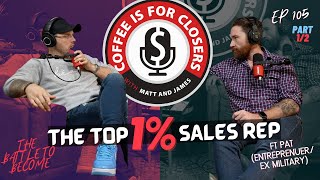
Jeremy and others break down what separates top 1% salespeople from the rest. They critique common sales training programs and emphasize continuous refinement of technique over following rigid formulas.
Hey, guys. What's up? Matt here.
Welcome to another episode of Coffee is for Close. If this is your first time here, this is a podcast all about sales, entrepreneurship, marketing, etc. Etc.
How to be a more successful person in general.
Special guest today is Pat.
Hello.
Hello.
It's my third time.
Is it?
Yeah.
That's very exciting for you.
It is.
It's immensely exciting.
Yeah, yeah, yeah. So what we're going to be talking about today is a little bit of an interview with me.
Um, we're going to be going over how to be a top 1% sales rep. And then Pat's got a bunch of questions that I don't know yet. So that it's, you know, a better way of doing things.
So make sure you, like, subscribe the.
Notification bell, all that kind of good stuff. Stay all the way to the end, and we'll see you after the intro.
If you listen to this podcast, you will make your first million within three years. I'm going to repeat that. You will make a million dollars within three years of the first episode. You listen to. We don't want pikers. We're not here to save the manate. We're here to make podcasts. You really want this? You listen and review. Put that coffee down.
All right.
Inquiring minds want to know.
So I've been sort of scouring the comments section of a lot of this, the media, as is my job.
Yep.
And one of the things that I see like a recurring theme around is, is what does it take to hit that 1% of sales? Like what level you've. What is the secret sauce?
Yes. So there's a couple of things to.
Be a top 1% sales rep. Let's define that. What is that specifically?
Well, I think you would define it as. The easiest way to define it would be income generation.
So I would say a sales rep that can produce a seven figure income.
For themselves, I would say. But even anyone who is able to.
Create high six figures is probably getting close to the top 1%.
However, there are some caveats on that.
As to what you sell.
Right.
Like if you're, you can be a.
Killer sales guy, but if you sort of have pigeonholed yourself into selling fitness programs that are a thousand bucks and you're making a hundred dollars a sale, like you're, you're limited in your, in your income capacity, but you could be like the top 1% of that particular industry, you know, and if you could be a terrible salesperson, but if you sold super yachts and every now and then you just like bumbled first, head first into a billionaire.
Like even a blindfold squirrel finds an acorn every now and again.
Exactly.
Right.
So like, but I would say just.
To keep it easy, it's like the highest earners in their respective industries.
But I think like the highest earners.
In their respective industries would be the highest earners in any industry.
Okay.
Like, that's sort of what it is.
Whenever we post up testimonials of like, hey, I made $70,000 in commissions this month. People are like, what do you sell? And the answer is like, it doesn't matter.
Right?
Like, that's the big, the big common misconception. I think that actually stops a lot of salespeople from becoming really good is.
The fact that they think it's not them, it's what they sell.
Whereas, like, I was doing really well selling, like I was selling $30,000 business.
Coaching programs, but I was only making fifty hundred dollars commission and I would get $1,000. And then if they pass through past like a love it or leave it period, then I would get the additional 500.
And it was only like a 50% pass through rate.
Right.
Because it just wasn't set up that well to hold people.
Sure.
So I was really getting a thousand.
Bucks a sale, but I was selling.
Everyone, you know, and I was making.
Three times the amount of money that the rest of the team combined was making.
Okay.
And it was just because, like, I had, I had much better systems in place. And I think that to get to that upper echelon of salespeople, like, they.
The person has done a couple of things.
One, they have realized that, like, they.
Need to learn things.
So like, you get rid of the ego. The guys who are in that like.
$200,000 range, like early six figures in terms of like commissions. Those guys are the worst. They think they're crushing it. They're like, I'm the greatest on the planet.
And so like, they don't ever kind.
Of release themselves to the process to be able to learn from people who are genuinely better than them.
Okay, so that's a huge one is.
Like going, oh, there's probably someone out here who's really cracked the code on this and I should probably learn from them and like surrender my ego, you.
Know, because the best sales reps that.
I know don't have an ego. Like, I'm obviously, you know, like, probably the exception.
So let me stop you because let me see if I understand correctly that to be in that top 1% of sales, there's going to be two metrics. First would be volume of sales and amount of money you're making. And you would consider that anybody who is in that 1% is going to be ticking both those boxes. So anybody that says, oh, but I sell heaps of product, I don't. It's a very low margin for me. I don't make a lot from it then, but I sell heaps of it and I'm good at selling it. And then there's other people who sell one thing a year but make a fortune from that one sale. Neither of those have the capacity to call themselves as having been that 1% of top salespeople. Because in order to pass through that gate, you need to be able to do both.
Yeah.
Yeah, I think so. And then there's. So there's the element of that and.
Then there's like, you have to kind of surrender and realize that you're not the best. So you're constantly trying to, like you're.
Constantly trying to improve things because you.
Know that it can be improved.
So if you believe that you are.
The God of all things sales and like you, you just go, oh, well, there's no better way of doing this. It's like, well then of course you're not going to progress because you think you've hit the pinnacle. And it's like, well, maybe you have. I don't know.
While you're standing there basking in your own awesomeness, be prepared to watch people pass by.
Exactly right. So there's that. And then I think the other big.
Separator is like the level of professionalism that people come at the exercise with.
Okay, So I think like in the industry that I came up in, which.
Is like the high ticket closing industry, it's been ruined by a bunch of people telling them, doing like biz op style selling, where it's like replace your 9 to 5 in 30 days by learning a high ticket skill.
Right?
Where you can sell people over the.
Phone, they're lay down sales, just come.
In inbound leads only.
You don't have to do any work. You just. People show up on your calendar, you sell them, you make a thousand bucks a call. It's not reality.
So what happens to those people? Right? Because for people who haven't seen me on the show before, like I'm outside this industry and now within this space, I'm just doing the creative stuff, like the actual selling. I don't do it all and I don't know a lot about. So what happens to those people? Because now that I am, you know, with our clients and others, I follow them online, their stuff comes up on my, my feeds, which means I'm now getting the targeted ads for exactly the kind of thing you're talking about. And I see that and I know it to be nonsense because I'm here and I'm amongst the real pros and I see a bunch of random jonos who I have no idea who they are offering to me this amazing lifestyle.
Yeah.
That just I know to be non.
People from the beach.
Yeah.
Right.
Good to go.
So what happens to those people? So I am a guy who, you know, follows Belfort Cardone, you know, those dudes online.
Yeah.
So I'm in the funnel. The ads now come to me and say I can be one of them. Even if it's not them that are offering the service, it's somebody who just, you know, is targeting their followers.
Yeah.
Maximally.
When they are saying to me, you know, for this, I think one of them I saw the other day was only a thousand bucks to do the course.
Right.
Like, and now then I can be selling what happens to someone like that? What actually happens to them? When I click that, which I'm obviously not going to do, then I'm, I'm one step closer into the funnel. What happens? And do you encounter those people very often who have bought that lie and are then like, oh, I don't actually.
All the time.
Yeah, so what?
Yeah, so what usually happens is. Now listen, I think people are responsible.
For their own actions. Sure. Right.
Big boys rules.
Exactly.
Right.
So if they've decided to purchase a product. They've decided to purchase a product.
Right.
So let's just take someone who buys.
Into a biz op, a business opportunity, learn how to sell.
Right.
If they're told that within a certain.
Period of time they'll have a skill set to make XYZ money, I think that they're being lied to.
Right.
So I'm a little bit more lenient with that. But if that's not the case.
But what happens is they'll go into.
A training program, usually from there. Like there's a pretty heavy ascension model.
Right.
If we use.
I won't say any names, but if there's someone that we know quite well who has this model.
Okay.
Right.
You know, red suit and all.
So I was going to say haven't done a bunch of content on that person.
So you come in at like say.
A two and a half K. Right.
Right.
I'll use that as a very random marker.
Right.
So you come into two and a.
Half K. It's a, it's a biz op.
Then from there you're like, okay, then.
What we'll do is we'll help to kind of give you the skills to go out and find a job.
And they have like a performer of.
This is how you approach business owners, you know what I mean? To then go and give yourself a chance to be able to sell, which is fine.
The only problem is like they're not.
Really armed with the skill set to be able to sell.
Like, selling is a very academic pursuit and it requires lots of study and.
Lots of time to get good at.
And like it's a, it's a tremendous.
I think it's very unfair for the individual that's being told that you can go in and sell a $30,000 information product over the phone in an hour quickly.
Like it's a very difficult, you're not selling a car, you're selling an idea.
For a lot of money and they're paying for it up front, you know what I mean? So it is a difficult pursuit and there's so many factors that go into like the quality of the marketing, the Nuel, that kind of stuff.
So anyway, they go into these businesses, then from there they're usually unsuccessful.
Right, right.
And like, it's not even a reflection on the training because I don't believe as I think I'm a pretty good sales coach. I don't believe in that period of.
Time I could get someone good enough.
Now listen, the unicorns of the world exist and there are some people who can go in there quickly, in 30, 60 days, pick it up quickly, smash.
It out of the park and go for it.
But there's probably something in the background.
That we're not realizing.
Like, for me, that's what, that's my story. And I've heard people tell my story.
Because I was randomly in their program.
Right.
You know what I mean?
And it was like, Well, I did.
10 years of full time selling before that. You've kind of left that out.
Right.
So, so then from there then they'll.
Come back and go, this isn't working.
And they'll go, well, it's not working.
Because you're not trained well enough and you haven't had enough accountability. Buy our $10,000 course and then you'll come into our inner circle.
And then from there you can be.
Taught the skill set required in order to really kind of take it to the next level.
So they buy into that.
Right.
Then from There they're still not really that successful. And then they're usually their mindset is blamed.
Right.
Like that is the route that a lot of these guys go down. They go, no, no, no, my training is incredible. Look at all these results. This is you, you have a poor mindset. And for $25,000 I can fix that.
Okay. That's the next upsell. The mindset training.
Yeah.
So, you know, and it's more advanced and it's more access to people and stuff like that. And listen, like, if people want to.
Go through that ascension model, they're big boys and they can make their own decisions.
Sure.
But that's the usual model that a biz op style thing will sell. And which is why like I don't believe in, I don't believe in selling it that way.
Like, I don't think it's a good idea. I think you need to be very transparent with people. Like one of the things that we've done at seventh level is like our marketing is, is sort of leaning towards actually like switching so current salespeople who are in like lower paying industries. Right. Who want to get into that 1%. It's like there are certain industries where there is a faster way to get there.
So what we've done is over like.
The 140 different industries that we train. We've identified the most lucrative ones for salespeople. So then we've set up training specifically for those five industries being high ticket insurance or like, you know, there's solar, stuff like that. So because we've trained the crap out of some of those guys and they're making a hundred grand a month. So it's like what we've done is gone. Okay. You're a current sales professional. You're like, you've been in sales for a while, you're doing okay. You want to learn the skills to then translate into a different industry because that is a pretty big step.
Right.
So learn these skills translate into a different industry. And then from there like you're in a much higher paying industry which will make it easier for you to get into that sort of like 1%.
Sure.
So as somebody looking to, you know, either get into sales or to ramp up their sales game, when you're looking at the type of training that's available, the difference between what is the, the junk and what is actually going to improve their skills, what is that key difference that people can identify? Is it, is it like practice in that there's group training where you actually are interacting with other people that can.
Be good and bad.
Okay, yeah, elaborate on that.
Well, if you're practicing with the other people in the group, it's like not.
Yeah.
Just reinforcing bad habits. Right. And, and yeah.
So like you want to have to coaches. So like I think it's very. I think like all training has its merit.
You know what I mean? Yeah.
You just got to realize what the outcome of it is. Like, so if I go into like a. More like.
Well, the training that we teach and.
The training that, you know, sales sniper and everything is ndpq. It's during miners methodology. It's a very, very methodical way of doing things. Like it's step by step. It's.
And if you, if you compare that.
To like a consultative selling, which is a lot, A lot of the other guys kind of teach consultative selling, which is like the doctor Frames and all.
That kind of stuff, like it's much.
Less, it's much more ethereal.
Yeah.
You know what I mean? It's like they say this, you say that they say this, you say that. It doesn't really help you unless you can memorize thousands of different iterations of individual kind of interactions.
Right.
Doesn't work unless you've just been doing.
It for a long time and then you've just memorized so many different ways of doing things that you can just have that conversation. But that takes a long time.
So what I like is a methodology.
Something that I can learn the foundations of and then that foundation can be built upon.
But they have to realize if someone's.
Telling you straight up that you can like replace your 9 to 5 income in 30 or 60 days, it's a flat out lie.
Yeah, of course.
Yeah, yeah, yeah, yeah.
Something I'm sort of curious about is there's a lot of people who are offering those. I guess one of the tricky things about the sales industry is there's not a lot of evidence of success.
Right.
Like you can show that you have a bunch of money, but there's lots of ways to come into a bunch of money and there's lots of ways to show that you have a bunch of money when you actually have none.
Right.
So there's those couple of issues. And I think what's interesting to me is that like Jeremy for example, has been a sales guy for a long time and everything from like knocking on doors to then selling, it's very expensive stuff. And I think that's what impresses me about the NEPQ and the like the seventh level stuff is that it's. It, it really is applicable to a big spectrum of people in the industry.
It's the only one.
Yeah.
So that's, that's the difference.
Right.
The point of difference of seventh level is and we've been approached by a lot of very, very well known sales.
Trainers as to how like they've offered to buy certain things off us and trade certain information and trade things in order for us to tell them how they've. We've managed to teach people how to sell multiple.
Right.
Like that like and they just, they can't figure it out.
Yeah.
Because they've never sold it.
Yeah.
So the difference is like Jeremy has.
Sold many, many different industries and been.
The guy like he still owns the.
Records for door to door alarm sales.
Right.
No one can touch him.
He is a legend in the industry.
He sold more in a four month.
Period than most guys will sell in three years.
Yeah.
Like I think in a four month period because he used to do door.
To door only during the summers in between like university. So we do it during the off time. And he did something like something crazy like 178 installs in four months.
Yeah.
I mean like that's, that's insane.
Like if you just think of the math involved in that like it's like.
It'S two to three a day.
Yeah.
You know, like it's crazy. So and then from there to transition.
Into more of like he transitioned that into event sales. So he was selling very high ticket events over the phone and then he finished in B2B debt relief.
Right.
So this is like large B2B calling big companies doing debt consolidation.
So like you've got like a door.
To door cold calling sort of background of selling like very, very face to face intimate. Then you've got large high ticket event sales which is a very emotional sale. And because it's events on how to learn to make more money. So it's kind of a biz op but sort of B2C and then you've got very high level B2B.
Right.
So there's just not that many people.
That have had the same methodology the whole way through.
And you know it was funny like.
We asked him to go hey, because we're going to do a bunch of stuff on objections. And I was like can you do an objection thing? And he's like yes, sweet. I've put together and scripted out the top 50 objections.
I was like man, I can think of four time money.
Think about it partner. I was like what else is there? And he's like this is this.
And it was like, all the nuances.
And I was like, oh, you've been doing sales for 30 years, man.
Yeah, yeah.
Like, you know, or 20, 25 years.
And I was like that everyone else.
In the game, like, just didn't have that long of a sales career. So he was full time selling for like 17 years or something. And that's how he made his income. And he earned $33 million or $36 million over that. Over that period.
And like, you know, the dudes never.
Hasn't made less than $2 million a year since he was 25 years old.
Yeah, right.
You know, and that's just straight commissionally selling. And there's just not many dudes who say that. And everyone's like, what did he sell? It's like, well, he doorknocked alarms, man.
Yeah, yeah.
I think. And that's what's interesting in that you hit the nail on the head from my point of view is that I see a lot of people selling B2B. Like, they. They just do B2B and probably make a ton of money and maybe really good at it. But how effectively they can train someone that's selling a $100 product, like, you know, to. To many individuals multiple times a day.
Yeah.
Like, how applicable is that?
Yeah, and it's. It's the understanding of sales process as.
Well that he's like.
So he's taught me a lot of.
That stuff, which is why I've sort of good at it.
And I've got that dialed in for.
Like, that sort of sales sniper kind of like the height. Like, I've nailed that.
Right.
But like, I was talking to him.
I remember a couple months ago, I was like, hey, man, I'm struggling with this account. He's like, let me go. Oh, you're selling this wrong. I was like, what do you mean? He's like, this isn't this. And I was like, ah, okay.
Because it was a little bit outside.
Of the wheelhouse of what I've normally.
Done, is that you got to remember these factors.
I was like, so he just kind of redid in two minutes and redid the process and was like, just change.
This here, do this here, have them.
Talk about this here, and then do your pitch like this. And I was like, oh, sweet. And then boom, the account triples, like, overnight.
When was that?
Probably like three months ago.
Okay, so. So he. So Jeremy's like the mack daddy of 100%.
Yeah.
But you're at king dealing. Like, you're. You're right. Up there and he's still blowing your mind on.
Oh, yeah. Like, I forget how good he is at it because, like, I mean, God.
Love him, but he's ridiculous at everything else.
Like, we went to.
We went to the ballet when I was over there with him.
Right.
As you did. Like, he forgot the tickets and took.
Us to the wrong place. And I was like, this is so Jeremy.
Yeah.
Like that.
And it ended up working out. But anyway, it was. It was just funny. Like, that's just kind of how he is.
Right. Like, he's a true savant level.
And, like, we're having a discussion the.
Other day, and I was like, jeremy, I need you to do X, Y, and Z for this, this, and this. And he's like, well, can't we get. I was like, mate, no one else in the world can do this.
Yeah.
I was like, you are the only.
One, as it stands right now, that can fix that problem. I was like, so either we either don't fix the problem or you do it. Which one is it?
Yeah.
Like, I'll adjust either way.
And it's like, I've only been doing.
Any PQ for three years, and I figured it out pretty quickly. And I can translate it through multiple industries and I can coach people on how to do it, but nowhere near to the level that he can because he's just done 10 times the volume of sign that I have.
And I made an active decision to be.
Like, I don't need to be as good as him.
Yeah.
There's no reason for me to be. So amount of training I'd have to do would be ridiculous.
So let me put a flag in that. And I want to come back to it, but continue as we're on the path. He as a mentor and a coach and guide, like, to someone even at your level, that can still kind of shock you when you're stumped by something. And he can just like, here it is.
Yeah.
How many people in the industry capable of that? Kind of.
No one. Yeah. Okay.
There's no one.
Like, well, I mean, maybe there is.
I just don't know them.
Like, I'm sure there is.
Like, there's got to be some other gurus out there.
But it's the, like, the guy. The big guys that I know of.
Like, a lot of them really cut their teeth in one industry. Like, Grant was a beast of a car salesman.
So most of Grant Cardone stuff is.
Actually very car sales.
Yeah.
So, like, their largest B2B division is car automotive.
Yeah.
So.
And that's where they're really known. Bradley as well. Same thing as car automotive. Belfort was Belfort. Phenomenal.
Like, savant sales level.
Right.
But is so good.
I don't think he systemized it as well.
Okay.
Right.
Like the straight line persuasion model.
I think it's great. I've done the course. I actually really like it, and I think it's a very good model of selling.
But it is a.
It is a model. It's not a method.
It's not like, as. It's not as dialed in and, like.
Really meticulously thought of.
And the big difference was, like, Jeremy is so meticulous.
Meticulous about it.
Like, he obsesses over, like, where to.
Put the pauses and why.
And so, like, for him to write.
A script, it's like, literally nine hours to write a script. I bang them out in 20 minutes.
Okay.
They're just not as good, but they're good. And then we kind of like, let.
It play out over time, and then I'll just make the adjustments instead of kind of like sitting down for nine hours and thinking about every possible iteration that could happen and then wording it in the correct way once we just kind of, like, let it play out, make adjustments as we go.
But. But like, so when. When. When he started, because he has a.
Human behavior background in university, so the.
The way that the reason why an EPQ works so well is like, he actually went to his professor and was.
Like, I think sales has been taught incorrectly because everything that he was learning from all the sales guys and all the books was completely counterintuitive to what he was being taught in his human behavior classes.
And he was like, this is so weird. And it's just serendipitous that you get.
A guy doing both at the same.
Time who's looking at the textbook over.
Here and the textbook over. These are not the same thing.
Yeah.
Right.
One is meant to work with, and.
One is meant to be completely combative against human behavior.
And so to, like, to.
To trick human behavior.
Right.
And so he actually asked his professor.
To work with him, and it was like they took it on as a project together to develop a sales style that would work.
Yeah.
I think innovation very often is the merging of two disciplines where someone from one discipline now goes into another and goes, hey, you're doing something stupid. And it's just how it's done in that.
Yeah.
If you remember from when we were in the army, you remember Leica, Like. Like a vector.
The.
Yeah.
I don't know if you're still around, but they. They were demoing a couple of products to us, and we're in there, and I think they're Swedish or Swiss. And so Leica got bought out by an aerospace company, and so they make vectors, so like, laser range finders and, you know, like on the mortar base plate, the positioning system, and that kind of stuff.
Right.
For accurate targeting of munitions. So they got bought out by an aerospace company, and part of one of the pieces of equipment that they had went from being this big and, you know, not man portable to being this big and fits in a pouch. And I was like, what happened here? Because this is. It's always been this and now it's this, but it does the same thing. And she says, well, we got bought out by an aerospace company. And they looked at us and said, oh, you use a spinning gyro. And they're like, well, that's how gyros work. Like, it has to level, and it spins in order to find the level. And that's how you get the. At the GPS fix. And they're like, no, in space, we don't have room for that. We use a vibrating gyro that, like, doesn't. Takes up less space and is less, like. You know, there's a million reasons why, but it was a space. You have to do that. And on the ground, there's no need to do that. Yeah. So the combining of the two, they were like, oh, we've revolutionized this product.
Right.
Because they had people who had not worked together in the past suddenly work together and go, oh, I can help you out.
Yeah.
Which is sounds exactly like what happened to Jeremy in his classes, that human behavior and sales meshed through him.
Oh.
And, like, he literally went. He was the lowest performer to where.
Like, I mean, I don't know if everyone's heard the story, but he was like, my feet were so tired.
And I was. You know what I mean?
Like, this is the whole way he does it, but it's all true.
And he sat there after, like, six.
Weeks, and he made, like, one sale. And, like, so I think he worked it out. He was on, like, 18 cents an hour.
Right.
And then by the end of that.
Summer, he was the highest performer.
The next summer, he, like, tripled everybody.
And they made him the head of sales for the whole company.
And, like. And it was just because he sat there and he wrote out all of his questions. And so he had a script that he wrote himself, and then he would analyze after every single interaction, he would go. I asked it in this way.
I got this response. Interesting.
Let's see if I ask it that way again.
If I get the same response, and.
If you can prove that that is how it's done, and you're most likely to get that response, that becomes the.
Way you do things.
And then from there, he just did.
That with every single line of his script. And then he changed his clothing and he changed how he approached the door.
So instead of going up and being like, no, no, he would wear a.
Vest and he would have a clipboard.
And he wore like, the white New Balance shoes. And he kind of looked like a.
Bit of a dullard.
And he'd walk around looking confused and he'd knock on the doors and they'd be like, oh, who is this person.
Who just looks confused, who works at the council who needs a bit of help?
And then next minute they're buying a fully blown, like, security system.
And he carefully just ever changed one criteria at a time, One thing at a time. Yeah, that's the truth.
It's so methodical.
Yeah.
He did that over the course of years. And then even I remember, like, even like in any pig he's been around.
For like 22 years or whatever.
It's been even like six or seven years ago.
He was making pretty big changes like about six or seven years ago.
So it's connection. So in its phase, it's like connection.
Situation, problem, solution, consequence, commitment.
And then. But where he had it was.
He had problem, consequence, solution.
And then he just trialed it still again, making adjustments because he's on the ground doing it. And then he's like, oh, my God.
This works so much better.
Better at that. And so, like, even though he was making millions of dollars a year, he was like, I wonder if this can be better still refining the process, still refining it. And which kind of goes back to that 1%. It was like the constant and persistent refining of his process and then always.
Realizing that the pipelines can dry up.
So even when he was making two.
To three million dollars a year, he blocked out cold calling time.
So he would.
He had a course called prospect time blocking.
PTB is what he would call it. And he had a sign on his door which, like, not even the only.
Other company was allowed to enter his office during that time. And it was prospect time blocking.
And he would turn it over, PTB time.
And everyone knew he was cold calling.
And this is like cold calling, cold calling.
And he's already making one point. We're already making like 3 million bucks a year.
So it's like, if you can imagine.
The way that he broke it down to me was like about half of his leads that he made into sales came from, from the company and then 25% came from referral and 25% came from his own outbound. Yeah, right, right.
So like he was making 1.5 million a year and then still did referrals.
To get another 750 and then still did his own cold calling outreach to get another 750.
So like that puts him in a.
Position where he doesn't need anyone because he could just go to anyone and go, hey, I'll just give me a product to sell. I'll do my own lead generation and he can just go out and do his thing.
And it was like he would call it like the water.
The water cooler club.
And it was like all the salespeople.
That just were like, at one point he was doing like more than everybody combined in the whole company. Right. Like he was just killing the game.
And he was still doing it, still took it seriously.
He got into the office every day at 7am, did his thing, took his calls, did his cold calling, did his referrals, had his small little time for lunch, took his lunch and then was straight back in. And he would see all these sales guys all day going back and and forth, chitchat and going over this. And he's like, no man, I'm here to work.
Yeah, yeah, I'm not here to make.
Friends, I'm here to work.
And then like just did that year.
After year after year and constantly refining his process.
And then like they'd come up to him be like, hey, like, how are you doing this?
Where are you?
And like everyone thought he was getting the best leads.
Everyone, you know, all the sort of self justification.
And again, that's the difference between like.
The top 1% guys is like you can see someone and go like, oh, that's unfair. Or you can go like, man, what are they doing?
Yeah.
And like if I was in that.
Company, I would have gone to Jeremy and be like, I will do your follow ups if you teach me the way I would like to be your pad one.
Yeah, yeah, like, you know, like, like.
Like how can I do?
Well, let's explore that. So we've talked a lot about Jeremy and he, yeah, certainly established him as the expert he is.
Yeah.
And his ability to sell is one thing, but his ability then to have systemized that in a way that can be passed on and taught. So the reason you're into any pq. The reason, you know, you became his business partner and it has become what it is, if I'm using that term correctly. Business partner. I suppose.
Yeah.
So it's become what it is is not because that was your initial exposure and that's the level of training you have. Like, you've done to me some of the courses that you.
I wrote to tons of courses.
Yeah, yeah.
I've done like, I mean, I can name them. I've done like a sales training with.
A guy called Thor, the sales warlord. So Guild over Giles, which was really good. It was very combative, but like an interesting form of selling which I think has some merit.
Uh, I've done like sales mentor stuff.
Which is like Taylor Welch. And I've done Eli Wild stuff. I've done like a guy called Travis Jones. I've done all of his sales training. Signed up with a guy called Andrew Sparks a couple, like, years ago. I did his sales training, which was like a very empathetic sort of emotion based sale. I've done Dan Lock stuff. I've done straight line Persuasion with Belfort.
Right.
So, like, I've.
I've.
I've done a little bit of Cardone stuff.
Not a lot, but I've. I've done it.
I like his stuff.
His stuff is interesting.
Okay. So smashy.
Smashy.
That.
That's the style.
Oh, dude.
It's go in hard and just an objection handle.
Yeah.
And then they buy or die.
I can see how that would appeal to some people, like, who enjoy that process.
Yeah. I don't mind combative selling.
I find it quite funny.
Yeah.
Like, if you enjoy an argument with someone, like, if you verbally spa with people, like, it's fun to do, but it gets old.
Yeah.
And less effective.
Yeah. So, like, the reason why I kind.
Of reached out to Jeremy in the first place is because he was on. He was doing a training for Eli Wallet's group. And I was like. I was friends with Eli Slam. He's a good dude. And I met him and we actually were gonna fly him out to Australia to do an event. We sold all the tickets. It was great. And then covet hit.
I remember that.
Yeah.
It was gonna be a gold coast, right?
Yeah.
We'd sold like 80 grand worth of tickets on everybody. It was a whole thing.
But. And then I was like, oh. And he started talking about this thing.
Called like sales resistance. And I was like, hmm, what's that? I never heard of that.
And I was like, I think at that point in time, I was the.
Personification of sales resistance. I was the most combative salesperson, man.
I was like, I should do a.
Review of like on a podcast from my old calls, man. They are ruthless.
Yeah, right.
Like, are you going to continue to.
Be a drop dead loser, go holic father or what?
You know what I mean?
Like, rough stuff, bro.
And especially in the fitness space, you. There's a lot of room to be mean to people in that space, right?
Yeah.
And then I took that on when.
I was doing the business coaching sales for Tradies, which is what I was doing at the time. And like, they just need to be hammered hard.
But there is, like now, looking back.
Now there's much better ways of doing it right. Where you actually get buying because I have a really high refund rate.
Okay.
Like 30. You could.
You wouldn't let them off the phone until they said yes. And then when they got to the delivery mechanism, they're like, oh, I'm not doing this.
No.
They're like, I want a refund.
I get 30.
Just don't bring out that guy again.
Yeah, yeah, yeah, yeah.
So it's quite funny. But then, so I heard this thing.
And I was like.
And like, I was getting to the.
Point in sales where I was like, I was. Headaches at the end of the day, I didn't look forward to calls. I was like, oh, another one of these. Like, you know, I was looking at the prospects. Like, they're. Yeah, look at these.
That's just a bad space to be.
Yeah.
Like, it's. You can't hate the people you're talking to before you talk to them. Like, that's not fair to them.
Yeah.
And that's just a mind framing thing. Like, because you knew you were going into battle with these people, you had to sort of villainize them before you even meet them.
Yeah, yeah, it helps. And I'm gonna say some rock, you know. So. Yeah. And then sort of we started training.
With Jeremy and like.
Well, like, actually I actually bought his course.
They sort of dropped a link for a course for 1997 and EPK 2.0. And I went through it and I was like, going through it and I.
Was like, oh, oh.
And I must have binged that course like 30 times. Just went through it over and over and over again, over and over and over again.
And I'm lucky that I've done enough.
Testing and adjusting in my life through, like being a sniper that I was like, well, I can't change everything because I'll up.
So I didn't touch My sales call, I just started like I had a two call close. I just started manipulating my first call.
A little bit and making some key adjustments because my. I thought my biggest issue was like getting people to turn up to that second call. Because I was so combative straight away, people would say yes to the second call and only half of them would turn up. It's a real problem.
But then I was closing 80% of.
Everyone I spoke to. You know what I mean?
So I was like, well, I don't that it's closing pretty high. So I was like, sweet, I'll just do that. And then I ended up with like.
An 80% show up rate. And then I maintained my 80% close rate. And I was like, sweet, this is great. But then I had like a 30% refund rate.
Okay.
So then I was like, okay, this.
Is working really well.
I need to know more about this because I was really struggling to put all the pieces together.
So I reached out to Jeremy and he basically sold me over dm. Like I look back now, I would.
I need to try and find those questions.
Like they'll be in my DMs.
Like that goes all the way back.
Right.
But he was just like, well, it was just he.
And he was taking me through an EPQ script over messenger, right? Just using voice notes.
And like then he offered me a.
Call and I was like, amazing. I get to speak to him. This guy's willing to talk to me.
And then he like again took me.
Through another more of the sales process.
And at no stage did I feel.
Like I was being sold. I felt like I was auditioning.
For the opportunity.
The opportunity. Yeah, exactly.
I was like, man, I hope this guy lets me buy.
Give him money.
And I hope it's not too much for me.
That was really the big thing.
I was like, if I can afford this.
Yeah, right, right.
He took me through and I put.
80 of all the money I had.
Yeah.
I was gonna say because you couldn't actually. Well, I mean you, you could, but it was a, a huge impact upon you.
Yeah, it was massive. It was like 30k US, which was like 40k Aussie.
Yeah.
For 12 months of training. And that was four one on one sessions and access to him over like a voice recording.
I was like, oh, that. And I had 50 grand Aussie in the bank. I was like, YOLO.
Yeah.
And I remember going into like the.
Bedroom because I was at nighttime when.
I spoke to him, she's like, how'd the call go? I was like, oh, well, oh, well, so did you sign up? I was like, yeah, yeah, I'm thinking about it, Thinking about it, you know? She's like, how much is it?
I was like, 40 grand. She's like, oh, it's expensive.
She's like, you.
You already bought it, didn't you? I was like, yep, yep, already.
She was like, better work out. I was like, I think it will.
Well, here we are.
Yeah, here we are. So. Yeah. And then over the course, like, I just, like, I. I understood it.
I was like, okay, this makes so much more sense.
Yeah. Okay, so I want to explore that, but let me. So at what point in the NEPQ were you like, oh, this is the one. Like, and like I say, not for lack of having done others and not for lack of understanding others and putting and implementing them. Like, I think sometimes people look at things and go, that's junk. And they don't try it.
Right.
And certainly in my industry, you see people who just a chronic course doers, and they go to every seminar and they go to. They do every course and they don't actually implement anything and they don't understand it of it. So I think your perspective is interesting because you are not that. Like, you've done a lot of courses, but you have, like, explored probably to the fullest extent the capability of the systems that you probably understood better than most what those systems are. And then you explored them, you know, and you, like, actually use them, implemented them, tested the boundaries of what was achievable by them.
Yeah, I had a very hybrid model of selling.
Okay.
Like, I'd taken what I thought to.
Be the best parts of all the.
Systems, and I had created a structure. Like, there were some guys that I.
Trained who are really good at objection handling. So I use their objection healing techniques. There are some guys that are really good at, like, cracking out certain emotional parts. I would use that and I created kind of a hybrid system that worked for me.
Yeah.
But I'd done a lot of testing on it.
Yeah.
So then at what point we like, oh, it's all not wrong, but it's not optimal. It's not the right way. This is the right way.
Yeah.
So I would say, like, I was.
Very cautious about implementing quickly.
And so I think that's probably one.
Of the main differences between people who are successful and unsuccessful is like, because.
You have the two people, right.
They buy the course and don't do it, or they buy the course and they throw everything out they've ever done. That's all they do.
Yeah.
Everything else is wrong.
Yeah, yeah.
It's like, like there's a middle ground.
Right.
So I was like, okay. Like there are some things in my.
System that could be better, but they're very good. Like, I was always very good at objection handling. It comes from 10 years of fitness selling full time. I am very good at handling objections.
Right.
So I was like, I'm not going to implement his style because that will introduce an unknown. But I, I have a known. So I was like, so any of the known elements.
I was like, okay.
So I really tried to adapt.
I really tried to focus on my first call because I thought that, like, there was the lowest risk whilst I'm learning.
Like I wouldn't learn a new style.
Of squatting and then try and do a max effort.
And then I had the opportunity, I role played and I practiced by myself basically because I didn't have anyone to.
Role play and practice with.
And I would ask Jeremy questions and.
I would do my sessions, but I.
Would just sort of sit in my.
Own head and I would read my script and I would just go over and over and over different ways of.
Doing it, but I wouldn't, I didn't.
Change my actual selling like my real live selling until I had done that for time, a long little while.
So let me just tease that out. As someone who's never done it, I don't fully understand that. So you would present like your pitch and you would imagine every objection to it and combat every objection. You could imagine. Like a flowchart that would unveil. Like, if they say this, I'm gonna say this. If they say this, I'm gonna say this.
Yeah, well, it was more like it. It actually was more like, if they say this, how do I get them back to where I want them to be?
Okay, right.
So I think a lot of the, the it's. I guess it's like if you have a dog and you learn a new technique, like, would you run the risk.
Up on your main dog?
Nah.
Yeah, you'd like.
And if you didn't have a secondary dog, you'd probably, well, try and flesh it out. Or you, you would try and put the dog into a situation where you knew that it wasn't up specific.
I mean, in specific terms, my poor dog is the one that gets. But so that on other people's dogs. I know what I'm doing.
Yeah, there you go.
Right.
Okay, so let me see if I understand. So it's not a flowchart, the sales via any PICU or whatever. Method you're using, your hybrid understanding of it.
Yeah.
Is not that there's a flowchart that goes down and you go left and right and whatever, but rather that you're just nudging people back to the path that you want them on constantly.
Yes.
And that path is a straight line between the beginning of the call and the end where they've purchased and your. All your interactions with them along the way are just keeping them on that path.
It's actually a funnel until a certain point where it becomes a straight line.
Okay.
So, like, the way I try and.
Describe it is like, at the beginning.
Of the call, like, we don't know why they're there. So we have to figure out. And the whole point is, like, the whole point of sales is. And the whole point of business in.
General is you're solving a problem.
Right.
That's it.
That's all.
And hopefully in a business, you solve that problem and it's cheaper for you.
To solve it than what it is to charge the client, and that's how you make a profit. That's essentially Business 101, in case you didn't know.
Right.
So. And it's the same with sales. Like, we don't know. Like, we have a solution to a particular set of problems. We have to know if they have.
That set of problems.
So I'm like, okay, what are you here for?
Right?
Like, I'm looking here to get better at sales, make more money, learn how to market, learn how to train, dog, whatever it may be.
Right?
And it's like, okay, cool, I now have that information.
I can now chunk that down a little bit. What are you currently doing to fix that problem or.
Sorry. To get to that outcome. Okay, cool. That kind of makes sense because I.
Want to get like a lay of the land as to what it is they've been doing, because they've been doing nothing. That is some alarm bells.
If they've done everything and it hasn't.
Worked, that's also alarm bells.
Right?
So I'm just trying to sort of.
Get the lay of land so I can figure out where I might need to take this later.
Then from there, it's like, what is the specific problem that you would like.
To solve that's stopping you from getting to this?
Then that's called problem awareness.
Then that's where I can start to.
Shift them into thinking about the problem.
In a more advantageous way for me.
So, like, if somebody. If I sell sales training and somebody.
Comes to me wanting to make more.
Revenue and they Start talking about their marketing.
I'll have that conversation. I can't control that.
So I'd go like, hey, man, like, let's control, like, what we can control.
We're here to talk about sales, right?
So it's like, given your current lead.
Volume, et cetera, if we were able.
To get you a sales process that.
Allowed you to convert more of those, what would you like to get from that?
Right.
But if I'm having the same conversation.
But I'm selling leads and they start talking about sales, and I'm like, well, let's control. We control. Let's worry about getting your sales team.
More and better quality leads.
Yeah.
So if you're able to do that.
Like, what would you like to get from this?
Right.
So it's like, I need to have ways of, like, that's. I don't want to have problems that.
I can't solve because that's going to.
Like, more and better quality leads.
Yeah.
So if you're able to do that.
Like, what would you like to get from this?
Right.
So it's like, I need to have ways of, like, that's. I don't want to have problems that.
I can't solve because that's going to muddy the water, if it will.
And if someone is here and they.
Want to get here and there's a river in between, I need them to.
Walk through the river. But if that water is crystal clear.
Even if it's neck deep, they just kind of walk through it and it's fine.
If there's mud in that water, they're.
Going to walk very slowly, if at all.
So I need them to have a lot of clarity as to what the.
Problem is, what the solution is. And then we help them walk over, then we help them walk through it.
Right.
So it's like I'm trying to chunk that down, then as soon as I get to what they want out of it, boom.
Straight line all the way to the end.
You know, you said something interesting then talking about red flags. Hit me with a yes or no answer on this one, because I'm going to elaborate after. I don't want you to tell me the piece. Have you ever been on a call, known you could sell someone and chosen not to?
Yes.
What percentage? Like this is probably two reasons. First, like, ethically, you know the product's not good for them, but know that you have the capacity to sell them. So I know that you then would be like, I'm not going to put you through this because it's not actually Going to give you what I want to give you. But second, so what percentage is that? And what percentage. How can you identify people that are gonna buy there and then. But again and not like fulfilled. They're not going to pay. They're not going to, they're going to ask for a refund. They're going to pull out. Like, can you identify that? And, and is there another column that I've missed? Like, is there another reason you would call them? You just don't want to deal with them.
You seem like a bad, seem like an annoying human.
Okay. Yeah.
So I don't, I wouldn't know on their percentages. Like, it's pretty low.
Okay.
You know, I mean like, especially if you're like, especially like if I'm selling.
Sales training, like, I'm such a believer in the methodology that it's, I'm not a zealot.
Right.
But I think it can fix most problems, especially if you're a sales guy.
Right.
As long as you're willing to implement it in the way that we tell you to implement it and actually do the work. And part of the sales call is getting that buy in.
Right.
And holding them accountable to doing such things.
So like, you know, but I've had people when I was selling business coaching and like they, they really wanted to.
Go against their business partner or their wife's best, like, sort of like, nah, they don't. They want me to do it. But like, you know, on a fall. But I mean I'm like hand. Like, let's stop and think about this.
Like, I would love the money.
However, I don't want you to turn around in two weeks time and say, my wife's left me because I spent all of our savings.
Yeah.
I was like, this seems like a bad idea. Like, let's work together to get your wife on board or to get your business partner on board. And let's not ruin your personal life for the sake of advancing your business. It doesn't seem worth it to me.
Yeah.
So how common is that as a trait in a salesperson?
I would say very uncommon.
Yes.
This is because knowing you, like I know you, I know that that's probably, that's you. Is there training that indicates that people should do that or is that an ethos held within the industry really at all or is that specific to you?
I don't think it's specific to me.
Because there's plenty of guys here at sales sniper, seventh level, that kind of stuff that, that do that.
And I'm very like and like, so we have a decision tree when it comes, like, objection.
Handling is far more decision tree. Ish.
Right.
And there is a part that I have built into our partner. Objection. Which is like, hey, is this an FYI or a permission conversation with your partner? If they say permission, it goes off to a different decision tree.
Okay, Right.
Which is probe and clarify to make sure that's not right. But then second of all, it's like, okay, let's get the partner on the call because we have to convince them together.
Okay. Yeah.
If it's an FYI conversation, very different.
Right.
First of all, probing, clarify, make sure they're not just grandstanding and trying to be the guy.
Right.
But if it is, and it's like, okay, let's come up with a solution. If it's not a fire, then you don't need to do it.
Right.
So, like, kind of build that in.
I teach that.
And it's like, I also teach you.
Need to, like, we earn our money as salespeople as the cash is collected.
So one of the problems that we have is like, when is like, we.
Had a lot of people selling Inner Circle.
Right.
Which is 15, 18k offer.
Right.
Depending on kind of what you go for. And they were getting the first month of people.
It's like they were going like, well, it's six payments of three grand. And then the people would get two months in, they would default. It's like, well, yeah, man, you're selling someone who makes two grand a month into a $3,000 a month program.
Yeah.
It's not appropriate.
Yes.
The training is phenomenal. That program is not appropriate for that person. It is outside of the realms of what they can realistically spend.
So, like, pick the program which is most appropriate.
If they have $10,000 to their name, don't sell them a $10,000 program.
Yeah.
Like, don't bankrupt people for the sake of selling them.
Like, so go.
Okay, we have a $7,000 program. I can split that up into three payments, three months apart.
Right.
Like, is that. Would that work?
Because then they're actually going to fulfill. So you have to look at it. I was training a guy who had. It was doing sales for a company.
Also the company, but they had a 25,000 and a $10,000 program. And they had a leaderboard as to who sold the most contract value and that kind of stuff. And he wanted to be the top one. I was like, the leaderboard. You want to make money?
Yeah.
I was like, so the commission structure for the 25, you ended up with.
Like a $2,000 commission. But for the 10 you ended up with like a 1500 dollar commission.
Right.
Because the margins are different on the products. And so I was like. Well I was like hey bro, that 25 grand doesn't exist anymore. You only sell to 10.
Yeah, right.
And even if it was like 12.50, it was like. Well I was like. Because the amount of time it takes.
To elapse a 25k deal, it can be 2 to 3 to 4 calls just to logistically because they have to pay in full. So these are have to get funding, they have to borrow it to pull it from their 401k or their superannuation which you can do in the states. Right. Which is a very common practice. Which I don't agree with in sales.
Yeah, right.
And I also as well to go back on that there are funding models.
That I've refused to use at seventh level.
Like we.
I refuse to use credit card stacking and I refuse to use. Everyone gets approved.
Okay.
So there are models in the states of funding where they have everyone gets approved models.
Does the GUI bill cover anything like that?
I'm not sure but I'd like to look. Should look into that actually.
That's some of the. That in the dog space some of the people waste their GI bill on.
And it's like oh God, you can.
Really earn that thing. Like yeah, yeah. Use that more wisely than this.
Absolutely. Not to say that using it in.
University is necessarily wisely, but there are, there are good ways and bad ways to use it.
Yeah.
But like you can have funding models.
Where literally everyone gets approved and it's just like the interest rates can go astronomical. Okay.
And I know most of the guys.
In the industry are competitors. Every single one uses that model. Yeah, that is the standardized. And they came to me and I.
Was like that, that is so unethical. I was like I'd rather not make the sale.
So.
So your decision on like who you sell to is ethics based. Really. But then you see that it has a better throughput by.
Way better.
Yeah.
So you're actually making more money by sometimes saying no to people because. And the reason probably what. What drove you to do that, correct me if I'm wrong, was that you want to close your eyes at night and feel good about your day and.
Yeah.
And know that you didn't someone's life up in doing that. And the happy side effect was that you get a way better.
Tons of referrals.
Yeah, referrals.
Referrals.
More salary they fulfill on the contract. So I remember teaching the guys at.
Like seventh level and all of them.
I was like, stop selling. Always selling the most. Don't always just drop to selling the cheapest because it's easiest to sell my. It's like sell the most appropriate, appropriate.
Package for the person.
Okay, what, what is like, Like I got asked today, can we just sell.
A guy straight to inner circle? And I was like, well, not most of the time the answer is no.
Because like first of all, like, if, if they have, if they don't have.
Any experience in any pq, the questions they ask is not appropriate for an inner circle.
Right?
So it's like they're not going to be a productive member of the community. It's probably going to be over their head. Too expensive doesn't benefit the current members, the past members, the like doesn't benefit them.
Sell them into this. And then it's like, hey, like give.
Them a 30 day, we have a 30 day option where you can upsell and credit.
Okay, Right.
So it's like, hey, if you're into it, like do this for 30 days. If you take all these boxes and you want to upsell, you can, that's fine.
Right?
So we do it, we do it in that way. But I'm always looking for like, fulfillment is key.
Like we have to be able to.
Fulfill on our promise to be able.
To get them the result. So like is doing this the best thing for them?
Because if we, if we do what's.
Best for the client, like, they will, I think it comes back tenfold.
The amount of people that I've said.
No to that sent me a referral the same day is crazy.
Yeah, like, it's crazy. I'd be like, man, I'm going to.
Be honest, I don't think this is appropriate for you right now given all the circumstances. You're going through a divorce.
You've got this, you've got this. I was like, mate, like, let's just park this for two months and I'll.
Book you in with a chat in eight weeks. Does that work for you? And they're like, dude, thank you so much.
And they go, hey, actually for mate.
Who I think would be perfect for this and like set it up perfect.
And in the more combative sales practices from which you've been trained.
Oh, that's not a thing.
That's not allowed.
Right?
Or there's no mechanism for that.
No, no, it's not allowed.
Yeah.
So I, I've taken over a couple of sales teams. Like, because we do. Some of the stuff that we do.
Is like we'll come in and take over the management and training of your sales team.
And it's previously been with one of.
The guys that I learned of who's on the list of people right there.
And it's like they were not allowed.
To stop until the person hung up.
Right.
And it's like I get it if you're selling like books in cold calling.
Yeah, yeah.
But if you're like selling a service based business where like you like there's only so many people and yes, there's a lot of people but if you're in a country like Australia with 27.
Million people, like let's say you remove half of them, right? So you've got like 13 million people and then you're gonna go into your niche. Let's say you've got a million people. It's not that many in Australia. It's a fairly small pond.
Right.
So it's like how many like times do you do that?
And that person tells 10 people what an you are.
Yeah, yeah.
Right.
So all you gotta do is piss.
Off a hundred thousand people.
Yeah.
And you're done.
You're done.
And it's like it also like they'll never come back. Like they had a list, this business.
That I took over, they had a list of like 30,000. They were just constantly calling and calling and I was like, guys, stop that.
They're like, oh, but we have to know. I was like, but you've, all those.
People have told you off, right?
They're like, yeah, yeah.
And I was like, they're not your people, you know.
And I was like, what we're going.
To do is we're going to work on selling in a way that we get the most amount of people to close. But we also create really good relationships. So they give us referrals and if it's not a right time for them to buy now, then they can buy it later.
Later.
Because like I was doing a training.
Today with the guys and I was like people are not pieces of. Because they don't have money.
Yeah.
Sometimes they just don't have the money.
Don't have it.
I've been super broke, like super broke where I like could not afford to buy certain things.
Like for summers I had to borrow.
The cash for my father in law for summer with my 3 year old. Don't know. For the down syndrome test.
Yeah, yeah.
I had to borrow the cash. It was like 400 bucks.
Yeah, you Know what I mean?
And it's like, I couldn't have afforded.
A 10k program no matter how badly I wanted to do it. There is no amount of finagling stuff that I could have done to actually make that payment.
Yeah.
And like, I'm not a piece of. With a bad mindset because of it.
Yeah.
It's just logistical.
Yeah.
Life takes some turns. Hey, it does, man. Hey, I have heaps more I want to tease out of you, but that camera is going to go dead. So we should make this two parts.
Okay, let's do a part two.
If you guys want to see part.
Two, let us know. Comment part two down below. But yeah, we will.
We'll wrap up.
We'll do another one. I hope you guys like this kind of content. It's always fun to chat to Patrice and make sure you, like, subscribe. Hit notification bell. Share this around to your friends if you find it valuable and we appreciate you staying with us. And we'll see you in the next episode.
Bye.
Bye.
You remember Leica? Like, like a vector. The. I don't know if you're still around, but they, they were demoing a couple of products to us and we're in there and I think they're Swedish or Swiss. And this lady, I won't butcher her accent, but they had made this Borg boo boo.





