The Twisted Psychology Behind Every Belief You Didn't Choose
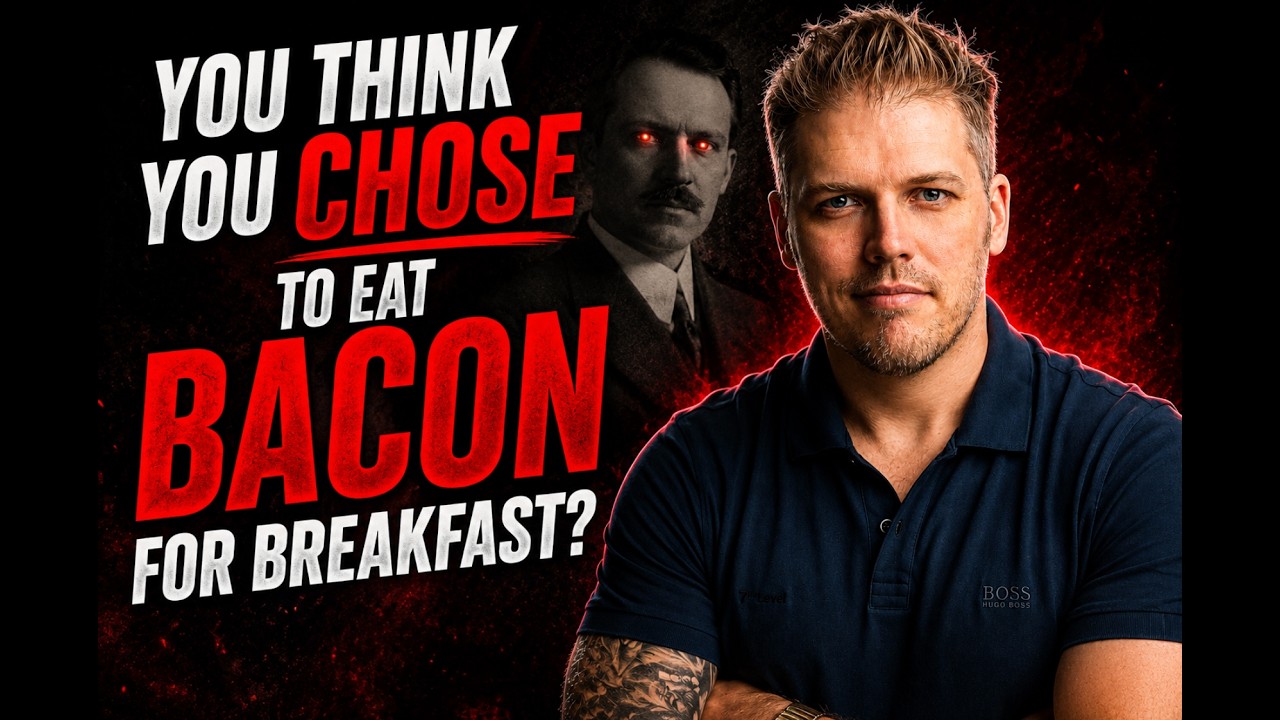
Edward Bernays, Freud's nephew, pioneered using emotions and social pressure to shape beliefs and habits. The bacon-and-eggs breakfast, women smoking as liberation, pink for girls, and the 1954 CIA coup in Guatemala were all engineered through PR campaigns. Repeated stories become indistinguishable from truth.
Chapters
How much of what you actually believe is really your idea? Not what you know, not what you think, but what you actually believe. Most people assume that their opinions, their habits, their preferences were all kind of formed naturally and organically, but history tends to tell a little bit of a different story. I see people in the comments all the time saying like, "Ah, this wouldn't work on me," and like, "I would just say that guy to this guy," and like, "Those sales tactics wouldn't work," and whatever. And it's funny because I could just ask them a few simple questions like, "Do you think that bacon is a breakfast meat?" "Do you think that pink is a girl's color and blue is a boy's color?" They would answer Answer without hesitation, "Well, yes, of course." And then they would go back to their day thinking that they're immune to the influences of the world and go back and doomscroll and buy whatever Mark Zuckerberg puts in front of them, thinking, "Well, you know, I'm too smart for that." The uncomfortable truth is that some of the most successful sales and marketing campaigns in history, they don't sell products, they change behavior, they change culture, and they change the entire generation's consideration of what normal is. The scariest part of the whole thing is that most people don't even realize that it's happening and actually think they're immune. And those people a lot of the time are actually the most susceptible. Today, we're going to look at some of the most influential persuasion-based campaigns that the world has ever seen. And we're not just want to understand how they worked and why they worked. We want to understand something far more important. What I want you to take away from today's video, that when you understand human psychology, you can shape the way that people think, the way people feel, and the way that they make decisions. And often without them ever realizing where the idea actually came from. So I want to start off, okay, with a little bit of lay of the land. So I want to talk about a guy called Edward Bernays. This guy was kind of a scumbag, but he was also a bit of a genius. And he's one of the most influential human beings that's ever lived. And you probably have no idea who he is. Okay. Bernays is often called the father of public relations, right? He was a fixer. He was also the nephew of Sigmund Freud, founder of psychoanalysis. Horrible person. And overall bad guy. But while most advertisers took time to focus on products, Bernays focused on something much more powerful. He was far more into the human psychology element of all of this. He believed that people were not nearly as rational as what they thought they were, which is definitely true, and that most decisions were not made through logic, and that they were made through emotion, identity, status, fear, belonging, and social pressure. Okay, so I'm gonna say this again: they make decisions through emotion, identity, status, fear, belonging, and social pressure. Okay? In other words, he thought that if you could understand what people wanted to feel, then you could influence what they did. Unlike kind of most theories, Bernays tested this over and over and over again, and some of the things that I'm gonna take you through in this video that you think are just complete social norms were engineered by a single person. And the only reason why you think that pink is for girls and blue is for boys is is because you were told to think that. And the only reason why you have bacon and eggs for breakfast is because you're a good little boy. Okay, good boy. We're gonna take this nice and slow and nobody's gonna get hurt. The first one I'm going to talk about is actually not an Edward Bernays one, but I want to start with one that is not very well known. I only know because I've heard the people talk who are actually part of it. And this is the Pass the Courvoisier campaign. Courvoisier is a large Hennessy. It was owned by a company called Diageo, and they had So much of this stuff backing up because nobody would fucking buy it. Okay, I don't know if that's because it's trash or whatever. However, the CMO of Diageo at the time was trying to figure out a way to sell Courvoisier, and he happened to be at the same place as a very, very prominent producer at the time, and they were talking about his problem with selling Courvoisier. He said, "I reckon I can sell that." And so he said, "Okay, like, what do you want for it?" He didn't want money. What he wanted is a huge party sponsored and thrown for his wife, private jets, unlimited alcohol, all kinds of madness, sponsored by this huge company Diageo, which owns hundreds of alcohol brands. And then from there, he would figure out how to sell all of the backlog of Cavossier, right? And they did a handshake deal inside of a limo, and then, uh, the party was done. It was like a $6 or $7 million party, huge thing. About 2 months later, Pasta Cavossier came out. Pasta Cavossier was just a marketing campaign for Cavossier because it was very influential, it was catchy. They actually had different alcohol in mind at the original outset of that, of the creation of that song, and they had the song mostly done at the time. But then this producer and Busta Rhymes, they changed it to Courvoisier, and Courvoisier flew off the fucking shelves like you wouldn't believe. And it was all because of this song, and that song was engineered to be a marketing campaign. It wasn't that the song came out and it just happened to work. It was that the song was the marketing campaign. So marketing and persuasion go much deeper and are much more deeply rooted into what we do on a daily basis, because everyone remembers that song, like, "Pass the Courvoisier," right? Like, It's just a giant fucking advertisement for that particular alcohol, and there was a payment made for that. The only reason why you fucking drank that back in the day, or anybody drinks that shit now, is because of Busta Rhymes' song, and it was written as an advertisement, okay? One of the more interesting ones that goes back to Edward Bernays is that, like, bacon is a breakfast meat. In the 1920s, bacon sales were struggling, they were down, and Bernays worked with a pork company and commissioned doctors to endorse the idea of a healthy breakfast. Back in the day, like, people would have, like, cigarette coffee for breakfast, okay? And so they created the traditional American breakfast, which is still to this day when you go to like any diner in the US, it's going to be bacon and eggs, okay? This was just a marketing campaign. There was also another part of this marketing campaign which was a good wife cooks their man bacon and eggs for breakfast in the morning, which was like an ancillary to this to get the wives who are usually in charge of the purchasing to go out there and go, well, I want to be a good wife. And in these scenarios, like, women are more easily manipulated when it comes to retail stuff. Men are more easily manipulated when it comes to other stuff. But when it comes to marketing campaigns and like retail type stuff, like, there are more strings to pull with women than that, and there are more strings to pull with men and other things, right? This next one is specifically for women, and there's, there's sort of a couple of those examples that I'll go over, right? But it's very interesting to see, like, when you know what people want to feel, then you can make them act, okay? If I tell the wives, hey, in order to be a good wife, your man has a traditional American healthy hearty breakfast. Breakfast is the most important meal of the day, which again was a fucking marketing campaign that was made by Kellogg that didn't exist before that. The only reason why you say that and think that, same as 8 glasses of water, that was a fucking marketing campaign. All of that's nonsense. It's just made-up gobbledygook by marketing agencies, okay? So like all these things that we think we know that are ingrained, that we're like, this is how we do it, most of that is just social conditioning and social pressures through marketing and persuasion campaigns. So the hearty breakfast basically was just a long-term engineered campaign to buy more bacon, and now bacon is like one of the most profitable and best-selling pork meats that is around. One of the next really, uh, interesting ones: in the 1920s, women smoking in public was considered socially unacceptable, which is a problem if you sell cigarettes, right? And I'm going to do another little aside to cigarette one, which is really interesting, after this. But you can see how, like, when you understand the problem, like, you don't just They're not just going like, "How do we sell more cigarettes?" It's like, "No, how do we make it cool to buy cigarettes? How do we, if it's socially unacceptable, like, how do we change the stigma?" Right? And this is fucking genius, and Edward Bernays called it "Torches of Freedom." In the 1920s, Bernays hired women to smoke cigarettes during the New York Easter Parade, in framed of the right to protest. Right? Newspapers covered it as a liberation fucking movement, and smoking in public became synonymous with female independence. Do you understand how incredibly interesting and persuasive that is? Like, the fact that they, through going like, "Okay, we like, we want to sell more cigarettes. Well, we're fucking tapping men out because you want to be cool, smoke cigarettes, whatever." You know what I mean? And it's like, but it's socially unacceptable. Women can smoke at home but not out in public. They will smoke twice as much if they can smoke in public. Okay, cool. 'Let's hire a bunch of fucking smoking hot women who look really cool to smoke in public as a form of protest.' And it's like, 'I'm an independent lady who don't need no man.' Meanwhile, Edward Bernays is telling you to fucking smoke in public, so you go Lungbusters and you get fucking lung cancer so you can look cool. The commercial objective was disguised as social progress. As another aside to that, there was a company called Lucky Strike which had a very particular green, and they came to Edward Bernays and they said like, 'We are struggling to sell our cigarettes. We want to sell more of them. So what he did in his infinite genius is that the green, he— it was like an emerald green. So instead of like, again, going after trying to take market share, trying to like push features and benefits, what did he do? He went to the big— I think it might have been like Macy's or something like that. They threw this big bowl. He basically made New York green. So he turned green into the coolest color in New York for women. So like green dresses, and like they had a green bowl, and and like out the front of like Macy's were all the, like all the displays, right? They were all green and it was Lucky Strike green. And so then women started buying Lucky Strike green because it was cool, and then they could have matching fucking cigarettes to their outfits, which was the color of choice. And speaking of color, blue is for boys and pink is for girls. Most people assume this is kind of the always it's been. Historically, pink was often associated as a masculine color and viewed as a stronger version of red. And blue was frequently associated with girls. In the mid sort of 20th century, retailers standardized gender colors because it increased sales. Gender-specific clothing, uh, parents bought separate boys and girls things, and entire industries were formed around genderized marketing. That was not a thing before the mid-20th century, and if anything, it swapped. And it was just because the marketing, uh, engine that decided to do that first decided that pink is girls and blue is boys, even though it was switched. And it was is probably a market disruption tool. But the only reason why we think that is, again, because we were told to and it just became a social norm. And it's social pressure, like you'd be weird now to put a little boy into a pink outfit. You'd be like, "What are you, fucking raising a gay or something?" It's all well and good, like it's, you know, it's unfortunate to be called gay if you wear pink clothes or whatever, but it's not as bad as what Edward Bernays did next, which resulted in the murdering of around 200,000 people. So some of you may have heard of this before, but it's called like the Banana Republic. So in the late 1800s and early 1900s, the predecessor to Chiquita Banana was the United Fruit Company. For some reason, evil companies always have like United Fish Company, United whatever company, like it seems like that's just an evil corporation name. They were selling so many fucking bananas that they became extremely influential and basically started a civil war through Edward Bernays. What he did is he started the Chiquita Banana Revolution, essentially is kind of what it's talking about, like, or like the Banana Revolution. But in the 1950s, Guatemala elected President, um, Arbenz. Arbenz. Jacobo Arbenz. I don't know, I don't fucking know how to say his name. And basically what he did is he— there was tons of land that had been bought very cheaply by the United Fruit Company, and then they were farming it and paying people basically fucking nothing, which is why bananas were so cheap and they were making so much profit. What happened is that this guy came in and said, this is bullshit, we're renegotiating, we're going to take back that land. If you want to buy it, you can buy it for market price, because the United Fruit Company had paid off the previous administration to buy it for super cheap and give under-the-table payments to him so he could get rich, right? And exploit the people. Classic kind of dickhead move. So when this new guy came in, he was like, no, this isn't happening, we're reneging on this, we're going to go back through. They thought this to be communism, right? This was kind of the, the lens. So Edward Bernays created a marketing campaign that turned a governmental land issue into a freedom fight against communism to convince the world that they were protecting people from communists and not just ensuring profits. The land reforms would take kind of this land, redistribute it back to the people, and United Fruit owned enormous amount of that land, which would then like create massive issues for them. So what ended up happening is United Fruit fought back very aggressively using Edward Bernays as their kind of head of PR, and they lobbied politicians in Washington, they ran public relations campaigns all over, and they portrayed the Guatemalan government as communists. And this is during the Cold War, And there was nothing worse than a communist in the Cold War. Like, nothing worse, okay? So in 1954, because of all this social pressure, the CIA backed a coup called Operation PB Success. This is all true. Which overthrew the government in Arbenz and installed a pro-business government. Historians kind of debate as to the motivations, but it's pretty clear and widely accepted that, like, the United Fruit's interest was a major factor. Now, the coup itself went pretty quickly. Right, because the CIA was running it. And it didn't, like, result in maybe hundreds, maybe a couple thousand deaths, but it created so much instability in the country that there was then a civil war that went for, like, 35 years, and 200,000 people died. This wasn't just a marketing campaign. This is, like, corporate influence and public interest and social pressures by going, "Look at these fucking communists." and our bananas are too expensive. So we're gonna create a completely farcical made-up scenario where these people are now fucking communists that are, that are, we need to fight the Red Scourge, right? Remember that? The Red Scourge? And then from there, they, uh, you know, ended up resulting in hundreds and hundreds of thousands of people dying. It's a fascinating thing that it's like, the United Fruits' challenge wasn't like, how do we sell more bananas? It was, how do we make protecting our business interests look like we're protecting democracy. The company and its allies, they successfully reframed the dispute over land and the Cold War and the battle against communism, which was one of the more kind of persuasive stories in like all of American politics and also public relations of all time. And that's why like many people consider Edward Bernays, he's probably one of the most influential people ever to walk the planet, because he's the reason why you eat bacon. He's like the reason why cigarettes are fucking cool, right? And there's so many other stories about the things that he did, but marketing is such a— is such a hugely influential thing, and it correlates one-to-one for sales. Like, diamonds are not rare. De Beers is the one that holds giant vaults worth of diamonds, and diamonds are forever. Diamonds had nothing to do with love. Diamonds are not that expensive, right? They're fairly common throughout the world, and they should not be that expensive, and the only reason why we— remember the whole 3 months on a ring? You should spend 3 months' salary on a ring. Like, that is the thing that De Beers released. Santa Claus was a depiction that Coca-Cola made up. These are all like things that we have been sort of impregnated with over social conditioning and over time. The people who changed the beliefs, they didn't have better products, they had better stories. When a story is repeated enough times by enough trusted sources it stops looking like persuasion and starts looking like reality. So the next time you feel a certain something and it's like, "Well, that's just the way things are," like, ask yourself, "Did I discover this, or did somebody sell it to me?"





