Ask Me Anything (AMA) Supply Chain with Maciej Kaniowski
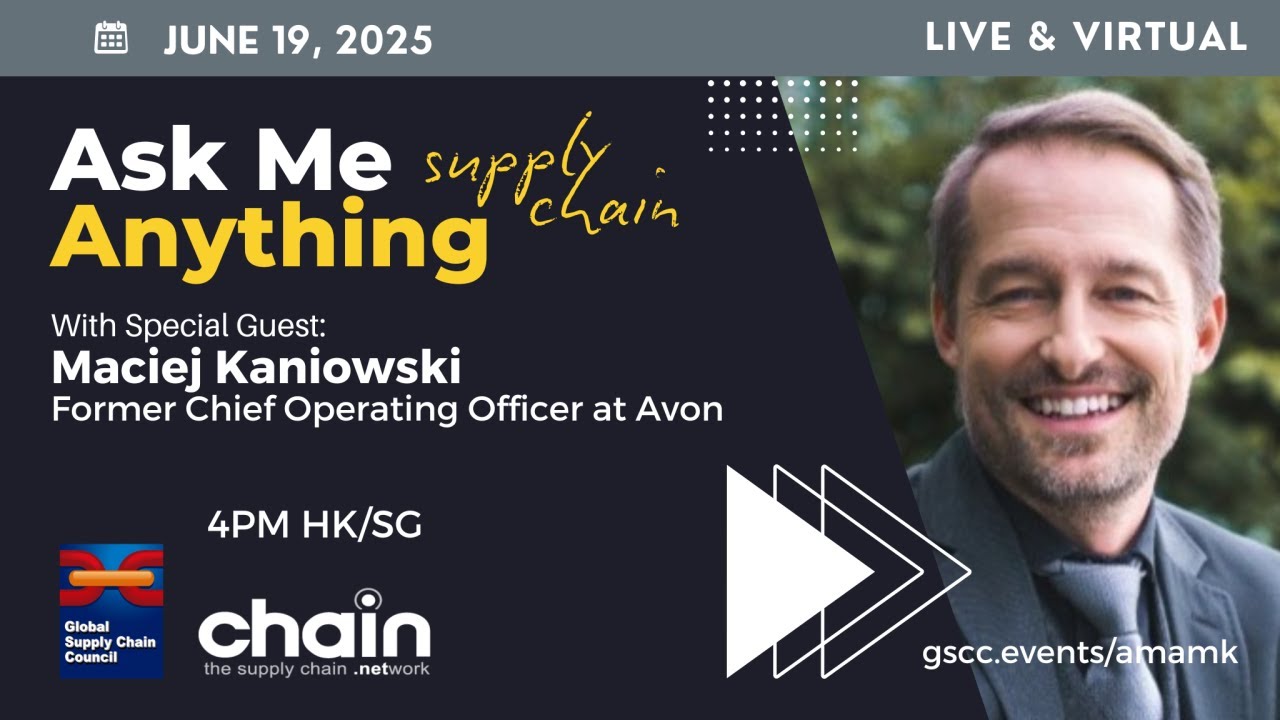
Maciej Kaniewski, former COO of Aevon and Chief Supply Chain Officer at Avon, shares 24 years of supply-chain leadership experience. He argues supply chain now shapes pricing and product strategy, not just logistics, and that leaders need to be "Renaissance" individuals combining business acumen with cross-functional curiosity. He stresses ownership, clear communication across shop floor to boardroom, and embedding AI in a real digital roadmap.
Chapters
Welcome to this new session, Ask Me Anything Supply Chain, together with our guest Maciek Kaniewski. We're so very welcome again to have you joining us from all over APAC, the Middle East, and some people also joining us from Europe. My name is Max Henry. I'm the founder of the Global Supply Chain Council, and we're very again very pleased to have you all joining us for these very exciting sessions where you can ask your questions to a supply chain leader. And so today we're very pleased again to have Maciej Kaniewski, who has been the Chief Operating Officer of Aevon. He's going to be ready to take all your questions, and you can ask them by clicking on the question mark located at the bottom of the screen. So feel free to ask anything, of course anything related to supply chain, and we will take your question as they come. But before I get started, maybe I'll have to get Maciek to maybe quickly introduce himself. And Maciek, maybe we can— you can maybe take us through your early career journey and maybe tell us what did you study and what drew you into the world of operations and supply chain.
Good afternoon and good morning to anyone from Europe. Max, this is great to be here. Thank you for the invite. I'm a fan and I respect what you do in terms of trying to share the best practice, the learnings, the reflections to the broader supply chain community. This is, I think that in current times that are so turbulent, this kind of activity that you provide is very respectable and very valuable. So once again, thank you for being here.
Thank you.
And I'm a big fan of the Ask Me Anything format. I have 2 kids. My son is 8, and this morning before I asked him to go for a walk with his sister and his mom, he looked at the screen and said, "Hey, ask me anything." Does it mean that they can really ask you anything? So I'm wondering whether he will be joining from another device to ask me the questions that he was not comfortable asking at home. Anyway, great to be here, guys. In terms of in terms of career. Career path. I'm Polish. I come from Poland. I have lived in a couple of places around the world, and I will not bring the juicy story of studying philosophy and ending up in supply chain. I actually did study at the university supply chain. My first studies were at the Warsaw University of Technology, mostly focused on industrial engineering. And then manufacturing management. Then I moved to Sweden and concluded my university there, also related to the field that we are discussing today. So I have been in this field for some years, including education. And in the early days, I was fortunate enough to land with a fantastic company, with Mars, Starting as still very young and very aspirational, high potential, so to speak, at that point of time. And this is the moment where only looking back, I realized how important and how valuable it is to end up in a nourishing environment, working with people, in this case, my line managers, my bosses, who are so much more mature than I was. And who were able to sustain this aggressive youth that joined their company. I started actually in an interesting way. My first post was logistics, local logistics, warehouse management, and warehouse reconciliation. But then I actually moved to sales. And after sales, I moved actually to marketing. All of this was luckily preconceived. It was not a random move, but it was something that absolutely opened my eyes to the world beyond supply chain and the interconnectedness that is absolutely necessary to run proper supply chain jobs, to have experience elsewhere, simply put. I've stayed with Maersk for 13 years. Being lucky or being again fortunate to move from smaller jobs, more detail-oriented jobs, to strategic ones, including network management. I had a chance to run a factory. I had a chance to run IBP. I had a chance to run supply strategy. And these were my Mars days. Fantastic culture, fantastic company, very, very independent from short-term spikes and troughs. And after 13 years, I changed the environment completely. I moved to work with private equities. So this was a shocking experience, shocking in a positive way as well, but also in terms of challenge. And after 5 years with private equities, I returned to a corporate world at Avon, but already equipped with a very different both mindset and toolkit. than I left Mars with. So I've been fortunate to be in the supply chain for more than 20 years now. I keep telling 20, although it's already more like 24. And the last post at Avon, I've been Chief Supply Chain Officer at Avon for 3 years. And the last year was actually extended with responsibility for Avon's transformation office, which was yet again, a very interesting extension to the job and operating in the realm of actual chief operating officers that do need to combine both supply chain savviness and operational savviness with understanding of business and the impact that each element of business needs to bring, especially for the company that is under heavy transformation.
Okay, so if you're just joining us, because some people are still just still logging in, I want to remind everyone that this is going to be an interactive session. Feel free to ask questions to Maciek at any time by clicking on the question mark, and then we'll be happy to take your questions. Maciek, looking back at your early roles, what were some of the defining moments that shaped your approach to leadership in supply chain and operations?
Probably the first one that stayed with me for so long until today actually was building and running a greenfield factory. And I was still very young. I was still very young. I was promoted to plant manager when I was 27. So you can imagine this is on one hand very attractive and I was utterly happy for it. I was pursuing this opportunity. On the other hand, this is clear that I didn't have the wisdom necessary to run an operation, even if the factory was not massive. But still, it was greenfield, it was chaotic, it was very ambiguous. And to make matters either more interesting or worse, it was the only factory of this particular technology in Mars. So we did not have any proper benchmarking in terms of neither technology nor how to run a place like this. And why this is meaningful? Because probably this was the first moment when I had to understand through experience and through living the pain and success that I transitioned from individual contributor to owner. of the team outcome. And it comes with all the consequences of owning the outcome, regardless whether this is a success or whether this is painful. And we did have some painful moments. I think this was very meaningful to remove me from this youth perception or young perception of appreciating process, appreciating pressure, appreciating individual savvy and acumen. to understanding that running supply chain is so much more and is so different from what I actually learned during my many years at university and first years at Mars.
What do you think makes a modern supply chain leader today? And what kind of skills or mindsets do you think are essential today that maybe were not, you know, when you first started? 20, 25 years ago?
Well, I do believe that we are going through a relatively seismic shift. But this conversation probably needs to start of, you know, what do you need supply chain for in a company? And this kind of rudimentary understanding that supply chain is necessary to deliver the products more or less in the right quality, more or less in the right quantity, and more or less at the required time. Luckily, this is already a thing of the past, and I do still remember where supply chain jobs were considered relatively narrow and relatively hidden. Today, I believe that around the world, that supply chain breadth is much more significant. It goes from performance through risk management, through orchestration of your vendor ecosystem, through sustainability, and probably recently also with the additional stress point of understanding much more both business and value creation that can come either from supply chain or broader, and understanding current drastically dynamic landscape. Geopolitically, I would. I do believe that we will get to the point where additional thing that comes on top of everything is will be probably related to science because technology is already there. But probably we are not there yet. So I would say first of all, I would like to see supply chain leaders to to extend much greater understanding of business and value creation. Value creation is not about savings per se. I would love to see people who can operate as healthy personalities in environment of greater momentum and greater amplitudes. I would love to see people who are, let's say, this kind of Renaissance people who are willing and actually hungry to learn things not necessarily related to supply chain. And probably the most important is I don't believe that we need heroes for a day and fools for a lifetime. I do believe that without sounding too cliché, that the world actually, and especially corporate world, will benefit greatly from leaders that we could describe as wise, not only as smart. And I think that supply chain is a fantastic training ground to actually develop wisdom.
Okay, thank you. I see your dog behind running around. What's the name of your dog?
So look, this is— this dog is uncontrollable. I cannot remove him from this little room because he will be very persistent in getting back in. His name is actually Joker.
Joker, I think, you know, he's interested in what you're saying, definitely. All right, so I just, yeah, I put up some, I'm starting to put up some questions because there are already some questions from the audience. And this is the first question that Shantanu has for you. So he's asking, or he's saying, how important that supply chain function sync with marketing, and how do you think marketing experience adds substantial value to the supply chain function? I think it's a good one.
Yeah, I think it's a good one. And I have seen and heard marketing and supply chain being put into 2 very distinct corners of the ring. This is not true. So first of all, marketing has many faces. It encompasses both branding and creation and creative and portfolio management and RGM. So let's say more advanced profitability, but also marketing is drastically related to overarching purpose of the company that needs to be— or not only purpose, but the strategy of the company that needs to be coherently transferred to the offering for customers. Also, good marketing stays close to customers. It's not only sales job, it's marketing as well. And let me put it like this. First of all, when you navigate and innovate portfolio on the portfolio angle, cooperation between supply chain and marketing is critical because we do have different perspective on portfolio development. And we need to learn to make trade-offs going both ways. On the other hand, marketing uses massive budgets for both creative part, but also for external innovation, for external development. And this is where close cooperation with procurement kicks in. Putting it bluntly, it's the procurement team that should be able to understand the services market. Around us and be able to offer to the marketing colleagues better and better. And by better, I mean more profitable, more effective, more breakthrough options than marketing themselves. Um, on, on, on yet another angle, I quite often look at supply chain as a function that could be called a modeling function. It's definitely not a back office function. It's either considered core or can be considered modeling. Modeling in a way that any strategy that needs to find— that is supposed to become successful needs to be implemented. And who better than operation guys to understand the constraints, the lead times, the tweaks, alternatives for implementation? So cooperation with marketing actually starts very early in terms of product development cycle, but also continues when the product is already on the market and needs to be serviced, so to speak. I hope that this response can be helpful.
Yeah, thank you very much. Thanks, Chandan, for your question. Let's move on. We have more questions and they're starting to pop up now. I see also, Yuan, I think you asked a question in the chat. I would appreciate if you could actually click Click on the question mark and copy your question so we can then display it for everyone to see. Let's move on to the next question from the Q&A. This is a question from Yanisa. What was the hardest part of leading operations at Avan during the transformation? Any sleepless night story?
I love this question. Thank you. So first of all, The question is, how do you define and how do you live your leadership principles? Uh, what, what is it really about when you try to lead a function as significant as supply chain or operations? I use these 2 words actually interchangeably. And sleepless nights are necessary. Sleepless nights are something that should not be avoided. It should be controlled. How many do you have? But I do believe that sleepless nights are necessary for any self-respective, respecting leader. Uh, the hardest part is when you create— for us in AivenOps was when you are building a winning team and where you are building a winning organization. So to speak, facing nonstop headwinds and very challenging commercial performance. It goes against everything that operations or typical standard operations like and appreciate because, you know, we, we like volumes, we like long runs, we like stable portfolios, we like stable branding campaigns. We like good and non-volatile relationship with sales guys. When you are in the transformation for the company that tries to reinvent itself and drastically change both operating model and operate and business model, this is probably the hardest part that you operate in the world of headwinds that are not supply chain related. And how do you transition your team to actually embracing this? And carving out the way of creating value for environment that will 90% of the time offer you bad news. This was the most difficult part, but also this was the most meaningful when it worked because it's, you know, it's something that I will always remember and keep with me, how phenomenal team can operate under any set of circumstances and actually enjoy this. Even if things are, well, going against the grain.
Okay, thank you. All right, thanks, Yanisa, for the question. Let's move on to the next one. Um, all right, so someone is asking, do you think supply chain leaders should get more involved in commercial decisions like pricing or product strategy?
Absolutely, absolutely. I do believe that it, it comes, you know, it comes with responsibility. That supply chain leaders need to understand more and more how to contribute to these kind of decisions. Because painting the supply chain perspective is one element. I would say this is the basic element. But there is advanced and expert level as well, where you can actually have a proper partnership conversation about the topics in question. And this is a requirement and need for supply chain leaders to be proficient enough to actually partner in discussion speaking business language, not speaking supply chain language. To be very precise, in terms of pricing or product strategy, we can contribute to pricing, for example, to dynamic pricing with a very close link between pricing and availability. This is where the real value is being generated when supply chain leaders and supply chain teams can contribute, can cooperate with pricing teams or sales teams on a real-time basis to actually adjust pricing based on availability or to make trade-offs related to margin protection from global standpoint. This is one element. The other element in terms of product strategy here, uh, here the topic in question is actually profitability and cash. And depending on the company, these 2 components will not be equally worthy, so to speak. For us, I used to prioritize cash and the whole sourcing matrix, sourcing strategy has a major impact on cash. So I do believe that we need to not only be present in the rooms, but actually contribute to those rooms with with visualization of consequences of particular pricing/product strategy choices.
Okay, thank you very much for this question. All right, says more coming in, so yeah, we can get ready for more. Okay, so this question from Aisha was asking, what's your take on AI in operation? Real value or just more buzzword we need to pretend to understand?
Absolutely real value. And to turn it from buzzword to application, I do believe that we need to move away a little bit from using just a simple word of AI, because AI is— this is an umbrella concept. This is an umbrella concept that has many, many, many subsets below that can find an actual application into real supply chain life. So I'm a big believer that technology that is based or rooted from machine learning, from neural networks, from heuristics, etc., happening in real time, this is something that brings fantastic real-time value. It's not a buzzword, but the thing is, when you construct your when you construct your digital roadmap, so to speak, and I believe that each one of us should have one, regardless of whether this is very complex, very advanced, or whether this is easy. What I found useful, and I was fortunate to cooperate with Zero100 on our digital roadmap, was the clarity of what are the biggest wins and the most applicable tools and instruments from the, let's call it, AI space or digitization space that for this particular company, for this particular period of time. So I do believe we need to get educated and probably faster than we are. Some of the world examples of what is possible through proper advanced simulation, through proper advanced what-if analysis, through sensitivity analysis, and through autonomous or automated and then autonomous planning, for example. These are eye-opening examples that create immediate value. If we can, obviously, if we can be able, if we are able to introduce those capabilities onto our legacy systems and not break doing so.
Do you think that the current supply chain leaders, so I'm referring again to people who are people of your age, you know, who have 20 plus, 30 plus more years of experience in supply chain and logistics or procurement, actually realize how impactful AI or GenAI will have on their job?
I believe that it's— you need to look at— I think it's worth looking at this like at any probabilistic distribution. There will be people who understand it perfectly. There will be people who don't understand it at all. And there will be the massive middle ground. that knows that something needs to be done. I do believe that— let me share my own example. You know, I feel I consider myself still not old, and I still have a long road ahead of me. But when I participate in proverbial AI trainings, either for very basic use of productivity tools for my own benefit. Or when we talk about supply chain applications, I feel like a dinosaur. The level of change is just unbearable.
Yeah.
And I do believe that this is worth putting work into, not only to understand and become more proficient, but also to understand the consequences, because I do believe that we underappreciate the social consequences of rapid development of digitalization that we are experiencing right now. And what we used to discuss in terms of how the world will look like in 2 decades, right now it's much more probably prudent to talk in how the world will look like in 5 years, and it will look very different.
And I think you're right. I think probably the hardest part in adopting AI today is to keep up because changes are happening so fast. And it feels like things are— everything is accelerating. So as a supply chain executive, I think it's, it's really hard to stay updated and to keep going with all the changes happening, right?
You are right. And, and, and I think this is yet another learning for actually for every leader, but in this case for supply chain people, that we do need to remember that this is not an individual exercise. And we are not here to become heroes. We are here to become better, smarter, wiser leaders, which means that with this level of development or pace of development of technology, our dependency on working, employing, working, and being able to support people who are clearly smarter than us in this particular field, this is a skill to master.
Yeah.
You know, I used to say proudly that my head of planning is a guy who is a head of planning, is better at planning than I am. And the person who was a head of manufacturing is better at manufacturing than I am. And I felt comfortable doing this because I still was able to have a meaningful conversation with them about the function, about merit, Now, when I think about talking to the technology person that is skilled in machine learning, in networks, in AI in general, I'm not that comfortable anymore because this conversation needs to be shaped differently. I need to be able to, let's say, ignite the retrospective and the thinking about objective and heavy reflection work. Because I will not be able to functionally ignite priority setting on the technological level. But still, we need to catch up and we need to do it together with our teams.
Okay, let's move on to the next question. There are more coming in, so let's go for the next one. You will see it on the screen. All right, so, hello, Maciek. What type of help Will decision makers need to create a sound strategy in the face of high levels of volatility and uncertainty? Good question.
I think it's a very valid question. And this was, hello, Maciej. I wanted to respond with, hello, anonymous, in this case. Strategy is obviously a heavily overused word, and the definition varies. Yet let me offer you a particular distinction between 2 types of strategy. One of them is usually called this kind of static primary descriptive strategy. This is something that our, our teams and decision makers try to come up with, model, visualize, to be put into practice later. There is a second part. There is a second type of strategy that is called emerging strategy. I think this was— this is the proper name. And this is the adjustment or variation or deviation from the original one that is happening relatively quickly from the induction of the first one, of the initial strategy. So within the first 1, 2, maximum 3 years, this was— at least this was the case in the past. Now it's probably within 2 years, no more. And basically, there are no companies that would be successful with the primary strategy only. It becomes increasingly obvious that we are talking that the success comes from emergent strategy. So basically from rewiring the current ones based on initial experiments from implementation. And this would be my answer to this question, that the levels of volatility the amplitude and, um, and the number of factors to be considered is, uh, so great that on one hand, while we can offer visibility— and I think this is the great value, to offer visibility of hardcore results and drivers behind those results— that we should not attempt to create a perfect strategy. We should attempt to start executing as soon as possible on the strategy that is drafted. Because the majority of learnings and majority of improvements will come from early implementation, not from extensive period of thinking, even if done by smart heads. And unfortunately, in the past, we used to— I believe that we used to find more comfort in designing a great strategy that would take months and then moving into implementation very slowly. I think that because we have moved from probably major— not majority, but more and more problems that we face are not complex, are not complicated problems, are complex problems. And there is a difference. We need to revert the sequence of steps. It's not about preparation and implementation. It's about action, testing, preparation, and rollout. And you can imagine how uncomfortable it is to start acting in the high levels of ambiguity, but I do believe that for— and research actually supports it— for complex problems, this is your way forward, not the other way around.
Okay. All right. Thanks for the question. Keep asking. We're still going to be here for another 20 minutes. So if, again, if you have a question, for Maciek, go ahead and click the question mark button located at the bottom of the screen. So let's move on to the next one. All right, so it's coming up. Okay, so curious if you ever had a big transformation fail and what you learned from it. It's a question from Nadia.
Well, define big. I've had— I can safely say that I've had I've had fails in any job that I had. The question is how heavy or how fatal they were. And what I can say is that, well, usually the failure is not fatal. So you should not worry about those. But if you let me, because you asked me, Max, in the early part of this conversation, you asked me about the early days. So let me bring a fail from the early days, from our greenfield site. What was amazing is that we started on time, on budget, and by on time, I mean to the day. To the day, including the very, you know, a visit of very important people that came to visit the factory on the first day of its operation, actually. Which is a rather risky approach to greenfield, but hey, it was successful. So you can imagine that the team was excited. The team was, well, highly tired, but very excited and very sure of ourselves that we can do it because the track record today was like this. After first month of operation, we had a quality failure. We had a quality failure that stopped us. completely for some time and required. You can imagine that on learning curve, our capacity and throughput was not too high. Basically, our quality failure made us reproduce 50% of the volume that we have managed to produce to date. This is quite a failure and an early one. Even if something like this proved not to be fatal, neither for my career nor for my team, I think nothing is fatal. Other than that, I would point out to one of my jobs in private equity where the transformation itself was not a failure, but the parameters of the business that we have worked through versus initial assumptions were so much worse that for anyone looking from the outside without the, I would say, internal context, this could be considered a massive failure because the numbers were nowhere close to where we wanted to get through the transformation. Despite the fact that the whole transformation happened, it was successful, it, let's call it, worked, but the outcome was so miserable. That it was, it should be considered a failure for many different reasons. What I learned from this, I learned from these guys that guys as listeners, it's great. I would say it's indispensable to doubt your choices, to doubt your performance, but never doubt yourself. I know it sounds like a cliché. It's not a cliché when you live it, that very few things in life are fatal and the transformation issues or bigger mistakes are not one of them. So doubt your choices, learn from them. Don't doubt yourself that this is a failure of you as a person, of you as a learner, of you as a leader. This is probably very painful learning point.
Okay. All right. Thank you for the question, Nadia. Let's move on to the next one. This is a question from Yuan who's asking, what's your definition of strategy?
Well, this is such a theoretical topic and we could spend hours talking about this. So let me give you— I know.
Just in a few minutes.
Let me provocatively answer with a very different perspective, because while I do believe that strategy in itself, so ability to shape the direction where we are going and the tools that we will deploy getting there, is important, let me use my favorite quote, which says, in theory, practice and theory are the same. Yeah. In practice, not so much. So if there is any doubt on your side whether you should invest more time in developing the strategy or into implementing it, go for implementation. This will always yield greater dividends because it's not many companies failed miserably because they missed a big strategic shift. Of course, we all love the examples of Kodak, you know, proverbial Kodak and so on. But believe me, the research shows and the practice shows that strategic misses, misalignments are much less frequent than leadership dysfunction that makes you omit things and not act on the signals that you see already. And spotting the signals and acting on the signals does not necessarily mean that you have to rewrite your whole strategy. Your strategy becomes much more emergent and becomes a flowing process, so to speak. a fluid process or the rolling process, not once in 5 years exercise.
Okay. All right, let's move on to the next question. Thank you, Yuen, for this question. Keep asking Maciek and then we'll take your question as they come. All right, my next one is, leading global teams across so many cultures, any tips on not getting lost in translation?
First tip is to accept that you will get lost in translations many— in translation many times. So what helps? First of all, acceptance. Not only tolerance, but acceptance that if we run global supply chain, the cultures will significantly differ. The sensitivity to language will significantly differ. The propensity for follow-up, the propensity for action, the embedded principles of action and feedback will differ greatly. Well, maybe not greatly, but will differ. So there was a great quote from Mike Krzyzewski. He's NCAA basketball coach for many years, a Hall of Fame guy. And he used to say that you don't have to like your team, but you have to love them. And what he meant by this is understand them deeply. So the tip would be, first of all, don't hesitate to understand your teams deeply. Understand that whatever your aspiration is, both in terms of business outcome, but also in terms of ways of working, that are comfortable to you. Regardless of this, what the aspiration is, you have to meet your team where they are. And they will be all over the place communicating very differently, acting very differently. I can only say, don't shy away from setting up the set of principles that you want to stay true to. And By principles, I mean not rules. Rules are too tight, too rigid. Simply principles. One of the principles that we had in in Avon operations was a very powerful one: was you never walk alone, and it was understood slightly differently, or implementation, so to speak, execution was understood differently in country like Poland. In country like UK, in country like Philippines, you can imagine people coming from very different backgrounds and cultures used to think differently about this very simple acronym of why of you never walk alone. If you stay true to this, if you explain your behavior occasionally, if you explain your thinking behind why. And you don't proceed to changing your principles every year, but you keep them with you for the extended period, this will land. So first of all, accept, accept that your team is all over the place. Listen to them very carefully. Adjust your communication. I had to adjust my communication, and sometimes successfully, sometimes not. But supply chain leaders or supply chain people are actually well equipped to practice speaking to the shop floor and speaking to the board. On the other hand, speaking to supply chain and speaking to marketing and speaking to customer. This kind of 2 axes, this is super valuable environment where you can actually practice being much more sensitive to cultural differences that, or nuances that many other people could miss.
Yeah, that makes sense. Yeah, thank you very much for the question. Let's move on to the next one. Question from Therese: when building high-performing teams, what do you prioritize first? Mindset, skill set, structure, or something else entirely?
Thank you, Therese, for this question. This is, you know, this is my favorite topic, so I'm just trying to process in my head right now how to answer in 3 minutes, not 3 hours. The high-performing team, to enable high-performing team to emerge, and I consciously don't use the expression to create a high-performing team, because high-performing teams, they emerge. They are not— they can be supported, they can be designed, so to speak, but never artificially created from the outside. So what do you need? First of all, you need clarity what kind of high-performing team you need, what this team will have to develop. And let me, let me tell you that what you need, you need something else entirely. You need people, you need grown-ups who want to behave like grown-ups. And this is slightly different than mindset, this is different than skill set. Let me, let me offer you an example of when I recruit. I look at 3 things. Obviously, I look at skill set, the functional savvy, which includes both business and supply chain skills, particular ones. I look at how this particular person would fit within the team in terms of, let's say, overall values that we express. And by express, I mean not talk about but live by, so to speak. For Avon Operations, for example, these were only 3 values. It was ownership, it was action, this propensity for action, and working together. And the third thing I look at is actually how I will have to adjust in cooperate in having this person in the team with the rest of organizations. For some people, I had to be the one who operates as a snowplow, so to speak. For some people, I had to operate as the one who will smooth the waters because the person in question was strong enough to, you know, ruffle some feathers. So to speak. So when you want to think about building high-performing teams, start from what kind of team do you want to have? What kind of skills will you prioritize both in terms of character, but also in terms of obviously functional? The topic of structure is completely separate. You need to adjust the structure for velocity. That's it. And structures should be considered very fluid. And the greatest learning for me, the more people who want to behave like grown-ups, who want to take responsibility and who expect responsibility and ownership from others and are willing to share, to share themselves, not only their performance, the greater the team is.
Okay. Thank you very much for this question. I think that's the last question, but I have a final question for you, Maciek. And maybe we can wrap up with this. What advice would you give to someone who wants to move from a functional leadership role into a broader, you know, CEO or transformation role? And what do you think they should be doing now just to get into that role?
Right. So first of all, let's use some of the verbatims that we already had during this conversation. First of all, Doubt your choices, don't doubt yourself. I've seen many supply chain leaders self-victimizing and putting themselves, you know, in the— at the end of the food chain, so to speak. This is unacceptable. With this kind of approach, there is no need to move to a more exposed, more senior role. The more senior the role is, the more it's expected to bring impact and influence The business, not the supply chain. So first of all, don't doubt yourself. Second of all, continue, continue your ability or develop your ability to be able to speak to shop floor and 10 minutes later to speak to the board. What it means? It means functional and leadership mastery for the shop floor. And by shop floor, I— by the way, by the shop floor, I can also, uh, I can include in the shop floor category also a customer, for example, customer service people and customers themselves. So basically very detailed feedback, right? For the board, you don't need leadership, you need strategic savvy and strategic savvy is developed by talking, reading, testing, experience, experiment design, and trying to communicate. And of course, some people call it storytelling. I, I don't, I don't necessarily resonate with this term, but any senior supply chain leader or any senior leader needs to be able to combine factual conversation based on data. And this is probably what comes easy to us with ability to craft a narrative because we underappreciate our audiences. Our audiences, especially the senior ones, are really not interested in the process of how we arrived at the conclusion and how much heavy engineering work went into development of particular either a strategy or tactics or whatever. They are interested in understanding whether we under— whether we have the narrative of value building, value creation. So if you are able to tell your story through the perspective of value, and if you can do it in 5 minutes, this is a good sign. If you can do it in 3 hours, this is unacceptable. My— I can, I can jokingly say that my shortest conversation with board was 3 minutes, and I can tell you that 3 minutes is enough to highlight the direction of supply chain for a global company.
All right, thank you very much, Maciek. It was great having you. Did you enjoy this AMA? The questions were okay for you today?
This was, this was great. Thank you, thank you. I just, I just hope I didn't digress too much and you got some value out of these guys.
No, no, it was great. And I also want to thank all the audience for those fantastic questions that we had today. It was definitely a good talk, a good exchange on many different topics, many of them related to more leadership and, you know, and the role and your experience that you had. So again, thank you very much for being with us. And again, if you missed part of the discussion, no worries. The replay will be made available tomorrow on the chain.net platform. So, you know, No worries, you'll be able to rewatch the discussion if you missed part of it. Thank you very much, Maciek, and again, we look forward to seeing you again at our next events. We'll definitely invite you at the other discussion that we had, and it was great having you. All right, so thank you very much.
Thank you, I enjoyed it.
Okay, thank you, and we'll see you next time. Thanks a lot. Thanks, everyone.










