Interview with Richard Barter, Founder & CEO at Replan
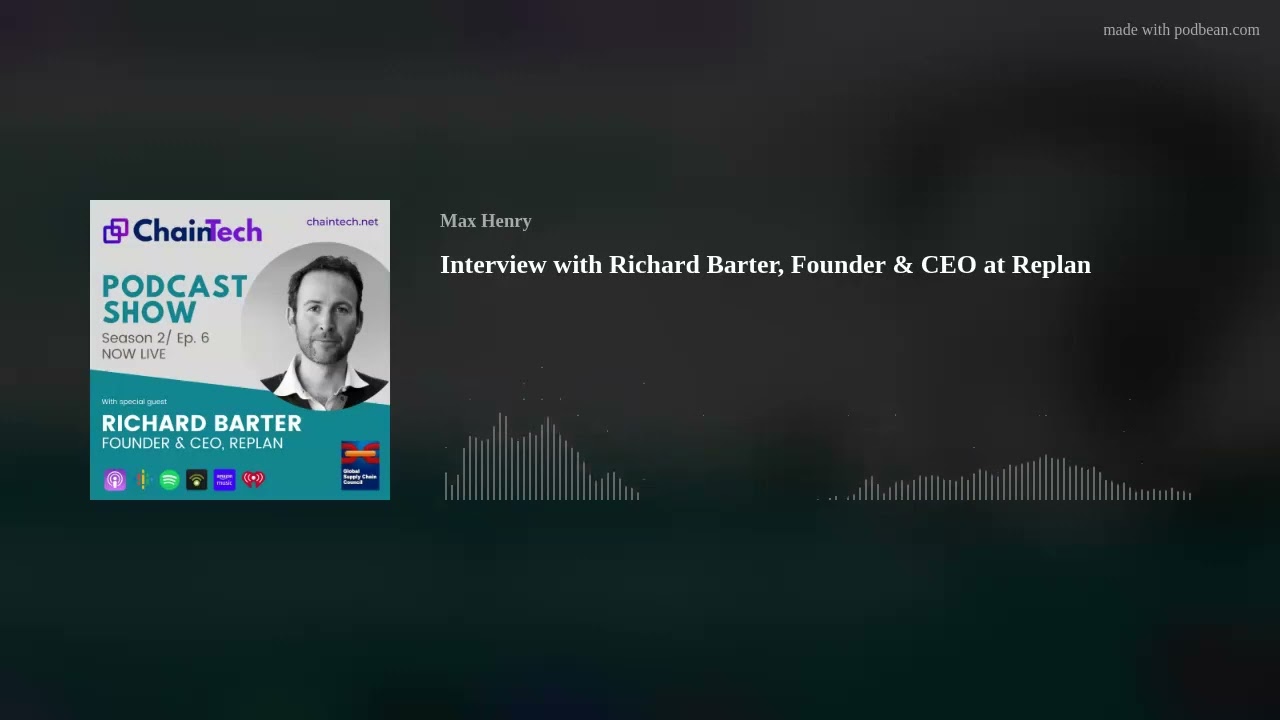
Richard Barter, CEO of Replan, built a cloud platform for factory scheduling after pivoting from e-commerce automation. The company uses AI optimization to fix the broken handoff between master planning and shop-floor execution, targeting food, chemicals, and life sciences across Europe and the US with a fully remote team based in Cork, Ireland.
Chapters
Welcome to ChainTech, the show and podcast focusing on the latest trends in supply chain, procurement, and logistics technology. My name is Max Henry from the Global Supply Chain Council, and together with my co-host and special guest, we explore the personalities, startups, innovators, and industry players driving disruption in supply chain. From early stage to unicorns, And from cutting-edge technology to the people using it to help drive more innovative, agile, and resilient supply chains around the world. This is ChainTech.
Hi everyone, welcome to a new episode of ChainTech. My name is Max Henry. I'm the founder of the Global Supply Chain Council, and I'm glad that you're joining us again for this new episode. I want to thank, you know, all of you for joining the show. As we know, as you know, we on an ongoing basis try to interview some interesting founders and discuss the rapid rise of supply chain logistics and procurement technology around the world. As we jump into today's conversation, I also want to make sure that you are aware of our ChainTech platform that we, you know, we have, are managing and trying to grow. You can also find the previous episode of the ChainTech, you know, show By just visiting gentech.show. So today we am I'm joined by Richie Barter, who is the founder of WePlan. Hi Richie, how are you?
Hi Max, great thank you. Thanks very much for inviting me today.
Okay, so as we always do, I like to get started with you a little bit on your background. Maybe you can share with us just let's start with the basic where you're from, you know where are you based and running the company, and maybe also give us a little bit of. background information about, you know, what did you study and what was your previous jobs before starting Replania?
Yeah, great. So, I'm from Ireland originally, grew up in Cork, which is a great manufacturing heartland for many large manufacturers around the world. Cork Harbour is one of the largest natural estuaries in the world. So, there's a lot of shipping there. So, I grew up looking at a lot of factories and shipping, which was always Uh, kind of piqued my interest. Um, currently living in Lisbon in Portugal, um, moved down here with my family a couple of years ago and we, you know, I run the company from here. Um, Replan, my business, is a fully, you know, distributed online company. So we were able to do that from wherever we want. Um, in terms of my background, um, so I studied originally a double degree in business and languages in the University College Dublin in Ireland. Followed that up with a master's in finance and accounting at the London School of Economics. And then 10 years into my career, I went back to university and did a master's in software engineering at the University of Oxford in the UK. And that was sort of where I took a lot of the nascent coding skills I had from working on the trading floor of a bank and turned them into some real understanding of systems and systems theory. In terms of my career progression personally, So I finished my master's in finance and accounting at LSE, ended up working in the City of London for close to 10 years, had various numbers of roles predominantly in Standard& Poor's, the rating agency, where I was doing a lot of sort of technical analysis of complex debt products. And then transitioned from there into HSBC, which is obviously a very well-known brand in Asia. Worked at HSBC in Canary Wharf on the financial markets side. Love that time, learned so much there around how data was used to make decisions and drive automation and, you know, underpins a lot of what I brought into building this business. And then about 13, 14 years ago, I decided that I wanted to transition out of banking. I, as I said, went back to the University of Oxford to study a software engineering degree and at the same time started this company. which we bootstrapped for the first 5, 6 years until we focused in on supply chain. Okay.
So what actually motivated you to start Replan? What was the trigger for you to start this company?
So I, there was some personal reasons around, I looked at my trajectory career-wise in HSBC and kind of felt that Um, as part of an organization that I think at the time was 250,000 people, that I wasn't really going to have a huge outsized impact on my own. Um, and so I wanted to, you know, start something a bit smaller. I come from quite an entrepreneurial family. My father just turned 79. He retired when he was 78 running his own business. Um, and I also have uncles and aunts and cousins who are all super entrepreneurial as well. So there was kind of a bug in me to do something a little different. I didn't really know what I was going to do, but I was taking those learnings from the trading floor where, you know, billion-dollar decisions are made on the data. And then oftentimes the algorithms are relied on to make the decisions without the human intervention. And I thought, well, there must be an opportunity to bring that kind of capability to other organizations, to other businesses. And so at the time, it was, there was a seminal paper from McKinsey It talked about big data. It was really early in this sort of data science AI wave that we've been on for the last 15 years. Cloud computing was really only getting started as well. And I thought all of these trends together, there was, there was an opportunity to build a product technology company that could really deliver outsized impact to organizations that use a lot of data. And over the years, we've refined that, we've invested in the platform, we've raised a lot of money. And we came to the supply chain space probably 4 years ago, identified this problem in supply planning, and really were able to bring all of those combinations of skills, process automation, distributed computing systems, cloud, advanced algorithms, AI, together into this one product. And I'm super proud of what we've developed and really excited for where we're going in the future.
So initially, Replan was mainly focusing on financial. Your clients were mainly in the financial sector.
Actually, it was the exact opposite. So the joke I had at the time was the last thing I wanted to do was leave a bank to go back selling software to banks. I think that was a pretty well-trodden path and I felt it was a little clichéd. So weirdly, we started in the e-commerce sector. We had eBay as an early big customer.
Oh, shit.
We were doing complex process automation for eBay around different tasks they had. We expanded that then. We did ultimately do work in financial services for some insurance companies. We worked with some oil companies, the UK government for a while, but ultimately we started working with a manufacturer in the UK called Hovis Breads. And Hovis had a legacy SAP environment at the time, and they had some automation challenges around their production planning and scheduling. And it was our first glimpse into industrial manufacturing at scale, our first understanding of some of the challenges that manufacturers face. And it was really exciting to see how far that industry could travel and how far it had yet to come at that time. And it was, you know, it was an easy bet for me to make to say, right, we're going all in on supply chain. We're all, we're going all in on production planning and scheduling.
Okay, that's interesting. So if you could just tell us in one sentence what Replan is doing and, you know, more specifically in the supply chain space.
Yeah.
Yeah.
So just to introduce you to Replan. So we're a software vendor. We're based here in Europe, but we have global presence. We streamline and simplify complex supply chain planning that makes S&OP and S&OE processes more intelligent and responsive. It's a cloud-based SaaS. If you're on our LinkedIn this week, you'll see that we're available on AWS Marketplace as of this week. And despite decades of focus on supply chain solution, we felt that the industry needed a fresh look at some of the older unsolved problems. And that's really what we've set out to do.
Okay, so you're basically trying to disrupt the existing crowded market of supply chain planning tools. So what are you doing different with the, you know, in comparison with the other existing players right now in the market?
It's very true. It is a very crowded market, but it is still an extremely fragmented market. And we can talk about the market structure if that's of interest. But I think when we were talking to manufacturers and customers, we understood that although a lot of work had been done on what we would call replenishment planning or master planning, which is breaking up demand and spreading it out over your network and where you're going to produce it, when you drop down to the facility level, that handoff between planning, scheduling, and execution or operations on the actual factory floor was broken. Rough cut capacity plans were being handed down to schedulers that made little or no sense in the context of the real problems they're facing in terms of what lines could do what, what human resources they had, what raw material they had, what demand they were trying to fulfill, the fluctuations in all of those elements as they get near to production. And there just was a lot of instability occurring. So what we came to do is say, well, how could we take the capabilities we have around product building and AI to capture all of those planning situations that a scheduler would typically capture in those last 1, 2 weeks of a production planning horizon? And scale that up out as far as manufacturer needed. If it's a pharmaceutical company, they may be planning 5 years out from a tactical perspective because some of the bets they have to make. If it's a food and beverage company, more likely 12 months or maybe even 6 months. But because of the algorithmic complexity and the processing challenges you get as you go out in time, you need to have very sophisticated approaches to modeling those planning situations that give you a single plan, a plan that runs from a year out all the way to week zero when you're making things. It's not that that plan is inflexible, but that it's capturing those constraints and those operational realities way further out. And the things you get from that— better raw material consumption visibility, better labor visibility, better bottlenecks in service, better ability to engage your customers, better understanding at the post-production stage what needs to be downstream of that in terms of distribution planning and so forth. And if you can get that that plan, that one plan at the heart of your manufacturing at a facility level, right, everything else starts to become much more resilient and effective across the supply chain. And every, every single manufacturer we speak to has challenges here. And what we feel is that Replan as a tool at the heart of the manufacturing problem makes all of these challenges a lot more effective.
And that's something that companies like SAP or Blue Yonder or even Anaplan are not providing today.
I think when you think about who we compete with in terms of, I'll come back to what those other vendors are doing. I think there's a lot of what we see is kind of Excel or do nothing where they've left these core systems and they're trying to manage some of this complexity away from those sort of advanced planning and scheduling technologies. I think we see the ERPs sometimes being used there as well. And we, sort of struggle with organizations where they feel the ERP should stretch down into this very niche space. And I rarely see that working. We see some custom solutions, either homemade in, you know, Access databases or other, you know, relatively small solutions. And then there's kind of a competition, coopetition kind of thing was what we would call it with those bigger vendors. So they've spent decades predominantly focused on the very, very, very large global manufacturers, you know, the 20,000+, as Gartner would call them, the, the, the, where there are huge networks of manufacturing. And this master planning resource allocation problem across that global network has been where they seem to put a lot of their effort. And what they've done as a trade-off is not really focused on the individual facility planning and scheduling to the same degree. Many of those products you mentioned have strong scheduling capabilities. So particularly SAP PPDS, which is bundled now with S/4HANA, but traditionally came with SAP APO, has a really strong scheduling capability. But a lot of the horizon challenges further out from that weren't as well, you know, catered for in previous iterations. And so we, you know, we augment and extend some of the capabilities provided by some of those tools, or we replace some of the less effective methods applied by other manufacturers.
Okay, so I understand you're targeting manufacturing companies. Do you focus on specific sectors or industries within the manufacturing space?
So there aren't particularly any limits from who we can address. But as a small organization, we're quite focused in our go-to-market motion. And so we kind of break the world down into discrete versus process. Most of our focus to date has been on process manufacturing. And we sum that up in 4 key industries: food and beverage, consumer packaged goods, chemicals and life sciences. And we see the same kind of complexity in manufacturing, sensitivity to changeover costs, downtime, high SKU variation, high packaging variation, multi-level production, floating bottlenecks up and down the production chain. You know, there's a common snack food product that we all know, it's 9 levels of production to model what's actually happening from raw material to finished good in a box. And being able to reason over that at scale is a really valuable thing for a manufacturer to do. So those are, those are the segments from a, from an industry perspective. From a geographic perspective, we're predominantly Western Europe and the US, but we are growing in Asia. We have our first major Asian customer this year based in Central Asia. And as a partner-led sales motion, we have partners in the Asian region, which is helping us to grow there. And we're interested in the Asian market because I think globally the numbers I have say that the planning market, the supply chain planning market is somewhere between $9 and $12 billion in total value. And it's growing at around 10 to 15%, depending on what research you look at. But Asia is really only 20 to 25% of that total pot, but it's definitely growing faster. And so we see Asia as a focus for us in the medium term. We want to establish ourselves in the industry, we'll establish the brands in the Asian market. And I think that's something for us. So that covers the industry segments and the geographies. And then I think in terms of sort of sub-segmenting within the manufacturing space, we kind of break the world up into what we would call mid-market or SMB manufacturers. And that's anything from sort of $50 million turnover to $1 billion. And they tend to be slightly less complex from a supply chain perspective, but potentially slightly less mature. from a supply chain technology investment perspective. They've been a little bit underserved, if I'm honest, by the big players who've gone after those bigger vendors, those bigger manufacturers at the higher end. And then above $1 billion, we would class that as enterprise. We have enterprise customers, we talk to a lot of enterprise customers. Those tend to be where there are legacy software investments and we're augmenting those investments.
I want to go back a little bit to when you started the company and if you could share with us When you started, did you actually bootstrap the business? Did you, you know, raise capital right away? What was your, you know, your starting path?
Yeah, it's funny because it's still really in the DNA of the company. Um, I was determined to bootstrap for as long as I could while I was learning about what I could bring to the market. I think a lot of entrepreneurs that I've heard or read stories of where they had this, they identified this problem and they went after it from day one. I was a catastrophe in that respect because I didn't know exactly what we wanted to solve, but I knew we had the capability to do a lot of hard, interesting problems. So I wanted to bootstrap for as long as possible. I think we signed our first major contract with eBay. I think we'd been bootstrapping for somewhere like 4 or 5 years at that point. You know, it kept us really lean, kept us really focused on value, kept us really customer-centric. And we've managed to bake that into the company going forward. So although we've raised now significant rounds of investment, most recently from Hoxton Ventures, one of the leading sort of late seed or pre-Series A VC companies in Europe, we still bring that frugal and focused nature on our cash flow spending and our scale-up approach. And I think it's a good lesson maybe for other founders who are at an earlier stage than us where Um, you know, if you, you are going to have to learn, you're going to have to spend time getting to know the market you're in. You're gonna have to understand what, what that product market fit looks like. And if you can, if you can do that in an extremely efficient process from a capital perspective, that gives you time. And time is your friend. The more time you have, the more you learn, the more you put it on the right track.
Yeah. So what is your current funding stage right now?
So we, as I said, we've raised significant capital. We're, we're sort of continually approached by the venture market, whether they're massive private equity funds or other VCs. Um, I think we're, we're evaluating when we'll next come back to the market, um, and, and decide when to take additional capital. Um, we're lucky in that we're very well backed from our existing VCs and investors. And, um, I, I think as well that the disruption in the VC space in the last 12-18 months has meant that, you know, it's not been a good time to be out fundraising. Luckily, we were well funded to do that. And additionally, I mean, we're growing our customer base all the time. So the pressure from a funding perspective is a little lower that way. So I think we'll probably come to the market in '24 and raise our next tranche of funding. But it hasn't been agreed with the board yet when we'll do that and what shape that will take.
Okay. You mentioned that you are— so you're running a fully remote team, you know, internationally. Can you share a little bit about your team? How many employees do you have and where do you develop your solution with your engineers?
Yeah. So I'm Irish originally. I've been very focused on Ireland over the years and we put our R&D team in Cork where I'm from. We have an office downtown in Cork City. And that's where our engineers come together every couple of weeks for sprint review and planning for the next engineering sprint. Again, not to bang the drum for Cork too much, but it's been a heartland for software and enterprise software for a long time. Apple have a major headquarters there, EMC, you know, a whole host of other large enterprise vendors. And so it's quite an attractive place to source really experienced, really knowledgeable software engineering talent. Beyond that, the local university there is special, has a specialism in constraint programming and optimization problems. And so you actually have a talent pool that really understands the branches of AI that we work in extremely deeply. So we've centered our R&D around there and it's all homegrown development. We don't outsource anything. We don't have any offshore partners for production. What we've done is build a really, really strong, deep team, small and focused, but strong in terms of capability that allows us to kind of keep very close to our own roadmap. Outside of that, we run our go-to-market organization, as I said, remotely as well. But our head of go-to-market, Kevin O'Flynn, is based in Dublin, but he has team members in Atlanta, in London, I support him as well here in Lisbon with the Central European efforts. The other point to make on the go-to-market side is this year 2023 really for us has been about growing our partner ecosystem. If you go to the partner page on the Replan site, you'll see a whole host of logos there. And we've focused on smaller consultancies and system integrators who have a deep specialism in supply chain planning. I think we've grown that ecosystem from a handful at the start of the year to something like 30, 35 now. And later this month, we'll have sort of an end-of-year partner ecosystem day because they're a really interesting source of kind of growth for us and access to the market. So one, just think culturally on that, which I think is really interesting, is I do sort of an all-hands for the entire company every 2 weeks at the end of every engineering sprint, which I think is a great way to keep everyone up to date. And that's a super transparent conversation where they can engage me and ask any questions they want. Outside of that, we bring the whole company together in January for a kickoff and then in July for a face-to-face. And those are chances for the organization to spend time together as well. So yeah, it's a pretty well-worn path. And as a founder, I don't bang the drum about us all having to be in the office together 24/7. And I think that flexibility is well received by our team.
Is that an issue for you to— so you're physically based in Portugal, but most of your technical engineering is based in Ireland. Is being away from them a challenge or somehow a benefit?
At times, you certainly want to be standing around a whiteboard together. And I do spend more of my life on a plane than my wife and kids would probably appreciate. I think I've traveled every once a week for the last 4 or 5 weeks. So yeah, but that's more about customer time and being in front of our customers and being with them in the room. I think from an R&D perspective, I'm really lucky that I have a team of super experienced product leaders and we have a very, very robust product process whereby Nothing gets built unless we kind of, we score it. It's not the CEO decides kind of idea. It's, you know, we talk to customers, prospective customers, partners, and we score, you know, all the product ideas that come in. And the bigger problem I have is that I could, you know, I could have a team of 50 more engineers and I'd still be, you know, building stuff because there's such amazing opportunity across the supply chain use cases to take what we've done in the supply planning and scheduling and really sort of extended into a whole series of adjacent use cases, which I think is part of the excitement for Replan going forward.
You mentioned your network of partners, which is interesting. You know, so you are obviously working with small, medium-sized consulting firms and SIs. Do you also get them involved in the development of a solution and the customization, or are those partners just used for go-to-market approaches?
So let me pick up first on the customization point. So we're a fully cloud vendor. You can go on AWS and buy a version of Replan with your AWS account right now and have it. We maintain a single instance of that. So every customer gets the same version of Replan and we don't customize it per supply chain. That's really important because You know, there are massive benefits that accrue to manufacturers by not highly customizing and kind of making it such that when the next generation of our software comes out, then there's a big negotiation with them about how you're going to move their legacy version onto the latest version. And I think we've moved beyond that, or we need to move beyond that within the supply chain world, because it holds back the ability for the technology to keep pace with the supply chains. That puts a challenge on us in terms of building that flexibility into our solution that we can handle all of those variations. And I think that's one of the value points that we have is we rarely say to a customer, you can't do that because it doesn't handle that. We don't want to apply the process to the supply chain. We want to take their process and apply it to the software, but not have a highly custom version for each customer. So that's just on the customization and cloud point. But I think with the partner support, 100% because every supply chain is different slightly in its own way. You talk to 2 Pepsi bottlers in different parts of the world, it's the same, you know, syrup room, storage room, bottling problem and out the door.
Yeah.
It's done slightly differently in 2 different bottlers. And so you need to have the consulting partner who understands the lay of the land, understands the people and understands the process. Do they run Weekly S&OE do they run? Who's in that weekly S&OE meeting? Who's in that monthly S&OP process? What are they trying to solve? How can the technology support the process or help enhance the process or help automate the process, give time back to the planners rather than just, well, this is how you do it in Replan. And if you want to use Replan, you have to change your process to this. I don't ascribe to that approach.
Okay.
So the partners are crucial. And I think, you know, the old adage from consulting is that the consulting process around the implementation of software is as important. And I'm really proud to say that, like, we've never had a failed implementation and we don't have a big consulting arm inside in Replan. We deliberately keep it tight. We don't sell services, we sell licenses, and then we rely on our partners, whether it's implementation, integration, people and process. Okay.
Let's talk about AI. So it's been very, very busy, very hot space in the last 12 months. How do you foresee, you know, the current AI models to be used in your supply chain planning tools? What is going to change in the next, you know, couple of years? And what do you think the solution will be in 2 or 3 years from now with all that AI embedded in?
So it's a brilliant question. It's a brilliant question. I'm really glad you asked it. I wasn't sure if it was going to come up today. So it excites me and it worries me in equal measure. And don't take the worry in the context— I mean, there's a massive conference globally happening in the UK this week with Bletchley Park talking about AI safety. That's not— it's not that branch of AI worry. I don't worry about the robots taking over our supply chains and making too many, you know, products for us. But let me talk about the positives first. So I think you can see the market reacting to the capabilities that this can bring. And I'm talking supply planning only now. I'm not talking about robots in warehouses. I'm not talking about logistics, talking about automated truck. I'm talking about supply planning and scheduling. So I think there's a European demand planning company, Jarvis, Jarvis, that was snapped up there by Legility recently. You know, Jarvis was at the forefront of applying sort of GenAI capabilities into demand planning. I think that's a really interesting move there. And it'll be interesting to see how Legility rolls that out from a vendor perspective. I think just this week, Microsoft have come out with their Copilot-enabled supply chain tools. And again, they have a vision around how, you know, the OpenAI capabilities that underpins the Microsoft stack will play through in supply chain. So I think these are the first forays of how this is going to work. For me, I think we've lost a little bit in the narrative, the distinction. I'm gonna get a little technical here. So apologies and tell me to stop if I'm going too deep. But the distinction between structured data and unstructured data. And so structured data is the ability to reason over datasets where you understand the context or the context provided in the scheme or in the domain model. You know, that lends itself very well to machine learning and techniques, you know, clustering techniques and a whole range of other reinforcement learning and so forth, where you can take that data and do things incrementally with it. And if you look at what the last 15 years have been about, it's been about efforts to produce, market, sell those capabilities into manufacturers in supply chain. Alongside that, you have the unstructured datasets. So those are fragments of text, fragments of voice, images, and so forth. Those datasets have always been the sort of nirvana for AI companies like us. You know, we did a lot of work on voice at one point in our lives where we were transcribing voice calls and doing really interesting stuff in that space. And I think the GenAI breakthrough really unlocks the potential value in that unstructured data. Great. So now you apply that to manufacturing and to planning. What are the unstructured datasets that are captured And are can be used to train Gen AI. And I'm thinking that within the context of the organization, because you have another case where you pool unstructured data from across supply chains to give you broader context. But I don't think we're coordinated enough as a or as as an industry to be there yet. And I don't think any really any organization maybe insurance has that kind of pooled data capability to do that. So there's a long way to go before able to say well here are all the chip manufacturers and here's all the unstructured data from all the chip manufacturers that they've all generously offered up. So let's park that and say within the manufacturer, what are the unstructured datasets that we could bring to bear that would support the activities within supply planning and scheduling, those being demand planning, supply planning, order fulfillment, and all the other elements of the planning set. So demand planning is an obvious one because There are notes that you ascribe to a forecast to say the reason I've made this forecast is these things I observed in the statistics and the customer conversations. So that's where you're seeing that first push go in terms of the GenAI to say, okay, well, we can now mine these things and come up with, you know, questions you can ask and interface with that, with that unstructured data at scale. I think where it comes into planning and scheduling is fascinating because similar problem, particularly as the scenario planning improves, where you can say, okay, we had n number of plans that we could have chosen for this production cycle for this set of lines in this one factory. We chose this plan. This is why we chose it. This is week, the week 40 to week 52 plan. What happens in week 41? Well, we chose this plan because of these things that had changed. And so what you boil it down to is actually at the heart of your software, is an unstructured data store that's hoovering up as much of this unstructured data in a sensible way and making a historical repository that is tied to both the structured data of the plan and the unstructured data of the context of why the planner made that decision. And as these tools become more important, it's, is that voice? Is that a video recording? Is that text? What does it look like? So that's the potential, right? And so the potential then being, GenAI model that then reasons over that unstructured data, the plan, a headless planning model that automatically takes the latest data, runs a plan, and then takes all of the historical unstructured data and says, well, this is the best plan because of all of the stuff we knew from before. And then the planner changes from a run the plan, make the decision to interrogate the GenAI UI and say, which plan should I be running? And then how fast does that feedback loop speed up? And when does it become a bit like what I would have seen on the trading floor in HSBC, fully automated, trading systems with guardrails around it.
Yeah.
I think we're so far to travel before we're there. I think that's the vision, right? So that's, that's the marketing pitch that's going to evolve. I'm sorry, I'm also, I'm playing down and I should also recognize that the customer service side of all of this is also crucial. Every interaction you have with a customer, the procurement of the raw materials, the PO, there's a lot of friction there and process automation, which GenAI will support, But I'm sort of boiling it down to our world of planning and scheduling. So I don't want to dismiss those other use cases, but from my passionate perch in terms of planning and scheduling, that's where I really feel it's valuable. So the worry, let's talk about why I'm more nervous. I think when I speak to, you know, we've spoken to over 500 manufacturers in the last 18 months in terms of our conversations with the market. I think if I look at the tech stack, the software stack they're running, the process maturity, the challenges that those manufacturers are facing, the gap that we have to travel between the marketing vision of what GenAI could do and where most manufacturers and supply chains are just fighting to keep the lights on day to day is such a lift that the boards of these manufacturers can say, well, we need to do some AI now. But they have so much of their existing day-to-day process and improvements to fight. And so I'm wary that the vendors will now roll out all the GenAI fancy toys. Those will become the reasons to be buying some of these tools, but we'll miss the opportunity to fix some of the basic stuff that still needs to be done.
Yeah.
We still need to move off on-prem. We still need to digitize the factory. We still need to connect the data from the production lines into the planning environment. We need to close the silo between the planning world and the operational world. We're doing that with partnerships like with companies like LineView, Fantastic UK software business has been around a long time. They take the event stream of data off the production lines and produce really rich runtimes, changeover data that can then be plumbed into the planning environment to give you the real plan, not based on what you think the runtime was or the batch size should have been.
Yeah.
I think until those legacy challenges are overcome, to a greater degree. I think we can aspire to the GenAI world, the unstructured data consumption world. But I think you're going to see a handful of bigger manufacturers who can afford to do pilots and start to explore on the edges of those things. I think for the vast majority of manufacturers that they should understand it, they should, you know, start to build those unstructured data silos, they should work with companies like Replan that provide that natively. in under the hood, but getting value from that data store is going to come later.
Yeah. So, yeah, so we have to be careful in not getting GenAI or any of those technologies just as a makeup on their, you know, current systems, right? Because like you say, they still, I mean, a lot of those companies are still trying to figure out basic stuff and they have some core issue that they haven't solved yet despite years and years of integration and implementation of different solutions. Yeah.
And you still see this emerging. I mean, I was at a major conference this week in the UK. And one of the vendors was called out on stage by one of its customers for the challenges they faced in rolling out the software over the timeline suggested. And you, you know, you see these massive global transformation programs that are trying to be run. And they're just really hard. They're hard because, you know, all the complexity in the supply chain, the need to keep business as usual going.
Yeah.
And to upgrade processes, people, and tech. And I think, again, it goes back to our facility-level approach at Replan. You can do line by line, plant by plant, and scale incrementally rather than having to turn the whole system over to a new piece of tech on a given day.
Yeah. Okay. Fascinating topic. But we are running out of time. I just want to jump very quickly into a few things I wanted to ask you. So first, you know, what is your biggest challenge as a founder and, you know, running the operation right now? And I'm, you know, referring specifically, how do you run a company today virtually, remotely? What would be your biggest challenge?
Yeah, I think my biggest challenge running the company is the frustration that I personally feel around all of the things that I'd like to be able to do with the business and how fast I can move to get there. And I have huge, as you maybe can tell from this conversation, I have huge passion for what we can do for manufacturers. And I think part of my job as CEO is to continue to build that trust with the manufacturers that we want to work with, because it is a trust. It's a, it's, you know, sometimes the idea of cloud software, you know, you don't want the manufacturer feeling like that you don't have a duty of care as a vendor, or you have a huge sense of responsibility and ownership around when they choose you as a partner to help them succeed in supply chain. And so, you know, at the end of the day, any planning system is a trust piece where the operations team of the manufacturer are handing the keys to the business, to you to make the plan. And if the plan is rubbish, you know, and the software isn't able to generate what's needed, then there's gonna be a bad plan and a bad plan means a bad supply chain and potentially really impacts the manufacturer. So, so my biggest challenge is building trust and continuing to build that trust. And by building that trust, allowing us to move faster and get more of the things that I wanted to have out in the market there.
How do you see, or where do you see your solution in 3 to 5 years? Briefly.
Yeah, my loquacious Irish habit for talking long, I'll have to trim a little bit. So, look, I think it's pretty straightforward, 3 to 5 years. As I said earlier, I can see clear opportunities for adjacent use cases where Replan can deliver a hell of a lot of value building upon the innovation and the enhancements we've already done at a facility production planning and scheduling level. I think there's a decision we have to make as to whether we go up in terms of the operation of a manufacturer into financialization, IBP, and more of a kind of a network level, or whether we push down into the factory floor, and think more about execution, post-production. I think there's huge opportunity in both areas, but I think, you know, we shouldn't fight a war on 2 fronts. We should pick one and be really, really strong there. And so I think for me, the hardest decision to navigate will be to taper our ambition and make sure that we're still building a brand that people believe in rather than something that's too broad, says it does everything, and then falls over when it's actually being implemented.
What would be the advice to a founder specifically in the supply chain tech space? If someone is starting a company, what would be your advice to them today?
I don't think I have anything unique. I think it's a brilliant space to operate in. I think, you know, there are an enormous number of extremely experienced individuals out there across organizations. And I think try and spend as much of your time with operators at every level, the people on the factory floor. I was, I was in the UK 2 weeks ago with a major bottling customer of ours. We walked the plant. We had a wonderful manufacturing leader from the factory floor taking us around. Just a wealth of knowledge and understanding that we can then reflect in the planning that that company does is immense. So get out in front of as many of the leaders, and the operators within the customer base you're trying to talk to. And I know that sounds, it's like 101 for a startup, but it's sometimes easy to hide behind your, you know, your coding environment, your IDE and feel like you're making progress because you're writing code. But actually you need to stop writing and get out in front of the customers, understand really clearly what problem they have, how you can solve it differently, and then what other competitors are out there because it's a busy marketplace.
It's a busy space. Yeah, exactly. All right. I want to wrap up with just quick, some quick questions for you. Cats or dogs?
Dogs.
Window or aisle?
Oh, depends. I'm window generally, but aisle on long haul because I've got long legs.
What has been a good movie you watched recently?
Oh gosh, a movie I've watched recently. I've been watching a series on Apple called Silo, which is kind of fun about running a supply chain in the underground. So it's, yeah, it's kind of fun.
Interesting. It's called Silo.
Okay. Silo. It's not about a supply chain, but you could think about it in supply chain terms. Okay. It's 10,000 people living in a grain silo, basically. It's really good.
Okay.
All right.
What's your favorite lunch? I mean, being in Lisbon, maybe you have something that you like.
Yeah, weirdly sushi, actually, when I treat myself. Yeah, really good fish here. But yeah, sushi is my favorite.
What's your most used app on your phone?
My podcast app.
Okay. Oh, that's interesting. Okay. Using what? Spotify or any other?
No, no. Pocket Casts. It's a small indie Manufacturing podcast provider.
Okay. What's your favorite tool to build your company and manage your team?
It's a toss-up between Google Docs and Slack for organization and coordination. The collaboration in Google Docs compared to, you know, other agency is fantastic or Slack.
Or Slack for communication. Okay. What would be the rest of your life in, you know, imagine 20 years from now when you are old and exhausted of running a business, where do you see yourself doing and where?
Yeah, well, I think, I mean, Lisbon is home now. I think I can see myself with a tiny little fishing boat, you know, bobbing up and down on the river here with a, you know, one of those beaten up iceboxes full of sardines and a little, you know, portable radio listening to some terrible, Terrible music, probably. Something along those lines. Although my dad only just retired at 78, so maybe I'll still be doing this in 20 years.
Who knows? Okay. Well, thank you very much again, Richie, for your time. Appreciate it. It was an interesting talk. I mean, of course, we can talk a lot more, and I had much more to cover, but for the sake of time, we're going to just close it now. I want to thank you again for your time. Thanks again for listening. That was Chentech, and we look forward again to see you next time. Thank you.
Thanks, Max.










