Interview with Ted Katagi, CEO, Kenja
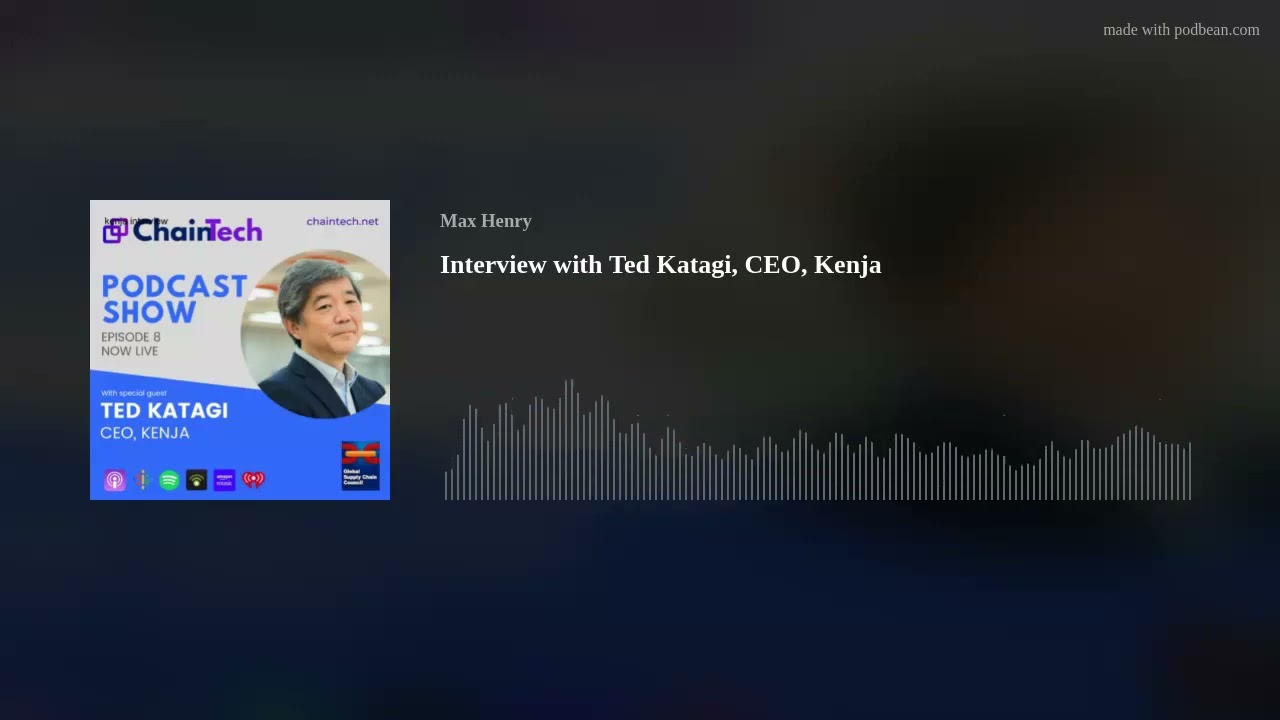
Ted Katagi, CEO of Kenja, built a supply-chain platform that uses blockchain only where it matters, cutting costs versus traditional ERP software. Real clients include 7-Eleven and a global investment bank. The company targets halal certification and food traceability, with ROI often exceeding 100 percent.
Chapters
Welcome to ChainTech, the show and podcast focusing on the latest trends in supply chain, procurement, and logistics technology. My name is Max Henry from the Global Supply Chain Council, and together with my co-host and special guest, we explore the personalities, startups, innovators, and industry players driving disruption in supply chain. From early stage to unicorns, And from cutting-edge technology to the people using it to help drive more innovative, agile, and resilient supply chains around the world. This is ChainTech. Hello everyone and welcome to another episode of ChainTech. I'm your host Max Henry from the Global Supply Chain Council. And I'm joined today with my co-host, Neeraj Krishna. Hi, Neeraj, how are you?
I'm fine, Max. Thank you.
Would you like to quickly introduce yourself to the audience before I introduce our guest speaker today?
No problem, Max. So I am Neeraj. I head the continuous cost and quality leadership function for Jardins Schindler, a market leader in elevator and moving walks. I'm based in KL, Kuala Lumpur, Malaysia, and I'm excited to be on this space with you, Max.
Thanks again for joining us again on this new episode of the show as we continue to host some of the most interesting chain tech founders and discuss the quick rise of supply chain logistics and procurement technology across the APAC region. As we jump into today's conversation, again, I want to remind all of you that we have launched this new platform called ChainTech. at chanetech.net, where you can find a number of solutions in the field of logtech and procuretech. And you can also find the previous episode of the show at chanetech.show. So today we're being joined by a very special guest. I'd like to introduce you to Ted Katagi, who's the CEO of Kenja. Hi, Ted, how are you?
Hi, Max. Good to see you. And, and Miraj, good to see you as well.
Okay, so maybe we'll get started with some, you know, understand who you are. Maybe if you could share a bit of your background, where did you grow up and what did you study initially and what has been your career before founding Kenja?
Sure. I was born in the States to Japanese parents, so Japanese American. And actually, not even though my parents are Japanese, I didn't speak a word actually when I was growing up, unfortunately. And I went to Berkeley to study economics and computer science, which was actually kind of a hardcore computer science school. But then I ended up just being more of a business person, went to work for IBM, and then went to business school at Harvard and went the sort of the Bain consulting route. And then from there, I went to be an executive in Vodafone for close to 15 years. So, I ran $10 billion units for them, a few billion-dollar units, mostly in Japan. And that's where actually they said, hey, you're Japanese, right? And I am Japanese by descent, but then, but I didn't speak a word when I first came over. So, it was pretty tough. And anyway, I learned the culture firsthand and learned the language eventually, roughly, I should say. It's not perfect still. And so, here I am in Japan. And then the story kind of evolved is that, you know, pretty early on, I was kind of a driven young guy. And I said, okay, I want to be a board member of a large enterprise company. And I was. And I also said, I want to start up my own company one day. And I was already close to 50 when I said, okay, you know what, I want to start a cloud company. And I wanted to— do that. And that's where Kenja was started about 10 years ago.
So, at Vodafone, were you already working in IT-related functions or you were covering different things?
Yeah, that's a great question. Even though I started out in IT with IBM and all that stuff, I went into more marketing. So, I was the Chief Marketing Officer for Verizon Wireless and for Vodafone Japan and also global strategy officer for Photophone. So, it wasn't really in tech. But this is one of those things is that I'm sure you guys can all relate to this is that being non-tech in a way is like, why do they do these software that doesn't make sense? And it's all big and ugly and expensive. And my frustration on paying the amount of money we did for enterprise software, I'm like, cloud software is free for, you know, like all these, you know, Facebook is free and this and that. Why are we spending so much on these big ponderous programs. So, that was my frustration and that's why we launched Kenja.
So, what was the trigger point for you to start Kenja and what kind of, you know, idea did you have, you know, before you founded the company?
Yeah, that's a great question. I was looking at, in general, at different entrepreneurial activities and it just so occurred to— we were brainstorming about different businesses and one day, We were brainstorming. I said, wouldn't it be great if you had something where all the content was in a room and everything that's related to everything we need to do, all the tasks and the documents and the commenting, everything was one room? We could reduce email. We could share it so that you're only invited to this room and other people are not invited to that different room. And that concept of nested rooms actually leads to so many different applications. I remember the next day the designer came up with that and I said, oh my God, this is exactly the type of thing I would've loved in an enterprise. And I couldn't sleep for a night and I couldn't sleep and I was just thinking about all the use cases. And that's when we were born, when I said, okay, I just gotta do this because— It's almost my responsibility to— I see this great UI and I wanted to bring it to life.
So, in one sentence, can you tell us what Kenja is doing?
In one sentence, we're the visual trust layer. So, what we do is we provide a layer of trust. You can say blockchain, you can say security, but what we do is you have a process and you want to see it visually. So instead of a blockchain, 64-byte blockchain, wouldn't it be nice to see a webpage of all the content? Who is in the halal food? Who is the one who actually was the butcher for food? What's the certificate? So I can see it visually. The visual, the trust means it's enterprise-grade security. Trust also means that unlike other blockchain providers, we're not trying to get rid of third-party player. We're actually trying to work with a certifier, so we're leveraging the trust. And the layer means that we understand that everyone already has systems, and so we're not trying to replace systems. What we're trying to do is we're trying to add this trust layer on top of what you already work with.
Yeah, any rush?
Good. So what problem are you solving, and especially when pertaining to supply chain solutions?
So the problem that we're solving is that the trust is not there at various different parts of the chain. And because the trust is not there, then various issues arise. So that's the general answer. The specifics, for example, is halal food. This is one of the solutions we provide. There was a trust issue because they had halal meat was mixed with non-halal meat. created quite a scandal, right? And so people were saying, they say it's halal food, but how do we really know it's halal, right? So the problem is, is there's a trust element, right? And so what we do again is that visual trust layer is that, okay, you don't have to trust a little package. There's a QR code, you can see it and you'll see the website. So visually, the consumer can understand that the trust is there because there's an enterprise trust and we're working with the certification. certification party. And the layer is that we work together with the existing bodies. So that's the problem and solution for that. Another example is we also did for 7-Eleven, we work with TÜV Rheinland, you know, one of the top ISO certifiers. Those are our partners in providing solutions for all their factories in outside of Japan. So that's like, you know, over 1,000 factories that they use our software for. And the problem that we're doing there is they didn't know about the— the buyers didn't have visibility into the quality of the factories. It was kind of a different manual process. And by putting it into a system, they could actually see visually what is going on, What's the quality of the factory? And so they have that now as a way that they can use that as a purchasing decision, whether this is truly quality or not.
So is your solution just using blockchain technology to provide that trust or you're tapping into different type of technologies in the solution that you offer?
Yeah, so blockchain is one of, it's a tool. And I think one of the issues people in the blockchain space is they tend to think blockchain is the tool for everything. And you can't use a hammer everywhere, right? And so blockchain has a lot of good use cases. I mean, we use it where appropriate. We don't have to use blockchain in our solution. So for example, one of the things that we— so we had to get for one of our— we have a top global investment bank as one of our customers. And for them, what they had to do was get up to NIST version 1.1 as an example. And so that top level of security, this, that is, we have to provide that level of trust. And so if you have NIST, you might not need blockchain, right? So if you have quality that's good enough for a global investment bank, Isn't that good enough for your supply chain, right? And so, but parts of it have to go publicly to a wide group of people. And so, that portion alone, we apply a blockchain. And so, we only give you blockchain where you need it. That's the difference.
Ted, Niraj and myself, I mean, are quite skeptical about blockchain. Again, we know we've seen what has been happening the last few years around the technology. There was a lot of hype. many years ago and everybody got super excited about it. The big vendors came in and told the entire industry that blockchain will revolutionize everything. And then it flopped. So, what is your view? What happened with blockchain? Why so many companies got super excited and why nobody's using it or very few companies are using it today?
Yeah, that's a great question. And this is the core of why we're seeing a lot of good business with this. So, you're right, is that there's so many new technologies that they go on what they call the Gartner hype wave, right? And so, the hype wave is like, you're right, there's too much hype. It's overselling the solutions and it crashes. But the other part of the Gartner hype wave is that eventually, 15 years later, it does come true. Right? The internet was the same thing. All these new technologies go through it and blockchain is not an exception. I think what happened a bit is that blockchain mistook that they have to provide an ROI, a return on investment. They have to do a solution that is really needed. It isn't just about technology. Now, let's first think about what is good about blockchain. What's good about that is it's a proven technology, distributed ledger, Which actually lets you say that this transaction really did happen. It's secure, it's immutable, it provides full provenance, right? That's great. Great.
Okay.
Full stop. No one's against that, right? The problem on that is that a few years ago, especially, they couldn't scale that very well because the gas fee was expensive. It was, let's say if it was even pennies and it wasn't really pennies, it was, you know, tens of pennies. That doesn't scale too well if you want to do blockchain on every single transaction. And you know what? The solutions, they wanted to do blockchain on every single transaction. So, the reason why we're doing this differently again is that, no, we're going to leverage off of— we already have a content management system. And so, we're enterprise-grade. We only have to do it on the last mile. The blockchain only goes at the last moment. And at the last moment, you apply a blockchain. It doesn't have to be everything, but realistically, isn't that good enough? If it's good enough for investment bank, isn't it good enough for your supply chain? And so, you put it on the last thing and then that's what allows you to scale easily. And that's what allows us to come in at a lot lower cost, which then addresses the ROI issue. And the other thing I was saying about this on blockchain, why it didn't really take off, is that a lot of the industry guys, yeah, okay, we understand immutable, why it's immutable and all that. But to a consumer, what does that mean, a blockchain? It doesn't mean anything to you, right? And so, what we said is instead of going to Etherscan and it was a 64-byte character that I could verify, instead of having that, why don't we have a website where I can show the certificates and the PDFs and the pictures of people and all that? Isn't that much more meaningful? So that's why I named that visual trust layer, right? And so that's what we're trying to do is we're trying to address some of the shortcomings of blockchain because of the cost and because they don't have a clear benefit to consumers. And so that's where we're setting the clock on that one.
Ted, it's interesting you brought that point on the ROI, right? Because, you know, when we, when we bring back, when we bring back the, the blockchain space to conventional industries, right, it's still— I, I don't know whether you would agree— it's still more of a buzzword, right? So how, how would you be able to justify the ROI to a management or a conventional industry, probably such as mine, you know?
Yeah, sure. Um, so ROI is a number. It's really literally a number, right? And, and as an, um, as a, um, you know, former board member of a large enterprise, I would want an ROI of 30%, 50%, 100%. That's a number, right? And then, the next thing is what are those assumptions that go into it? And we could show, hey, this is our cost. This is what we've done for other industry, other companies. And typically, the ROIs that we do are north of 50%, 100%, 200%, 300%. We get those kinds of ROIs. And the reason why we're able to do it is that we customize off an existing platform, right? So we don't have to start from scratch. A lot of these blockchain projects, they got to be expensive, very expensive in the millions or even tens of millions of dollars. We don't typically go there. We take a zero off of that easily. And so, and in fact, that's what we did for companies like 7-Eleven, right? They— 7-Eleven, they had something that was much more expensive and it was on the table. And we had to show why we can literally take a zero off, a tenth of the price, okay, of what it would do for a large ERP solution or these other things that they were looking at. And so that's why I'm confident that if we're given the chance, to compete. One of the things that I don't like to say it, but it's true, is that you should invite us to an RFP because if nothing else, we'll be the stalking horse for the other leading guys that you know are going to be expensive. So, they'll say, well, why can't you get to that kind of price? Right? So, that's our sweet spot. The sweet spot for us is that we're not really into SMEs. So the typical SaaS is like, no, no modification. We're doing $10 a month per user and, you know, this kind of thing, right? That's not really our business model because we know enterprise. We know how to do work with enterprise security. We have that whole protocol down and our tool was designed for enterprise from the beginning. So no, we're not playing at that end of it. But then again, we're not in the same realm of some of the very, very expensive ERP solutions. So we can We kind of go into a thing where, hey, you've got something which needs some customization. You need to do something that's a little bit out of the box. And that's where we think we come in with a really great solution, which says we listen to what the users need. We come up with a POC. We can do out of the box, and this is a good thing in Rooms. We can do a demo the first day that we go to the customer, we give a demo. We say, this is a first draft version of how it would look using Rooms. And then they can usually relate to it. And usually people don't do that. They do PowerPoints. They never show you the product. And then we can show you the product, how it would work in your environment. And then if you like that discussion, we'll even show you some mockups as to how it would even apply even more for what it would look. And so the visual Visual trust layer, again, is that's how we kind of do our sales as well, is that we actually have to visually show you what the advantage is.
The other issue that I see happening around blockchain, Ted, is, you know, it's a lack of applications. I think that's probably the biggest complaint we get from our members here at the Global Supply Chain Council. You know, they kind of know the technology, they heard about it, But when it comes to actually finding useful, you know, real-life application for their own supply chain, logistics, or procurement operation, there's just very little available, especially in Asia. Do you think it's still an issue right now in the current environment?
I would agree with you that, in general, this is an issue for blockchain, is that they had use cases that were few and far between because It was customized one at a time.
Yeah.
Right? Now, one of the things is that we— I recently was speaking to a top analyst, the top blockchain analyst for Gartner Group. And basically, she's been writing about what blockchain needs is blockchain needs a content management system that has blockchain. Okay. Now, that's exactly our core is a content management system. And so, what is that so key about that? What does that mean? So, they have some things that have a blockchain against the file, right? Or against some, you know, like an NFT is that. It's basically there's a digital asset, right? But the problem with that, I don't need just the file. I want to know who uploaded that file, who has rights to that file, What other related files are there, right? What's the full provenance of that? Who touched it? I want to know all that information. Guess what? That information is all in a content management system out of the box. That's what we do, right?
Okay.
And then simply I put a blockchain on top of that. And one of the really interesting things with our technology is any one of us, literally right now, we can add a blockchain. We just— there's literally a button that says add a blockchain. to our system. You add a blockchain at any point in time. It's not a smart contract, but it's without using a programmer. Smart contracts require a Python programmer and he has to know blockchain, all that. Ours, any one of us hits a button, there's a blockchain applied. And the great thing about that is a content system with tasking And with blockchain applied, you can think of 100 use cases, right? You can think of procurement. Okay, on procurement, I want to keep all my contracts in a secure room. And I want to put a task in 9 months. I want to review that contract because before it goes up for renewal, I want to make sure that there's people looking at it and all the related parties are sent a notification. We do that out of the box.
Okay.
No software programming, nothing. You just put a template for a room with contracts, put a task on that, copy it, and then you're done. That's how simple our system is. So, you get to a lot of different use cases. Now, I add a blockchain to that. So, why is that good? Because in a case of a legal dispute, nope, we have it right here. Here's a signed contract that you actually agreed to it, and we have a blockchain that says that you received it.
Okay.
Right? So, that's why I think that the problem on blockchain is that they were trying to do it full blockchain from the get-go for each use case. And what we're saying is no blockchain, or if you want a blockchain, have it the last mile at the last moment. And then there's a use case that exists with or without blockchain.
Okay. Let's go back to the company, Kenja. And I want to understand when you started the company, did you actually bootstrap your business? Did you raise some funding? And what is your current funding stage right now? Yeah.
So, when we started, we've had some, you know, I want to say angel investment, large angel investment. But, you know, the typical thing on the venture, they say, okay, there's the large, you know, professional venture round. We've largely bootstrapped based on the angel investments and we've had 10x, 2x, 2x growth rates So, we've been doing very well. And it's based on the fact that we go to enterprise customers. In the beginning, that was pretty difficult because enterprise don't trust a new company. And I remember 3 years into it, I was talking to some Japanese companies. They said, oh, yeah, we do this for major insurance companies. And they said, but you've been in business 3 years. Why don't you come back next year because you're still not mature enough for us?
Yeah.
So, we've gone through that, and now that we've got enough logos like NTT and all these major companies that people trust, now that we got the logo list up to dozens of clients like that, now that we got the trust of clients that say, okay, we know you can do it. And basically, on the funding, we've got this year, we've got commitments for a good-sized capital round.
Okay.
that we're funding with some major corporate-backed venture funds.
Okay.
So, good. So, tell us about your team and how many employees do you have full-time and how many engineers? We would like to know about that.
Yeah. So, that's a great question. So, we roughly— and it all varies, but the entire Kenja is about 50 people. And of that, we have about 20 people or so on the tech team, including business analysts and people who support it. But the engineers are a little bit more than half that number. So, that's kind of the tech team. Yeah. So, it's not a large company by any means, but for a SaaS company, it's not a small company either. And the fact that we've been around for 10 years means that we have literally Yeah, maybe it's about 100 man-years of effort on development on our platform. So it's not something you can go into a weekend hackathon and replicate what we do. It's full enterprise. And the other thing about this, and I kind of have to emphasize this, every time I talk about a customer, it's not a POC customer. It's a production use case. So, 1,000 factories, hundreds of users, it's this kind of thing or thousands of users, right? It's something where it's being used in a real way by a real enterprise customer. So, anyway, so that's a little bit of our size and all that. But one thing is the size, but everybody, I guess, will say this, but I'm very, very proud of our team. The quality of people that we've assembled is probably as good as any team I've ever had working at Bain or Fidelity. I was a private equity head or Vodafone. Pound for pound, I think this is the best team I've worked with. And so, I'm really proud of that. And quite honestly, it's not the same salaries as we paid at these other ones, but what we lack in In that, we have the spirit of being entrepreneurial, right?
Let's talk a bit about the landscape of supply chain and logistics startup, especially in Japan. I'm curious, you know, to know whether you actually, do you know them? Do you get together? Do you meet up? Do you exchange experience with those startups?
What I find in startups that the ecosystem tends to, It's a little bit different is that, you know, for startups, they have what they call is the valley of death, right? You've heard this, right? Where they say there's the 3F round, friends, family, and fools, right?
Right?
You start out with that and then you go into the valley of death where you got a platform and you're looking for customers and customers are hard to get to, right?
Yeah.
And so, what I find is that there are definitely people at the 3F stage And then the people later on, there's not a lot of companies who've managed to get past that and grow a lot. But informally, there's some people I stay in touch with. There's nothing nearly as close as like a Silicon Valley network or this kind of thing. But yeah, it's there. It's out there.
And what do you think is also partly because of a culture in Japan where people Tend to be more introvert. Yeah.
Risk-averse. And like one of the things I remember when we were doing our angel round is everybody would say, oh, there's this one guy, you need to talk to him. He's like the angel guy, right? Talk to this one guy. So, I talked to him and he goes, oh, you know, I used to do an angel investor and I made money on a few deals, but I lost money on a deal. So, I'm out. And on ventures, that's the model. You make money 4 times and you lose money 1, right?
Yeah.
But Japan is kind of risk-averse that way. So, I think the reason why I'm pretty excited about this is recently, we've been going to Europe and Southeast Asia. That's about a year and a half ago we went there. And the nice thing about that is because we went through the fire of a very, very conservative Japanese culture to sell into. We have that discipline of quality and a certain way of doing business, but I think that our customers abroad really appreciate that. And also, we appreciate how flexible and fast they are compared to people in Japan.
Do you wish you could meet those startups evolving in the same space, especially, you know, if they are located outside of Japan, in Asia, or You know, yeah.
And if people are listening to this, feel free to contact me. I don't know when to say that, but I can be easily reached, ted@kenja.com. Send me an email.
Okay.
If anybody does that, I think that, you know, there's so many— the world is so big that I find that there's always more collaboration opportunities than competitors. You know what I'm saying?
So absolutely, yeah, absolutely.
But Ted, uh, what would be the biggest challenge that you still face in the current landscape that you are in right now? What keeps you awake at night?
Uh, yeah, that's a great question. I think, um, the challenges that we face is right now, because we're growing very rapidly, um, it's a question of scaling, um, and how do we get the right skills in place to allow us to grow with the demands of our enterprise clients. And so, that's one thing that I think is— and the answer to that, by the way, is processes. You have to establish processes everywhere, processes for hiring, processes for how you do delivery and solutions. Of course, we do all those things and testing everything. And believe it or not, one of the greatest tools for that is our own Kenton Rooms because we keep our processes on our thing. So processes and scaling is one of the biggest things. And I think, as always, with customers, you know, unfortunately, the world of IT is there's a lot of unsuccessful IT projects out there. If we were really to look at it, when I say unsuccessful, it doesn't mean that it didn't work at all. It means it didn't match up to the expectations of the original our project. But our growth is coming because we are able to keep our customers happy and organic growth is always the best type of growth, right? So, what keeps me up is making sure that we're keeping all our customers happy at all times too. So, that's the other thing.
How do you see your company in 3 or 5 years from now?
In 3 or 5 years, we have the visual trust layer, which is kind of a overall big strategy thing, but it goes into halal food and supply chain for food security use cases. So, we see us growing into different verticals. And so, 3 to 5 years, I'd like to be— already, we're, I would say, the leader in halal based on the fact that we have so many certification agencies signed up in Indonesia. We want to be the leader in food food traceability in a few years as well. So it's taking each vertical and then applying our lessons of our visual trust layer to each vertical.
What advice would you give for entrepreneurs who want to also launch a startup of their own?
Well, the number one advice I would say is know who you are. And therefore, what type of company that you should launch. As an example, I'm an enterprise guy and whenever I try to do SME solutions, it never worked out for us. And I learned that I understand enterprise space and that's the product we designed. So, stick to what you know, right? So, if you're an enterprise guy, stay enterprise. If you're an SME guy, go to SMEs, right? So, know who you are, meaning, What part of it excites you? I'm a real product guy. I love product and I love talking about UI and all that. So, if you like that, then do that and surround yourself with people that do other things really well, right? So, that's another thing. So, know yourself is kind of one of the big things, right? In terms of who you are, what you can do. And the other thing I would say is is know that no matter what, if you're an entrepreneur, you have to sell, okay? Because this whole thing of like, oh, I want to be a marketing guy and I want to just, you know, I don't want to actually go out and do that. Yeah, sure, B2C, but guess what? You have to sell your investors and you have to sell your employees on this and you have to sell the vision, right? So, this thing about not being a salesperson, You have to understand that's part of being an entrepreneur. Yeah.
It doesn't work. Yeah. I agree. All right. Okay. Let's wrap up this interview, Ted. I've got some quick questions for you. Cats or dogs?
Dogs. They're very friendly, right?
Window or aisle?
Aisle because I don't like to— the bathroom, right? That's the key. From 30,000 feet, all cities look pretty similar.
What's your favorite action movie?
The Matrix. It's deeper than it looks.
Okay, probably not the last one, right? The last Matrix was not so good, right?
Well, yeah, no, the original 3, and then the last one was kind of like, yeah, you're right. A little bit of disappointment.
What is your favorite sandwich?
French dip.
Okay. What is the most used app on your phone?
Probably Line, WhatsApp.
Okay. What's your favorite tool to build your company right now? Kendra Rooms.
Yeah, you wouldn't know that, right? We use our own software.
If you had to describe the rest of your life in just a couple of words, what will it be?
Taking Kenja to scale, and and and along the way of of creating a great product, we create a great way of doing business.
Okay, so very very Kenja focused then. Okay, that's good.
All right.
Yeah, thank you.
That's the last piece of advice. If you're not focused on your company, then don't be an entrepreneur.
Okay. All right. Thank you very much, Tate. Thank you for this discussion. It was interesting to get to know you and also what Kenja is doing, both in Japan and the rest of Asia. A very interesting interview. So I want to thank you again for your time here.
Thank you, Max. Okay.
Thanks. Thank you guys, and thank you, Niraj, for joining us today for this talk. Again, if you're interested to hear some of the previous episodes, don't forget to go to our gentech.show website where you will find all the previous interviews that we had. Thank you guys, and we'll see you next time.
Okay, thank you.
Take care.










