Interview with Vivek Singh, Co-Founder, Hopstack
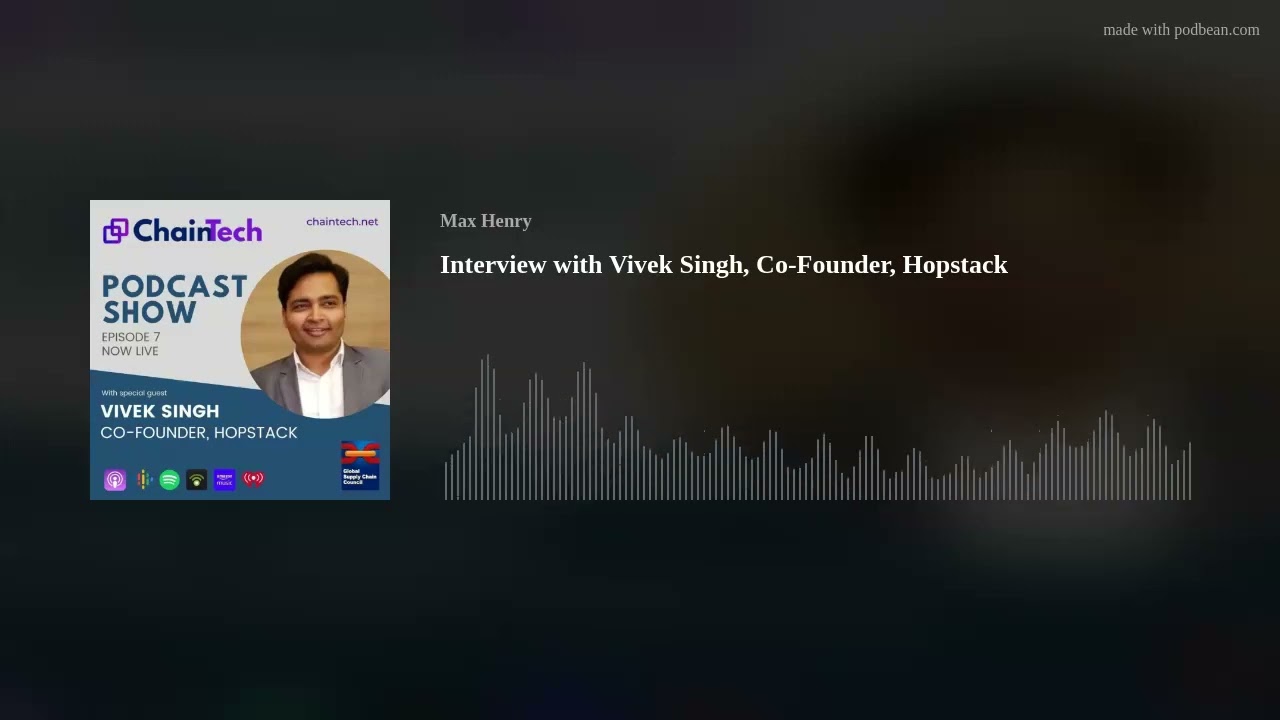
Vivek Singh, CEO of Hopstack, built a no-code platform to automate warehouse order fulfillment for mid-market companies. Legacy systems from the 80s can't handle modern e-commerce, so Hopstack sits between order sources and shipping carriers with drag-and-drop workflows. Singh bootstrapped the company with a small angel round and aims to become the "Android or iOS of warehouses" in three to five years.
Chapters
Welcome to ChainTech, the show and podcast focusing on the latest trends in supply chain, procurement, and logistics technology. My name is Max Henry from the Global Supply Chain Council, and together with my co-host and special guest, we explore the personalities, startups, innovators, and industry players driving disruption in supply chain. From early stage to unicorns, And from cutting-edge technology to the people using it to help drive more innovative, agile, and resilient supply chains around the world. This is ChainTech.
Hello everyone, welcome to another episode of ChainTech. I'm your host, Max Henry, from the Global Supply Chain Council. And Chantech. Thanks again for joining us on another episode of the show as we continue to host some of the most interesting Chantech founders and discuss the quick rise of supply chain logistics and procurement technology across the APAC region. As we jump into today's conversation, I also want to make sure and remind you that you are aware of our Chantech platform that we recently launched. You can go ahead and visit it at chantech.net. You can also check out some of the previous episodes of the show. show at channtech.show. Today, I'm Bin Zhuang. I'm very happy to be able to have, you know, a discussion with Vivek Singh, who is the co-founder of Hopstack. How are you, Vivek?
I'm great, Max. Thanks for having me here. Looking forward to have a great conversation.
All right. So let's start with some personal questions. Maybe I'd like to understand, you know, a bit your background, what you've done, before founding Hopstack. So if you could give us a bit more information about what you've done before.
Yeah, certainly. As you've already introduced, I'm one of the co-founders and CEO at Hopstack. My primary responsibility here is to head the entire engineering and product operations that is based out of India, and also responsible in a great capacity to build the go-to-market strategy for India and the greater APAC region. Before joining Hopstack, obviously, you know, I just to give you my background in a nutshell, I grew up in Varanasi in India, which is, which is a small town up north, more known for its spiritual tourism, not for logistics. Went to, went to school in Mumbai. That's where I primarily grew up. And then as soon as I did my engineering, I moved to the US for my grad school. Went to University of Missouri, did my master's, and was hired by Monsanto right off the campus, right? And I ended up working with Monsanto for a while and basically spent a lot of time working with some of the largest corporations in the Midwest US, helping build their warehousing, distribution, and supply chain tech platforms, primarily from the data and analytics angle. And that's, that's how I got my beginnings and the initial flavor of sort of problems within the space. And, you know, I wouldn't be wrong to say that, you know, it sort of started to plant a seed up front. Spent a couple of years in consulting as well, worked with Hitachi, traveled around, took a break from the corporate career, backpacked around the globe, then moved further east, a couple of years with Manhattan— in Manhattan with Bloomberg. And 2016 is when I actually relocated back to India. During my initial days in India, I was actually a digital transformation consultant for some of the largest corporations here, namely Hindustan Unilever, Emami, Singer in Sri Lanka, optimizing their supply chain and logistics or sort of digitally transforming them. And, you know, that sort of consolidated my hypothesis of building what we are building today at Hopstack.
So what was the trigger point for you to actually start this company?
I think the trigger point was primarily my frustrations with the legacy platforms. And I think what I was seeing on the outside world was not necessarily replicated by the software supporting that industry. The business models were becoming increasingly complex, right? So every, the business models that worked 10 years or 20 years ago were no longer holding up. We see this emerge of e-commerce, the direct-to-consumer channels, and a lot of businesses had to reconfigure themselves to operate in this omnichannel world. But, you know, their software was still confined to the '80s and the '90s that operated more in the traditional wholesale distributor-retail model. And it took a lot of pain for them to reconfigure the softwares, which is why I saw that gap in the industry and saw that while a lot of softwares are being innovated upon, the warehousing and the logistics space is still relying on software that built for the '90s and not for the modern world.
So you are a co-founder, you have another co-founder at Hopstack. How did you actually get together and start the company?
Yeah, this is an interesting story. Me and Gaurav were building— we're sort of thinking about this problem in 2 parallel universes. I was actually based out of India then, and Gaurav was obviously based out of Bay Area in the US. We were introduced through a mutual friend 5 years ago, and this mutual friend had known Gaurav for the last 2 decades. And because we happen to know the same individual, he He connected the dots in a way because he knew 2 of us were working or thinking along the same lines about the same industry. And he was like, maybe you guys should talk to each other and perhaps there could be synergy for you to build together. And that's how it all started. Obviously there were a few months of, uh, wining and dining, courting each other, uh, to be able to get that alignment right. Yeah.
In one sentence, tell us what the company is doing, Hopstack.
Very simply put, we are a digital platform that optimizes, automates, and digitizes the entire post-purchase order fulfillment journey for brands or for third-party logistics company that enables those brands.
So what kind of problem are you solving?
So, uh, we are simply ensuring that brands and, uh, the third-party logistics companies have— provide a better fulfillment experience to their consumers. And they are able to compete with the large retail giants like Amazon and Walmart to provide that 2-day shipping experience by streamlining their fulfillment process through our platform.
So this is based on the fact that you've seen, as you mentioned earlier, you've seen those solutions, many of them were legacy systems, they could not keep up with, you know, the needs and the requirement of e-commerce. And this is why you created Hopstack, right?
Absolutely, absolutely. The way we envision the platform or the software to be, I mean, there were traditional WMSs that were built on the traditional model and it was very extremely hard to reconfigure them. We saw the warehouse software of the future as one unified platform that can allow any business or brands to run multiple operations from the same platform, whether you run a B2C or D2C, B2B wholesale, Or you are running cross-geographical operations, you should be able to run the same thing from one platform and not operate in information silos of 5, 6 different platforms.
So where is your solution sitting? Because many of your clients probably have an ERP system. They also have a number of logistic tools, WMS, and so on. So where is Hopstack actually fitting into that landscape of solutions? that companies have here.
Absolutely. Uh, we sit right between, uh, the, uh, the order channels and the shipping carriers, right? So we, we— our platform fills the gap in the warehousing and the distribution facility. So we are seamlessly integrated with all the commerce platforms or the ERP systems that becomes an inlet to send us the product and order information. Then we obviously run the entire fulfillment through our platform send that information back to any logistics carrier to complete the final piece of that fulfillment experience. So we sit right between the two.
So you're sitting in India. We've seen in the last few years a tremendous amount of startups in logtech, a lot of funding. Some of the companies have been very successful and also starting to becoming global players as well. So what is your view on the current startup scene especially, you know, for those companies who are focusing on supply chain, logistics, and procurement? What's your perspective on what's happening in the sector in India?
Sure. I think before I answer that question, just wanted to also put a bit of more clarification that while majority of our team is based out of India, we are a global company in nature. Most of our customers are from North America, and we've slowly started to expand into APAC. Having said that, we are very in tune to what's happening in the logtech and the startup ecosystem here in India. I think there are— and the larger world, right? Obviously, we have seen over the last couple of years how pandemic has thrown the entire supply chain of the entire world into haywire, right? Companies are— supply chains are no longer, you know, backroom discussions, but it has become more of a boardroom discussion now. Right? And hence everyone is looking at what can they do ahead of time to ensure that they are totally in, in, totally in ahead of the consumer expectations, the head of market changes, the head of external factors that are, that could impact their supply chains. And the decision around investing in technology to automate their warehousing, their operations, their last mile, their procurement is no longer an after-the-fact discovery, but it's more of a— it's becoming more of a proactive discussion. So which is why you will see that a lot of supply chain and log tech startups are raising a lot of— attracting a lot of venture capital, not just in India, but across the globe. There are a lot of unicorns minting out of this space. And a lot of corporates actually investing not just as a buyer, but also as a as a part of their corporate venture capital and corporate innovation programs, trying to work together with startups. So this is a space that will continue to be at the forefront of venture capital and corporate innovation over the next decade or so.
So some people are calling it a bubble, and with the anticipated drying of funding in the coming months or years, some people are also predicting that a number of those companies, whether they're in India or the US, will actually go bust. Would you agree with that?
I think there's a lot of nuance to that question, Max. If you think of it, right, there is certainly a bubble in some part of the startup ecosystem, while the others are sort of very, you know, immune to what's happening in the economy or in the capital world, right? The bubble is primarily in space that were built on lack of fundamentals, lack of business fundamentals, that were built on problems that doesn't necessarily— I would say were a pain point, but more of a nice to have. And a lot of those companies ended up attracting a lot of venture capital. And we are seeing that bubble burst as the capital crunch is happening today. But there are some real key problems and supply chain is one of those, right? You know, you look at providing healthcare access, you look at solving supply chain problems, providing real quality education. These are real problems. And if you're building a company around solving these problems on strong business fundamentals, I don't think there will be an economic— bubble-like situation for you or any sort of a long-term economic impact.
Okay. Let's go back to what Hopstack is doing. Can you share with us who actually do you sell to? What kind of enterprise? Are you focusing on SMEs, mid-market, or other larger players?
Yeah, we primarily focus today on SMBs and mid-market, mid-enterprises. If I have to put a number around it, we focus anywhere on companies doing $10 million in revenue to up to $500 million in revenue. And these are companies that are struggling to stay competitive against large e-commerce and retail giants. And they are— they would want to have a packaged software that can automate and digitize their entire process. So that's the market we are selling into. And most of our customers today come from North America. We slowly over the last year have started to expand in Southeast Asia and as an extension now to India as well.
Are you focusing on certain sectors or industry or maybe some product categories?
We are— I would say it's more by design than choice. I think 3PLs, third-party logistics companies, are the bulk of our— form the bulk of our customer segment. And we are seeing a lot of traction there. And primarily 3PLs that want to operate or want to serve both B2B customers as well as B2C customers.
Okay. Does the implementation— actually, you know, it must be quite different, right? Because on one side you're talking to brands and end-user shippers, and on the other side you have those 3PLs. Is the implementation of the solution, you know, very different whether you deal with one or the other?
Uh, it is. And I think that's, that's one of the core hypotheses that we built the platform on. And that's something, uh, which is a core differentiator to us, right? So what we, what we say is whether you're a brand or a 3PL or a prep center, you can run your entire operation or you can configure the platform to suit your own operations. So we have built the platform in a totally no-code paradigm. So you can literally drag-drop workflows, configure processes totally without involving any engineer or tech person, and create the platform as a digital twin of your own operations, right? Whether you're a brand or a 3PL, and that's one of our core differentiating factors. We are— we don't tell you that this is how you need to operate your business, but you can configure your business on the platform. In fact, even if you're a 3PL, no 2 warehouses are the same. Right? And that's where you can configure 2 warehouses differently on the same platform, which is one of the USPs that we have as opposed to any other platform out there. And in fact, we have had customers who have switched over from other platforms to us primarily because of this differentiation.
So you mentioned the competition. I mean, how would you consider to be a competitor today with, with OpStack?
The competitive landscape is fairly broad and I always look at, you know, I have this thesis that if you're a B2B software, your primary competition is Excel and spreadsheet, right? And so we are obviously always competing with paper and Excel and a lot of our customers are switching over from there and becoming— using our platform to become— to have the de facto digital version of their operation. But yes, there are competition out there. We have companies in the US who are a cloud-first WMS like 3PL Central or Logiva in the US. We have companies in Southeast Asia like Enchanto. We have companies in India like Unicommerce. They— all of them have carved out their own niches, and I think we obviously compete against them. We have also had customers who have switched over from some of those platforms And we have won deals against some of those competitors. So we are looking at how we could continue to building our differentiation.
Can you share with us what is— what would be your strategy to compete with those companies which are, you know, somehow competing with you, especially maybe probably focusing on those companies in Asia as you expand in the region also?
Yeah, our strategy is to obviously always— our strategy has always been to look inwards and not be bothered about what the competitors are doing. Uh, we work very closely with our customers, understand the pain point at a deeper level. And it helps that me and my co-founder Gaurav and other members of the core team come from this industry, have a very deep experience of this problem statement. Uh, so we understand our customer problems much better and we are building a platform in tune with what the modern, uh, modern landscape is, right? No-code configurability, very data-driven. So a lot of optimizations are built by the platform. Not— it doesn't rely on humans to make those decisions. We are totally integrated across the entire connected world of commerce, be it shipping carriers, ERP, marketplaces, all of that. So these are, these are the differentiations that we continue to build on. And one biggest thing that I will say is a lot of, lot of industrial or warehousing softwares in particular that have been built in the past, they almost forgot about the last mile worker. Right? The worker on the factory floor, the worker on the warehouse operating floor, right? The software was so difficult for them to operate that they always struggled to get that last mile adoption. And when we build Hopstack, or when we are building Hopstack, we always keep the last mile worker in mind and at the forefront of who the primary user of the software is.
Okay. So you started in the US and then you mentioned earlier that you are now looking to expand into Southeast Asia, and maybe in India as well, whatever some of the challenges you face, because US and Asia are very different markets. So can you share with us some of the challenges that you face as you expand here in the region?
Certainly, they're totally different markets with different pain points. I think in some aspects, some aspects Southeast Asia or India lags behind, but in some other aspects, they are at forefront of the technology, right? Some key things that I would mention as a differentiating factor is obviously, you know, the difference in currencies, right? So the markets in Asia is slightly more price sensitive as opposed to North America. So that's one thing. The second aspect is about the presence of infrastructure, right? Sometimes you will see that not all warehouses are Wi-Fi enabled or internet enabled. And so you have to ensure that your platform, your solution works for those customers as well. Right. And the third aspect I would say is where I think that India and Southeast Asia are ahead of a lot of the Western world where these economies are, or these countries are very mobile-first in nature. Right. And more so, and that's why we built the platform in such a way that it operates on every device. And a lot of our customers here in the local geography, they use our platform on the mobile devices. So we have— these are some of the key differentiations that exist in these 2 markets and that we have to cater to today.
How do you promote and market your solution in a region like APAC, which is highly fragmented, different countries, different culture, different language? You know, it must be quite difficult for you.
It is, I think. And we're learning the ropes of it as we are working through working in this market. Some of the challenges obviously come from our personal experiences, being obviously being from this region as well. And we are using different channels, right? We are primarily relying on content-based marketing. That's the primary source we are using today. We have not— I wouldn't say we have spent at all on paid marketing today, right? So we do a lot of content-based marketing. We do a lot of product-based marketing. And a lot of things are still at the experimentation stage today, right? So we're still experimenting in what works, what doesn't work. And perhaps over the next couple of quarters, we'll have a little more established channels, which we already have in the North America, North American region, right? We have pretty much established channels. We know what works, what doesn't work there.
Yeah, but again, some of the things that you do in the US might not work in Asia, right? So as you go to places like Thailand or Indonesia, you know, it must be quite different. Yeah, it is.
And language is the key thing here, right? So we have to, we have to be very, very local, right? And that is, that is a learning we have. And in fact, which is why every geography we are expanding, we have local teams. We have teams in Malaysia, we have teams obviously in India, and we are only focused on markets where we have local presence.
Okay. So we are coming out from this pandemic, hopefully slowly from this. What are some of the lessons that you learned and maybe some of the good things that came out from this?
I think, uh, the good thing obviously is very obvious to, to everyone out there that supply chain has become a primary focus now, right, due to the pandemic. And, and it has sort of made people think about how, uh, external factors can throw your business off totally, right? Uh, in fact, design decisions today are made based on how your supply chain is configured. Automobiles are constructed based on what components today you can procure or not procure in time. So that is probably one of the best things to come out of pandemic, which is focus on supply chain, focus on automation, focus on digitization. And I think every decision that was supposed to happen 3 years from now has gone significantly accelerated in terms of investing in digital technologies. So that's— that I would say is the best thing to come out of pandemic. And second thing, obviously, I would say that the world has become in its own way a little more connected remotely, right? Today we could build companies from one place and still be global in nature.
Yeah.
And that has certainly become a little more possible as the world has adapted to this remotely connected nature or version.
Do you think that also it helped you to actually reach out to clients more effectively and be able to have those meetings remotely and do those demos just on a Zoom call, right?
It certainly does. I think one of the things, one of the factors that we've been totally proud of is we have implemented almost all of our customers remotely and in a very complex environment, right? Warehouses and industrial floors are very complex in nature, and we have implemented all of our customers remotely. Having said that, there are also challenges of being remote, right? And I do, I do see the perks of being present in, present in physical way. And I'm sure the future world will come to a consensus in some form, in some sort of a hybrid manner, right? But yes, today I do see that as an advantage where we could do demos, we could have discussions. You could even deploy totally remotely. Yeah.
Okay. When you started Hopstack, did you actually bootstrap a business or raise funding? And could you share with us what is your current funding stage, if it's not confidential?
Sure. So we, we have been totally bootstrapped from, from day one. We just raised a very small amount of funding last year, and that was in angel funding. from strategic investors who were from the space or from our own networks. But we have never raised any institutional funding. We continue to be very, very capital efficient, driven by customer revenues as opposed to external funding. We do have plans to raise funding in the future, but that's not something which is extremely imminent.
Okay. As a co-founder, what will you say is your biggest challenge? in your current role? Because as you explained earlier, you're covering different aspects of the operations development as well. What is your biggest challenge and probably what keeps you awake at night as well?
Yeah, I think 2 answers to this question, right? One is obviously as being a co-founder or a founder of a bootstrap company, you're always striving to do more with less and being very scrappy in nature, being very resourceful, especially when you have to compete against extremely heavily funded competitors, right? So that always is the biggest challenge for me or for us as a team and glad that we have significantly overcome that with our core focus on product and innovation. The second thing, what keeps me awake at night, I think 2 things, right? So one is obviously I'm always paranoid about whether I'm doing enough as a founder, as a leader where this continues to be an exciting place and exciting space for all of my colleagues and coworkers to wake up every morning and be excited about, right? So that, that is something I'm always paranoid and always measure myself in if I'm doing enough to continue keeping Hopstack as an exciting place to work at, right? Second thing is I'm paranoid about providing enough value or better value to our customers than anything else out there. Right. It never bothers me whether a large funded competition or, or, or the likes of Amazon or Google may enter our space. What bothers me or what keeps me awake is always those 2 individuals in a garage with nothing to lose who can outthink me. Right. And I'm always looking over my shoulders to stay ahead of those 2 driven individuals. in the garage. So these are the 2 things that always keep me awake at night.
So you mentioned, yeah, how difficult sometimes it is to share your passion to the employees, especially, you know, in a very dynamic industry, which is the logtech sector right now, especially in India. You clearly have turnover. I mean, your employees are not as passionate as you are. Is that an issue? Do you have to deal with that turnover and keeping those Was people motivated as much as you are?
Yeah, I think we've been fortunate enough to build a core team that is extremely motivated and passionate about this space. But yes, we have had our share of challenges where there has been a disconnect between folks coming on board and not necessarily share the same passion for the industry. And my advice for them is always that, you know, Uh, life is too short to not work at a place that you're not really excited about. Right. So if Hopstack is not the place, then I, in fact, I'll help you to find that place. Right. But, uh, let's work here. Let's work together only if, if you're extremely excited about being in this space. Right.
How many employees do you have both in India and the US right now? If you could share a rough number.
Yeah. Sure. Uh, we are a team of close to 25 today. Uh, with about, uh, that's a combination of full-time employees, interns, and consultants. Uh, about 80% of that is our full-time employees.
Okay. How do you see your solutions in the next 3 to 5 years? What's, what's your roadmap? What do you want to be in the coming years? Yeah.
Uh, what we want to be is an industry benchmark, uh, for, for, for this, for this space. Not only we want to be the first system of choice if you start a warehouse or a fulfillment center or a prep center, we want to be the operating system layer. We want to be the Android or the iOS of your warehouse. That's what we envision to be. And that enables a lot of other streams and mechanisms, right? Today we might only be focused on order fulfillment, but be it your labor planning, be it your benchmarking your shipment experience against any other industry player out there, right? So that information will also be available in the platform where you can sort of benchmark and decide what you need to plan for to provide a similar level of fulfillment experience as any other competition, right? So we want to be that core operating system of choice for this industry over the next 3 to 5 years.
Okay. That's interesting.
All right.
Maybe a final question before we move to the fire questions, which is something also we do at each of our episodes. What would be the advice to a new founder who wants to launch a startup? Again, specifically around supply chain or logistics.
I think my— I mean, I've founded companies before and I've learned myself from a lot of failures. And my 2 advice is always go extremely deep into problems. understand the problem better. Don't build a solution and try to force fit a problem into it. Always try to understand a problem and don't, you know, get very close to your customers or your users, right? And then build a solution that someone's willing to pay for, right?
Okay.
Second thing is do not build a business that is extremely reliant on a lot of capital, right? So be very cash efficient. be a cockroach before you can be a unicorn, right? So survivability is the key.
Okay, cool. Excellent. Okay, I've got some quick questions for you just to wrap up on this interview. Let me ask you, cats or dogs?
Dogs.
Window or aisle?
Aisle.
Your, maybe your favorite action movie?
Troy.
Okay.
What's your favorite sandwich?
My favorite sandwich?
Yes.
Yeah.
Oh yeah, it's the, it's the banh mi from Vietnam, or we get the grilled sandwich in Mumbai, on the streets of Mumbai.
Okay.
What's your most used app on your phone?
Audible.
Audible. Okay, that's interesting. What's your favorite tool to build your company or to communicate with your employees?
Favorite tool, Slack and WhatsApp.
Okay. If you can describe the rest of your life in 3 to 5 words?
3 to 5 words?
You know, just a few words.
Yeah. Someone who worked to build his legacy.
Okay.
All right. Thank you very much, Vivek. It was great having you for this, you know, again, new episode of Chentech. Very interesting discussion, straight to the point. I'm impressed with what Hopstack is doing and the fact that you guys are bootstrapping and trying to grow your business thanks to your customers. And as you say, understanding where the customer needs to develop a solution. So I think it was very, very interesting, very refreshing coming from a logtech company. Thank you very much.
Thank you, Max. And thanks for your audience too. For tuning in.
Okay, so that was again a new episode of Chaintech with Vivek Singh, co-founder of Hopstart. We'll see you next time again. Thank you.










