7 Secrets Behind Chick-fil-A’s $50B Empire
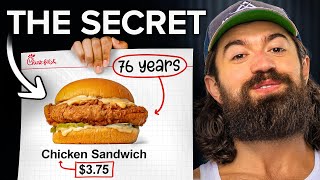
Alex Hormozi breaks down how Chick-fil-A built a $5 billion business from a $50 first day. The chain had 76 straight years without a down year by limiting its menu, closing Sundays, and accepting less than 1% of 60,000 franchise applicants yearly. It prioritizes culture and values over quick profits.
Questions this video answers
$50
Over $5 billion
76 years
60,000 applications per year
Less than 1%
Chapters
Chick Fil A makes more money than McDonald's, Starbucks and Subway combined. In their first day in business they made $50. And today they make over 5 billion. I love Chick Fil A. I love their sandwiches, I love their desserts, I love their milkshakes, I love their waffle fries, I love their sauces, I love their tenders. But what I love even more than that is their business. Because there are lessons that all of us can take in terms of how they do business. Not what they talk about socially because, but the actual business of running a business and how you go from $50 to 5 billion. And I can promise you it's not by doing what everyone else does. And they did that without raising tons of debt. They did it over 76 years. They did it after the founder died and have continued to grow. And they never had a down year where they went down in sales. For 76 straight years. They sell 1/4 the amount of items of any other franchise. Subway has 7 1/2% net margins. Their royalty alone is 15% of top, meaning their stores are running 20, 30 plus percent margins in brick and mortar food. And they do that being open only six days a week, having 52 days a week that they are closed. Unlike any other franchise. No franchisee can own more than one location. Unlike any other store. They get 60,000 applications a year and they only award less than 1% of those people a store. And they do it with arguably a very controversial social setting that would never work in a publicly traded corporate company that has to massage its pricing. So here are the lessons that I take away from Chick Fil A that I've tried to apply it as many different places in the portfolio companies that we own and even just ad acquisition.com@ the holding company number one is that they sold chicken sandwiches for 76 straight years. And I don't think they're going to stop having singular focus on the core products and not getting cute and not getting fancy and not having 49 menu items. But just saying, what are the things that the most people want and how do I get better and better and better at doing those things? Because better gives you leverage. It means the same input gets you more output. Rather than having lots of different things you have to put input in, you just put more and more and more because you only have so much juju. If you had two items, you can only split test them half as much as you could want. For example, if you think about this like an Olympic runner, the difference between first place and fourth place in The Olympics is a tenth of a second, but the difference between first and fourth for a person's life, massively different. We get these outsized returns by making these marginal improvements of being better rather than being new. Despite our entrepreneurial desire to have not a chicken sandwich, we're like, what about tacos? What about burgers, right? Like, how many times could they have done something like that? But they did it because they knew that they wanted to stick to the essential few and they knew that focus is what was going to compound over the long term. Despite being publicly criticized for not taking on debt and not trying to grow faster, for talking five, six, seven, eight years having somebody beat him. Boston Market. Remember Boston Market when they had their rotisserie chickens and the Mac and cheese and all that stuff? They took on a ton of debt, grew super, super fast, and then imploded. Boston Market shot up and then shot down because he wasn't thinking on a five or a ten year time horizon. Esther Cathy has literally sold chicken sandwiches from the time he was 25 till the day he died. He was a missionary, not a mercenary. He wasn't doing it to brag about his ego. He was doing it because he believed that this way of doing business was what he wanted to represent. I know that the likelihood that my competitors are going to be here in 70 years is almost zero. So if I build in a way that I'm going to be here in 70 years, I will win by default fault. And I think that's powerful because so many people want to say they're number one. The question is, when you look at the richest man in the world, I want to be the richest man in the world. You got to respond to somebody's answer with for how long? Because eventually you die. What are we aiming towards? For him, he wanted to build an amazing chicken franchise. His legacy outlasted his life. And for me, that's my dream. My hope is that whatever we build can continue and not only just stay alive, but grow beyond us. And that you can only do through a mission, not through a mercenary cause because if you're just chasing the money, people get diluted out because there's always a shiny easy win that distracts from the core items. The fact that they don't let anyone have more than one store. I think there's a lot of wisdom to this. So there are lots of people like.
Let me, let me open 100.
And they're like, no, because you're not going to be able to focus. We want someone to put their heart and their soul into their location and treat it like it's their own. While he was alive, you have to have worked at a Chick Fil A. I think they loosened that up because he wanted to create a way for people to come in mopping floors, flipping burgers, going all the way up, and then eventually own their own franchise. He has profit sharing now, mind you. He doesn't share the whole profit, but after he takes his pieces off, they have an ability to make more money. And having that kind of, I'll say, uncapped earning potential for somebody is very inspiring, but he keeps it constrained to a singular focus because they know that somebody can give it their all at one location. They've already tested that. They've learned over the years, and I think there's a lot of wisdom in that that we can take for our own businesses. Number four, saying no on Sundays means that you have to say no to things that are obviously going to make you money but will deter, detract from your values. And so there are lots of opportunities in entrepreneurship, and you probably have some on your docket right now that you're.
Like, I don't know, this is a little left of center. But, like, it's such an easy win.
Imagine the new CEO comes into Chick Fil A tomorrow and says, you know what? I found a way to make us 13% more sales and have most of that drop to bottom line. They're like, what's your amazing idea? And he's like, we're going to be open also on Sunday. It would be such an easy play. And imagine how hard it is to say no, because in the beginning, he had to say no to an extra 13%. On a million dollars, it makes another 130,000. But when 13% is $650 million and you still say no, it means that you're appealing to a higher power, something above the money. Values matter more than just about anything, in my opinion, if they are true to the founder, true to the business, and they operate in that way. And I would say that Chick Fil A is a great example of a type of company that believes in its values through and through, and they practice what they preach, pun intended. Now, I also believe that appealing to something above the money long, long makes you more money. But you have to say no in the short to get the long yes. One of the things that permeates any Chick Fil A, if you've ever been there, is that they have a culture of service.
You're one step away from an awesome lunch Meal. It'll be a pleasure serving you at our drive through window. After two more things. You know what that is?
Fish club each.
You guys are awesome. One and two, you have an awesome day up ahead.
All right, thank you.
And so what they did was they actually studied the hospitality industry and even hired people from Ritz Carlton to help them create an exquisite experience at Chick Fil A. Estreukathy noted that when he wanted, everybody in his team and his company started saying my pleasure, it didn't change until he changed how he spoke.
He's trained all of us to always respond to thank you by saying, my pleasure. So if somebody wants a refill, my pleasure.
People will learn 10 times more from watching what you do than listening to what you say. And so if you say, hey, we're all about being on time here, but you, the CEO, are late, it will never work. We have to pick the very few values that we know that we will never break, that we will always stick with. Which is why values have to be true to you, not nice words on the wall. Because they have to be things that you would actually live. Otherwise, they are meaningless. If you want to have a business that grows even longer and bigger, you want to have a compounding vehicle built within the business. Chick Fil A has a compounding vehicle of capital within their business. Whenever a store creates money, they have the cash and they can pick the next location. They buy the land, and they buy everything itself too. So they get the highest return and they get some tax benefits. And so if there's ever areas in the business that we can get some kind of compounding effect where money compounds on itself, that is something that I always try and build in every business that I have is how can I get this money that I'm getting today to make me even more tomorrow? Within the structure of the business, not taking the money out and putting into stocks or putting it into just like a random fund or whatever it is, but actually saying within my business, where I have active control, where I get the highest returns based on my skill and my competitive advantages, I get higher returns. And that's how these guys build Crazy wealth that beats the market. Ruthless prioritization on the essential few items that they need to sell. The fact that they haven't changed their menu in decades should be a testament to the fact that we as entrepreneurs want to change it all the time. There's a Henry Ford story that I think drives this home. He was looking at a marketing campaign, and he had been working on it with his executives point at some three or four months in, he walked past his marketing CMO's office and was like, hey, when are we gonna stop running that ad? He's like, I'm so tired of it. And the marketing executive looked up to him, he was like, you haven't even ran it yet. And so the thing is, is that we have all these things that happen in our mind because we're always iterating. Like we assume everyone knows everything about our products. We assume everyone's already bored of it because they're talking about chicken sandwiches 24 hours a day. But reality is that most people might get Chick Fil a once a month, right, as a treat. The customer's perception. When we change something slowly in our mind every six months as a small business to a customer, it just feels like it's constantly changing. There's no consistency. People value consistency. People want to know that when they exchange money, they're gonna get the thing that they liked last time. And if you make the same thing the same way over and over again, it also gives you the opportunity to improve it. If you have to improve a hundred things, it's a hell of a lot harder than improving two or improving one. And so you've heard me say one product, one avatar, one channel. For anybody who's trying to make their first million each one of these stores, if you think about them as a single business, like that's how they're thinking now. Do they have drinks, yes, etc. The principle behind it, compared to everyone else, the marketplace, they have a quarter the amount of things on their menu compared to McDonald's and they make twice the money. They have such a refined menu because it makes the order process have fewer mistakes in it. It makes the drive thru process happen faster. They're able to have less food go bad because they don't have to have all these extraneous options. They follow Prado's principle of 80 20. They know that 20% of their stuff creates 80% of their sales. They have all of these efficiencies in there because they're not trying to be cute, they're trying to be the best at a handful of things. And by doing that they've been able to sell way more than anyone else does with a way more constrained menu and do it so much more profitably. There's wisdom there. And so I try to think about that as like, okay, even though I could do those things, should I? And most times the answer is no, I should just get better at the thing that's in front of me and confront the problem that I have, which is how can I sell more chicken sandwiches? Whatever your chicken sandwich is. And to drive even further on the focus, they have even at a micro level within their core product, the chicken sandwich, if you Compare that to McDonald's Big Mac or Burger King's Whopper, McDonald's Big Mac has six ingredients, the Whopper has seven, not including the bun. Now compare that to Chick Fil A's sandwich which just has butter, pickles and chicken. That's it. They even have half the ingredients on their 1/4 sized menu because even then they get more efficiencies at the ingredient level. They make it faster and easier to prepare so it's more consistent and they're able to do that with greater economies of scale and they can make the process itself leaner and faster and leaner and faster. And then you do that for 76 years, you become unbeatable. So one of the things that when they were asked why are you so limited in their, in your selection, besides all the reasons I already gave, their response was that every time they added another item, they just saw their sales of their main thing decline. So they're just splitting some sales off the thing, their core products. And so how many of us have opened a new thing, gotten people to switch from the old thing to the new thing and now you're doing two different things for the same amount of money. Sound familiar? Happens all the time. And so it takes the discipline to say no and say we're just going to get better. The last piece that makes them exceptional, I think is their VP of growth who was talking about this. He said 80% of what fast food restaurants do between each other is the same. But I wasn't hired here to do the same thing that the other 80% are doing. I'm hired to do what the 20% are not doing. That much more efficiency has been driven into how can we improve this business? Because if we change nothing about this business, we sell the same 12 items, you just get better and better and better at the same thing. They even do practice runs in an indoor arena for the drive thru to test in real world scenarios to see how they can make the drive thru more efficient and increase the accuracy. That's the level of detail that the kingpins can do because they've been doing it for 70 plus years. The biggest takeaways I see from the big companies that I try to apply to my own business is what is a business that I could be in for 100 years. I believe that if you only try and solve the same problem for 100 years, you get pretty darn good at solving it. After Kathy lived that and then he. I mean, technically even died, that he took one concept, a chicken sandwich, and thought, how can I just do this one thing that everyone understands better than anyone else? And he built an empire, and he built a mission behind it that I think millions of people are happy and frequent every day. He has edged his way to now being number three and likely will become the second biggest food chain in the entire United States.










