Build a Team of Superstars
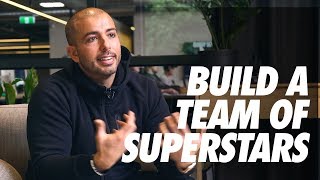
A first-person, advice-driven YouTube talk (presented by Sabri Subhi) about scaling a business by building a strong team and an "intoxicating" culture. Key points: clearly define a mission and vision to attract talented, mission-driven "A-players"; the founder must lead by example and focus on where the business is heading rather than day-to-day tasks; create opportunities for team members by growing repeatable sales; promote from within to develop managers who understand the company culture; maintain regular check-ins and active leadership to prevent attrition. Uses orchestra and coach metaphors and emphasizes founder responsibility for hiring, firing, and managing leadership.
Chapters
Hey guys, Sabri Subhi here and in today's video, I want to talk to you about building a team and really building an intoxicating culture within that team. Because if you run a business of any kind and you're looking to scale up, you're going to find very, very quickly that you're going to exhaust the amount of hours that are in your day individually, right? And that's when you're going to start what I call buying. And that's going to be by bringing other people into the business and leveraging that time to really be able to have more impact. And it's something that most business owners and marketers specifically like, they don't talk about at all. Like, no one is really out there talking about the quality of their team or talking about how proud they are of the team that they've built, right? They're typically out there talking about themselves or talking about a Lamborghini, or talking about the latest marketing hack or funnel that you can apply to your business. And you know, I think one of my secret weapons and what has really allowed me to kind of scale my business so quickly is being able to kind of hire and attract a players like, you know, fire breathing unicorns to come into the business, buy into the vision and really work with me to kind of build this business up. And it's something that I'm incredibly proud of when I say, you know, hire and attract and whatnot. It all starts with having, you know, a very clear vision and mission for your business. You're not going to be able to get really talented, hungry people to come in and work for your business if you don't have those things clearly defined. You're not going to even be able to really build a culture if there's not some mission for everyone to kind of huddle around and to really come into work and go to war every day to make happen. And that's really the very first thing you need to sit down and you need to think about what is it that your business doing? Like, what is the purpose of your business? Like, are you just in it to make money? Like, are you in it just to provide a good lifestyle for yourself? Or do you want to build something that's way bigger than that? And the reason that I say that is because you will have to, you will have to have some mission that is a lot bigger than you making a lot of money. Because otherwise you're gonna be able to bring people into your business and be like, hey, like you should get really excited about My business and all this money that I'm gonna be making, like, that's not how it works, right? And even on the money piece, you know, there's a certain amount of money that once you get and kind of any more money beyond that, it doesn't really have a huge measurable impact to you and to your life. And when you reach that point, that money is not going to keep you motivated. And that motivation is going to wane very, very quickly. Your sales are going to be deflated, you're going to lose all that wind in your sails and you're going to be kind of just have no direction. And you don't scale a business without having direction, right? So that's the first thing that you really want to stop and think about is like, what is it the vision and what is the mission to my business? What am I actually trying to achieve? What is the problem that I solve in the marketplace? And you know, why am I doing this? Like, what is that higher mission that you're fighting for that you believe, like there's some wrongdoing in the world or some injustice or just a much better way of doing things that you think you can do to kind of give back? And that's really what the why is around your business. So you need to get that really clearly defined. And that's going to set the tempo and the culture piece of your business. And the way that I look at it is like, you can get really good a players that come into your business and you want to look at like an orchestra, right? And you might have someone that comes in and they're very good at like playing the cello or the violin or whatever it might be. And you've got all these people that are like really individually good at what they do. But the whole orchestra, it's kind of. It's made up of something that's much greater than just the sum of its parts. And you, as the founder of that business is really the leader of that orchestra and the leader of that symphony. And you're kind of making all of those a players kind of contribute on their instruments to really have an incredible song. And that's really what it comes down to. And there's so many different moving parts to really making sure that that kind of takes place in your business. And let me just kind of run you through a few. A few of the things that I've learned in scaling my team from, you know, 0 to 65 plus all in house and really building a thriving culture around our business. And the first Thing is, you know, it all starts with you. It all starts with the founder. It comes from the top down. You know, regardless of how you want to look at it. You can, you know, have great people in the business, but they're always going to be looking to somebody. They're always going to be looking to someone to sell. Set that example. And you know, typically that's driven from the visionary, from the founder, from the CEO or whoever that kind of person is in a leadership position within your business. And you know, if you look at it that way, you know, you're going to be very critical of yourself and you're going to be really conscious of setting the best example for your team. You can't ask your team to do things that you either haven't done yourself or that you aren't willing to do. Right. This has got to be something where it's like, you know, you want to make it hard to spot the general by working like a soldier and by being in there in the trenches, going through the problems with your team and leading from the front. And when you think about leading and you think about like what the role is of the founder is, you're steering the ship. So I'm not talking about being so wrapped up in the day to day that you're worried about like what's happening this day, this week or this quarter. It will get to a point where you hire enough people that you know, where it's like, where I'm in my business, I'm not thinking about like, what are we doing this quarter, right. I'm thinking about what are we doing this quarter, next year, like, where is the puck going? Where am I leading my team, where is the market shifting and how do I position our company in the best place to really capitalize on where that market is shifting and one of these underlying currents in our industry and how do I really make use of those, those trends and how do I capitalize on them for our team? Because the next piece is opportunity. Like, you really need to create an incredible opportunity for people to come and work with you. And you need to be a founder that's out there pushing and shoving and scratching and really creating just an incredible opportunity for your team. And the only way that you can do that is by one, growing the sales of your business. Because, you know, if you have a repeatable way to bring in customers, bring in sales, and that's not something that you constantly worrying about, you can go out into the marketplace, extract the cash in exchange for value, and then you can reinvest that in your business and create opportunities for everyone on your team to win, right? Winners like to be in a team that is winning. And the only way to do that is to actually win and to go out there and to make that happen. Now the other thing that you really want to start to think about as you're kind of scaling your team up is how do you empower the other leaders on your, your team and how do you train them to be effective leaders? And the way that I like to do that is just by being an effective leader myself. I like to look at things of like not creating an environment where you need to manage people, but you need to lead those people, right? And if you've got like a team and you've got, you know, 10, 20, 30 people, it's obviously going to come to a time where you've had like a team that directly report to you and you're training them and you spend a lot of one on one time with them and you've mentored them up and then you're going to get like another layer and another layer of management. Those people that you directly worked with in the beginning, they're basically going to become managers, right? And I have found from experience that it's much better to basically promote internally than it is to hire from the outside for someone in a management position. And that's because they've spent a lot of time with you, they get you, they bought into your culture, they understand exactly your motives and the way that you do things a lot better than somebody that you're going to bring in from the outside, right? So, but then once you've done that, you've got that small group and then they're going to start leading people, right? And then they're going to be looking to you as the leader to basically see like, how do you lead other people and what's going to be tolerated. And the reason that I'm harping on about this, about the leadership piece is that, you know, this is not like a just set and forget strategy, right? This is something that you need to be a student. You need to be a lifelong student. You need to constantly be reading books about being a leader, about managing teams, about motivating people, about telling stories and getting people to buy into exactly what it is that you're doing. And you never want to get into a position where you as the founder have checked out of the business mentally, you know, emotionally, even the amount of time that you invest into the business, because that's going to just cascade and that's going to just set off this vicious, like, downward whirlpool of people just getting sucked out of your business, because all the managers and the leaders, they're not going to have anybody to look to, right? So that's the number one thing, is that you need to understand that it's like, you know, a sporting organization is the way that I like to look at teams. You want to be a really effective coach. You want to be out there motivating them, training them, and getting them to buy into your culture. And it's not, hey, I've hired you, let me give you a little spill and then leave you to your own devices, right? This is something that you need to check in with your team every quarter or every month or however often you know, that is available to you, too. But it needs to be something that's in the calendar where you can spend time with your team and let them know the mission of what it is that you are doing. And all I can tell you is that, you know, there is a limit to growing a business that is just based on one person or even two people or three people or four people or five people. Like, look at the big businesses that are out there changing the world, right? They all have ginormous, enormous teams. They have sound management structures. They have, you know, very good cultures within their business in order to do that. Nothing great was ever done by just one person. There is always that need to rally an army of people behind you. And it needs to be something that your coach, that you're conscious of and that you focus on. Because when you scale your business, it always goes through, like, a couple of different trajectories. And it generally begins with you starting a business because you're passionate about it and you're on the tools, you're carrying out all the work. Then you get too many clients or you're making too many sales that you don't have the time to do that anymore. And then you take one step back and you hire somebody to go in there and do that. And there's like all these different ascension points on that path to growing a business. And it gets to a point where at the very, very top, your number one responsibility of the founder and of yourself is really to bring in a players into your team. It's to be hiring, it's to be firing, and it's to be managing that management and that leadership team to go out there and really rally the troops, to go out there and basically achieve the mission and vision of your company. And it's something that no way near enough people talk about. But I assure you that once you get your business to the size where you've got five, 10, 20, 30 employees, that this needs to be the area that you spend the majority of your time. Because the business is a system and its inputs processing those inputs to getting the outputs. And if you have shit inputs, you have shit people coming in, or even if you have good people that aren't aligned and they haven't bought in to your mission, then the processing of those inputs is going to be subpar. Therefore, the outputs of what your company is puts out into the marketplace is going to be subpar. And it's the outputs that are directly correlated to the value that you create and how much you're compensated for that value in the marketplace, which is the sales and the revenue, which is the scoreboard in business. So I would really urge you to stop think of your team. It's been a few months and you haven't checked in with your team individually. Some time in, spend some time with them. You want to treat these guys like your family and really look after them. Things that are just outside of even work, you want to look after those things for them. Because these are the people that you are really in the trenches, on the front lines, going to war with every single day. So I hope wherever you are at on your business journey that you got something out of this. Hey guys, if you enjoyed this video, make sure that you click the like button and subscribe. We're dropping a video on YouTube every other day and if you've got any questions about any of the content that I covered in this video, just basically leave a comment with Heysubree in the comment section. And every week we're also trying to go through all those questions and get them answered. So go ahead, click subscribe and we'll see you in the next video. Sam.










