Building a Frozen Yogurt Store in 11 Minutes
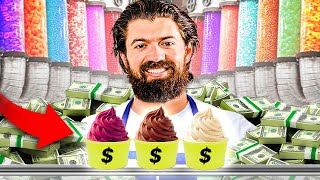
YouTube monologue (Nate Tilley) exploring the unit economics and practical lessons of running self-serve frozen yogurt stores. Covers average daily/topline revenue (example: $2,100/day), per-store annual revenue ranges, owner take-home (example: Menchies ~$93k), margins, topping vs. yogurt cost splits, franchise fee impacts, and operational tactics (pricing by weight, default cup sizes, product placement, cleanliness, and grassroots marketing). The speaker also shares personal plans and discoveries about buying used equipment from foreclosures and promotional strategies targeting colleges and affiliates.
Questions this video answers
$2,100 a day (selling ~500 cups at 8 ounces each).
Between $750,000 and $800,000 a year (average store).
About $93,000 a year (take-home).
8 ounces.
Approximately 75% yogurt and 25% toppings by weight.
Chapters
Frozen yogurt stores make $2,100 a day selling 500 cups at 8 ounces each. And it was the business that I almost started instead of starting my gym. So I know a ton about it and I will tell you how it works and what you can use from psychology that I learned from yogurt stores that you can apply to your business today. When I was 21 years old, I wanted to be an entrepreneur. And I was deciding between which business I should start. Either a test prep business because I had done really well on my standardized tests. Fitness, because I was in shape, I liked fitness. People always talk to me about it. And the third was frozen yogurt. I did an extensive amount of research on how to open a frozen yogurt store. Couple quick things that you may not know about frozen yogurt stores in general. They on average make between 750 and $800,000 a year. I thought 800,000 a year. That means I make 800,000 a year. I'm going to be rich. Doesn't really work that way. The average store that we're talking about does. 2,000 plus dollars a day means $328 a day in owner pay. They run margins between 10. The average Menchies owner, for context, makes $93,000 a year. Take home. Not as sexy as you might think. You've got strawberries that are going bad. You've got machines that are breaking in the back. You've got hard cost of yogurt. You've got a retail lease that's prominently located with good signage, good foot traffic, ample parking. Like there's lots of other things that go into this business. And on top of that, if you wanted to buy into a franchise, Most franchises have 6% ish of top line that goes straight to that. Now that may not sound like much, but if you're running 10% margins, that's 60% of your take home. So they have figured out a way to take the majority of the profit from their franchisees. And what most people don't know is that franchises will structure their fee so you make just enough that you can keep going. And maybe if you're a good operator, open another location. But not so much that you're going to get rich on it. So they're only looking to optimize to beat the return on capital of the stock market by a decent amount of if the stock market gets you 10, they're going to try and get 20 to 25 and they're going to squeeze off the top and take the rest because of how good their model is. The flip side of that is that if you are into a franchise, you should be saving enough on bulk purchasing because they're buying for 200 plus locations that they can save you on hard costs of things like yogurt, fruit, spoons, cups, machines, etc. The converse of that though is that many times when you're starting the franchise, they will upcharge you on all of those things because they're trying to make money too. There's the theory and then there's the practicality. Because I went on a site called Rasmus.com it's a business foreclosure site. I got my first gym equipment from that foreclosure site for 13 grand. I sat there and I'd refresh every week until eventually one came up and I bought it. All the gym equipment from a gym that went under. A franchise won't let you do that because that's where they make their money. But there are ways to open these things for cheaper. I did a cursory search on there before this video and there were three frozen yogurt stores that were franchises that went under in terms of I could buy everything inside the store. The most expensive of the three was 20 grand. You're trying to get into this world. You want to open a restaurant, you want to open a gym, Go find foreclosure sites. Now, you may have heard of some of these places. Golden Spoon, Yogurt Land, Menchies, Pinkberry. If you search frozen yogurt store near you, you probably have 30 locations that open up because there's demand for it. The average cup size is 8 ounces that people will buy. The average split between toppings and yogurt, 25% of people's weight is 10 toppings, 75% is yogurt. It's best for the store owner to have as much yogurt as possible in the cup because the toppings are more expensive. So toppings cost between 10 and 40 cents per ounce. Most places charge between 25 and 60 an ounce. They can even break even or lose money depending on which toppings you're getting. You get the fruit. It's costing them money, but they make up for it in the fact that yogurt costs them about 8 cents per ounce and they charge 50, even 60 sometimes. That's where the margin of the business exists. When you're working on margins that are even like 70%, that means that you have 70% left to cover everything else. So if you want to run a 50% margin business, for example, then you'd have to take 20% of your top line and pay every other bill. Very hard to do. For that $2,100 a day, they're selling roughly 500 cups a day of yogurt on average with an 8 ounce cup. Of all those brands, most of them are commoditized, meaning there's very little difference between a menchies and a yogurt land and a golden spoon. It's been a poorly competed marketplace solely done by franchisors who are trying to sell as many locations as they possibly could rather than build a brand. There is no chick fil a of the yogurt world because if there were, they'd be dominating. The underlying lesson is that if you look at any industry, there is the potential to have an amazing business inside of it, even if it is a commodity. Today you can out compete them. All you have to do is walk into any yogurt land and see that the floors are sticky, the chairs are all over the place, the cups are a mess, sample cups are strewn on the side. The girl behind the counter is on her iPhone when you walk in, doesn't say hello. One of the nozzles is out. It says out of order everywhere. It doesn't take a lot to win. Most times just to beat everybody. You got to be better than the bottom 25% and you make money. One of my favorite things that I learned from one of the big breakthroughs that I think they had was actually how they priced ice cream is usually sold by cup. You get a small, you get a medium, you get a large, they flip that and made it weight. The consumer gets to pick how much they spend. Someone might fill up a cup, get to the counter and see $7 and be like, ah, I'm such a fat ass. Rather than when you buy one off the shelf and then you see the $7, you're like, wow, this place is so expensive. Because there's an element of control on the consumer side. They are the ones who bear some of the accountability or responsibility for that fact. The second thing that they did that I thought was brilliant, they used to have small, normal sized cups at yogurt lands. Someone, I will bet you a few years ago ran out of small cups. And then people only had the medium and large cups left. And they realized that at the end of the day their sales probably went up by 20 or 30% and they wondered, I wonder why our sales went up. When you give people a bigger cup, they will fill more of it. They're like oh, I guess this is standard. The power of the default option when selling anything. That's why assumed closes and things like that are so powerful. When you say hey, do you want this or this? You can even listen for this. At fast food places they're like hey, do you want a medium or a large cup? They have a small option but they want you to pick between the larger ones. Yogurt land and those ones went a step further and just removed the small option because it is self serve. But if you got a small amount of yogurt in a bucket sized cup, it just looks weird. They did that and by extension were able to raise the amount of yogurt that people bought probably by a large percentage every single time and not take the blame for it because they're the one with the hand on the nozzle. You'll also note that the order in which they present the items are reverse order of the cost to them. So they start you with the cheapest option. This is exactly how buffets work too. They want you to fill up on the salad and then they put the seafood all the way at the end because they want people to fill their plates before they get the most expensive item. They'll attract you with the expensive thing, but they'll put it at the end of your self service line. You have the yogurt which is the highest margin first and then you'll have your dry items that don't go bad, crumbled Oreos, things like that. And then you have the fresh fruit that goes bad, that costs more money by ounce. And so they get people to fill up their cup in the beginning with the highest margin, then they sprinkle on a little bit of slightly lower margin. And then when you have almost no room left, then you put your few fruit on top. If you get a pound of strawberries, it's like 10 bucks. You put that pound on the machine. Ounces there cost you 60 cents. They'd be pretty much breaking even on that. Corporate noted that the number one way that they are able to get more customers and the highest performing stores did so with better service, cleaner stores, more selection and the most important one, word of mouth. When you have an average ticket that's so low, like yogurt cups and you have margin even on that tiny little cup. The only profitable way to really acquire customers is either word of mouth or affiliates, meaning other businesses that send you business, they double down on that. Now when they started years ago, Google search was cheap enough that they could actually drive pay per click campaigns to get people to their locations. But nowadays it's too expensive for most of them. So they almost all have to rely on the quality of the product and the experience. The way that I was going to open my store was that I wanted to create a better experience for somebody who walked in. I wanted to have floor to ceiling kind of candy, see through experiences. So when someone walked in they were overwhelmed and they would just turn, turn the nozzle on there, which by the way, I would have it so that it clunky so too much would fall through. So I get a little bit more weight on it. And I always felt like that you should have more selection. People eat more, the more options you give them. Then my promotional effort, my plan was to go to the university, so I wanted to be close to colleges. And then I was going to partner with all of the fraternities and sororities and have competitions between them to see who could get the most yogurt and then give some sort of swag or something for the fraternity or whatever that got the most yogurt during that period of time. I could rinse and repeat that process with companies. I could rinse and repeat that process with affiliations. And that is the cheapest form of advertising when you don't have a lot of money. Is going to find places where there's buckets of people that you can give them some sort of promotion to bring them in. I'd run the competitions to bring them in. I'd have a crazy incentive to get the text number. Like, hey, do you want to save 50% today by joining our text list? I just acquired a lead that I can get lifetime value on for $2. I'll take it because I know that I'm going to be able to get them back or get them to bring a friend and I want to be able to remind them of my store on a regular basis. So if you're looking at stuff that you can model from the yogurt businesses and also not do that, they're doing poorly. Number one, when you have the option to give a customer the ability to pick their own pricing by usage, do it. Oftentimes people will blame themselves, not you, when they overuse or overspend. Think about minutes, but back in the day or text messages. Number two, you want the most people to see the thing that makes you the most money first. We want to use up as much of their spending power on the things that make us the most profit. Number three, if you have a type of product or service where someone can sample multiple things. The more things you offer them, the more things they will ultimately buy and consume. Number four if you are starting a business, unless it's something brand new and completely radical, there's likely somebody who started a business just like yours who failed and you can oftentimes buy all their stuff for $0.10 or $0.05 on the dollar and dramatically decrease your startup cost if you can get a decent amount of actual equipment for that amount of money when you go to the right seller, and that is a motivated seller. Number five the power of the default option. The fact that they went from removing the tiny cups to only giving large and bucket sized cups for yogurt encouraged people to use more yogurt themselves. And they do that because it looks silly in comparison. 6. When you're trying to promote something that costs very little money, especially consumer products, it's very difficult to acquire customers with paid advertising profitably. That's why a lot of these places raise funding. If you don't have tons of cash and you're not funded, then the two most profitable strategies for acquiring customers you get word of mouth, which is referrals, is not just having a very good product, which is important, but reminding and encouraging people to share it. My podcast I just decided to say hey guys, if you could leave a review and share this with somebody, that would be great. As soon as we did that, we 20x the number of reviews that we were getting and our growth skyrocketed just because I asked. By the way, click subscribe and notification bell and all those things and share those tags.










