How I Would Invest $1000 If I Were In My 20s
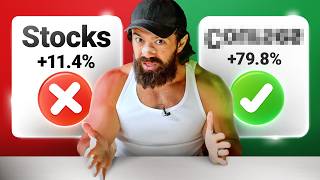
Alex Hormozi says skip the S&P 500 if you're in your 20s. Take a $500 phlebotomy course to triple your hourly pay. Invest in skills and mentorships instead, where returns compound faster than the stock market.
Chapters
I guarantee you that you will be making more than people who have four year degrees. You'll probably start making money by the end of the first year. I was at Brooks House and she had seven 20 to 23 year olds at her house, no cap. One morning one of the guys was up early and he was like, hey, right now I've got a thousand extra dollars. Like, where do you think I should invest it? You know, I've got my 401k and I've got, you know, whatever stuff. And it was cute. It was so interesting to me because like he was looking for an investment vehicle that was going to yield him return. I want to be very clear about this. If you invest in the s and P500, you know, real estate, things like that, and you start really early and you do it for a long period of time, you absolutely will make money. It is a very safe way to live life. But the moment you start investing in kind of the asset side of stuff, which is like the S and P stocks in general, and you're not day trading or doing that stuff because that's, that's stupid. The moment you do that is actually the moment in my belief that you're actually ceasing to want to make more income. Hear me out. If you're 18 years old and you graduate high school tomorrow, you are now eligible on the marketplace because you have no skills besides your high school diploma. You did no job, fucked off the whole time, don't watch YouTube to learn stuff which is not you. But just imagine, in two days you could go and become certified as a phlebotomist and go from making 750 or whatever the minimum wage is to a phlebotomist. Make at $25 an hour, you would triple your earning capacity after two days. And spending $500. If you can triple your income for the rest of your life, the $500 certification in two days, do you think it's worth the investment? Probably. And so the problem is that people think about the biggest investment as the stuff that they take their money and they put it into. And I'm going to be over, I'm going to be trite right now. Your ability to earn money, to provide value to the marketplace and solve problems for other people is how you will be able to make money. There's the value of the problem that you solve and what you charge for it. The bigger that number is, the more you can charge that gap between their old problem and that solution. That value is the percentage that you can take and put in your pocket as something that you have now created in this. And it could be a service, it could be products, it could be whatever your earning capacity is going to be the thing that generates you wealth. Do you want to be smart with your money and save it? Absolutely. Because that gives you way more that you can play with. But when you're 20, even when you're 30, and in my belief, whatever age you are, I believe that you should take all of the excess money, live as cheap as you can, take 100% of that excess money and invest it in education that increases your earning capacity. Because what happens is when you take that money, like that phlebotomy course, right, and you take $25 an hour times 2,000 hours a year, you're now at a $50,000 year income. Cool. If I can live on 20 because I'm 20 years old and I can live with buddies and we can eat ramen soup and whatever, and I got 30 leftover after taxes. 25, whatever. 25 grand can buy you a lot of education. I would rather you or I would rather me or somebody who's 20 or somebody who's 30 take $2,000 a month because that's what 25 grand is and invest it in course mentorships, workshops and seminars. Every month. I'm putting that 2K now. You could put 2K into one opportunity. You're like, dude, I think real estate school. Cool. We're not doing real estate as my passive income. We're doing real estate as I'm going to get into the real estate game and I'm going to make it my active income. And by the way, everybody who builds their wealth in real estate are actively spending their time in real estate. Don't believe what they're saying. They're like, dude, I did this deal and I made X amount of money. It's like, what was the process of finding deals? How many deals did you look at? How many conversations did you have? How many buildings did you walk? How many different general contractors did you. Oh wait, there isn't. There's other stuff that has to happen, right? Back to the point, let's say that you take that 2,000 doll dollars a month and you do that for four years. And I'm not saying do the four year degree. I think that is a play if you want to. I don't necessarily agree with it anymore in the marketplace that currently exists four years later, I guarantee you that you will be making more than people who have four year degrees. You'll probably Start making money by the end of the first year. The amount of like copywriting courses and books and programs, mentorships, and even one on one coaching. Like, I think one on one coaching is in a phenomenal way to learn a new skill. If you're like, hey, I need to know how to buy media. I need to know how to run an ad. Go pay someone who runs ads or teaches people how to run ads. When you make that payment, you're seeing it as one class in your entrepreneurial degree rather than this one. $12,000 investment has to make me rich. You can make that shift is like, this is my course. Like, when you get your degree in college, you're not like, oh, I'm going to take one class in Spanish, graduate and get whatever job I want. No one thinks that way. But for some reason think about that. When it comes to entrepreneurial stuff, you're not paying someone to think that they're going to be your savior. They're not going to save you from your life, do everything for you. No one person is going to teach you everything. I'll do my best on this channel to teach you stuff. I know, but you have something to learn from everyone. You know, like, that wasn't the value that I thought I was like, you can still learn from that. You want to go to the person who's providing the most value for free. It's the easiest way for you to decrease your risk of purchase. You follow someone's Instagram, you follow their YouTube, you see the stuff they put out and you're like, dude, this is really good. Like, this is a lot of new information that I didn't know. And that's like, very tactical. And I understand, like, a, you already know that you like the person. B, you already know that you're getting value from the person, from the content they have. And so the likelihood that the thing that they have that's paid is going to be worse than that is low. You know, hopefully follow lots of people in a particular space. See the one that you jive with the most, you like their teaching style. You don't need to follow this stuff for forever to, like, belabor the decision. Give yourself seven days. Because you know what's really even cooler than buying one person's? Buy them all. And then you'll know what everyone knows. And then guess what happens? You become just as good or better. Now you're making $80,000 a year. Well, now we've got $4,000 a month that we can spend on coaching and mentorships. And learnings and courses and whatnot. I always think to myself, like, I'm going to be the number one student here. I'll just do whatever they say. I'll see what happens. And I'll do whatever they say. I'll see what happens. You want to replicate before you iterate, before you say, I'm going to put my Alex sauce on. Before you do that, just make sure that you can duplicate what they're doing. Because then you earn the right to make the iterations, even if it's not perfectly your style. Copy it first before you make the iterations. If you see it as a bridge that has many bricks on it, you have to lay all the bricks. And here's the bad part. Let's say you've got 30 bricks on this bridge to make your first dollar. The first dollar has to walk across the bridge. When you're 28 bricks in, you might not have made the first dollar yet, but you're 90% of the way there. And the speed with which people are able to traverse or cross that bridge is how well they identify which brick is missing and where they put their attention. That's where a lot of people get disheartened, is that they will start building new bridges and get two, three bricks and then they'll start building a new bridge. Two, three bricks, and they have lots of half built bridges and they never make it all the way across. Let's say you're a videographer or you like video stuff. Skills stack exponentially. You got a video skill now. You got an editing skill now. You understand social media, messaging, copywriting and branding. Ooh, management and operations and leadership. See how that person starts to expand. You can imagine how their pay is going to dramatically increase because now you're a cmo, broadening your horizon and going deep in these other silos. And all of a sudden you're an entrepreneur. One is you have to make that decision that you're not going to spend all your money on stupid stuff. The second is that you are going to spend your money not on the S and P, but on the S in me. What is that? You're going to spend it on you? Because that thing is going to compound a hell of a lot faster than 10% a year. You can double, triple 10x your earning capacity. The people who are the richest people in the world, they make a thousand times more. Jeff Bezos made $40 million an hour last year. It's a lot.










