How I Wrote A #1 Bestseller with $0 and No Publisher
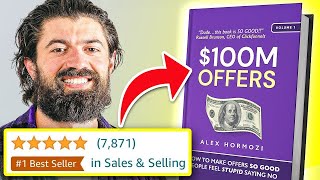
Alex Hormozi explains how he wrote and launched his #1 bestseller $100 Million Offers without a publisher or advertising, emphasizing storytelling, tightly focused problem-solving, iterative drafting, and heavy editing to simplify language. He reports the book sold over 200,000 copies largely via word-of-mouth, spends ~20–25 hours/week on his books, and prefers solving a narrowly defined problem completely. He outlines story structure (setting, character, desire, struggle, eureka, victory, resolution), newsworthiness factors that increase stakes (recency, impact, prominence, proximity, conflict, unusualness, updateability), editing rules (show not tell, use five senses, cut sentences/words/adverbs, prefer short words/sentences), testing frameworks for validity, crowd-feedback process (4–8 beta readers → editor), and production metrics (roughly 1,000 hours, eight drafts, condensed ~600 pages to ~200). He mentions tools and promos: hemingwayapp.com, and an upcoming sequel $100 Million Leads (expected within 6–12 months) with an early-bird list at acquisition.com.
Questions this video answers
Over 200,000 copies.
About 20–25 hours per week.
Approximately 1,000 hours.
Eight full drafts (reduced ~600 pages to ~200 pages).
From roughly 12th-grade language down to 3rd-grade language (notes average American reads 5th–7th grade).
Chapters
My last book, $100 million offers, just crossed its one year anniversary. It sold over 200,000 copies with no publisher, no advertising campaign. I launched it before I had an audience. Truly off of word of mouth. Alex Homozy just launched brand new book. It's 100 million dollar offers, 100 million dollar offers. And so people read the book and shared the book. You need to create a grand slam offer. If people aren't sharing it on their own, then it's not worth promoting because it's not good enough. I think that when I die, the thing that I will be most proud of is not the businesses that I've built, but the books that I've written. I think the books will outlive anything else and I think will help more people. That's why I spend right now about 20 to 25 hours a week every week on my book. Most authors pretty much only do that. They write for four or five hours a day and then they end their day. For me, I write for four or five hours, then I start my day. And so I wanted to do one deep dive video into my writing process. The most powerful ability in the world to influence other people is the ability to tell stories. That's because you can both educate and entertain with stories. It literally changes people's brainwaves when they're listening to a story and they become more suggestible. So I'm going to break down the elements of storytelling. How, how to edit a story to make it better, how to increase the stakes that make it interesting to a reader, and then how to do it in such a way that you're actually breaking someone's beliefs so that you can actually influence how they behave. And once you have that ability, you can use it to sell, you can use it to educate, you can use it to teach, to reshape someone's beliefs, you can change someone's character. You can give skills like there's endless ways and it's the most effective way to communicate to other people that there is if you wanna write a book. The way that I outline these things is what's the point of writing this book to begin with? What is the problem that I'm solving? The vast majority of books that are written now are not written because they want to serve the audience. They're written because the author wants to make money from the book. Accolades, whatever, most books are not worth reading. When writing and publishing a book became easier was about the 1960s. From that point going forward, the amount of books that were published, you know, has exploded. 1.6 million books are written per year. The reason people publish has changed, but I believe that great writing comes from a place of wanting to add to the body of knowledge. And when you do that, then it allows to compress five years into three hours or four hours for somebody. And that's where a book becomes valuable. Next is kind of like, how do you come up with a big idea? And then after that, I'll talk about the editing stuff from a big idea standpoint. This is what actually takes me the longest period of time, which is narrowing down the focus of the book to a single problem to be solved. I have to answer the question very truthfully. What do I want someone to get from this book? The first book offers is people don't know what to sell. And so that's the first problem somebody has before they can make money is they have to know what they're actually going to sell someone, which is the offer. And so that's why I started my book series there. The next problem is they don't have anyone to sell it to. They need leads. And so the idea is that when someone's going to meet somebody else, I have to think like, where does my book come out in the wild? Just saying like, oh, I read this great book. You should read it. Some people read that. But where I think it's best is where someone's like, dude, I wish I had more leads. People are like, oh, if you're suffering from that, you have to read this book because now it's a solution to someone's problem. The problem with most books is that they don't actually solve anyone's problem because they basically name hundreds of problems and don't completely solve any of them. So I would rather very narrowly define the problem and then solve it completely. A good book is a complete solution to a narrowly defined problem. And so what is the problem that we're solving? And then what are the ways that I would think about solving the problem? Usually it's going to be three to six big buckets that are going to fit for solving a specific problem. Once I have those buckets, I'm going to think, what are the experiences that I've had that have shaped this belief that I have about this? Like, why do I think there are these three to six buckets? It's like, well, this is what happened in this time, and that's what shaped this part. And this is what happened this time. This would shape that part. When I saw the charity event at Arnold Schwarzenegger's home that we were invited to. I saw scarcity in action about how are they able to sell these things that were never normally worth more than $10,000 for $100,000? There was all these other factors at play. And so it was a very good story for me to transfer, like why scarcity is important. There's lots of different frameworks for creating stories. I will give you the one that has been useful for me setting, which is where this is happening. You have the character, the person who's doing the doing. You have the desire, which is the thing they want. You have some sort of struggle, why they can't get it. You have some sort of eureka moment that changes things, achieving the victory and then some sort of resolution. They talk about this as the heroes two journeys. But not all stories have heroes that have two journeys. But the external and the internal, and you want to tell both. The external is what you can see with your eyes if you were in the room. The internal is what you have to experience as the person emotionally. And see, we want to weave both of those together in the story. And so someone might have the victory, but it might feel empty. And so it's like we want to tell both sides of that. There's two kind of rules of thought that I use. One is I want to use all five senses. So I talk about what I smell, what I hear, what I see, what I can touch, how things feel Like I could feel the back of the chair against me. My back was sore because I've been sitting for hours. So I could set the setting that way by kind of describing rather than telling. Number two is you want to show rather than telling. So I'll give an example that Stephen King uses in his book on writing, which is a great book. Instead of saying Cheryl walked in, she was his ex wife, he might say something like he stroked the spot on his finger that was still bleached from where his wedding ring used to be. You show the situation to the reader rather than telling them. And that is also true of great copy of great marketing, of great ads, is that you want to demonstrate rather than saying it. Well, then what details do you include? Because I could spend an entire book to describe this room. But if I just said there was a pelt on the wall and it's made of wood and there was a view of water and pine trees, you probably have an idea of what kind of place this is. You want to be selective about the details that you're choosing to call out, because otherwise you're just wasting time. Now, if the pelt that I have on the wall in my mind's eye is a deer, and in your mind is a buffalo. Does it change the story? And if the answer is no, then we don't need to go in more detail on it. You want to be vivid in your description about the things that matter. For me, I've always had stories heavily ingrained in books because I want to bring the experience that taught the lesson with it, because then it gives context to why the framework that I introduced in that chapter is useful. So what makes a story interesting? I like to think of it as one main thing, which is stakes and struggle. I can give you a simple story. I was at home. I was hungry. I couldn't find any food. I realized I had my phone and I ordered Uber Eats. Ubereats arrived, I ate, I was satisfied. That is a story. It's not a very interesting story, but it is a story. If I tell that same story and I were to say I was hungry, I'm a diabetic. If I don't eat, I could die. And there was no food in the house. As I was rummaging around, my vision started to narrow. I started getting cold sweats, and I was like, am I going to be able to get food before I pass out? My family's out of town. They're not going to be able to find me. And so I started having thoughts about, like, is this how they're going to find me? My body on the floor? What are my kids going to think? All of a sudden? I created stakes in the story. The reason game shows are inherently interesting is that they literally put money on it so that there are stakes. That's why those exist. Imagine you were watching a bunch of poker players play, and the chips were meaningless. Like, stakes is what makes things interesting. So there was a textbook that my buddy Dr. Kashi also sent me to create better ads, write better copy, and ultimately write things that are more interesting. What are the factors of newsworthiness? And so if you think about newsworthiness, it's just, what are things that make things interesting? And so there were seven components. The more of these components that you can tie into a story, the more of a story it is. And they literally even talk about stories in the news, like, what's the story? The first one is recency, how far away the event was to the thing. So if you think about, you know, hopping on trends as fast as possible when you're telling stories, the recency with which the thing occurred to when you're telling the story makes it more interesting. The second one is impact of the event. So if there's a story but it has no impact on the reader or the listener, it's going to be limited, which is why it's the job of the author to a select the stories that they're going to tell and then make sure that they're bridging why this is important for you as they're telling the story, and then they tie it to the action items, especially if you're teaching that you want someone to take as a result of that. The third is prominence. Like if Kim Kardashian sneezes, it becomes interesting because of how prominent she is. And so if you can involve characters that have prominence in a story, then you make the story more interesting in and of itself. The next one is proximity. So it's close to homeness, if you will. If I tell you a story of a house that's burning down, it might be kind of interesting, but if I told you it was your neighbor next door, it's probably much more interesting to you. If you have an ad and you're marketing to a local market, the closer you can get the headline, if it's, it says, rather than like Baltimore, Maryland, it says Towson, Maryland, which is a sub suburb or whatever. They're going to be much more inclined to listen to it. The next thing that makes something interesting is conflict. Whether that's natural or whether it's between people. We're here recording this video and a man with a gun walks in. All of a sudden, this got way more interesting. And so it's because there's conflict, there's tension, and there's unresolved, there's mystery. The next one is, how unusual is this thing? Is there something odd or bizarre or unique about this particular situation or story? Like, if you see something that you expect, your brain doesn't say, oh, let's pay more attention to this, because it matches the patterns that you expect. And so the idea is that you want someone to cast a pattern or expectation on your story, and then all of a sudden you shift it and they're like, whoa. And then their brain will divert resources towards the story because it's not matching the patterns that they already had in their mind, which means they need to create attention to reconcile the conflict between what they expect and what is reality. And the last one is the amount of times you can update. So this is a little bit more around news, but it's like, how many times can you update someone on the same thing? Right. That's why news stories love giving updates up. We're pressing news right from the crime scene when you're telling a story. Might not be always able to do that if you're fixed in a story setting. You don't have to have all of these things, but if you have two, three of these things in one story, it makes it a much more interesting story. Hey, guys. The much awaited sequel to $100 million offers is $100 million leads. It is coming out in the next 12 months, realistically probably six months if you want to get on the early bird list, because last time we sold out in less than an hour. So if you want to get on the early bird list and just make sure that you have a guaranteed copy ready for you for distribution so you can use it and get more leads in your business. Go to acquisition.com anywhere and just opt in. And then you'll get automatically added to that list that we can send you the link the moment it launches. Once you have that, you have a way to tell a story. Now it's like, okay, well then how do I bridge that into a wireframe for a book? And so for me, my general rule of thumb is that I just put stories in where I feel like it starts to get heavy. I want to deliver as much of the things they need to do in their business. And right when I start to feel like it's heavy, I zoom out and I create a story that creates more context and we dive back in. I have my big problem, the supporting arguments that lead up to that single thing. And then I have the stories about how I learned each of those things to fill in the blanks for that book. And then the framework for each chapter. Now, once I have that, I have a general idea of how I want to go about solving that problem. Everyone has different writing processes. For me, I go as far as I can until I realize that I have a logical inconsistency or an inconsistency with my own experiences that would prove my theory or model wrong at that point. This is the part where most people don't want to do it. I go back to the beginning, I adjust my assumptions, and then I restart the book and I write it again. And I usually get a little further. And then I realize that something is wrong with the model. And the bigger it is, the more I have to adjust the book and start over again. Models have to be two things. They have to be useful and they have to be valid. There's too many things in life that you don't want to rediscover and redo the work. So your brain creates these mental shortcuts, these mental checklists that you go through in your head. A lot of them are not documented. So all the framework really is is documenting the checklist you already go through. There's always a process everyone goes through to make a decision, as simple as they may be. Which serial am I going to grab? The one that's closest to me, you know what I mean? Like, it's. It could be as simple as that. There's a framework that you use, and it is useful. Now the question is, how valid is it? And the validity of a framework depends on how many different circumstances it can be applied to and also still work. The very valuable frameworks like E equals MC squared apply in every one that we have found to date, which is what makes it so valid. When I'm testing a framework, I know the situations it does work. And so then I start testing it in new situations, seeing if it's still valid. And if it isn't valid, I go back to the original framework, say, how would I need to adjust this so it would incorporate both. And then I tested another situation in another business situation, until eventually I get a framework that I can't find a way that it's wrong. The longest process for me is ideating all the pieces that are going to be in the book. The next longest process is actually writing the first draft. From there, I go through my heavy editing of going from 12th grade language to 3rd grade language with more pictures. My goal is that when someone reads the stuff that I have, that they spend as much of their mental capacity on consuming the concepts and not translating the words into things they understand. The average American reads somewhere in the neighborhood of fifth to seventh grade, depending on where you read, which means half of Americans read. Below that, there's a free app called hemingwayapp.com that literally is just a paste box. And when you paste your words into the box, it highlights it and says, this is too complicated. Adverb passive. If you want to train yourself to be a better writer, using it gives you immediate feedback. Because as soon as you change it, the color changes. And so when you talk about changing people's behavior, having something that immediately gives you feedback when you make a change is the best way to reinforce behavior quickly. And so I think it's one of the best teaching writing tools that exists. It's so simple, you'll be amazed at how much better your writing comes out. So if you have a paragraph and you can eliminate a sentence and the paragraph's meaning stays the same. Eliminate it. If you can use shorter sentences versus a long sentence, it is better to use the shorter sentence. If you have a shorter word, it is better to use it. Try to eliminate adverbs whenever possible. Really whenever possible. Like, whenever you're like, I'm really not sure. Still trying to eliminate it. Most times when you see an adverb, it's because you did not use the right verb. I walked quickly. It would be much better to say I ran. I always used simple tenses. So rather than, like, would have liked to, I just say wanted or wanted to. If you can't make something sound simple, it's because you don't get it. Not them. From there, I go and send it to 4 to 8 of my, like, ideal readers. People whose opinions I value but don't hold me in high enough esteem that they're not going to tell me the truth. So they're like, hey, I had questions here, or, this didn't make sense, or, this sounded contradiction to something else, whatever. And so they send me back their notes again. I use Stephen King because he's just, like, my hero for writing, but he's like, if you get lots of different feedback from everyone, then you did a good job. If everyone's saying the same thing, he's like, you probably should change it. Once I get the feedback from those readers, I create what would be considered my third and final draft. Then I send that to an editor for, like, grammar typos, et cetera. And then at that point, I have what I would consider my finished book. I spent a thousand hours on a book, roughly. And a lot of people can't comprehend that, like, level of work, which is also why most people can't make good stuff. People think that writing a book is, like, just literally getting the word account to a book size and then slapping a cover on it and shipping it, which is why there are so many bad books. There's this visual that Stephen King gives that I think is, like, the best visual, and it gave me hope about writing. He said, writing is walking uphill with a bag of rocks, where you keep adding rocks the higher up the hill you go. So the longer you've been writing something, the heavier it feels. He's like, you just have to have the endurance to be able to go through the hard work, pruning through the writing and killing the darlings, where you're like, I spent so much time on the section you. But it shouldn't be in the book. With this particular book, I went through eight full drafts. So it's about 600 pages of writing to create what is now 200 pages of version eight of the book. So with the leads book, I can tell you the sections of the book are understanding how to talk about leads. Get leads. Get other people to get you leads. Get even more leads. Do it. Those are the sections of the book, right? Like, that's very simple. And then within each of those subsections is the different types of ways that you can collect leads. And so. But all of them aligned that single point, which is, how do I get people more leads if this thing that I'm writing does not apply to that? You take it out. I'm shooting for a book a year. We'll see if I get there. But like, that's what, that's my like mental back of napkin goal is, you know, I still have to like run all the companies and make these videos and stuff. So if you took some takeaways that you can write into your stories, into the content that you make, into your marketing, into your advertising, into the stuff you use to sell people things should check out my content video of how we gained 1.2 million followers in six months just using a standard step by step content strategy, which I break down in all the detail and the stages that you can apply them within your business right now.










