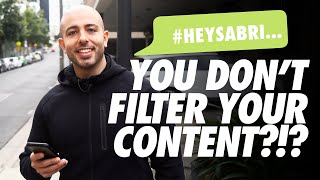
This is a short YouTube Q&A where Sabri Suby answers a viewer (Steven Chen) about how much time he dedicates to learning and creating content and how he filters incoming information. He says he spends ~2–3 hours daily actively learning and treats work as an all-day orientation (from waking to sleeping), values activities that fuel creativity (exercise, renewal), and produces content partly via weekly sessions with a collaborator. For filtering, he researches creators’ credentials and overall life balance, looks for principles and mental models rather than isolated tips, and warns against adopting "mind viruses"—toxic ideas that can derail progress for years.
Chapters
Hey, guys. This week on hey Sabri, I'm going to be answering Steven Chen's question. He's written, hey, Sabri, how much do you dedicate? How much time do you dedicate in learning knowledge and producing content? Also, how do you filter incoming content on your path? Cool. So in terms of how much time do I dedicate to actually learning and sharpening the sword, so to speak, I probably dedicate two to three hours per day on that, from reading to, you know, practicing my craft. And that's just, you know, my day is set up in a way that enables that. And, you know, most people only look at work for the time that they're actually sitting down in front of their computer. Now, when people ask me, like, you know, how many hours a week do you work, Sabri? The answer for me is, like, from the moment my eyes open, the moment they close at night, right? And that's because everything that I do, from learning to exercising, to, like, my whole renewal schedule of how I renew my energy, that is all that fuels the person that is able to produce the results that I'm able to produce. So, you know, when you're learning and when you're reading, when you're spending time on those things, don't think that that's not work, right? Because a lot of your best ideas will also come in those times. Like, a lot of the, you know, the hooks, the copywriting, all the stuff that I do, it's not like I sit down at the computer and be like, oh, let me do this now. Right? It comes to you from all the other activities that you do in terms of content production. I catch up with my boy Ilya for about an hour a week, and we produce content in that one hour. Then everything else is just really documenting everything that I'm doing and building my business. And then to unpack your last question, we can walk back this way to unpack your last question. In terms of how do I filter content? It's a great one. The way that I look at the content that I consume is I spend a lot of time researching the person that has put out that content. And I don't spend time, you know, really with, like, shallow content and blog posts and all that kind of stuff, because, like, you think about how long it takes for somebody, for instance, to research and write a blog post, and it might be just say it's some epic blog post, and it's 15 to 20 hours. Like, that's not a lot of time, right? And it's a very fleeting piece of Knowledge. I look for principles, and I look to understand the way that people feel, think, and what leads them to make those decisions that they make. So I'm really doing an audit on that individual, what their credentials are, what they've been able to achieve, not in just one area of their life, but really in all of them. Because, you know, I talk about engineering being a eudaimonic polymath, and that's as somebody that is well balanced in all the different areas of their life. Because for me, you know, if I am trying to learn something from somebody that's in business, but they have, like, a terrible relationship with their husband or their wife, and they've failed at doing those things, or, you know, their health is in shambles, that's not what success looks like to me. So I really want to look at somebody that I look at the whole package and everything that they're doing and everything that I've achieved and seeing, like, is this. Can I get something from what this person has achieved? Can I learn the way that they think? Not what they say, but how they think? Because what they say changes over time, but how they think, typically, you know, it's based on what their mental models are and the way that they've constructed their life. And I'm very selective with the information that I do put into my mind because, you know, a lot of content out there and a lot of ideas. People don't realize that it can take you one bad idea to really throw you off your game for a year, for two years, for three years. And I call these things mind viruses. And they're very, very. They can be very toxic and very bad. And it really comes down to consuming other people's information before you've really audited who that individual is. So I hope that helps you. Hey, guys, if you enjoyed this video, make sure that you click the like button and subscribe. We're dropping a video on YouTube every other day, and if you've got any questions about any of content that I covered in this video, just basically leave a comment with heysubri in the comment section. And every week we're also trying to go through all those questions and get them answered. So go ahead, click subscribe, and we'll see you in the next video.