"HYPER Focus" TRY IT FOR 1 DAY! You Won't Regret It
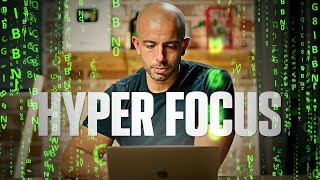
An entrepreneur shares an eight-step system for hyper focus: audit your time, drain shallow attention, optimize sleep and energy, automate decisions, batch tasks by energy level, declutter ruthlessly, invest in ergonomics, and design a work environment you actually want to be in.
Chapters
Focus is the number one superpower in life. It is the currency that the modern world is built on. And nothing will impact how successful you are more so than your ability to focus. Because it doesn't matter how skilled you are if you can't apply those skills by focusing. And just like any other skill, you can get better at it. And in this video, I'm going to walk you through my eight step process for unlocking unwavering hyper focus. This is the exact eight step system that took me from an add ridden entrepreneur with an extreme and chronic case of shiny object syndrome to running a hundred person company with multiple offices, thousands of clients, having a family, having a Life, traveling to 15 plus countries per year and almost selling 1 million books. This is what has worked for me and I hope at least some of it will work for you. When I first got started as an entrepreneur, I found it incredibly hard to focus. It was the first time in my life where I didn't have an agenda that was really set by somebody else. So I would just wake up in the morning and I would sit down on my computer and I would be like, well, it's time to get to work. Not only did I not know how to focus, I didn't even know what to focus on. And it was only after doing this for extended periods of time when I was like, this is not effective and I'm not waking up in a structured way and actually just chipping through and moving the boulders that are really going to propel my company forward. So everything that I'm telling you in this video, it was developed not from reading some productivity books or anything like that, it was learned from literally working away in my dungeon and figuring out like what is the most effective path and not only what is the most effective path to work on the big boulders, but then once you determine what those boulders are, how to just ruthlessly get shit done and not get distracted by the never ending little bleeds of your attention, they're going to come your way when running a business. Now this brings us to step number one, which is total awareness. Whenever in your life has somebody sat you down, identify what are the most important things that you need to do and then once you've identified them, to actually get them done. Yet most people just get caught up in this race of being productive and being busy and letting the busy work get in the way of the important work. So the very first step in this whole process is to become hyper aware of what are the things that you need to focus on and the way that we figure out. What you're focusing on is by doing something that I call the King's order. You look at the 24 hours that you have in a day and let's just say that you're going to sleep for eight hours, then you have 16 hours of the waking day. What you want to do is you want to break down those 16 hours into 30 minute increments. And really every 30 minutes that goes by, you mark it down and you write down what was the activity that you did in those 30 minutes. And it can seem like a cumbersome process. But what is more cumbersome is just floating through life not really understanding where your time is going. This is the most valuable resource that you have, so you better damned know where that thing is going. And I suggest that you do this for a full week. Now, once you know where your time is going, you want to get an understanding of what the value is of your time. How much do you make per hour? And then you want to basically remove, delegate, and outsource anything that falls below what your hourly rate is. If you are a business owner, your per hour earnings is $160. There's no point doing a $20 task, whether it's shopping, food prep, cleaning the house. And that's not even getting into the total upside if you were to spend that your business, and then how much additional profits that you would create. Because when we're talking about focus, focus is like a laser beam and it's useless targeting that laser beam at something that doesn't need to get done. And a lot of the times there are just mundane tasks that you can completely eliminate altogether before you start to use your mental ram and thinking, how am I going to delegate it or automate it? Which brings us to step number two, which is to drain the shallows. People on average check their phone 144 times per day. And those 144 times add up to an average screen time of five hours per day, which is two days per week, four months, a year, or 22 years of their life staring at their phone. And the quickest way to value something is to understand how scarce that is. One of my sales guys recently bought me this poster. And what it shows is the total weeks that I have left in my life. And I remember like, it was like a visceral reaction when I saw that. I was like, I only have like half of my life left and nothing will get you to kind of wake up and smell the roses. Then really understanding, like, hey, like this Isn't a dress rehearsal this time that I have got every day is so, so valuable. And it's such a cliche thing. Like, we all know that time is valuable, but unless it's rammed up in our face and it's something that we constantly remind ourselves, the engineers and all of these big, huge corporations that are behind engineering these highly addictive dopamine dispensing machines, they are to win every time. Willpower is finite. Like, there's only so much willpower that you have in your body to control the natural urge to want to check your phone. The indoctrination that you run yourself through needs to be so, so strong to counterbalance all of these crazy systems that are trying to latch on and suck your most valuable resource of your life away from you. Because the cost of anything is the amount of life that you exchange for, for that thing. You need to get very comfortable with tolerating boredom. For me, when I hit the sauna at night, I just like to sit and observe my thoughts and letting that whole process continue and string out your thoughts and clear your mind and be in a state where you're digesting your thoughts rather than constantly cramming in information. And the more time that you can spend thinking than doing and actually observing what needs to be done, the more progress that you make. And being able to tolerate boredom is also the muscle of focus that strengthens. If you're not able to tolerate any boredom in your life, then you're not going to be able to focus because all the things that are worth doing are very, very hard. And if you're constantly going to a state where you're feeding your brain, then it's going to forever be difficult. And the way to stop that and to counterbalance that is by being able to tolerate boredom. Which brings us to step number three, which is optimizing your energy. Your energy is, bar none, the thing that is going to move the most amount of money freight when it comes to focus. So let's look at the first step with optimizing your energy. Bar none, the biggest needle mover when it comes to energy is sleep. Now these are the things that I have split, tested and I have tried over the years that dramatically improve the quality of your sleep. Some people need eight hours, other people say they can get by with six or four and all these different schools. I'm not going to get into all of that. I'm going to tell you what's personally worked for me for measuring my sleep and then really analyzing the data and all of the other metrics that are really, really important when it comes to sleep hygiene. So the first step is actually getting a sleep tracking mechanism. I use the oura ring. There's whoop band. There's all types of different things out there. And you want to start to experiment. This is how going to bed earlier affects my sleep. This is how going to bed later. Then once you get all of those down right as a baseline, then you want to start split testing and introduce other little things in there. Some of the hacks that I have found that really move the need is one, having a sauna. If you don't have access to a sauna, then also a hot bath does the trick. Then you can also look at the oral form of magnesium. In addition to that is herbal tea. Chamomile tea really is good. And then putting honey in a herbal tea in the evening I have found dramatically improves the level of sleep that I have overall. You want to be sleeping in a dark and cool space. You want to opt for having complete blackout blinds in your room. Whether there's a street light or there's some kind of atmospheric light from the city that you live in, all of these things aren't good. 90 degrees Celsius. I have personally found that that is the sweet spot for how cool you want your room to be. In addition to that, you want to get something which is a white noise machine. I got one of these because I have three children. Me and my wife were reading about it and it was like, hey, this is really good for if you have like a light sleeping child and they'll sleep really deeply. At first I was like, this is like, I'm sorry, sleeping in an airplane hanger. And it took a few nights to get used to. But then I went away on holiday and I was having really light sleep and like waking up and hearing like hotel doors bang and police sirens. This thing that we got for our babies, I need one personally. And I saw how it really impacted my sleep quality from just having a constant noise in the background to drown out any of the atmospheric noise that would disrupt you and take you out of these sleep rhythms. The other things that naturally impact your energy is the food that you consume or the lack of it. I found that fasting for the first five to six hours in the morning gives me the ability to have really clean focus. And I can sit down and I can get a good four to six hours of deep work done in the morning and just tear through the biggest needle movers in my business. You also want to make sure that you're going out in nature and you're moving your body around and you are oxygenating your whole body system. You're taking deep breaths. And lastly is also exercise. I've personally found that the best thing is to lift some heavy ass weights and to do some very vigorous training, some sprints, and really oxygenate my blood, get my brain firing and put myself in a natural peak state where I'm ready to get up and get after it. Alrighty. So this brings us to step number four, which is to automate everything. If you've watched my videos for any length of time, you'll know that I pretty much wear the same clothing all the time. People talk about it in the comments. I typically will only wear black T shirts. I've got two pairs of jeans, a couple of pairs of shorts, and two pairs of shoes and that's it. Already. I am making hundreds, if not thousands of decisions every single day. The last thing that I want to do is fill that time up with making more decisions. My wife often makes fun of me because whenever we go away on holiday, it's like my whole suitcase is just full of black T shirts and like two pairs of jeans. But it's what works. I'm not saying that you need to do this, but I highly suggest really looking at all the decisions that you make in your life and thinking like, how can I simplify this? Clothing is one of them. And then there's also food. I have a personal chef that comes home, cooks all my meals. If you're not in that position, it's okay. Pick a menu, food prep on a Sunday. Have all your meals done or buy meals out. Have a certain delivery schedule that you work with. Same thing in terms of workouts. Have it all predefined. Figure out the days that you're going to work out and just hit those days. Figure out the exercises, the splits, everything that you're going to do. And have that thing automated and fully dialed in. I get so obsessive with it. I'm talking about where do I put my keys, where do I put my phone, where do I take my watch off? They all have a designated place in my life, so it's not like I'm running around the house looking for my keys every day. You want to have as much of that stuff compartmentalized to keep your brain clean on that clean fuel of focus. Then you have your calendar. So my calendar runs my life. I have everything on it planned out to a T. And typically if I'm going To be having meetings, they're going to be reoccurring meetings. And you want to block that out in advance and have as much rhythm and reoccurring schedule as possible. So you're not spending time planning them time. Which brings us to step number five, batching your high energy and low energy tasks. We all have the same 24 hours in a day. What you want to do is look at the energy that you have in those specific units of time. For me, I like to wake up early between 4 and 5am in the morning and then get my big, huge projects done for the first half of the day. And I'm just using a focus laser beam to burn my way through that huge chunk earlier in the morning. Find out what that time is and make sure that these big boulders that you're trying to move forward, that you're attacking them in your high energy hours. Now, it doesn't only come down to the hours of the day. This is my calendar. And as you can see on here, I have all of my meetings on Monday and all of my meetings and interviews on Fridays. And then Tuesdays, Wednesdays and Thursdays is complete, uninterrupted deep work days. That is, I have identified what the biggest tasks are that are going to move the money needle in my business and in my life. And I am focusing on those things with unwavering and maniac focus. And I am not allowing anything to penetrate my world and disrupt me. It takes a certain amount of time to get deep into work. And whenever you get disrupted and whenever you are switching in between tasks, you never ever get into the zone. So you want to create an environment and a calendar and a schedule that forces you to get into the zone. This brings us to step number six, which is essentialism. You want to declutter all the digital and physical things that are in your environment and you only want to keep the essential things because we've never been living in a time and a day and age where it's easy to just buy shit that you don't need. Instead, what you really want to do is you want to deliberate and you want to think about is this thing something that I really need? So the way that I approach this is I look at having the essentials and I want to make sure the essentials are the very, very best. And the way that I figure out if they're the very, very best is that I split test things and people laugh at me when I say this, but I'm not going to use something every single day. And have it as a part of my life unless I know that it is the absolute best. It doesn't just go for the physical things that you accumulate. If your hard drive is a mess is there are files and all over your desktop, believe it or not, they actually occupy a little compartment in your mind where you're actually bleeding out attention and you're conscious and aware of those things and instead you want to be in a monk like state where it is like a stone raked Japanese garden and it is clean and simple and you can focus on the main thing. This brings us to step number seven, which is tools. A craftsman must have good tools. Now for me, the craft that I am in, it involves me being on a computer and sitting in an office and working for long extended periods of time. So I want to make sure that I've got the best tool. So the first thing that you want to make sure that you've got is a fully spec'd up to the gills computer. It's going to be something that you're on every single day and every little bit of efficiency in it is going to add up to so much improvements in time. Next thing is what are you going to be sitting on and actually working on that computer all day. I have found that the saddle chair without question is the best for my posture. There is something about some ergonomic science of what you want your knees lower than your hips. All I know is that it forces me to have a good posture and ever since that I've been using it, I feel very, very good and very, very productive. Next things when it comes to focus, if you want to have some high quality noise cancer headphones so you can completely control the environment that you're in and you're not getting any outside unnecessary stimulus, the next thing that you want to think about is the keyboard that you are using. Again, Captain Subie has split tested this. Mechanical keyboards are where it's at. You get a lot cleaner response from when you click a key and because you're clicking keys all day long that increase in response. This makes it quicker, more efficient for you overall. Then you want to make sure that you have a good mouse and that that mouse is cranked up to full speed. Nothing frustrates me more than someone with a slow mouse speed. It's like you're getting around the landscape that is your computer like five times as slow. Crank that puppy up, get it moving fast. It will take you a while in the beginning to get used to it. After a day you'll go to another Computer and you'll be like, man, this is really slow and shit. Ergonomics. I have gone through great extent to make sure that I have the absolute perfect eye height with my computer screen. I have bought little contractions that go underneath my computer. I've got monitors that go up and down. Whatever it is for you, you want to make sure that you're in a very good, clean setup that is ergonomic for you and that you're comfortable working in for, again, extended periods of time. This brings us to the last step, which is your environment. The biggest hack, bar none, for getting lots of work done and having a lot of focus, is to control the environment that you work in. You want it to bring great joy. When you walk into your office and you walk into your desk setup, it should be aesthetically pleasing. It should have a positive anchor to a place that you like to spend time. If you have some shitty office setup, then you're not going to want to work. So let's look at what makes a nice environment to work in. The first thing is lighting. Is it a combination of warm lighting, natural sunlight and open spaces? I went deep down a rabbit hole in science around this before designing my office. It makes a huge, huge difference. I also like to keep salt lamps in my offices. Non direct lighting and lamps that give you an ambient feel. Overall, it's really important to have lots of greenery. My office is like a freaking jungle. There's plants everywhere. You, you want to create that kind of whole nature and then bring it inside and make sure that it seems like a natural environment. You want to make sure that you have lots of fresh air coming into your office. In your bedroom, when you're sleeping at night. And if you don't have access to a window is make sure that you get an air purifier. Another trigger is smells. So if you have like an oil diffuser or something that you can set an anchor up where this is a nice clean environment for me to work. And then we have music. For me, the thing that I have found to be the real needle mover is just to pick one song that ideally has like a repetitive BPM and a repetitive beat to it and to just to have it constantly on repeat. And I like to have a playlist that is specifically designed for deep work and getting into a flow state. And I only listen to that playlist when I work. So my brain knows that I'm triggering it visually. I'm triggering it through some smell and then I'm also triggering it through music where I am controlling my physiology and putting myself in a state where it knows. Okay, now it's time to focus. Overall, you just want to make sure that the work environment for you is a place that is anchored towards happiness and productivity. You need to be happy to be in your workspace, because otherwise you're never going to want to work. So that is my eight step system for unlocking unwavering levels of hyperfocus. Like subscribe and I'll see you in the next one.










