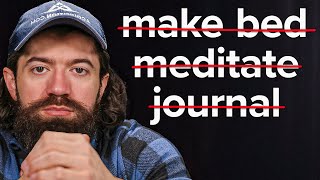
The speaker (Nate Tilley) critiques the popular "millionaire morning routine" idea, reframing productivity as output per unit time and arguing that many elaborate routines waste time rather than increase real productivity. He emphasizes leverage—doing or building tasks that return more output per unit of input (e.g., hiring a salesperson vs. making sales calls)—and advises ordering tasks by leverage. He proposes an "anti-routine": minimize rituals, train yourself to start work immediately upon waking (speaker's own routine: coffee then begin work), compress any necessary warm-ups, and prioritize high-leverage activities. Ends with a pointer to a longer video about assessing leverage.
Chapters
What's the Millionaire morning routine? A lot of people ask these questions. If you look on YouTube, Instagram, TikTok, so and so's morning routine. The five things so and so does. The moment he wakes up, they think that there's some magic pill or some super five step thing that's going to somehow get them to do the work. At the very end of this video, I'll give you my morning routine. Everything that I do between when I wake up and when I work. We have to define what productivity even means. Productivity is getting more done per unit of time. People who move faster in life don't actually move faster. They get more done per unit of time. I had this guy reach out to me, he's like, dude, I got this coach, he's got me doing like morning walks, red lights on, and I do a cold plunge and I do my gratitude journal. He's like, by the time I'm done my morning routine, it's like 11am and I was like, do you think you'd be more productive if you just prospect it for three hours a day? He's like, yeah, probably. And I was like, doesn't sound very productive then. What's interesting is that people approach the problem of the fact that they're not getting enough done per unit of time and they think that I should add more things that are not getting things done to become more productive per unit at a time. That doesn't make sense, right? Why do people not think that way? Because people don't define the terms that they use. But if you define productivity as the amount of work you do per unit of time, probably would stop doing a lot of the things that you're doing that aren't work. When people give you their advice for how to become productive, think, is this adding things that are not work to my calendar of the work that I'm doing? How much leverage am I getting from that work so I can multiply even further the work that I do? You order your tasks in order of the leverage that they have. The definition of leverage is you get more output per unit of input. If I do a little bit and I get a lot, I have a lot of leverage. You simply have some things that you get more money per period of time and less money per period of time. That's it. What are the tasks that get us the most output? For example, I could could make sales calls. That is going to be a one to one input of like I do this effort and I get sales out of it with that same level of Effort. If I could go recruit a salesperson, which would take me a finite period of time, and then that person replaces that, My ongoing support for that person is going to be two, three hours a week. So I gain back 20 hours a week of prospecting in exchange for two to three hours a week plus money. And so the act of entrepreneurship is simply consistently making these trades of what can I buy my time back with? Even to the point where you had an entire company leading to one person and that person talks to you. If we were to try and think of, like, the perfect morning routine, we should think about the reverse of that, which is, what's the worst morning routine? How could I create a morning routine that would make me the least effective one? I'd make it long as humanly possible. Number two, I'd have lots of steps and processes involved so that I could use up lots of mental energy before I could even start working. Number three is that I would become very, very reliant on that thing. If I don't get this one thing in, then it means I cannot work. You have to make your bed in order to become a millionaire. The problem with that is that we're separating fact from psychology. If I make making bed mean that I'm going to do the things that I said I'm going to do, then it's super productive. But it's not the making the bed that's the thing that's important. It's the fact that I'm committed to doing the things that I said I'm going to do. Gurus will get on this superstition around these things that they do, but not describe the meaning that they've ascribed to the thing. Oh, I do this thing to establish discipline. Then it's not the thing, it's the discipline. In which case you could replace the thing with any other thing. Or you could just tell yourself you're disciplined. You don't need to prove it to yourself. The easiest way to disprove something is to say, let me find an instance where this doesn't exist and I still have the outcome. That's you disprove something in, like, science. If there's a millionaire morning routine, then it would have to be the same thing that all millionaires do. You have to wake up early. I can tell you right now, plenty of millionaires don't wake up early. You have to have seven streams of income. All I have to do is find one person who doesn't have seven streams of income to show you that that's not true. Do you have to do real estate in order to become a millionaire? No, you have to be in software. You have to be in web three, by the way, buddy, doing 70 million a year with janitorial services for big buildings. Boring as shit. The anti routine concept came from the fact that I get asked by so many fucking people what my routine was because they thought there was some magic pill of how I got stuff besides getting stuff done that somehow is going to make them confront the fact that they're not working because they don't want to work. You don't need to create some magical morning routine where you sing a flute, magical dance outside and sing in the rain and the journals and all the other shit. Like there's work to be done. And the question is, how quickly can I begin that work? That's it. The perfect routine would be you wake up and you immediately work because you've trained yourself to be able to do it. If you are one of these people who has a 90 minute morning routine before you start working, try waking up and walking straight over to begin work. Don't even check your phone. Most people spend most of their time doing shit that doesn't matter. And for the people who are going to say, isn't the morning routine kind of like a warm up before a workout or don't you like need to prepare yourself before you start working? How long do you really need to warm up your brain? Do you think that your ability to warm up your brain is trainable? Because if it's trainable, then your routine should shrink and your number of hours of work should increase. And if people are like, I get more done if I have a morning routine. Cool. See if you can just compress the morning routine to take less time. Of the 10 things you do remove one, see how you do remove to see how you do the fundamental equation of productivity. How much you do multiply by how much leverage you have on the stuff you do. If we're defining those things as the equation for productivity, then the perfect morning routine should be one that maximizes the volume of work you do and the leverage that you create from the volume. And so for me, that looks like waking up, having a cup of coffee and getting to work and then ordering my day in the order in which I have the highest leverage activities to the lowest leverage activities. And if you enjoy this stuff and you want to think about how can I get more leverage for the work I have, then you should watch this 55 minute video, which is the number one video on my channel on leverage and assessing opportunities.