Sabri Suby with Adam Lang on FEAR AND GREED Podcast: How To Grow Your Business
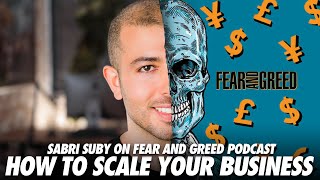
Sabri Suby, founder of King Kong, explains how small businesses scale through predictable customer acquisition and unit economics. He treats advertising as an investment that returns multiple dollars per dollar spent, uses high-value content offers to capture emails, and has expanded to clients across 135 countries.
Questions this video answers
July 27, 2021.
$50 (VOIP credit).
$1.33 billion (reported client revenue).
More than $50 million (claimed).
United States, United Kingdom, Canada, and New Zealand.
Chapters
Founder Sabri Subhi joins me now in the studio. I really look at business as an incredible vehicle to really like, make good and make change in the world.
Welcome to the Fear and Greed daily interview. I'm Adam Lang. For so many businesses right now, the focus is simply on staying afloat. But there'll come a time again when attention returns to growth and some businesses will be doing that right now looking for opportunities to grow their business and perhaps in areas they hadn't previously considered, even overseas. Today I wanted to get a guide on how to do it. How to take an existing small to medium sized enterprise and turn it into something bigger. Sabri Subhi is the founder and head of growth of King Kong, an Australian digital marketing agency that now operates worldwide. Sabri, welcome to Fear and Greet.
No problems. Thanks for having me on.
It's a pleasure at the moment. How do you suggest businesses strike the balance between trying to grow and just keeping the doors open?
I think that realistically the focus still needs to be on the same area of your business and that is to really bring in sales and to bring in opportunities for you to make sales within your business. And it's just being realistic also about, you know, if you had, you know, further goals that you wanted to hit before COVID or lockdowns, all the craziness that's taking place in the world right now, you need to look at, you know, not only were you planning, what were you planning in order to hit in terms of those revenue milestones or those growth milestones, but also the level of effort required in order to make them a reality. And if anything, I don't say that business owners need to be realistic about resetting their goals and lowering their targets, but, or more so get more realistic about the level of effort that's going to be required in order for you to not lower those targets. So like, like being crystal clear about that is that yes, there is a lot of uncertainty going on in the world right now. You know, in some pockets of some industries that's creating huge amounts of upsides and opportunity. In others, you know, what they can say is only downside. But if you be creative enough and you really think about the fundamentals of any business that are still present, it's people in a market have a problem that you need to solve and the very first step in you being able to do that is to focus on getting attention. And there's nothing that's more important and it's nothing that's more difficult to do right now in such a noisy climate. Than get attention. But that's where all the growth, all the sales and everything stems from. That's the absolute with you boil it down to its first principles. That's the first thing that's going to kind of move the money needle, as I say. And whether you're looking at growth and you're looking at dealing with all this uncertainty, the major focus of any business right now needs to be on ringing the cash register.
So amongst that sales pipeline and as you describe it, that immense level of noise, how does a business know if they're ready to scale up?
So the very first thing is, you know, you want to make sure that you have, you know, product market fit and I. E. You've created a test case for your business and you're able to generate a predictable result of whatever the promise is that your business makes. You know, whether it's losing weight or growing a business or all the other things that come into it, you want to make sure that you, first of all, you've got that kind of hypothesis tested. And you know that, okay, this is the use case, I can predictably deliver this result. You know, I have the back end infrastructure ready to scale. And they're the kind of precursors that you need to look at. There are other things within that that you can look at. If you've got a reoccurring client base, you can look at like, you know, achieving negative net churn, I. E. You know, how many people is the average person referring to my business? If you're not getting any referrals, that means that you're not really delivering a great service. So then you need to go back and have a look at, well, what is it that I need to change operationally within my business or, you know, the offer that I'm actually making to my marketplace to get it to the point where I can bring a customer in, I can get them great results, and then that one person at least tells another, or hopefully two other people about it. And then once you've got what I call a winning DNA, that's the kind of winning DNA that you're looking for, then it's about scaling the front end to bring in more customers. And then you get this thing that Jim Collins calls a flywheel, where you're getting basically a positive network effect and you're getting other people tell other people about your business. And that in itself is really a growth engine for the business.
So it sounds like you really work closely with your clients on helping their customers become advocates for the business. Is there a Secret to growth, a magical digital ingredient. Does it come down to the way your business is marketed, how you use Google, Facebook and the rest?
Yeah, look, we don't work super closely with our clients around making sure that they're engineering word of mouth within their business. To be honest, we're more so on the customer acquisition side. So we're all about how to create those opportunities in, in the first place. And I guess to answer your question, the things that, you know, when you ask a business owner like, okay, what are you trying to do right now? You know, they're typically going to say, look, I'm trying to grow. I want to double my leads. I want to get a new sales guy, I want to get more sales in the door, I want to expand into new territories and markets. And then you begin to kind of unpack and unravel the layers of the onions, so to speak, and try and get some hard data or plans or tactics that they plan on employing to make that a reality. And that's where most things fall over. Most business owners know that they want to grow their business, but it's like this esoteric concept. They don't really have the building blocks in order to do that. So what we do within our business is that we've got something that we call scientific customer acquisition, where we're looking at all the different constituent parts for a business and we're looking at all the unit economics that are present within that business, and then create a framework to make the growth equation a scientific one. That is, we start with the end in mind. If someone says, okay, look, I'm at 100 grand per month right now, and I want to get to a million per month, or they might be at 100 grand per year and they want to get $1 million per year, we start to first, you know, back into that goal. We back into the million dollars by having a look at, well, how much is the average client worth to you? And then having a look at what is it costing us to acquire a customer? How many customers, how many leads do we need to get in order to get a customer? What's the cost per lead? What's the cost per click? And then we come up with a formula where we really know scientifically what are the inputs into that system in order to reach the outcome that they're striving for. And we break business down into unit economics and give people a framework and a roadmap of what it's going to take to actually go out there based on their current numbers and their Unit economics to actually make that a reality.
Okay. So I imagine in that customer acquisition and into the economics, the unit economics that you talk about there, I imagine that effective marketing is only part of it. You need to be able to back it up with service and with supply. When you're doing that process, are you able to see what's making the business successful?
Yeah, like we have certain KPIs is, we're looking at from the acquisition front, we have certain KPIs on the acquisition front that we will shoot for. Whether it's like a percentage of a click through rate on an ad to the conversion rate on an opt in page into a lead and then a lead into like a sales ready opportunity and then look at how many of those leads are actually being closed by the client and at what close rate. So then we can kind of problem shoot and go, okay, like this is the area that's falling over and a lot of the time it's that the clients don't have a predictable and dependable script and a formula of what to say to those inbound leads that come into their business and being able to close them at a rate that's profitable enough to sustain not only our retainers, but the cost to advertise on Google and Facebook. And that's because a lot of businesses, they're used to dealing with referrals and word of mouth and they, they might operate off an 80% CL close rate on those leads. And that's kind of like their, their business is built off that system and they don't really have the system to turn a complete stranger into a high paying client because it's a, it's a whole different skill level that's required. And as you scale a business up from a hundred thousand to a million a month, to a million to a million dollars a year, to a million dollars a month, it's, it requires more skill because you're typically going out to colder audiences that don't have as. To give that some context, you might start with one advertising channel and that advertising channel might be Google, which has a huge amount of intent behind it. Like people are on Google, they're in hunt mode looking for a solution to a problem that they're experiencing right now. They're the hottest, easiest leads ever to convert. Right. And then you might, you know, exhaust that. And then there's, because there's only so many people that are doing searches per month for your, for your products or your services. And then that might allow you to get to a million dollars a year in revenue and you might have goals to build a $10 million per year business then, then you need to start looking at other traffic channels that's going to be able to allow you to unlock that growth. So then you might go to something like Facebook. And on Facebook, these are people that aren't on Google looking for a solution right there. They're a complete stranger and they aren't out there looking for actively. They're, they're a passive audience. So being having the skill to get that person that to identify themselves in a sea of people and raise their hand and say, hey, I'm interested in what it is that you've got and then being able to actually convert that person to the point where they're your client is a completely different game to then just converting, you know, a Google hot prospect that's coming in. And that's the thing that I see is really a bottleneck to, to a lot of businesses is just having a different mindset of what success looks like and what the close rates need in order for them to scale their business. Because if you go in with the mindset of hey, I'm used to closing 80% of my leads and then you start advertising to strangers and you know that goes down to 40% and then 30% and 20%, then it's very easy for that business owner to look at this, the precursor metrics and go, this is not making sense. Like I'm not closing nowhere near as many people as I usually do. I when it's just like it's a different avenue and it's a different chapter of your business's growth cycle.
Stay with me Sabri. We'll be back in a minute.
Mazda's history as a challenger brand has spread constant innovation. Now first ever Mazda MX30 electric has arrived and has been created to the new rules of electric. A beautifully simple design in more sustainable drivetrain that gives you the responsive feel of performance vehicles of the past. It also contains unique features like freestyle doors and sustainable materials such as cork throughout the cabin. First ever Mazda MX30 electric. New future, new rules. The census. It's more than just stats. Every stat tells a story. Accurate census data leads to positive outcomes like this one.
Hi, I'm Susanna, founder of Bipolar Australia. I had my first episode of Bipolar as a teenager. By the time I got proper help, I had moved to Australia, started a career and had a family. When my doctor told me I had bipolar, he said I was lucky. I thought he was joking, but he was actually right. My recovery had started Today we support 1.5 million Australians impacted by bipolar. We use census data to understand where at risk age groups are so we can intervene earlier. By completing the census, you are helping us to get people the right support at the right time. No luck required.
Such an interesting story. Remember, your answers don't just make statistics, they help build a better future for all of us.
My guest this morning is Sabri Subby, founder of digital marketing agency King Kong. It sounds like you learn a great deal about different businesses. Do you get a charge out of it?
I do, yeah. So this is what lights me up, right. I really love, I really love business. I think that business is just such an incredible vehicle to drive change in the world and you know, it's a lot. That's the way that I look at it. It's not, I'm not helping people just grow their traffic leads and sales like I'm helping people transform their lives. You know, you help somebody grow their business. You know, one of our clients was stressed out of his mind, working out of the back of a friend's yoga studio, barely breaking even and struggling to make payroll. And you know, we've taken that business from being in that position to, you know, being an international business employing lots of staff, making very healthy profits. Not only has that changed that client's life and his family's life and the people within his extended family, it also is showing other people within society what's possible and that they can look up to those people as like a beacon of like, hey, I can actually go out and do this. And then if you think about all of the customers that his business is positively affecting through the transformation that he provides to his clients, it's, it's, it's a really, you know, positive network effect out there as opposed to just like charity and helping charitable cause like you. It needs to be self sustaining. It needs to be built on a capitalist kind of structure where it's self supporting, it helps people, it delivers results, it creates jobs and lots of opportunities for people. So, yeah, I look at it a lot deeper than what a lot of people probably think.
No, I can imagine that your passion is really clear and looking at it from the other side, you've perhaps seen some things where people are doing things that are holding them back, preventing those small to medium sized enterprises from growing. Can you give us an indication of some of those?
The number one sin I think that most business owners commit is that they look at advertising as a cost on their P and L. So they meet with their accountant, they look at it. They're like, oh wow, like you spent a hundred grand on marketing this year. Like, I think we should probably look at ways that we can reduce that. Yet they don't look at it as the single greatest investment that a business can ever make. Is it to invest in advertising? Like it's not untypical for our clients to get $3 out from every $1 they've invested. Like a lot of them, it's a lot higher than that. And what other investment vehicle on planet earth that you have control of will give you that return in a 30 day period? Like it's very difficult to get that kind of return. You know, interest, high interest savings accounts that most business owners have their money parked in. Like that money's rotting in that. Because if you factor in like a interest that you're getting in like a term deposited account or up to 2% and then if you factor in inflation, you're actually losing money. Right. Where with, with advertising, it's, it's. Most people aren't looking at the consequence of what that's doing to their bottom line and also their top line. They're just looking at, oh, okay, this is just a cost. And you know, it's not good for me to go from spending $5,000 per month on advertising to $20,000. Like that's like a huge cost structure. But you'd be hard. You know, I've asked lots of people to show me an investment that they're doing in that shows greater returns and advertising. You know, property on average gets you a 12%, you know, per annum. You look across the board in all the different sectors. So that's the biggest thing that I see holding people back is that they're really looking at it and they, they almost wear it as a badge of honor that they don't advertise. They're like, yeah, I get all of my customers from word of mouth and it's like, okay, well typically your business is probably plateaued and you probably aren't experiencing any huge growth and you've got like a broke mindset about growing your business where you're constantly looking at advertising as a cost.
So in, in that realm, Google has pushed back the stopping of using third party cookies until the end of 2023. What impact do you think that's going to have on the way businesses advertise?
Yeah, look, it's already like where we're in turbulent waters right now with Facebook and Facebook's whole attribution with, you know, Apple kind of coming out with iOS 14.5. And that's really throwing like a spanner in the works in terms of attribution and tracking and all of those kind of things. But what we're going to see is definitely a rise in, you know, reporting software about using more than just cookies to track people. There's, you know, a whole bunch of softwares that we use in our business that closes the loop on tracking. And so for instance, one of the big parts of our strategy is like, most people are going out there with their advertising and they're basically doing the equivalent of walking into a bar and asking a complete stranger to marry them. That is, they're running this, they're running ads, and all of their ads are making a marriage proposal. They're like, hey, like get in contact with our team, you know, buy some stuff. Like let's do business together. We've been in business for 30 years, blah, blah, blah, blah, blah. And it's just like, man, the market is so skeptical right now and skepticism is just so high that you can't go out with those offers anymore and expect for the unit economics to stack up and for it to be a profitable exercise. So one of the things that we do, we're all about giving value in advance for asking for the sale. Whether, you know, and a concept around that is something that I call a high value content offer. Whether it's a free report, it's a cheat sheet, it's, it's a webinar, it's something that you're actually giving value in advance than asking for the sale. One of the advantages of doing that is it very quickly pulls the people off that advertising platform and it puts them onto an asset that you can control, I. E. Your email database. And when you get somebody's name and email and you know that they're pumped into your database, then you can basically pull in what data source that they came from. What's the traffic channel that will always be able to do that? Will hopefully we'll always be able to do that. And that's basically just going to be a forever a stamp on that prospect in your CRM that this is the kind of channel that they came through. And then you'll always be able to kind of report offline conversions and what's happening offline. And it's a client that you're converting over the telephone or it's a direct E commerce transaction. And you'll always be able to tie that back to that first event and that first ad that that person came from. So that's some of the ways that we're getting around, like the attribution and the tracking issue. But yeah, it will be a climate that we constantly are going to need to be looking at, looking at ways to kind of not rely just on cookies, but a whole bunch of other digital touch points to give us more granularity around what the ROI is from that channel.
So I'm keen to hear your story, Sabri. King Kong started eight years ago with a $50 investment. It's now valued at more than 50 million. So how did you do it?
Yeah, it's. It was. It's been a wild ride and we're only really just getting started, I feel. I started the business in my bedroom. Yeah. With $50 that I loaded up into a VOIP account and used an old computer that my girlfriend had bought me, who is now my wife and mother of my children.
Congratulations.
Thank you. And basically, yeah, just rolled up my sleeves, made 150 cold calls per day and basically just got abused for a living over the telephone. And I did that enough to have enough money stored up in the bank account to then start deploying my messages that I was delivering to 150 business owners a day over the telephone and putting that on mediums that instead of, you know, calling on 150 businesses in a day, I was writing ads that would call on 150,000 businesses in a day. And I've just kind of, you know, with it with a really big focus on solving the number one problem that all businesses face, which is how do I get more customers? Like, that's just the problem that's on every business owner's owner's mind. That's what our business has been centered around. And that's what I've really been focused on mastering and having the hard conversation of, like, how much money did we put into this and how much money did we get out? And it's always a very difficult, like, conversation to kind of have with business owners because at the end of the day, we run a campaign and it doesn't work. Then we are out there stark naked in the cold and we have nothing to hide behind because we're not saying, well, look how many people saw your ad and how many impressions that we got. Like, let's take all these impressions to the bank and pay your employees with them. Like, we can't have that conversation. It's like, this is exactly how much money we spent. This is what the leads got. And I'm a big believer of that. You know, we're compensated by a Percentage of the value creation that we have out there in the marketplace. And you know, while we've been on this wild ride and we've been growing our business from just me and my bedroom, you know, to a team of, you know, 70 people plus globally, the way that that's been possible is that we've generated our clients over $1.33 billion in reported client revenue. And we, we're just, you know, sharing in a percentage of that upside that's allowed us to go on that crazy journey.
It's a great story. So where to from here? This year you announced an aggressive global rollout to the U.S. uK, Canada and New Zealand. What does an aggressive rollout look like in your industry?
Yeah, most people when they, you know, they expand, you know, globally or they expand into a new international market, they kind of get like a, you know, an office, a virtual office and they stick some poor guy in there and they basically send out a press release and that's kind of the end of it. And it's like it's more of a vanity thing where they might have one client in that region and they need to have some kind of physical presence to support that client with us. You know, where we've been ranked by the Australian Financial Review as the number one fastest growing digital marketing agency in the country for the last several years in a row. Right. So we've been fortunate enough to get some really, you know, strong traction and growth in the Australian market. And for us, an international aggressive rollout means there's 2 million small businesses in Australia, right. There's 60 million in the US there's 6 million in the UK like, if you look at just the English speaking countries around the world, like, you know, Australia is really a drop in the ocean of the size of the opportunity that's out there. And all of the businesses, whether you're located in Orange county in California or you're in the Northern beaches in Sydney. If you run a business, the thing that is constant is you're going to be wanting to get more customers. And that's just the problem that, that we're, that we really solve. And the way that we're going out there and expanding into these markets aggressively is by marketing our business aggressively. You know, we're already in the position where we've got clients in 135 different countries around the world. And it's really gotten to a point where anything, our international expansion is overdue. Where, you know, getting into a position where the demand for our services is kind of tipping into the balance of the Northern hemisphere countries, really, them not being able to find people that can deliver the results that we're able to deliver all the way here in Australia. So you're getting people in New York hiring a Melbourne digital marketing agency to help them solve these problems. So we're just kind of, you know, advocating our messaging, our whole standpoint and aggressively marketing that into those markets to kind of roll out and to further fill that demand.
Sabri, I know the King Kong story has really only just started, so good luck to you for the rest of the journ. And Sabri, again, thank you so much for talking to Fear and Greed today.
No problems. Thanks for having me on.
That was Sabri Subby, founder of King Kong, Australia's fastest growing digital marketing agency. This is the Fear and Greed Daily Interview. Join Sean Aylmer every weekday morning for the full Fear and Greed podcast with all the business news you need to know. I'm Adam Lang. Enjoy your day.
If you enjoyed this video, please like and subscribe. Subscribe. We're dropping a video like this almost every single day on YouTube and if you've got any questions, leave them in the comments box below with heysubri and I'll do my best to get in there and get that answered.










