Six-Figures Cash Collected From His FIRST Webinar With ROAS - [FULL CASE STUDY BREAKDOWN]
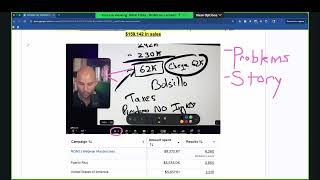
Nate Tilley breaks down how Eduardo's Spanish-language webinar generated $103K upfront and $159K total revenue. The case study covers registration rates, show-up percentages, and ad spend, then walks through a four-part sales framework: Problems, Story, Mechanism, Promise.
Chapters
Day. And. And, guys, any questions that you have, just divert to the chat. And if you want to, I'll take some Q and A at the end. So if you guys have some questions, feel free to drop them in the chat. And then if you have something you want to, like, ask me directly, just raise your little virtual hand. There's a little raise hand bar at the bottom, so we can do that. But I have my team put together a doc. Massive, massive congrats to really, my team, because they did a webinar yesterday, and Ricardo's on here as well. He was a big part of it. And the webinar ended up doing 100 and, well, 103,000. We're going to go into all the details, but 103,000 cash collected. And it was for a guy in the brotherhood, Eduardo. And one of the things I thought was the coolest was Eduardo started the webinar off. He was almost late to starting it. Like, I was like. I was like, hey, we got to start the webinar. Because he was praying. And he started it off with a prayer where he just said. And it was in Spanish. This whole thing was in Spanish. And that's why I feel really comfortable sharing all this stuff with you guys, because most of us are marketing in English, right? So, you know, it's not really a competitor or anything like that. It's not a competition. And, you know, anyways, I want us all to win. But his prayer, he just took a second and said, you know what, God, separate me from all the results, separate me from everything that, you know, help me to forget about the money. Help me to just be here, be present, think about the service and the people's lives that I want to change today. And the people, you know, pray that you brought me the right people. And I truly believe that when you market a good product, when you have a good product, and when your product helps change people's lives, okay, it helps them to have more financial freedom. It helps them to bring legacy to their family name. It helps them to get in shape. It helps them to do better things in life. I truly believe that that is what changes the world, makes impact on the planet. And by marketing a product like that, there's nothing more satisfying. So, you know, I know some of those people that got into his program, and I'm gonna talk about what made him successful, like, what he had as prerequisites. But one of those things is he has a lot of case studies. He had a lot of testimonials. And so, like, that's one of the biggest things not. We didn't even show the testimonials on the webinar. So I don't mean that's one of the biggest things of success, but that's one of the biggest things with selling something that you can actually stand beside and have confidence is like, you've done it before. It's gotten people results before. It's changed lives before. You know, if they just follow your process A to Z, they're going to get results that are going to change their life. And that's the main thing. So I'm going to go ahead and I'm going to share my screen here. Let me just pull this up, close down these other tabs that I got. And yeah, if you guys need anything, I will be watching the chat. Let's see what we got. Super excited. Thank you. I'll be in the background. Yes. Sounds good, Brooke. No worries. And yeah, congratulations to him. Really. I mean, he. He absolutely crushed it. And the team, my team crushed it. Like, I don't speak full Spanish. My wife, she's from Peru, and so she handles actually all of the Spanish department. We've done many Spanish campaigns. And if you work with people in who speak Spanish or they're in Latin America or they're from Latin America and they're in the United States, it's a huge, huge opportunity that a lot of people sleep on. But today, I'm going to teach you guys and I'm going to show you how we put $9,216 into ad spend, and we made $103,000.50, $103,562 in upfront sales and $159,142 in total revenue from one webinar. Okay. And the really cool thing about this was when most people come to me and they're like, nate, I want to do $100,000 webinar, I go right into expectation setting and making sure that, you know, sometimes I have to bring people to just grips with where they're at in the business. You know, I trained Brazilian Jiu jitsu. I'm a brown belt in Brazilian Jiu jitsu. And for those of you that don't know, it takes 10 years, it takes a decade minimum to get a black belt in Brazilian jiu jitsu. It's not like karate. Nothing against karate, nothing against taekwondo, but some of these other martial arts, you can two to three years and you can get a black belt. Also, kids can get Black belts under 18 in Brazilian Jiu Jitsu, that's not the case. Kids can't get black belts. And it takes a minimum of 10 years, a decade of, of consistent training. That's not a decade of on and off. And you don't just get it based on your time, you get it based on your skill level. And the only way to grow your skill is with mat time. And so one thing about running webinars and when people come to me and they're like, hey, I want to do 100,000, well, that's kind of like saying, hey, I want to tap out the professor, I want to tap out the instructor. I want to put them in a rear naked choke and tap him out on your first day. If you're a new coach, it's not going to ever happen. It's almost impossible. It's like statistically impossible. But if you're somebody that's been rolling in the math, you have experience, you've been training a while, you just might be able to catch the professor. And if you've been training a really long time, and depending on who the teacher is, nobody could really tap out. My professor, he's one of the best in the world, multiple time world champion. But sometimes people would catch him, or sometimes, you know, I'd be in there and there was times when I passed his guard, I would get a score on him. But it was only after consider consistent crazy reputation repetition. And so a lot of times people want to skip the nine months and go straight to the baby with marketing, they want to like fast track it. And there's really no way to fast track, especially with webinars, because there's so many things that you have to have perfect. You have to have your frame dialed in, you have to have your, like there's just so many avenues. And that's why I decided to just host this call today and open it up to everybody so that you guys could learn some of these different facets. So first we're going to get into the marketing, and then we're going to get into the actual mindset. So let's break this down. We got. You guys can all see my screen. Okay, cool. All right, thanks, Nick. Okay, so we got 6360 registrations, and we had 1800 people show live with 1400 showing at one time. So there's 400 people that kind of jumped on, jumped off. They didn't stay for the whole time. At one consistent time, we had 1400 people show up. And on a webinar, you're trying to go for an average of a 30% show rate. 30% show rate is solid. It's not the best, it's not the worst. Anything below this, you can probably optimize something in the tech, not something necessarily in the strategy, but a lot of times in the tech. Because if people are signing up but they're not showing up, a lot of times there's a tech issue. They didn't get the text message, they didn't, they didn't get the zoom registration. So I'm going to show you all the different tech things that we do on the webinar today. But you know, 6360 registrants, 1800 shows is a little bit under that, that 30% mark, but it's really solid. And I'll tell you why. Because we had a very low lead cost. And in the Spanish market, a lot of times your all of your things are kind of reduced. You get a lower lead cost, which means typically lower intent, which typically means lower conversion. But in this instance, it wasn't the case. And here you see Eduardo. Some of you guys might know him, he's an absolute savage. He takes really good care of his students. He's been coaching for a few years now, and he's got testimonial after testimonial after case study after case study. So when somebody comes to me and they want to run a webinar, if you don't have a bunch of case studies, then you basically have to frame your webinar. As this is my case study group, I'm doing a pilot program. And for that I'm going to be doing a reduced price, more exposure to me, more hand holding, more direct access, and you have to have that give and take. If not, if you try to just go into it and you don't have case studies and you don't have proof of concept and you can't show someone what you've actually done for someone else, then it's going to be very hard for them to believe you. And so if that's the case, it's going to be very hard to actually get them to transact. Part of what you're doing on a webinar is you're transferring belief. And there's four ways that you transfer belief. And really these are the four components that make up a good sales message. From your ad copy to your emails, to your webinar slides. Every single thing that you do in marketing boils down to these four components. Okay? And I'm going to share them with you right here. It's problems. So these are the problems that the person is going through in their life. And this offer is a make money offer. This is a business opportunity offer. He teaches people how to invest in multifamily real estate and commercial properties in Puerto Rico specifically. Okay. And you don't have to be in Puerto Rico to do it. Very lucrative, extremely lucrative. And the opportunity, and kind of like the problem is that a lot of people with big money, big corporations, private equity are coming in and buying up the island. So if I'm from Puerto Rico and I hear that they're buying up my island and for as low as $5,000 I can actually get a piece of my island and I can start cash flowing that I'm interested. It perks my ears. But I need to know how. Right? And that's what the webinar bridges, the gap between how, how do I do it? Okay, so problems. That's number one. So a problem people face is they're stuck in a 9 to 5 job, okay? They're stuck in a 9 to 5 job. They are not making extra money. They're living paycheck to paycheck. They're frustrated with not being able to buy appetizers and desserts and AKA splurge on the little things. They look at the price tag before they decide if they like something. Okay? This is what people deal with in their day to day lives. These are problems that people have when they don't have a vehicle that produces wealth for them or passive income or a business that's doing very well. And these are normal problems. These are problems that I had. And so every business offer, a lot of times if you're targeting like he was a 9 to 5 worker, okay? So I'm going to tell you guys about something. He was a 9 to 5 engineer and he worked at Microsoft and he had a really stable 9 to 5 job living in Puerto Rico, making really good money. And he left it all. Now what did I just tell you? Story. Story is component number two that makes up a good marketing message. So number one is the problems and then number two is the story. And oftentimes that story is the story of how you personally overcame those problems. Now, some people on this call today are coaches, coaches, consultants, speakers, authors and experts. Let me let some people in here. Okay, cool. So if you're a coach, the archetype of a successful coach is typically not. I wanted to start a coaching company, so I did. That gives people the ick. It really does. The typical archetype of a coach is the following. I worked. This is my personal story. This is my personal archetype of how I started my business. And it follows these principles. Everything falls in line with, like, the hero's journey. If you follow that, there's an arc in the story of all movies that you watch. I mean, there's a reason, there's like a symbiosis that happens. And you want to align yourself with that story for your own business, for your own life. So what that looks like for me personally is I was working at a car dealership in the middle of nowhere, Spearfish, South Dakota, on a gravel lot. We had no foot traffic. We had only a few cars. It was dusty, and I wasn't even a salesperson. All I did was clean the cars. Okay, one second. Let me close my. And I was sitting there, and I wanted to figure out a way that I could grow my income. And so I started to basically learn from YouTube and different other means of, like, studying advertising and digital marketing. And long story short, the owner came up to me and said, hey, since you're 20 years old, you probably know about social media, right? And I was like, I don't really, but I've been studying it. And he's like, perfect. Well, you're. You're our new social media manager. Here's the access to the accounts. And I heard about this thing called ads. Could you run $100 in ads for us? That hundred dollars felt like a million dollar cash injection from investors. It was the scariest moment of my life. And I diligently spent that hundred dollars on advertising, on Facebook ads. I stayed up late at night, I studied, I overthought it, I worked hard at it. And the next week, we had three people, strangers, coming and buy cars from us. Well, I didn't realize how crazy that was until the boss walked in and he's like, how did you get these customers? And I was like, I just put the ads out there. I sent them to the bank, and then they got approved. And then they came and bought the car. And he's like, you sent them to the bank without meeting them? And I was like, yeah, they just like, they wanted to see what they could get approved for. So I sent them to our banker. The banker said they approved him for 13,000. We had a car that was worth. That was. That was 12, nine. And so I told them that car. I showed him a video of it. They wanted to buy it. And he was like, no, that's not how you. Wait. Okay, keep doing it. I want to do $500 this month. And he passed me a check. It was $3,800, and I was making about $500 a week. Like. Like, less than that. Like, three to $500 a week at that point in my life. And I thought. I literally thought that I. Like, I was ready to go. Like, I thought I was the richest kid in all of South Dakota at that point with the $3,900 check. I sat there, I called my mom, and I was like, I figured it out. We're gonna be rich. I figured out how to print money. This Internet stuff is real. And long story short, well, shorter. Then he said, one of my buddies is struggling with sales. They're about to close down their dealership. They really need this. Can you set it up for them? I set it up for them, and I forgot about it. And two weeks later, actually, two and a half, three weeks later, that dealership, they called me and they said, nate, what are you doing? Is this even legal? How are you getting these customers? How are you getting these credit applications? I want to know, actually, I don't know if I want to know. Is it legal? And I was like, yes, it's very legal. I'm just running ads. And he's like, keep doing it. He signed up. He was my first $5,000 a month client. Then he added on another store. They ended up paying me almost $10,000 a month for, like, her. My client for five and a half years. They just recently downsized, but just due to. They sold off the company. They did really well. But long story short, that told me that this was gonna work. And so I kept doing it for other dealerships. I knew that it was my duty to go out and share that with other people. And so I did. I started running ads to get my own clients. And then those clients, I would run their ads, and then I would get success from them, and then I would use their success and run it as other ads. So that was kind of long winded. But my point is, a lot of people fall into the coaching space. They needed to do something out of necessity that they solved the problem. Once they solved the problem for themselves, the natural next step was solving it for somebody close to them. And it wasn't like they sought it out. They just kind of helped somebody. That person got so much success, they realized that they had to make a whole business about that. So that is the story portion of what needs to be inside of your marketing message. Okay? Now, number three is the mechanism. How do you actually get the results and In Eduardo's case here, the way he gets results is he finds properties. He shows his exact listing platform. Let me close my office door real quick. So he uses this exact listing platform that he showed on the call. This is exactly what I do. I filter. I use these filters. I look for places here and here. I avoid this area and that area. He showed everybody the exact mechanism that he uses. Okay? Not all mechanisms are created equal. If I want to get in shape, how many different mechanisms are there to get in shape, guys? There's a ton, okay? There's a ton. So I could. I could go to the gym every day and start working out, and I could get in shape. I could buy an online program and I could do the workouts at home. I could do calisthenics, I could do dumbbells, I could do barbells, or I could get liposuction, or I could do Ozempic. Okay? These are all different mechanisms to achieve the same result. Does that make sense, guys? Drop a one in the chat, if that makes sense. Now, the thing that you want for a mechanism to actually make it equal, to make it better is, is it needs to be simple. A guy told me this that's doing $40 million a month with one offer, and nobody knows who he is. He has no brand. It's all affiliate traffic. It needs to be easy, effective, simple, and fun. If your mechanism checks all four of these boxes, you can scale your company to a billion dollars. But if it checks only one of these, like, it's effective but it's not simple and it's not fun and it's not easy, then you're going to have an uphill battle selling. It's always going to be an uphill battle to sell. Now, on the flip side, if you check two out of three of these two out of four of these boxes, you're going to have more success and so on and so forth. The more boxes you check, the more success you're going to be able to have. Does that make sense? So if you can check all four boxes with your offer, you make it seem easy, it's fun, it's simple, and it's effective, then people are actually going to sign up with you very easily. That's why Ozempic is able to spend a billion dollars a month on their advertising. Okay, so these are the three first components that make up a good sales message. And this is exactly what went into Eduardo slides yesterday. Like, this is the way that we think about it before we even touch pen to paper. This is exactly what we start with for everybody. And now we have a process that kind of simplifies this. We leverage like some different automations and things to make this easier. But this is the old pen and paper way to think about this. What's the problem you're solving? What's the story of how you solved it for yourself and for others? What's the mechanism that you discovered was the best way to solve this? And then finally, problems, story, mechanism. And then we have promise. What is the promise? What is the outcome? What is the transformation that your mechanism is going to bring? Now, these are not supposed to be weighted perfectly even. It's not a 25%, 25%, 25%, 25%, 25%. It depends on your industry, it depends on your offer, it depends on your price, it depends on your icp, on what different fractions this is going to be. You know, if I'm Andy Elliot and I'm selling, how much do I talk about? Mechanism. He might be like 5 to 10% mechanism. If I'm Andy Elliot, I'm big on promise and I'm big on story, okay? He's probably 50 to 60% story. And then probably 30% promise. And then maybe 10%, how he's gonna do it, and then maybe, maybe he's higher weighted on the problems. Now, the way to figure this out is you take a sales pitch. And I learned this from the same guy that's doing 40 million a month. You take a sales pitch in your industry that does well, that you know does well. Maybe you know the owners, you know the founders. You print out the transcript. You take different colored markers, okay? And you highlight every time they're talking promise, every time they're talking story, a different color. And then you figure out what the fractions are, what the, what the weights are and how they broke this down. How much promise. And then, you know, for your offer for your industry, okay, for a fitness product, it's about 40% promise, 60% mechanism. These guys aren't talking story. So you want to figure that out? Okay, you need to control, or it could be your own control that you naturally figured this out. Okay? A lot of people are able to naturally do this. I mean, some people like, I mean, I'm married to a Latina, I'm married to a Peruvian girl, she knows how to dance kind of naturally, and she doesn't know the fine mechanics of it. If you're a good marketer, if you're diligent in your business, you're going to naturally do a lot of this. Stuff, but you don't necessarily know the fine mechanics of it. Does that make sense? So I'm going to get into this now and I'm going to show you guys.










