We Spent $5M on Business Gurus (Here's What Actually Worked)
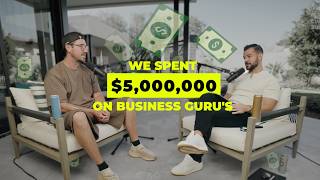
Nick Fisher and the host spent $5 million combined on business courses and coaching while building 8- and 9-figure companies. They detail which programs stuck: Sam Ovens' Consulting Accelerator for customer interviews and product discipline, Traffic & Funnels for high-ticket sales, and Alex Hormozi's lead-gen fundamentals. They also break down the "Ready, Fire, Aim" scaling framework that moved them from zero to $1M, then $1M to $10M, and beyond.
Chapters
So I'm here with Nick Fisher today, co-founder of New Reach. They do over $150 million a year. And so between us, we probably invested $5 million plus into coaches, gurus, courses, etc. And in this podcast, we're going to give the top 5 that were most impactful for us in building our 8 and 9-figure businesses. So, Nick, we should start with some honorable mentions.
Dude, I'm super pumped for this. Yeah, we've spent way too much on courses, but in a good way, I think. Over the years. Honorable mentions, there's a few that didn't crack my top 5 that were super impactful for me in my career because they just gave me like one thing or even a mindset shift. The first one I wrote down was the first course that I bought that was over $1,000, which was Derek Halpern's Yes Engines.
Oh, he was a GOAT back in the day. He was the man.
And he still is, I think, in the e-com space.
Well, which is funny. Yeah, which is funny. It, it's my fiancée's favorite protein powder.
No way. Well, shout out to Derek Halford.
He actually was one of the few, 'cause it's funny how few, uh, people from like back then it was info. I don't even really call it info anymore. Yeah. It's more of like coaching and services. But he was one of the only few people who, there's only been a few who actually can break out, you know, like Alex Becker's broken out, Sam Buffett. I mean, but he was an OG in terms of going into e-comm and then, I mean, they're in retail now doing really well. Yeah.
You're right, dude. I think there is that perception. There's like a lot of people that say they're gonna get out and go, man, this place sucks. I'm gonna get out of it.
You guys don't suck. Yeah. And they come right back in.
They come right back in.
Come right back in about 18 months later.
Yeah. Derek left for good.
He's, it's been 10+ years. What went off? 1K course, anything else?
Yeah. 1K course. It might have been 2K. I just remember it was a stretch for me and I felt like I might refund this. Like, what's his risk reversal at the time? And the thing that actually reassured me that I brought into my business to this day is Derek Halpern himself called me on the welcome call. Wow. And I thought it was, you know how people are like, is this AI? Is this a setter? Like whatever else.
It wasn't back then.
It wasn't back then. And I just recently did that myself. I just called a few people that I've sold in the past and they said the same thing. And I had that like full circle moment. I'm like, this is me questioning if Derek Halpern is Derek Halpern.
Yeah. What's funny about that course too, just to make you feel better, is I I looked at that and I think I was too poor to even afford it. I was like, 1K. I was like, I got like $300.
Yeah. Yeah. We were roughly at that same stage.
I was like just finishing college. Right. Very poor. Yeah.
No, 100%. So what was yours?
Let me, so you just have one honorable mention?
No, no, I have 5.
Oh my God. Okay. Let's rapid fire through the honorable mentions. So mine, I'm gonna give in one big group. Okay. All right. So my honorable mentions are all my copywriting teachers because for me, You know, I think, um, I was obviously really good at sales when I started my company, but the way I thought about it is like, okay, I'm really good at sales. There's a lot of other sales trainers who are really good at sales. I don't necessarily wanna outcompete these guys on sales, even though I still need to make sure my training and everything is good. I wanna be the best marketer and the best business person. Yeah. Out of all these people. And that's where I put my focus. And so part of what helped me be a good marketer was these copywriting people, but that was kinda my blue ocean strategy. In a way, if you want to call it that, when I first started the company. So I'll give you— what do I got? I got 4. Okay, you're going to know all of these. So obviously I got to start with—
give me heck for giving 5 when you have 4.
But I'm going to give you— I'm going to rapid-fire them all.
I'll rapid-fire mine too.
So one is Frank Kern. So, you know, you got to give him the—
like Mass Conversion.
But I bought the thing that was like, just buy every single thing I've ever had. And the— there's a few like trainings in there that I still use the language and the framework of like some of the stuff that he taught today. So like the one I used, I still use today, is the, here's what I got, here's what I'll do for you, here's what to do next. It's just like the most simple direct offer copy of all time. You're right. And so when I first learned that was when I first started the recruiting offer and we started placing setters. And so I did a simple post on Facebook that was in that format for setters. It was like, Read if you need setters. Like, here's what it is. Here's the benefits. DM me. That was like it. That posted like 171K. It was the first time I ever sold any sales recruiting. Damn. But 171,000 from that one post. So Frank Kern, obviously gotta throw Jason Flagellin in there. He's the webinar goat. Uh, he's like just probably the best one-to-many sale. I almost view him more as a salesperson, but he's a little, I mean, it's both. And, uh, he's like one of the best one-to-many guys, insane objections. John Benson in his VSL course. So he's the only person, you know, you hear about big ideas. I think he created P90X. I'm not sure, but it was, he's created something like that. I might, it might not be P90X, it might've been something else. But, he's created one of those things. It's like you, you would know what it is, but he has, have you seen his big idea map?
No. The only thing I bought from Benson is like 3Xcelerator or something like that.
It was a long time. Yeah. I don't know. I, I did, I just did the thing with him too. I just, Bought all the things. That's smart.
And start doing that.
He has the only process I've ever seen for like creating big ideas. That's like a mechanical type of process. So he was good. Then last, and I think this is the best teacher of direct response marketing period, is Todd Brown. Ooh. Because his, I think it's called E5.
E5.
It just goes over like, you know, how to create a marketing thesis, how to create a central marketing argument. And then how to create the sub-beliefs of those arguments and then the claims and the proof of that argument, and then how to actually really put that into marketing and sales assets.
Right.
So I kind of grouped them all into my honorable mentions.
Well, can I ask you a question on those? Because the first time we worked together, it was like in the very early days of STA. I've never had anyone do this because you're right, you were the most—
Yeah.
Copy savvy sales trainer I've ever met in my life.
Well, and I sent you a document that basically I called it the copy platform.
Yeah.
And it was essentially like the argument, the thesis, the sub-belief, the belief ladder. Yeah. And it had the empathy maps, what they feel, and then like, yeah, it was the, um, what I do is I forget what it's called, but it's not empathy map, but it's like a visceral pain point thing. So it's, uh, you know, when you describe their pain points or their dreams, hopes, and desires or whatever, you want to relate it to what do they see, hear, feel, touch, etc. So like a Basic one, if you're selling like lead generation, what do they see in terms of a pain point? They see an empty calendar, right? What do they feel? They feel instability of not knowing where the next dollar is going to come from. But like, that's why, like, one of the ads that, you know, I don't know if this ad still runs, but it worked for me for a long time, is I would point to like an empty calendar. I'd be like, does your calendar look like this? And do you want it to look like this? Like, a lot of people have done that one, but it's like, that's, that's coming from that.
See? So you're using visual hooks off what do they see?
What do you hear? So like, what you might hear is, is You only get unqualified prospects that say, I don't have the money for this, for instance. But like, when you brainstorm all of that stuff, you will like— and, and, and that's why going through that Copy Platform process, you will come out of that with 100 ad ideas. Yeah, it's just like, it'll flow so well. And now AI can actually help you with it a lot. But that's why when you have that, it makes— you're never really starting an ad from a blank page. Like your start, like the ad starts in this like ideation process. And you know, if you want to, like if I wanted to make a bunch of ads, what I really should do is just go through and fill that out from scratch, even from my existing offer. Because like just by the nature of doing it, you're like, dude, I should have an ad like this. I should have an ad like this, et cetera.
So how do you pull those out? Because a lot of them you could pull from transcript from like sales call transcripts.
Well, there's that. Yeah, right. Well, I mean, honestly, AI can give you good stuff. There is the transcripts of sales calls. You can look at competitor testimonials or your own testimonials. Some of it you can just use common sense. Like, if they don't have leads, their calendar is empty. Like, I just know that, right? So there's other things, like what else, you know, there's a lot of other things you could probably put in there. But it's, oh, it's called dimensionalized pain points is what I call it. Dimensionalized pain points. Yes. That's one of the most helpful things you can do.
It's one of the most powerful things I've ever seen.
Because the best way to start an ad is you want to try to start it if possible. Like, you know, I don't necessarily follow this because I do a lot of offer guarantee ads, but you know, the best way— true— the best way to start it is if you could call out a pain point that you can touch, you like, you could finger touch, right? So like a lot of people, they're like, do you not have leads? Well, that's like an abstract concept. So that's taking the vague. If I make that specific, then what happens is specific and tangible and concrete language is Does your calendar look like this? You see how there's a difference there?
I see. It's, it's very powerful.
Back to the honorable mentions. I need to finish these up.
All right. So my honorable mentions, all group, I'll just speedrun it real fast. Nathan Latka, he had some sort of giveaway course, taught me just promotion. And honestly, from how he moved, I learned a lot. Lewis Howes had a live webinar course which he taught by doing live webinars every day, and that just taught me grit and like discipline of like, if you want something, you should just do it every day.
Old school Lewis Howes.
Yeah, I just remember like, really, I remember joining multiple times to see if he was actually doing it on a webinar or like, like, he was actually live. Yeah. Uh, John Loomer, Advanced Facebook Ads. He taught me kind of like the basics and the guardrails. He was an OG.
He was an OG. OG when you're a Facebook targeting option. Yes.
Yeah. 100%. Yeah. Shout out to John Loomer, Frank Kern, and Ryan Dyson for those OG Facebook targeting options. And then, um, The Perfect Webinar by Brunson. I think it was part of a bigger course that he probably did, but that 1-hour live training on The Perfect Webinar is like textbook marketing fundamentals of how you actually run a webinar.
It's good.
Yeah.
All right. Then you go, let's go into your number 5.
All right. My number 5, and I put people through this, um, in variants of this as soon as they start for me in New Reach is Alex Hormozy's free course on acquisition.com. I wanna say it's the lead generation course. It's the one that starts with more, better, new. And it's such an important, I think that's the lead gen, the lead gen course. And it's such an important concept to me because a lot of times people, especially in marketing, they come to me and they're like, oh, I got this new ad idea for Pace. It's day 1. I'm like, oh, I'm sure you do. You got a great ad. So like I take them through this process in Any Beginner. I started there because A, it's free and it just builds the fundamentals that you need in marketing. You got to do more before you can refine or do better ads and you got to do better ads before you start thinking of new concepts altogether.
Yeah, I agree. So that's your number 5. That's my number 5. My number 5. Ever heard of Cat Howell?
No.
Okay.
Whoa.
So I gotta get, I gotta set the stage here. So basically when I first started my business, you know, long story short, I was bartending in college. I started a nutrition blog and then eventually that kind of over time, maybe like a year, 14 months, 15 months morphed into a Facebook ads agency. And then when I did the Facebook ads agency, I basically went another full year of just sending 50 cold emails a day. With no response. And I, that sucks. By the way, as an aside, I now know from back then what had happened was the first day I sent those cold emails, I got myself so pumped up, you know, I'm like post outta college, right?
Mm-hmm.
So I pull an all-nighter. I sent 400 emails off of my domain. So like, you know what I did? I blacklisted the domain.
Yeah.
Yeah.
That's so sick.
Because the first day I got a bunch of responses.
Yeah.
You gotta work hard. And then after that I sent 50 a day religiously. Discipline, 50 a day, nothing. And I did that. I'm not kidding. I did that for a year, bro. I love that about you. I was so like, that's so— I took a program, I cold emailed. This is what you're doing. You're supposed to get this client. You're supposed to send this. And it was like the program really hammered you too. It was like, don't quit. Don't deviate from the process. Like volume, whatever. And so I'm like, I'm going to make the most out of this fucking investment. And so I'm like, 50 emails a day, customized written emails. Oh, shit. For a year. And it morphed to the point where I was like, I gotta make the offer better. So I was like trying to ask people to work for free and I was getting nothing. And I now know, like I was able to, I didn't know this till like 4 or 5 years later when I started doing cold email at scale for my company. And I was like, oh, that's why that didn't work 5 years ago. I blacklisted my domain the first day. And then I spent 11 months and 29 days basically just in the dirt.
You're probably the only example where quantity didn't win.
No, more did not win. That was one I needed to do. I think that's, I needed to shift to better. You should have shifted to better. But anyways, so I'm like in the cold email 12-month grind and I'm like, fuck it, man. Like, this is, you know, what am I gonna, what is, what is wrong? Like, why is this not working? And so I see an ad and it's like, grow your Facebook ads agency, yada, yada, yada. And it's Kyle Howe's ad. And so I was like, okay, I'm gonna click this ad. 'Cause back, that was the first ad I saw that was like a specific I mean, this is how long ago this is. I mean, this ended up being such a popular offer, right? But it was the first ad I saw that was like, how to grow your Facebook ads agency. So I'm like, click, you know, I'm like, this is not what I'm trying to do. What I'm doing is not working. And so I, I booked this call. I get on a sales call and the sales, the sales guy's really good. He's super nice. He's, it's, it's, he pitches me $4,000, which at that point was like, you know, half of my net worth. And so I was like, holy shit. I still bought anyways. And then I get on in the program and I remember like kind of going through the modules. I'm like doing my thing. I attended a group call, then I attend the second group call and she's like, basically the client journey in that program was you were supposed to like launch a funnel with ads to get clients. And, you know, so I was doing cold emails. So that appealed to me. But I was kind of dragging ass. I get on the second group call and she yells at me. And I was like, oh shit. So then I'm like, by, by the next thing I had my freaking funnel launched. And, um, what ended up happening was I did, back then I was getting like $50 calls for agency leads. I mean, in hindsight, all these leads were unqualified, but, but that didn't keep me from pitching them.
Still pretty good for a bad beginning.
So I ended up doing like, I think it was $60 grand. Total over the course of like 10 weeks. I know I did $32,000 or $31,000 in a month. But the problem was, anyways, the problem was I was so new and so green and I was getting business like so fast. I outsourced a lot of the business to contractors and I spent more on the contractors because like I would have to fire them and hire a new person and they wouldn't get results. I spent more on the contractors than I actually like made in revenue. So I ended up losing all my money. But that wasn't her fault. Like it was a, it was a good program. But here's, here's the interesting thing about this is that, and this is the reason it's my top 5, is when I came in that program, that sales guy who sold me, we just got in the conversation and he was like, yeah, I'm making like $30,000 a month. And I was like, you know, to me, I was making, dude, I was bartending in Appalachian Ohio. Okay. So I was making $2,000 a month. So I'll make $30,000 a month. You know, you might as well told me you're making a million a month. At that, at that point in my life. And so I thought, like, I seeded into the back of my head, I was like, if this doesn't work out, I'm gonna do this sales thing. High ticket sales rep. And then also then what happened was the only thing I sucked at funnels. That's why I contracted it out. I really wasn't that good at ads and like this program, cuz she was like a, uh, divorced lady in her thirties. So all the people in the program naturally are divorced ladies in their thirties. And so I'm like this young 23-year-old dude who's like living in a shack.
Wait, this is funny. I think I was in her free group actually. You were in her free group? Yeah. Yeah.
Yeah. So I'm like living in a shack. My computer screen barely even works. And I don't know how to run ads. I don't know how to do funnels. I'm just like, whatever. But I'm making fricking sales. And so the thing was, is I think because they were like, how's this fucking kid? Like, I was beating like some of these people who were way better than I was. And they were just like, oh, you know, he's just so good at sales. And so when I heard that, I was like, oh, like I'm good at sales. And so then I kind of identified with Okay, I'm good at sales. Like I grabbed onto that because like when you suck at everything, the first thing you kind of, someone does see you're good at, you're trying to figure out like, what am I good at? Who am I in this like new career world I'm in? So like I latched onto that as an identity. Realistically, I wasn't that good, but I latched onto that. And then that's kind of also fed into that. Okay, if this doesn't work out, I'm gonna get into sales. So when I lost all my money, that's when I got into sales. So the reason that was so important to me, and it's number 5, is not necessarily because I made a bajillion dollars. I mean, I actually lost all my money, which wasn't, again, her— not her fault at all. But that sort of what I did after that is I was like, okay, I'm getting into sales. And then I got my first sales job right after that.
Dude, I would challenge the idea that you probably weren't that good at sales too, because if you raised like $60 grand, dude, I suck. Well, what was your redeeming quality?
Did you follow script to a T or did you— No, volume. Volume. So like I would take 10 calls a day and do my close rate was like 4%. Cool. You know, so, but when I applied to the sales job, I just didn't tell them that. I was like, oh yeah, in 10 weeks I just like ripped, you know, 52 grand. I'm the shit. No, my, my sales, my, my close rate was literally 4 or 5% and I was just burning leads, dude. Like, and I sucked. I sucked so bad actually. But I thought I was good, which is what matters.
That is what matters. Self-belief, self-belief and conviction.
You want to move on to number 4?
Let's do it, dude. Number 4. This is the only one I tried not to do, ones that I had direct involvement in for, but it's Consulting Accelerator 2.0. Okay. And it's maybe not for the reason that some people think, like, I, I worked on that course. I didn't end up buying it. Yeah. So I was comped it, let's call it. But I've probably been through it 6 times. Mm-hmm. Just because of how much work I had to put into it. Um, rewrote it, did transcripts of it, made the workbooks, the whole gamut, if you guys know that era. And it teaches people how to get clients.
Right.
It never did that for me. But what it really taught me was how to make a great course, which was super impactful. So anyone watching this and like growth operating too, is the story goes, when I got there to work with Sam Ovens, I was on a base plus a rev share. The first day I audited our AdWords account and I told him it was shit basically, or like, we can do a lot better than this. And at the time he was just samovens.com and he was like, okay, we're going to shut it down then and work on a new product and it ended up being Accelerator. Oh wow.
Yeah.
And I didn't know how long—
It was a $2K webinar.
Yeah. It was a $2K webinar, but we were 9 months from that point at that point. And he was like, we're just gonna shut it down and make no money. And I was like, bro, I kind of like took less salary than I had before to come out here thinking the rev share was gonna kick in. So for 3 months we made zero money and I was sitting there in New York in an apartment that Sam told me to live in in Midtown, just burning through cash. So I was like, this has to work. But it taught me, the lesson that I got out of it was the discipline to work on a product every day. So like Sam had outlined and done all the curriculum, and then I was doing all of the customer calls and testimonial reviews. Mm-hmm. And if you remember, we launched—
I do remember that.
Yes. And that's like the lesson I learned out is if you can really, if you can afford to put yourself in a point where you can shut off or not, at least you don't have to shut it off. We just didn't have a team. It was me and Sam at the time. So it was either like, you know, he knew ads would be a distraction. He is a big preacher of focus. So I just did, he made me do over 800 customer interviews and get those like first testimonials. And then Nick Fisher and a bunch of people took it from there and we had 3,000 at launch. But I just remember being like, holy crap, if I have to do another user interview, I'm going to, going to collapse.
So, so a couple things. Uh, so give people a little context. So you, Sam was doing Uplevel and he was probably doing, you know, he was actually doing something called Consulting Blueprint at the time.
If you remember, that's, I thought it was Uplevel. It was— it was Uplevel 1.0, but he wasn't even selling that anymore when I—
but it was like a high-ticket $5K thing, right?
It was a high-ticket $5K.
He was doing that, and he was probably doing like $400,000 to $800,000 a month or something like that. He was. And then you came on. Okay, you guys shut it all down. Then you launched the $2K Auto webinar.
$2K Auto.
Right? Which that's what scaled him to like— at the time, it was like $30 million-ish a year, which at that stage in our industry was like, you know, $100 million. Here. It was like, that was like—
nobody was doing that.
Yeah.
It was like publishing.com, like today.
And, and when you first launched it, it was just ads or, uh, it was just ads or was the JV the initial launch?
Did I'll have to show you the—
JV was the initial launch.
I've never shown you the full pre-launch warmup. I'll send it to you. Not, not for this, uh, this room to see, but it was ads, JV. Yeah. One and two. And he had come off a year, 2016, when we met where he had Tai Lopez. He had met Tai Lopez and Sean Voss hooked them up. And he had printed money in JV space, so he knew how to do that and he had that relationship. I didn't grease that at all. I just came in from like the ads and I was like, whatever we're doing in JV, I was like, I can definitely help.
Because the JV, what happened was the JV went nuclear, but then as that audience started fatigue, you had to replace it with ads. Correct. Yeah.
Okay.
Yep. So, and then, and then just to help the audience understand, 'cause I know what you're talking about, I still think today that 2.0 course is the best course I mean, it's not really as relevant tactically as it is today. Yeah. But for its time, I do think it is the best course that has ever been made.
Dude, thank you.
I think it is the best course that has ever been made because of how, like, he does such a good job of— it's all like the high-level concepts, but then it chunks down to the littlest detail and catches all of the limiting beliefs, et cetera. And then it chunks back up. And every single module course, anything I've ever made,, I always try to like think about that framework of when I took that course. Ooh. Yeah. So anyways, let's move on to number, my number 4. That's cool. So, uh, Alex Becker's SaaS Mastermind.
Oh, I was never in that one. Yeah.
But I've heard— so have you ever done an Alex Becker? You've probably done, uh, Iron.
Yeah.
Okay. Have you ever done anything else? No. So, okay. So what's funny about this is I didn't even have a SaaS, but when he launched it, it was $30K. I was like, I don't, I was like, you know, and Hiros was like exploding. It was like, you know, the, the big thing in the industry at the time. Like, I'm just fucking going. I don't care. I'm just gonna say I'm gonna start a SaaS. And so I go, I did ROI actually just from the networking cuz I got a lot of clients for the salespeople. And you know, a lot of the SaaS stuff was just kind of like way over my head. But the cool part about that, number one, didn't have a SaaS. Is it, is it? Yeah. Yeah. I mean, I just was like, oh, this is not really relevant to me right now, but I just sat there. Because the thing is, if you've never done like an in-person Becker event and Spencer, who's my CMO, he's done multiple. So he said this is like always how it is, is it's not like you get there and there's coffee and tea and there's a breakfast and then there's like an intro, applause that he just like doesn't say anything, gets up there, and then he opens up his laptop and just runs through a Google Doc for 8 hours straight, just firehosing information. Like, I mean, almost like he was like, hey guys, all right, we're just going to go through this. And we were all sitting in Airbnb and we're just like, fuck, you know, just like fire hosing information, you know, no breaks, no nothing. You know, it just was, that's all it was. And apparently that's just like how he, how he does it. So I actually, uh, it, I enjoyed it. I mean, I, I just want the information, so I enjoyed it. But here's the deal. So at the very end, he was doing how to do marketing for SaaS and he was breaking down, uh, what I call now today, like the Direct VSL funnel. And he was breaking down essentially like his funnel that was like this, you know, what was it like this hard drive or whatever will decrease your cost per book call and increase your ROAS and do X, Y, and Z or you don't pay for it. And then he would hammer you with the social proof. So it was offer guarantee, hammer with the social proof. And then it was a CTA and then it was like, so if that's all you need to hear, go ahead and book. But if you wanna know more about why this works so well, keep watching and I'll tell you why. And then he would go into essentially like a demo of the product.
Yeah.
So to speak of like kind of a little bit more detail of why it worked to essentially sell more higher information buyers. And I saw that and he had actually said that, you know, he evolved that from Hormozy's gym launch funnel. That's what he said. Mm-hmm. And so that makes sense. They were really the only two kind of doing it at the time. Joel Erway also with his power offer thing, he was doing it and, and he, what his system was really good as well. Yeah. And I thought about it and I'm like, I'm thinking about like Joel's stuff and I was thinking about what he did and I'm like, I have like a done for you recruiting offer. Like this has got to work for my business. Because at that time I was just doing like $500 grand a month off referrals and organic. Right? So I went back and wrote that funnel and that funnel has produced, I think alone, it's had to have been over $100 million, you know, because that's been the main funnel for my B2B side of the company for years. It's, it's had to have done at least over 100. It might be like 120. I don't know. It still runs.
That makes so much sense.
Yeah.
You, Becker, and Hormozy, and Joel all come from that. You have such strong direct leads.
Yeah. Direct. I mean, and it worked. So it works. That's my number 4. Number 3.
Number 3 for me is, Cole didn't pay me to say this, is STA. All right.
And the reason being, glaze me up right now. I will glaze you up.
Glaze me up. Dude, I will glaze you up. You guys should click the link below. I'm gonna include it in my description if Cole doesn't. But STA, so going back, like, let's call it 4 years ago, it was about 2021 or 2022. We had kind of maxed what I would call like the relative scale of the VSL call funnel inbound one call direct close that I was kind of getting known for at the time. And we had all these leads. In fact, like, I want to say the first time I looked, it was like over 60,000 leads that we had a phone number that hadn't been called. And around this time, Cole was starting to blow up and he's made modifications, refinements, and a bunch of other things that I was like, okay, maybe the game has changed here. There needs to be— does there need to be a set close model? And I remember I was like, I was against it at first. I was like, no, you don't need to do that. It's just like delaying the sales motion. We want to liquidate cash faster. And then I don't know what caused me to look into it, do one more time. And I was like, okay, maybe it was a conversation we had and you told me your average, like basically time to liquidate ad spend and it was less than mine and I'm pretty fast and I remember being like, maybe Set Close is actually better and faster. So that was the aha. And then I ended up buying it for our sales managers. Chad went through it first. Yeah, yeah, yeah. And then I made everyone, so like our whole sales team, they still train on it to this day. Someone asked me for the login last month. Oh, nice. Joel on our team. Nice. So legitimately, um, STA, like I don't know how much improvements and refinements you've made over the years since then, but it's still relevant to our team to this day. Yeah. And they train off of it.
Well, I've done multiple versions, but I appreciate it.
Yeah. We'll leave it at that.
We'll leave the link in the— the link in the description. The link in my description. All right. I'm going to give you number 3. And so this is my— I cheated on this one a little bit because it's not something I invested in, but they were technically a coach, but I was working for them, which was TNF and particularly Taylor Welch. Cool. Because he was my manager when I was a salesperson at at Traffic and Funnels. And so that was by far in my life the most transformative year in terms of personal development in my life. I bet. And so there's a couple reasons why. And the first thing is, is I was able to work, and you probably had this a lot with Sam, is I was able to work in person in an office with a company that went from at the time I started, they were kind of rebuilding. They had kind of peaked and then they went back down. They were like $300,000, $400,000 a month. And I got to be all the way up to $1 million to $1.5 million a month, which again, you know, now that's like great. You did a good job. Back then it was like we did that and was like Sam, that was it. It was like just us two in the industry that were the only ones to do that. So I was able to see how we scaled through that journey. And because we were in an office and I just, naturally, you know, a pretty social person. Like, I would talk to Ashton Shanks, who was the CMO, and I'd be like, oh, you know, how do you do this? How do you set the budgets? Oh, you got to spend, you know, $400 grand this— we would spend probably more because we would do a liquidating funnel. So like, he'd be like, yeah, we're spending like $600 grand. I'd be like, okay, like, how does that work? How are we doing that? How are you doing the budgets? So I would learn so much about how the marketing department worked and how they would have, you know, copywriters and media buyers and this and that and people on low ticket and people on the email and all this stuff. And I also learned like, okay, here's the ops people, here's what they do, here's HR, here's what they do. Obviously, you know, our sales team scaled and all that stuff. That's where really also, I don't wanna say we invented it because clearly calling your leads has been around for a long time. It goes, you gotta realize in our industry at that moment, there was, you know, high ticket was more of a thing where it's like, oh, you know, it's all about you reaching out to me and you booking a call with me and you— it was all about attraction, right? Why should we work work with you. Yeah, it's like, and that was really pioneered by Kevin Nations. Kevin Nations. Yeah, which, which Frank Kern, and he's a legend, right? He's a beast. But at that time, like, the idea of calling your leads was like beta in a way. And I remember Taylor being like, you know, dude, every business calls their leads. We need to call our leads. And he's like, I want you to figure it out. So like one day I literally, this is when I first started at the company. I had like never done outbound, you know, I had done high ticket before. I had several other sales positions., but like all we did was inbound.
Yeah, we just came up with the inbound.
We just like followed up, you know? Right. And so I remember sitting down with the Woofle, what was it called? The Straight Line Selling book. And I'm like, there's gotta be something in here. You know, I can, I was like, I don't even know what to say to these people. And do you remember the memos? No. Like there was a, I never went to the newsletter that he sent out every month. He had this Jordan's $79, uh, Taylor's. It was $79 a month.
Yeah, I do remember Taylor's.
So we had all these, like we had 1,200 memo buyers. So I just pull up that list in the CRM and I'm just like, I'm gonna call these people. And, you know, newsletter— people who read a print newsletter are probably the warmest leads of all time. So like, I'm calling these people and it's so easy. And I just kind of create the script on the fly calling them. And like, my first set of 100 calls, I got several sets and like got several closes out of it. And then I refined that over time and then eventually helped train the entire setter team that we had at TF with that scripting. And then we shifted from webinar to low ticket. And then obviously everything was setter driven. And that was, we were really the first company at that time who was doing any, I mean, no, no company was setter driven. I mean, there might be like maybe some old school heavy direct response companies or something like that.
Yeah. They were like the ones that—
like, I'm not saying we created it by any means, but the online— but like in the Russ Ruffino, Sam Ovens. Correct. Uh, Scott Oldford at the time, us, like, nobody else was doing it. So obviously I learned all of that kind of on the fly. A lot of it I kind of just like figured out just because he told me I should figure it out. And I was like, all right, I'm just going to sit down and call a bunch of leads. So there was that. The other thing, and you probably got this in consulting as well, is what was so transformative about that experience is I got to see, because we were a coaching company for companies in the industry, right? So I got to see like all these clients come in. And then like you, you pick up a pattern recognition. So you're like, okay, the clients who hit $500 grand a month to a million a month, they do, they usually have this type of offer. They usually have this type of funnel. They're all pretty good at sales. They run good sales. Like you just pick up like these basics and pattern recognition. Yeah. And so that combined with knowing how to run, like seeing how an 8-figure company operated and then also being good at sales. Was part of the reason, like when I went to start my own company, I basically did 70— like I launched the company and then did $71K in 48 hours. Yeah. Is because like I had those skills that I learned sort of from osmosis. And so there was that. And then I would say the other two things is like the standards at that company and the culture was so intense and so high that like I had a lot of sales mechanics coming in. And a lot of people ask me like, what did Taylor teach you about sales? And He, you know, I learned some stuff about sales from him, no doubt, but it, we really didn't train on sales a lot. Like he didn't review my calls a lot. What it was, was like a massive demand of performance and a super high standard. And we would just have to like figure it the fuck out. So like I was investing in sales trainers and coaching and this and that. I was reviewing my calls and I just had this, so such a tight feedback loop to where I got so good just under that culture. Like I got good because of the culture, not necessarily because of the training, but still that's like really important. And so I grew a lot that way. And then, you know, you know, me and Taylor have made up since. But when we left.
Yeah, I remember we didn't have that when you—
we didn't have the best departure. And so, you know, he even told me at the time and like, you know, I love Taylor now and everything, but he told me at the time he was like, you're never going to make more money than you make here, right? And I was like, fuck you. And so I swear from like zero to like probably beyond a million a month. I mean, I was like determined to just prove him wrong. And I'm kind of glad he did it because it gave me a lot of like dark energy fuel, you know. And so that's my number 3. Number 2 for you.
That's so funny. I had a similar experience with, uh, Cody Sperber though. Like that culture, a lot of people had that, you know, experience like that. Uh-huh. 100%. I agree. And I love Taylor. I need to check out his new podcast. Have you listened to it?
Dude, he's ripping right now.
I need to listen.
He gets like 400,000 to 600,000 views a video. It's some sort of Christian niche. I don't really understand that. It's not my particular— like, yeah, I just don't consume that level of content. But I don't even know what his monetization is. But if you're getting 400,000 to 600,000 views a video, he's figured it out somewhere up there. I mean, it's a lot, like multiple hundreds of thousands. I'm sure you're making money somehow.
Yeah.
So good for him.
100%. Number 2, this one I thought about for a while, and this one is for people who specifically have a course and are thinking about the future of operations. I'm like, which one has inspired me, um, in looking forward of how education's gonna be consumed with, especially with AI being so prevalent. And it is Spencer Hanley's Sonora Guitar Accelerator. And you guys, like, it's, it's, it's the deepest cut I have for you guys. And if you don't wanna play guitar, I would still recommend going through it because for the operations, for the operations, he is an operations genius. Cause the dude's mind is so, he's an operational genius. Yeah. He was the first dev at Patreon. So he has experience in like coding LMS and his LMS was the first one that I ever went into that wasn't just a Kajabi, go HighLevel, like ClickFunnels backend. The thing was custom built. And because it's a practice skill, if any of you guys sell a practice skill where you need to continue the practice in order to maintain the skill, which is like guitar. Imagine going through his course and it has an algorithmic LMS backend where instead of just going through a linear course process, it's like, oh, you did, you play the guitar at like 80 beats per minute. Now we want you to do it at 100, the same structure, just go faster. And then, so it's unlocking or thinking, like thinking through of how you actually get good at a skill. And I told him eventually it'd be super cool if you like put the camera on, it analyzed, like think of where AI could go and you could just, It could just be a live, like, teacher with you in real time. Um, for linear-based outcome courses where you're getting the knowledge and then just going practice and it doesn't really change much, not so relevant. But about half the people are in an industry are teaching a practice skill. Yeah. So that was a huge unlock for me and I haven't done it to the effect that he has, but I've thought about that concept in other courses where people get rusty in certain courses. I'm like, okay, instead of having 'em watch a new video, have 'em do this thing again. Have them just rewatch the same video in a slight variation.
Yeah. So, you know, I'm his ideal market because I told him, I was like, yeah, you know, I can play pentatonic scales. I can like play pretty much anything you hear on the radio unless it's like some crazy John Mayer solo or something like that. But you know, what I can't do is I can't like listen to something and then kind of know what key it's in and then riff like a solo or whatever to the key. And I can't pick up and like just jam with somebody, or I can't, like, if somebody lays on a drum beat, I can, like, do something with guitar. Like, I can't do that. I'm like, I gotta do the tabs and listen to it on the radio and then, like, figure it out. But I can, like, like, my coordination is decent, right? But I don't have that, like, ear and that. And he was like, yeah, dude, you, like, you're literally, you're literally, he's like, that's the intro of every single discovery call that we have as a sales call. And so I was like, and then he tried to sell me and I was like, ah, and honestly, you might make me buy because I would go through it and and relearn a lot of the guitar stuff I've dropped off. And it sounds like it would help me with even fulfillment stuff too. But I'll tell you this. So Spencer Hanley, who was a client of mine and might even still be in our mastermind, I'm not sure, but he's been in our stuff for years. He was in Boardroom. And he's a great guy. He's one of the most— it's a great example of an extremely advanced operator, in my opinion, in not the best opportunity vehicle, probably. Yeah. Which he still got to, I think, $10 million a year-ish. He did.
I had— I didn't think he would.
And, and, you know, he had to really squeeze everything out of that business he could to probably get it there. Mm-hmm. Now, that doesn't mean necessarily that I think he should do something else, cuz I know also he likes guitar, he likes to travel, he likes to like go to South America and like learn this crazy type of guitar and jam with these random people. So maybe it's a business that, you know, I mean, dude, if you could make a lot of money, which he's certainly making and also do, you know, everything that you love and lifestyle and all that stuff. I mean, that's probably better than just making a lot of money. So I'm not saying you should change, but like if he was in a different, like if he had a SaaS company with like a high, like a high ticket type of SaaS, I mean, he could, you know, sell a company for 9 figures. I think he's very, he's very impressive. Very like he would show us some stuff and I'd be like, I'd be like, okay, like do our setters do that? My team would be like, my team would be like, yeah, what he's doing is pretty good. Like we do it, but He would— I will say this, he was probably, especially with setter operations, setter, probably the most advanced client we've ever had.
Yeah, I would agree. Yeah, he, he showed me and we had to course correct it sub-2. His setters were, um, there's a bunch of different metrics you could evaluate it on, but let's call it 2 times more active in just, just active time.
Active time. Yeah. Which Dialer now has built in. Yeah. But he was really the first one to do that.
And we talked about that with Ryder.
Yeah.
So like he was, he was the first one to show me and I was like, shoot, maybe my, my people are just like, lazy.
Yeah.
Or maybe I'm lazy as a manager. I just didn't know.
Is he still doing that business? What is he doing now?
Yeah. He's still, he's still running his own.
I should hit him up. You should. Okay. So that was your number 2. That was my number 2. Okay. My number 2 is my series of Hormozy investments. Cool. So I gotta tell you a few stories. So the best Hormozy training I ever went through was one of my clients. Well, so I'll tell you a little backstory. I, I, I knew who Hormozy was cuz Taylor had told me. Who again was my old boss, he was like, yeah, dude. He's like, the real dude who's fucking crushing it in this industry is this Hormozy guy who sells gyms. And I was like, what do you mean? He's like, yeah, dude, he's doing like $40 billion. I was like, what the fuck? Like, what is this? So I had no idea. This was 2018, 2019 or something. And so I'm like, I kind of knew who this guy was, but I'm like, okay, he's like a gym guy, right? Yeah. And then I had these clients.
He'd have mustaches with people on stage.
Yeah. So I'm like, okay, cool, whatever. And then he had, I had these clients that were agency owners and kind of, you know, Hormozy sort of like is agency adjacent. Gym Launch was agency adjacent. So they're, they were telling me, and particularly this one person, like one guy was like, dude, I funnel hacked their sales process. It's like the greatest thing I've ever seen. I was like, okay. And then this other person told me, they were like, dude, you should listen to the Gym Launch Secrets podcast. I was like, what do you mean? I don't have a gym. And they were like, no, It's just really good business stuff. So I started binging the podcast. This was in 20, early, early, uh, 2020 during COVID And so I started binging the podcast. I was like, this is fucking good. Then I had, uh, I don't, I don't know. I wanna get him in trouble. So I had a different client who was like, yeah, dude, I spent $50K to get a consulting day with Hormozy. And he was telling me a little bit about it and I was like, dude, you gotta send me these recordings. And he's like, I'm not gonna. I was like, I'll buy 'em from you. And he was like, he was like, look, He's like, if you give me a sales rep, I'll give you the recordings. So I bartered a sales rep for the one-on-one full day, uh, consulting day recording that they got with Herb Ose. And that was probably at that time the best content I've ever been through my entire life because like he hadn't, he didn't publish a lot of like business stuff on YouTube yet. Right? I mean, it was like business stuff adjacent for gyms. So this was the first time, like, you know, more, better, new, right? Like, yeah, I was like, more, better, new. That's pretty fucking cool. Like, I had heard that before it was like public. And there was a bunch of other of these frameworks. Like, you know how he has the other one that's like beliefs, character traits, and skills or whatever it is? Like, like, there was, there was that, which like he still says now, but like, I, I had that back before he was even like a YouTuber. Right. And so I go through this one-on-one day and I'm like, dude, this is amazing. So then I have another client who's like, yeah, dude, we also just invested in a 1-day coaching from— I was like, I'll give you 2 sales reps for the recordings. So I borrowed the sales reps again to get the recording. So I'm going through these recordings and I'm like, dude, this is like the shit. So then they were like, you know, when he launched Allen, he— no, that's like the lead nurture software that he had.
No, I missed that era.
That, you know, so he was reselling it for agencies as like a white label. That's what he was doing. So he would like bring an agency in, you'd pay money or whatever, then you would like use the software. He would obviously make money from you using the software and then you would charge the client or whatever. But when he would bring 'em in as like affiliates or what have you, you would get all this course material about how to like scale your agency. And that was like the OG, like all the Hormozy frameworks. So like the Profit Genie, like all this stuff was in there. You didn't tell me about that at the time. I bartered sales reps for that too. Because I was like, I don't have an agency. So I was like, yo, dude, I had this one guy in my program. I was like, I'll give you some more sales reps if you give me the logins. And I would have bought it, to be clear. I wasn't trying to be cheap. I just wasn't like—
I hear you.
I was like, I don't have an agency.
I've done that too.
Yeah. So I was like trying to get in. So then, you know, I'm already like well-versed in the Herb Ozy stuff because I'm like, I kind of got the underground content, which by the way, underground content's sometimes the best content. I would agree. Then, you know, he, he gets big on YouTube, right? In like the, the 2020, 2021 Hormozy era of YouTube. Like any advanced person will tell you is like the OG Hormozy videos were like the best videos. Like now, like, you know, they're just broader, you know? And I've heard a lot of the same concepts like again and again and again. So those were good. But then I did the 250K thing, right? Which I made a video about. I don't know if you saw it. So did you—
which $250K thing?
Well, I don't know if it's a thing, but basically when he did that Money Models launch, one of my sales reps who was a top sales rep for me at the time, Hermosi, poached him. And but I was like, yeah, I know. I didn't watch it. I was like, yeah. I was like, I get it, dude. He got this really good offer. And I was like, you should just take it, dude. Don't even worry about it. We're good. And so we're still friends. And he called me during the launch. And he's like, hey, dude, there's this special offer. It's like $250K. Consulting with Hormozy. And then it's also this like event you get to go to with 10 people who also made $250K. So I was like, yeah, fuck it, I'll just do it.
So you bought for your old sales rep?
I bought the $250K for my old sales rep. And you know, I want to support— the other thing is too is like, I want to support my old sales rep. I hear you, dude. Like, you're already— I'm that way too. Like, you're already getting commissions from this. I'm that way too. Yeah, so I bought it. And, uh, the thing is, it's hard to like— I always get roasted when I talk about it online.
Why?
Uh, because, well, people will— I'll be like, oh, I spent $250K with Hormozy. Then I'll be like, here's what I learned. And then all the comments are like, You could have learned that in ChatGPT. You know, I could have told you that. I'm like, dude, you're fucking broke. Like, it's a bunch of broke people being like, well, I could have told you that. I'm like, well, if you could have told me that, why are you broke? Yeah. You know, first of all. But anyways, so—
His time is worth what his time is worth.
But it's hard to, like, encapsulate everything you learn because you're there for so long. And a lot of the stuff is like a little nugget here, a little nugget there, a little nugget there, a little nugget there. They all, like, do culminate, but they're not— it's not like— I can't make content about it because it's— I'd have to give you so much context on like my whole business and then, okay, I had this relationship with this one. How you're going to restructure that. Yeah, it's like it's very difficult. Yeah, I can't really— it doesn't make for good content. Right. So, you know, when I try to summarize it into like my takeaways, I always get roasted because it does make for good content.
It seems like with that headline.
Yeah, it seems like I didn't get any good things from it, but I'll give you a few. I'll give you a few. All right. So he gave, you know, I want to— I've been trying forever to move the business into a different industry or and/or upmarket.
Sure.
And so we talked a lot about that. Got a lot of great strategies.
Is that for valuation multiple or for a different—
No, just because I think we could scale further into the high-ticket online services market. I think we'll have better LTV to CAC in a different industry.
So it's really just hit—
And also diversification, just in case, you know, something happens to our industry, which I don't— foresee happening like in the next couple of years, but you never know, just AI and stuff.
So, okay.
Expansion of target market. I particularly want to move into home service because home service can be, you know, small business all the way up to private equity rollups. I agree. Yeah. Whereas like coaching, like, you know, I mean, you get an extreme level of topping out at like $10 million. Uh-huh. There's just not that many people who, whereas like, you know, there's a, there's a wider segment of let's say bigger businesses in home service than others.
So, right.
Um, okay. That makes sense. Yeah. So I wanna do that. So we talked a lot about that. Uh, we mapped out like a lot of content strategy and so I got to see like how all their whole content team, content department works, how that's all working, et cetera. And, uh, I mean, obviously I've basically, we get more views probably in 15 to 30 days now than we did all in 2025. And, and in, in 2 weeks, 2 to 3 weeks, we probably get more views in that timeframe across all platforms. Than all of 2025. So I think that worked.
And then I would say so.
And then, uh, got some good leadership and management stuff. But I would say like the biggest thing, and, and again, a lot of that leadership and management stuff is just stuff that's like, it, it's not sexy to talk about in content. But, um, the biggest thing is like, it was just overall such a sick experience. And so you go in, like his office is sick.
Right? The old—
his team is really fucking good. And then also, like, a lot of the value I got was I was just interested in what he was doing and why he was doing it. And, you know, and, and how big he was thinking. And okay, what, what's like Sharon doing? What's Sharon over? What's Layla doing?
What's she—
I would be interested in all of that stuff. Yeah. And obviously, again, I can't say that on social media because like I would feel like it's a little bit of like, you know, I don't know. I don't know if some stuff was told to me in confidence or not. So I'm not gonna like be like, oh, they told me this. So, but like seeing how big their vision is, how good their team is, how sick they're— you leave and you're like inspired. Fuck. Like I'm playing like so small, you know? And like, okay. And look, if all I got from it was I'm playing a absolutely like belief-breaking ideal of what's possible to me when you're running a $30 million company, $250K is worth it. Right. And so there was that as well. But overall, I would put like all of those experiences as my number 2.
All right, sweet.
All right, number 1.
Number 1. Number 1, I thought about a lot and I wanted— it kind of fits in that same category as your Hormozy like experience of like what has impacted me the most at like the CEO founder level in this industry. And it's the Agora Black Book. And I can finally talk about it because I've seen—
That's an underground training.
It's an underground training, but it's 600 pages. And I had the same experience, dude. I tried to buy it off people that Michael Masterson had mentored directly. And I was like, I finally found someone who's like, yeah, I would just send it to you for free. And I go, could you do that right now? And then I made a ball of his email and he sent me the PDF version of the Black Book. I've read it over 6 times and it's a thesaurus. It sits on my desk. And if there's ever just a publishing problem, because if you guys don't know Agora, they're the only one, the only one I know in our pocket of the industry that's Over a billion. Been over a billion.
And they're like not necessarily a coaching company. They're an investment newsletter. They're an investment, which is an info product basically with high-ticket stuff on the back end. Yeah. And, you know, they've, they've had controversy because like I think some of their— I think even they would say like some of their marketing at certain points got pretty out of control.
Yeah. They use heavy fear-based marketing.
Yeah.
But obviously you can learn a lot from how they, how they operated as a company. And same thing as you go into acquisition.com. I actually, I had Agora as a client for Agexa. We didn't have equity in it. If you guys don't know, we have two different models. Like one, partner with people, take equity and only get paid if the business goes well. B, for a little bit, we had a marketing agency for cash flow. So Agora was a cash flow client and they were the first ones that were like, hey, could you just, could we just prepay you for ad spend and you could put it on your card? And I was like, sick, I get points. And you're going to give me $100K upfront to just blow? Yeah. Hell yeah. So I got invited to the office. It was right around the launch they did with Tim Sykes. But then I learned they had 40 or 50 other brands and newsletters too, and like sub affiliates. So it kind of opened my eyes to what my business model could be if I played it right. Just this house of brands and you have all these experts that are going well and then behind the scenes they cross-promote each other. That's like ish how they got to a billion. Okay. There's more nuance to it than that.. But this 600-page book I didn't know about at the time, but I was chasing. People kept telling me there's like this internal SOP book and like series of letters from the founders. It's everything you need to know about how to like launch a publishing company. I was gonna bring it, dude, and I totally forgot. I didn't have enough time to swing by the office.
I've read it and I should also maybe read it.
I have physicals.
It's funny is like, it's an underground thing, but like when I, I had dinner with Hormozy, uh, right as he was starting to get big. And I remember I was like, dude, have you read The Black Book? And he was like, dude, have I read The Black Book? And like, it's so funny that like really good operators, they all know about like that secret piece of content. There's also one that is, I think, just a Stansberry one. There's, there's like 3 actually.
I didn't know about.
And I've read all of them. The Stansberry one has a lot of carryover from The Black Book. So I think if you read The Black Book, it is Yeah, it's like the main thing.
And if you've read Ready, Fire, Aim, that's basically 1/6 of the Black Book.
Yeah. Yeah. Which is really phenomenal. Yeah. That book, because I was going to bring it up, is the best book in business I've probably ever read. And I was actually thinking recently I need to reread it. I've probably read it 4 times.
No way.
And because when I'll say this, a lot of— I think, you know, not to just keep like bringing up Hormozy, but a lot of his early content, you could tell was very inspired from Ready, Fire, Aim. And you know, like, and I think it's a lot evolved since then, but you could tell that like was a big influence in some of his thinking, in my opinion at least. And it was in mine as well. And if you're running a publishing company, it makes perfect sense. Yeah. Because there's different phases, right? And like the phase one from zero to a million is really good. I think most people should read that because a lot of like when you read books out there and it's like, oh, how to go from zero to a million or whatever. It's so general and broad-based, or it's like a lot of business writing is really built for like software companies. Mm-hmm. Because that's kind of like the, you know, that's really, yeah, it starts with product market fit. I mean, look, that's like most of the American stock market is software companies, right? Right. So a lot of like business writing is software-based, which doesn't mean you can't learn from it. But if I'm like a beginner, you know, that book, The Zero to $1 Million Phase, which is really more about like how to properly market and sell to get product market fit. Is really good. Then there's the million to $10 million phase, which I believe is like essentially kind of scaling it and getting a good front end— getting a good front end to back end system. Right. And then the $10 to $50 million is more operational. It is, I believe. Gosh, I need to reread it. I'm a little rusty. Yeah, but it's more operational and like bringing in proper management. And then the $50 to $100 million and really, I think $100 to $1 billion. Is essentially the proliferation of different front ends for the same core product. Yeah. Or even like essentially kind of like, it's like model different product lines and just repeating the process, which they did with Agora because essentially they were a publishing company. So they were just always trying to find and produce the next hit, if that makes sense.
Exactly. Yeah, dude, you nailed it. Like that actually is at least how I remember it too, the exact 4 different phases of scale that they walk through. And I have found myself like guardrailing against it as we've gone over $100 million. You start to wanna start non-standardizing things. I'm like, no, like if we don't standardize our funnel model, our acquisition model, and start printing and going off and be like, this one can do this, this one can be a low ticket funnel, this one can be a low ticket ascension.
Yeah.
This one can be a $5,400 mid-ticket with a, uh, one call close. All of a sudden you have no synergies across the whole business and you're sitting there wondering why things are so complex and confusing. Yeah. So yeah, I 100% agree.
I think we gotta move on to my number 1.
Let's do it.
Do you want to guess what it is?
Uplevel 2.0?
Close. It's Consulting Accelerator 2.0. Ooh, sick. Yeah. So this was funny. So you know how I said earlier that I was sending the cold emails because like I was trying to be so disciplined for the program? It was Consulting Accelerator that I was trying to be disciplined from. So what happened was, is again, you know, for people who don't know, I've said this story a million times. I started, you know, now I have a $30 million company. I've also got two SaaS companies that— so the two SaaS companies actually are together doing like almost $800 grand a month. Dang, pretty cool.
That is pretty cool.
And then, then I obviously had RCA and that did, you know, $20 million a year. And then if you count the medical company, that did $30 million a year. Uh, yeah, $30-ish million a year. So 3 8-figure companies and 2 7-figure, soon-to-be 8-figure SaaS companies. But anyways, before any of that, I started, you know, I was gonna be a doctor and then I was like, okay, that's, I basically read a book. It was How to Get Rich by Felix Dennis. Have you ever read that?
I remember you telling me this story, but no, I've never read that book.
You know, I was bartending. I read this book when it was over the winter break. All the students were gone. Nobody was there. It was just me and a hobo in the bar. And the hobo was drinking this beer called Little Kings.. And so I'm giving him these little Kings and then I'll, you know, he's just sitting there being a hobo and then I'm just, okay, I'm gonna read this book. So I finished this whole book on my shift cuz not a single person came in the bar. And that book, what it really helped me realize was I was trying to be a doctor cuz I thought that's how you make money. And the book literally was like, if you wanna make money, you should basically be in business. Yeah. Like that's like, just start a business. That's how you make money. So I'm like, okay, I'm gonna start a business. Like entrepreneurship wasn't like trendy like it is now. No. So I was like, oh, entre— I'm gonna start a business. Okay, cool. And so I'm like, what business am I gonna start? Well, I was a nutrition major, right? It was kind of gonna do pre-med. So I was like, okay, I'm gonna start a nutrition blog because I had seen like Muscle for Life, Mike Matthews, and some of these other bloggers out there. And I'm like, okay, you know, they're making money somehow, I guess. So I'm gonna start a blog. Well, obviously that didn't work out. Because I basically started publishing blog posts and I'm like, so proud of these blogs. I'm sending it to like my friends and my view count was like 3. And so I was like, okay, well, so how do I get traffic? And that's when I saw the ad that was like how a 26-year-old punk. Yeah. And so I saw that ad and I'm like, who's this guy? Okay, whatever. Then I'm also like any 23-year-old who wants to make money does. I'm following Tai Lopez on Snapchat and I see the JV.
I forgot that was the thing.
So then like I saw the ad, then I'm like, oh, that's the guy from the ad. I see him in the JV and I'm like, okay, I'm gonna register for the webinar. And so this was my first real like direct response experience as a consumer. And I get into the funnel, right? And I'm like watching the webinar. I had no desire to become a consultant. I didn't know what a consultant was. I didn't even know what I wanted to, I realized I didn't even know what I would do. Like, am I gonna consult? What am I gonna consult on? What am I gonna coach on? I don't know. It's just almost like I got put in a hypnotic state and I just bought. And then immediately after I was like, I got a refund. So I like email and I'm like, can I get a refund? And I think they were like, well, you can get a refund, but you have to go through the course.
Yeah. I was like, it was action-based.
I was like, okay, I'll go through the course. Then I start going through this course and I'm like, Holy shit, this is like the best thing. Like, it blew my socks off. I went through it like 3 times, dude, and it blew my freaking socks off. And so again, like, part of it, it was a really well-structured course. But, uh, the best part for me, obviously being super young at the time, was the mindset training. Week 2. Like, you remember the, uh, week 2? And it was like, he's talking about like, uh, what is it called? Quantum physics and monk-like discipline and all this stuff, right?. And I'm like, okay, so now I'm like so dialed in productivity-wise to where it's like, you know, like even if you get up to pee, you're like, oh, this is messing with my productivity. You know? So I'm like, you know how like that phase people go through and like Sam went through that phase where it was like, you just have to be like such a relentless, like focused obsession machine.
He made me like that too. I've never worked 9:00 AM to 9:00 PM consistently like I did under Sam.
Yeah. I was like dialed down to the 15 minutes. I didn't even have a business. I'm just like, I'm just so focused. And but I also learned, you know, some bare bones sales stuff. I learned what Facebook ads was. I didn't know what Facebook ads was. Then obviously, like most people in the program who had no idea what the fuck was going on, which is like me, what did we all do? We were like, he's like, don't start a Facebook ad agency. He's like, you could do it if you want. Here's how to do it. But like, try to do something unique. Yeah. And I'm like, I'm starting a Facebook ad agency. So I start the agency and then, you know, how do they teach you how to get your first clients?
Cold email.
Dude, I did that. So that, that spurred my whole year of essentially sending 50 emails a day with no response. Dude, good job. Because I burned my thing the first, I mean, I, I was so, and then I got into the CAHAL program. So that, but that, the reason it's the most impactful for me is it, is it started my journey because like it blew, it literally blew my mind. Like I remember doing the consulting math spreadsheet. Yeah. And it was my first, uh, ever encounter with, uh, You know, being spreadsheet rich is what they call it, where you're like, oh, if I get this clients and this and this price, start future pacing, and then you're like, oh my God, I can make $100,000 a month. And then you're like, but if I increase the price to this, and you're like $200,000 a month. Yeah. You're like, oh my God. You know? And so, uh, yeah. And I think, you know, genuinely too, like obviously Sam is probably, I think the best entrepreneur to ever come out of our industry. I think I think so too. You know, I think even more so than Hormozy. Um, I don't— he's never publicly said this or wouldn't say this, but there's a reason why I'm pretty sure— I mean, he's technically, I think, a billionaire now.
I think on paper.
On paper. Yeah. And I think he's going to be a lot more than that. And, you know, especially when you think about— he basically— when people saw him go from making a ton of money to starting a Facebook group competitor, I will even call you out, even you, And some other people too were like, I don't know why the fuck he's doing this.
It's stupid. Dude, I know.
You're like, this makes no fucking sense. And now that company's worth, I think, you know, I don't know, I'm just speculating, but probably well over a billion dollars. Yeah. And so it's absolutely crushing it. So I think you gotta give him props. Like he, I think he's the GOAT of our, of our industry.
I know. And I'm so proud of Skool too and what it became. Like, it's cool. I was there the day we bought Skool and I just remember him saying, he's like, yo, I bought Skool.com and like without consulting me. And we were working on this together and I was like, what do you mean Skool.com? How much does that cost? It was a lot less than I thought. And then he was like, it's S-K-O-O-L. And I was like, shoot, what are we doing here? Yeah. We're like, we're really all in on this. And yeah, he just had that belief, man. And like, I always tell people, I'm like, Sam, I would never bet against Sam Ovens.
Yeah. He's a, he's an animal. He's an animal. What do you think? I mean, you worked with him. What do you think are the things that make him, you know, unique, different, just really good?
Dude, I— the first thing that came to mind that I experienced with him that I've never seen to that level with anyone else is he just does not— he's hardened himself to the point where he really doesn't care what people think.
Like, a lot of people say that on camera, and also is Jensen Huang or Elon Musk would put it, you know, Jensen, this is Jensen Huang's quote, is he tortures himself into greatness.
That's exactly what Sam did. Yeah. And I learned just from our discovery calls, like I could, I have my theories, like he got bullied as a kid. He doesn't talk about that a lot too. He had like bad acne. Like there's a lot of things that if people think Sam's a robot, there's a lot of empathy I've pulled out of him, like behind the scenes doing things that we just didn't tell certain stories. Like I had to, I did parent interviews with him. Before, because he wouldn't even tell me on some of the stuff. So like, he— I feel a lot of empathy just towards his come-up story and how like, how he was treated as a kid. And me, me and him, like, once I got that story, like, I'm willing to go to war with someone. So me and Sam kind of like, at our worst, we bullied people back during that era. We just like did not care, both me and him. I was like, shoot, oh, you'll let me write whatever I want? I was ghostwriting stuff for Tai Lopez and he was like, screw it, Tai, we'll watch it, we'll Dude, I'm like sick. I'll just write the most crazy stuff I can. So that era of copy, I felt, I felt maybe invincible and I don't know what Sam felt, but he gave me that feeling of invincibility, which is super cool. It's very rare for an entrepreneur to give you that much control, freedom, autonomy where you feel invincible in your craft.
Yeah. Yeah. What do you think consulting would've became if he just went all in on just info and coaching and stuff. Yeah.
I, I think he would've done what— I'll send you the original Sam Ovens job offer letter that he sent me. I've showed it to people and people are like, dude's batshit crazy. Uh, and it said we're going to grow consulting in 3 years to $100 million company and sell on the NASDAQ. And I believed it. Like that's what got me to come to New York. And I, I remember thinking it was crazy too as I read it, by the way.
Yeah. What would've been the purpose of going public though?
I don't even know.
Just because it's cool.
Just because it's cool.
Because I mean, the only reason to go public is obviously to raise money.
To raise money. Yeah. So we like—
I mean, not necessarily. I guess you could just get a huge cash out. But generally, it's really to expand because obviously if your stock price goes up, you could issue more stock. You can expand. Uh, also the initial liquidity of the IPO gives you a lot of capital to be able to expand. I mean, that's why most companies go public.
Right.
Like, and also because of, you know, the venture and PE cycle of they gotta get liquidity at some point.
Yeah. Phase 2, like LMS wasn't even a thought that came in about a year after we started thinking about LMS. Mm-hmm. And I started doing research on Teachables, up. Kajabi's come up. Circle's come up. And that became the market research for school. But before that, we just thought we could get with 3 products, we could get to $100 million. We would IPO because that's like definition of success is you look cool in NASDAQ because it had a tech leaning to it.
Yeah.
And Sam liked that. Um, and then we thought we were going to buy something like entrepreneur.com and just content distribution network. Interesting. Yeah, that was the original plan.
Interesting.










