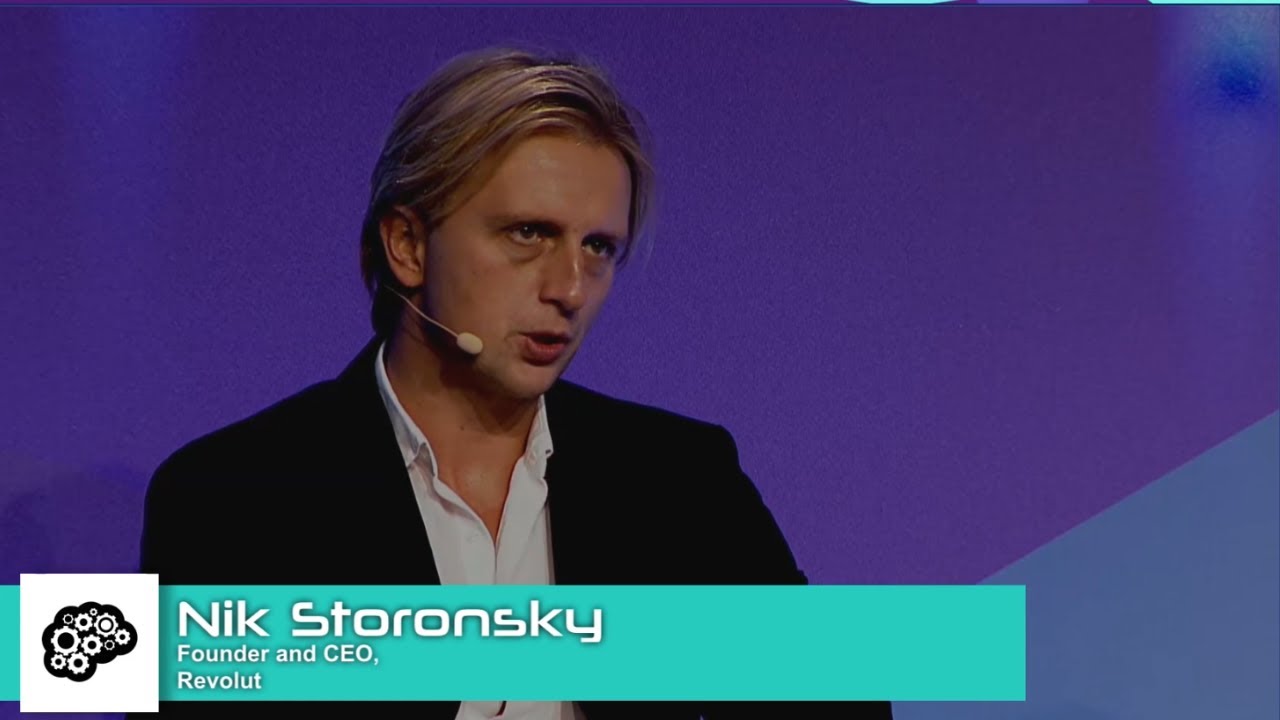
Fireside Chat with Nikolay Storonsky (Revolut) | Disrupt SF 2018
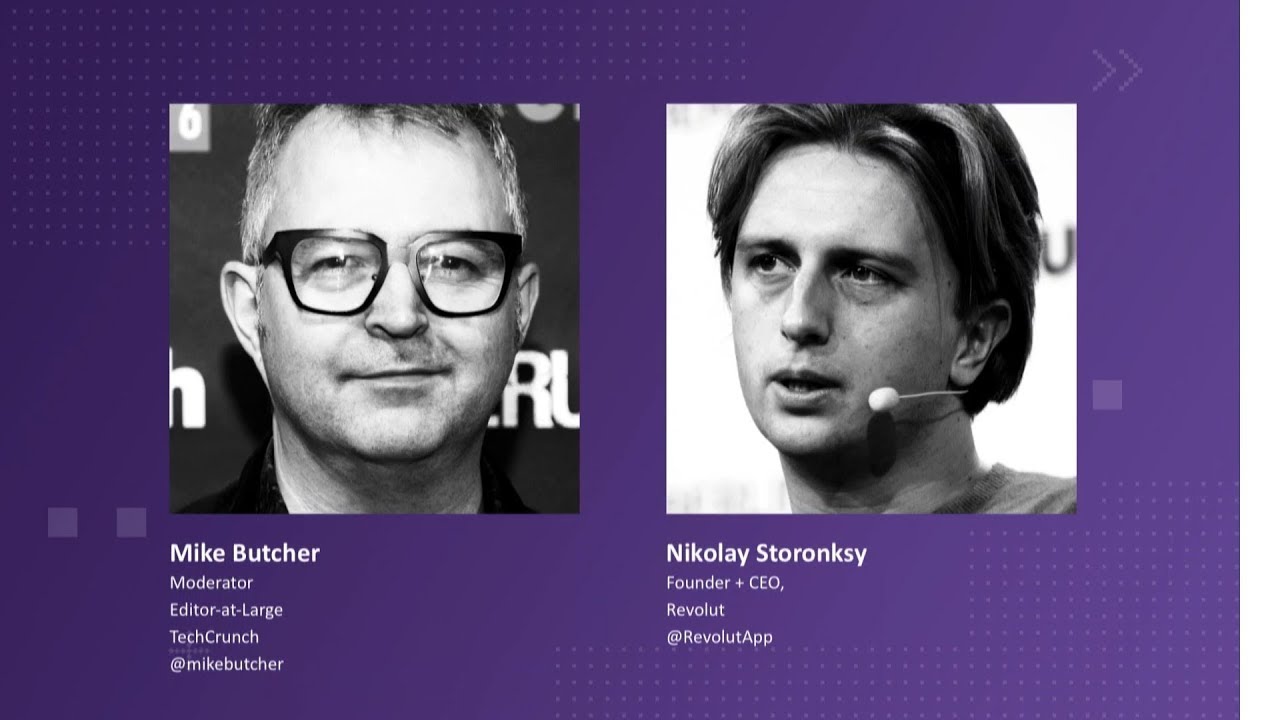
This content was created by Nik Storonsky. This content was uploaded by Nik Storonsky. This YouTube video titled "Fireside Chat with Nikolay Storonsky (Revolut) | Disrupt SF 2018" is a fireside interview recorded at TechCrunch Disrupt (2018-09-08) featuring Revolut co‑founder/CEO Nikolay (Nik) Storonsky and an onstage interviewer. They discuss Revolut’s app‑based banking products (accounts, cards, cryptocurrency wallet, disposable virtual cards, commission‑free trading plans), growth and funding, international expansion (North America launch plans), security and regulatory/compliance issues, company culture and staffing, and competitive positioning vs. incumbents and challengers. The excerpt is an English interview focused on product, business strategy, and regulatory/security topics.
Chapters
Fantastic, thanks very much. Now, those of you who aren't familiar with Revolut, I'll just bring you up to speed. What's going on in Europe at the moment is a fascinating new era of banking. Challenger banks, startups challenging the, the old system of banking, the, the high street, the main street stores. that you know very well, and it's really very app-based. It's very aimed at the new generation of the smartphone generation, isn't it? And that's been going on in Europe for the last couple of years, and Revolut is now pushing out here to North America.
Yeah, just to give you an idea about us, so we launched the business 3 years ago. It's effectively an alternative to your bank account. So we do everything what banks do, but we do it 10 times better and 10 times cheaper, and it's all app-based. So within 2 minutes you can open yourself a bank account, you can send money, you can borrow money, exchange money, buy cryptocurrency, invest money as well. So we are growing extremely fast with zero marketing. So we're opening 7,000-8,000 accounts every day. We have about 3 million users. We also entered into business accounts world as well. So opening about 100 to 200 business accounts every day, again with zero marketing.
You're doing it— you're, you're, you're, you're doing the whole interview on your own, which is marvelous. I don't have to do any work. But Nikolai, what I want to know is a little bit more about you and the company. You know, you were saying earlier that— just now— that you've managed to achieve this without any marketing. What do you think is the special sauce of behind Revolut that's made it as successful as it has?
I mean, the special sauce is not a secret, right? So it's a usual thing, 10x, right? So if you want a product to be sold in huge quantities, right, with zero marketing, it has to be 10 times cheaper and 10 times better. As simple as that. So that's what we do.
And it's obviously— you don't have to run any physical stores, of course, so you, you know, shopfronts. Doesn't that mean that the barriers to entry are pretty low? Well, you have plenty of competition, and in Europe we have Monzo, you have N26, you have Starling Bank as well yapping at your heels. What— how do you think that you're going to be able to compete with these guys?
Just providing people with better products. As usual. So if you look at other competitors, they're always behind us, like, you know, 2 to 3 years behind, right? So we're fast in releasing new features. We are faster in expanding outside of Europe as well. So they're always, you know, trying to catch up but never can.
You've raised something like $300 and almost $340 million. So you have an enormous war chest, and you've expanded to about, what, 28 countries in Europe?
Yeah.
Already a lot faster than some of your competitors. Well, what's interesting as well is not just doing banking, is that you're also doing other products, aren't you? I noticed that you, you've launched— you had a premium version. It's kind of weird to have a bank that have a premium version. Surely a bank should just have, you know, treat people equally. No, maybe that's not true, is it? But this premium version has got a sort of a metal card. You launched that recently, didn't you? Why would you launch? I mean, isn't that a gimmick? Come on, it's a gimmick, isn't it?
Well, our metal card is quite a special product, right? So show me a bank who gives you premium product, which has metal card, which has dedicated concierge, which has cashback in cryptocurrencies, right?
Dedicated concierge?
Yeah.
So like a sort of butler? Well, it's more like a butler.
For booking tickets, you know, restaurants and so on. But the main thing for me personally, I think it's cashback, which you can set up also in cryptocurrency. Imagine yourself, you pay right everywhere with a metal card.
So when you pay something, yeah, you— lots of, lots of cards have cashback schemes, don't they, to encourage you to spend? And so I think it's something like, is it up to 1%? You can get cashback from all of your spending. Yeah, you can get that in cryptocurrency. Yeah, in that cashback. Now, what do I get to choose? What sort of cryptocurrency? You're not giving me Dogecoin, are you?
No, no, I mean, you can choose Bitcoin, Litecoin, Ethereum, or like, you know.
So I can have cashback in Bitcoin?
Yeah, you can. Yes, if you want. Who—
hands up who likes the sound of that? Few people. Seems like quite popular. What— I mean, wait a second. Now hold on, let's just slow down a second. So I get cash back in cryptocurrency and it's in my Revolut wallet. Where— what about the security of that wallet? Can it be hacked?
I mean, this is bank-grade, right? Obviously because we provide banking products and effectively we have banking-level governance, right? So we need to go through all this, you know, penetration testing.
Do you have machine guns? Where is the cryptocurrency held?
So yeah, cryptocurrency is held in cold wallets, so we don't disclose where it is, and it's obviously not in North Korea.
In a cold wallet somewhere?
Somewhere, yes.
In London?
Can't disclose.
Where is it? Swiss bank account?
In reality, I don't know myself, right? I am not allowed to know this information.
So you've got loads of cryptocurrency just on hard drives sitting in, you know, surrounded by barbed wire somewhere?
Sitting somewhere in a secure place.
Marvelous. Well, there you go. That's— well, I don't think I'm going to get much further with that line of questioning, but that's really fascinating. It's really innovative. And do you think that's what's kind of really attracted your audience? You know, that kind of gimmick—
not gimmick perhaps, but I don't think it's number one thing that they— I think the main thing is it's a really beautiful card, the way it's done, right? And unfortunately—
Beautiful metal card.
It is, yes. So if you look at it—
Do you have one?
Yeah, I have one, yes.
Can you show it to me?
I left my wallet like—
You left your wallet behind? Okay, somebody will have it. You're taking this— the whole strategy though, Revolut, is you're doing this So you've got these premium products, you're doing banking, which is, you know, hard enough as it is, and you're doing cryptocurrency wallet. Oh, by the way, now can you explain to me, can I trade cryptocurrency to other exchanges from your wallet?
So you can trade cryptocurrencies within the wallet, but you can't, well, transfer.
So you can trade inside your environment?
Yeah.
Okay. But so you're sort of taking this very large kind of Amazon approach, aren't you?
Exactly.
You know, you're, you know, banking, cryptocurrency wallet, concierge services. I mean, where else can you go?
I mean, for now we are concentrated on financial services and new financial services. For example, one of the services that we are launching is commission-free trading. So in the US you have the service in Europe, you, you don't have it yet. So that's, that's what we're working on. Wealth management as well, when you can effectively allocate a certain amount of your money and then to professionals to invest for you.
So this is, this is going to take on Robinhood in particular over here. Yeah, with this commission-free trading approach. So they're coming in from the sort of commission-free trading approach, and apparently they're now going, trying to go into banking. And you're already a bank, you're coming out into commission-free trading. Who's going to win?
I think to build a bank is much more difficult than— I think it's harder. Yeah. Mm-hmm. So for us to move to commission-free trading is much easier in terms of interface, licenses, infrastructure, than from commission-free trading to become a bank and issue cards, issue loans. So I would, I would estimate it like, you know, 10% versus 90% of complexity.
And so you said that you're going to launch into North America. What's the launch date?
So expect to have it here by, by end of the year. So we already have about 60,000 people in the US on a waiting list.
60,000 people waiting to get a Revolut card right now? Yeah, without even— you haven't done any marketing?
No.
Just announced. What— so when can we expect? October?
I would say closer to December.
Closer to December?
Yeah.
Excuse me, my phone's going off. That's embarrassing. I apologize. So October, or did you say November or October?
No, no, December.
December, you think? But your PR man is having a heart attack on the front row here, I think, somewhere. You are an interesting fellow, aren't you? You were the state swimming champion in Moscow.
Yeah, I was quite good at swimming. Yeah, when I was at school and then at uni. I've done a few sports competitively.
Do you still swim?
Well, occasionally, yes.
Occasionally. Do you think it's kind of interesting that a Russian launching a bank in America in 2018?
Well, in reality, I left Russia almost 13 years ago, right? So when I was 20 years old. So I mean, yes, you can claim I have, you know, my origin in Russia, but in reality I'm like a world citizen, right? Because I live like, you know, in the UK, I spend a lot of time in the US as well. So I mean, in reality I don't really have any kind of, you know, space I don't have a specialized nationality now.
You're a citizen of the world.
Yeah, exactly.
There was an article I read about you recently. It said that you encourage a long hours working culture in Revolut. Is that true? I don't encourage—
I just observe it, right? So when I come in the office, there are like a lot of people there. When I leave the office, there are a lot of people there. And I work myself personally very long, right? So I just observe it, and I think that the reason why we're having long hours is just, you know, people are passionate about, you know, what they do, and they, they really want to change the way banking is done.
So it's, it's, it's more about the fact that everyone's passionate about working?
Yeah, so they're passionate. As a result, they work long hours, and that's what I observe, right? It's not like, you know, I'm pushing long hours. I just tell you what I see, right?
And do they get paid more if they work longer?
Well, there is a bonus system, or yes, so every half a year we pay stock option bonuses based on their performance. But it's not correct. It's not correlated at all with the number of hours you put in because, I mean, for us, sure, you're a startup. We, yeah, we want to have like, you know, output.
Did all the staff get Revolut cards? Yeah.
Exactly. Metal cards for free.
Metal cards for free. You had a bit of controversy recently, didn't you? Because there was— you had to institute a whole bunch of new features and checks on customers, and a whole lot of people couldn't access their Revolut banking account. There was a bit of a, a bit of a Twitter storm about it, wasn't there? People were on vacation and and couldn't access their bank account, and it was a little bit problematic. What went down there?
So we, we introduced a new compliance system which does, you know, transaction monitoring both against fraud and, you know, against money laundering. And because we are innovators, we are trying new things all the time. And then we introduced additional model on top of old models, which performed, by the way, quite, quite well, but it also increased percentage of number of locked accounts, right? And then there is a process how people can unlock accounts. And in reality, it was less than 0.1% of our customers, but people don't like when the accounts are being locked. As a result, we had, I don't know, quite, quite a few customers who complained on Twitter.
Mm-hmm. And but I guess you, you know, you over that hump Now, and that was a— that was something you sort of had to get over with the KYC. But it's interesting also, you're trying to do a lot of anti-fraud systems. I noticed that you're doing something called an anti-fraud disposable card. How does that sort of operate?
Yes, it's a very cool product. So within the app, you can generate a disposable virtual card. So every time when you pay with this card, card number changes. So as a result, it can never be hacked.
So it's actually brought like a burner phone. Yeah, exactly, transactions.
So it actually brought fraud on e-commerce down. I don't remember the numbers, but it's quite significant, by 20 or 30%.
That must be incredibly useful. I don't think— I haven't actually heard of another bank doing that. Is that a unique thing?
I think we were first one.
Yeah, right. You're kind of— you're a unicorn actually, basically now from Europe. How does it feel to be a unicorn?
Same as before.
Same as before. No different.
I mean, no difference. I just, you know, team is bigger, there is a lot more attention, but we just continue working hard and innovating all the time.
You're the— do you think that with this sort of cryptocurrency aspect that you're doing, do you think that might have SEC implications? Do you think— have you been talking to the regulators about that? Especially in the US.
Of course. So in the US, cryptocurrency is actually regulated. In Europe, it is not. So every time when we approached FCA with different proposals— FCA is a UK regulator— so every time when we approached FCA with different proposals about the products, their comment was that they are not regulating cryptocurrency, they can't advise. So what it means is that effectively any company can launch cryptocurrency and there are no regulations. to follow. I think it's being changed now. There is a special task force created by FCA who actually looks at implementing some kind of, you know, regulations around cryptocurrency in the UK and in Europe, but it's not in— well, it's not in production yet.
You, um, you know, you came from the— you were from the financial sector before you did Revolut. What, what was the kind of the moment, the eureka moment, when you decided to do Revolut?
Well, I always wanted to run my own business, right?
Weren't you— were you a trader?
Yeah, I was a derivatives trader. Yeah, in Lehman Brothers, actually. It was 10 years ago when Lehman Brothers went bust. Yes, it was last week. So yeah, I was a derivatives trader, and then after being in the industry for, I think, 7 years, I decided to create my own company. In completely different sphere.
In a way, it's interesting, isn't it? Because you have a similar idea to TransferWise. They also didn't like all the, all the foreign— the costs of moving money around the world, and you sort of thought, well, I can, I can address this as well.
Yeah, exactly. Initial frustration with banks was because I was traveling abroad a lot. I was sending money abroad as well a lot, right? And every time you waste 3, 4, 5, 6, 7%. It just adds up all the time, and there was frustration, and I was always questioning how to avoid it. And the initial product that we launched was just a simple account plus a card which allowed you to avoid conversion fees, FX fees. And then with time, we actually expanded it to the full range of banking service, but the initial idea was to avoid FX fees.
And you took a kind of an unusual approach, didn't you, when you launched Revolut? You started with a a UK platform, which is a crowdfunding platform, to launch it. Why did you choose to launch it using crowdfunding?
It's actually a great marketing idea to crowdfund your startup, even though we didn't really need it because there were like a lot of institutional investors who wanted to invest. We allocated a certain amount of capital for crowdfunding platform. So we can have extra 4,000, 5,000, 10,000 retail investors. So what happens if someone invests in you, even, you know, $100, right? They become your advocate, right? So they sell your product to their family, their friends. It's like a powerful marketing machine, right? Like, imagine yourself 10,000 people speaking about your company every day, right? That's what happens when you do crowdfunding. And we've done it twice. And I was quite happy with the result.
You actually have quite— most of the time, as far as I can tell, actually, you, you managed to leverage the sort of crowd aspect of— not crowdfunding, but I mean, there's sort of the marketing, the viral sort of uptick of Revolut. You know, you get a lot of people like calling you out, sort of calling out in a good way on Twitter and things like that.
Yeah, so during crowdfunding campaigns, we did, you know, a few, few, few kind of tricks. Well, not tricks, but like in a good way to increase promotion of our product. For example, you can only invest if you have at least, you know, I think 100 people using Revolut. So we forced people to actually invite a lot of friends. First crowdfunding was you can only invest if you buy premium product from us, so which actually spiked premium users acquisition. So all these things are actually quite powerful.
I mean, part of the reason you're successful in a way is that the big traditional banks have actually started to move away from retail banking, haven't they? There's less money to be made. There's more regulation about consumer protection. It's just not as good a business for the big traditional banks anymore.
Well, I disagree to the point it's not a good business. I mean, what we see in terms of numbers, it's It's a very good business and it can be even more lucrative, right? That's number one. I think that the main problem that banks face is legacy systems, legacy culture, and legacy people as well, right? I mean, really, if you have like, you know, senior management who've never done tech before, they simply can't show direction where to go, right? So they— I mean, I know a lot of banks, they're hiring, I don't know, McKinsey McKinsey, Deloitte, or whatever to create them a strategy how to digitize their operations. Like, in a year's time, McKinsey prepares a report what to do, right? And then it's, uh, it's just wrong process, right? Instead of hiring consultants, you always need to hire tech people to, to build great products.
They're just too slow generally.
I mean, too slow, and the approach is wrong, and people, people who are leading the efforts, they are wrong people as well.
Um, I imagine that, um, you know, with the amount of funding you've got, the amount traction. You're launching in North America later this year. I mean, there's obviously a little bit of a pathway to, to exit or to IPO. I mean, what sort of preferred path would you take if you had the choice?
I mean, I don't really think about it. I think IPO creates a lot of friction actually in the business because then you need to have quite a lot of bureaucracy, governance, and so on. So it's probably slow you down, right? So we actually try to stay, you know, private as long as possible.
You want to stay as private as long as possible. I should imagine though there'd be a few very large banks looking at you rather jealously about some of your, your such high growth in the last couple of years.
Yeah, it's true. I mean, we've got like a lot of banking CEOs, you know, coming to our office.
You had a lot of calls?
Yeah.
Yeah, exactly.
They want to find out, okay, how we do things. We obviously keep silent. We're telling, you know, we do the same as you guys.
Say goodbye, put the phone down. Fantastic. Thank you so much for coming to TechCrunch Disrupt, Nikolai Storonsky from Revolut.
Thank you.
Thanks, sir.
More from Nik
Revolut CEO Nik Storonsky on Building a Fintech Giant | The David Rubenstein Show


Nik Storonsky, Revolut Founder: What Revolut Needs to Do to Hit $100BN Valuation | E1233
John Doran interviewing Nik Storonsky, Founder and CEO of Revolut at the Dubai Fintech Summit
AI Summit London 2021 – Revolut's Vision for The Future of The Banking Industry