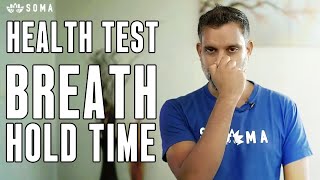
This transcript is from a Niraj Naik YouTube video explaining the Breath Hold Time (BHT) test as a simple measure of body tissue oxygenation and overall health. It gives practical instructions for performing the test (best done in the morning on an empty stomach, seated, nasal breathing), interprets BHT ranges (e.g., ≤5s serious, 20–30s average, >40s healthy, ≥60s ‘super yogi’), and links poor BHT to factors like stress, poor diet, disease, and dysfunctional breathing while promoting breathing training (Soma Breath) to improve BHT and related symptoms.
Chapters
This video we're going to talk about breath hold time and how it relates to your health.
Remember to subscribe to our channel and hit the notifications button so that you never ever miss an episode. We can actually use what called the BHT test that we use in Soma Breath to measure your state of health. Right now. What this test will do is measure your level of body tissue oxygenation. So this is like the level of oxygenation and your ability to get oxygen into the tissue cells of your organs, muscles, the cells that you really need to have oxygenated if you want to live a healthy and vibrant life. So factors can affect this body oxygenation because of things like stress, poor diet, lack of exercise and certain diseases can disrupt this. Also bad breathing habits like hyperventilation, breathing from your mouth, breathing in a stressed out way will also cause poor body tissue oxygenation and this will affect your breath hold time, your ability to hold your breath with no air in the lungs. Okay. Or just the best way to actually measure this is actually to do this in the morning on an empty stomach when you've got no food in your bowels within the first 10 minutes of waking up the morning. Breath hold time is really good measure. And what you do is you would sit comfortably, be relaxed, have your back straight, don't be slouching and hunching. That will also affect your breath hold time. Be comfortable, be relaxed, don't be lying on your back either. Just sit comfortably and breathe in through your nose.
Breathe out through your nose. Breathe in through your nose.
Out through your nose. Not like force you're not doing, you're not doing anything like that. Just simple.
A couple of times.
Breathe out. You don't need to force the air out. Just breathe out normally and then hold your nose and hold your breath now for as long as you can until you get the first big urge to breathe. But then your following inhale after that shouldn't be where you're gasping for air. You shouldn't have to open your mouth for air. Your inhale and exhale should be relaxed afterwards. Okay. When you're like really gasping, that's when you know you've held it too long. This is going to give you the most true, accurate measurement of your breath hold time. It's good to do this every single.
Time during the day, at the same time each day. So you also can do this at night before you go to sleep. And it will also give you a indication of how well you've slept at night as well, how well your oxygenation, your system during the sleep and your quality of your sleep. So you'll find that the evening breath hold time is much higher and especially if you do it other times in the day, much higher than your morning. The morning one can be lower. Most people, okay, majority of people are going to have a lower breath hold time than other times of the day because we suffer from this thing called morning hyperventilate ventilation. Almost everyone has this issue. And when you wake up within the hours of four to seven is when you're most at risk of this morning hyperventilation. And that's why it's the best time for you to actually do Pranayama breathing. Reduced breathing exercise. If you're into Buteyko method or whatever is you like to do, if you do those exercises and yoga, things like that in the morning, it can help correct the over breathing, the hyperventilation that occurs.
Which causes over breathing in the morning. And actually strange fact, most heart attacks occur in the morning, okay. Up to like 12 o' clock in the afternoon. So. So if you can correct your breathing at this point, you can actually prevent heart disease. Okay. So when you do different techniques, okay, that actually improves your breath hold time, which are designed to improve your breath hold time. You'll find this will improve steadily every single day. That's why it's a good way to measure your progress with breathing exercises. In Soma Breath, you do that every day, the same time every single day. All right? And then what it also shows you is your tolerance to carbon dioxide. If you don't have a good tolerance, carbon dioxide. Because carbon dioxide is what triggers your brain to tell you to breathe again, not the oxygen levels, carbon dioxide. If you don't have a good tolerance, carbon dioxide, it means you, you breathe way before you need to. Some people suffer from hyperventilation syndrome because they have very poor tolerance carbon dioxide. It means they over breathe naturally. But we can rewire the brain, okay, reduce breathing exercises where you're reducing your breathing rate. And also breath based intermittent hypoxia training which we teach in our Soma breath courses like the 21 day protocol and the Soma Breath Fit Challenge are all designed to improve your breath hold time. So what we've found with our many students, we have thousands around the world, is that by steadily improving their breath hold time, they get improvement in any symptoms they have of disease. They get better endurance, stamina, fitness, their mood is more balanced. And the science shows, the evidence shows us that actually.
By reducing your breathing, by lowering your breathing rate where it's not where you're forcing it over, forcing yourself to breathe slowly. Where you're gasping for air. No, where your natural breath has been reduced because you've hacked your, your physiology in a way, you become very efficient at using oxygen. What that means is that you'll start to have longer, longer breath hold times. So just as a guideline for you.
If your breath hold time is five seconds and less, that means there's something really wrong with your health. And it can even be an indication that you've got serious disease. It needs to be checked into. Most of you are not going to have that and you'd be hospitalized if you did. You'll find that people who have very slow breathing rate, very short breath hold times, have very fast breathing rates. They'd be like.
Breathing very fast like that. That's when they're very, very sick. But.
When you go beyond 10 seconds, between 10 and 20 seconds, it could be a sign that your body is trying to fight something or heal itself from something. Okay? When you go above 20, 20 to 30 seconds, we're talking about your morning breath hold time here. You're entering more into the kind of average, what most people are going to have between 20 and 30 seconds, especially people who haven't really practiced in these techniques before. And that's where you're in your average. When you go beyond 30 seconds, okay, you're starting to go into the realms of normal health. Like most people are not healthy. Unfortunately, we live in a very unhealthy world. We're full of bad lifestyle choices. Okay. And so when your normal health and the normal, which you should and you all deserve to have, when you get to like 40 seconds, that's when you're at that kind of level. And that's when you're going to be full of energy, full of enthusiasm, full of life, and really.
Able to get the stuff done that you want to do. You're genuinely living life full of passion. When you go beyond 40 seconds, when you start going to 60 seconds above, that's when you're a real super yogi, okay, super healthy yogi. But also your breath hold time should also be associated with a healthy breathing pattern. So a healthy breathing pattern is when you breathe in through your nose, out through your nose, but your exhale is nice and relaxed. You have a slow inhale, your exhale could be double the length of time of your inhale and you relax all your muscles in your abdomen. And this relaxed breathing could also be followed by an automatic pause where your pause can be for several seconds. Okay? The Healthier, you might be able to hold your pause and it happens unconsciously without even thinking about it for even longer periods than that. And that's a sign that you have abundance of oxygen in your tissue cells. Okay. So that would be a normal, healthy breathing pattern. But for most people, average breathing patterns will be you breathe in through your nose and then just relax your exhale.
And then you might breathe in straight after. There'll be no pause. Unhealthy breathing patterns is when you're breathing quite fast and erratic and you might be even using your mouth.
That's somebody who is often sick. Okay. But some people just do that unconsciously. They're doing it and it's just because they've built up a habit of mouth breathing or erratic breathing. They may have a very busy mind and be stressed. So you can actually bring yourself back into balance just by breathing in a rhythm, breathing in a healthy way. We have.
In our breath fit course techniques that will train you to have normal breathing patterns, which is really, really good beneficial. We also have more advanced course of 21 day awakening protocol that trains you to dramatically improve your breath hold time. Using our breath based intermittent hypoxic training protocol is extremely profound and powerful. Will dramatically start to improve your breath hold time in a matter of days. So we highly recommend you check out these courses and you can find them by clicking the links in the description below. And remember to subscribe to this YouTube channel for more updates, click the notification tab and you'll never miss another episode. Also, if you really want to go deep and you want to solve any issue that you might have, we have Soma Breath instructors who are trained to help you with a variety of different issues and they can customize a program just for you. Because we're all about no one size fits all. And with a mentor, with a coach like a Soma Breath instructor, they can actually help you and guide you towards healthy breath at all times. So they hold you accountable so you do it the right way and it really helps you with your health. So you know what to do. I'll see you in the next video. Peace. Click on the link in the description box below this video to get access to the full masterclass where you get lots more free tips and resources. Remember to subscribe to our channel and hit the notifications button so that you never ever miss an episode.