How I Healed Chronic Illness Through Pranayama Breathwork (TRUE STORY) - SOMA Breath
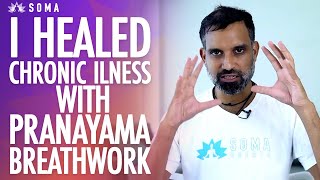
Niraj Naik recovered from ulcerative colitis using pranayama breathwork, nasal breathing, and extended exhalation ratios like 4:8. He explains how breath retention triggers the autonomic nervous system and shares the specific practices that healed his autoimmune disease.
Chapters
So it was around 10 years ago that I was diagnosed with a chronic autoimmune condition called osteocolitis that left me housebound for nearly a year. And for those of you don't know what it is, well, it's an autoimmune condition that affects your colon. You bleed out your backside like up to 40 times a day, some people even more. And I lost a considerable amount of weight. I lost like three stone in weight, which is around 25 kg. And I was on medication, they weren't working. And I was faced with two last options. That was, one was having my colon removed and the other one was to be a guinea pig for drug that hasn't even been tested before. And I was super depressed, super fearful at the age of 30 to have a, you know, to be shitting through a bag was not what I wanted to hear. And as a pharmacist, I was actually my professional at the time. To go on a drug that hasn't been tested before was also very terrifying because I know what side effects can be like. So I was desperate and that's when I went inward and I started to pray. And they literally, they say that God stands a gift of desperation. And I was so desperate, an act of God literally happened to save my life. And if it wasn't for this joining all the dots now, I don't think I would have this community that I have now. Soma Breath, we have hundreds of instructors carrying out and facilitating the same techniques that I'm going to discuss with you in this video today. And providing people with an amazing way ability to get back into wellness like I was able to. And literally what happened in this act of God was a dear friend of our family, Swamiyamakananda, she came to me and she said to me, you have a gift. If you can heal yourself from this situation without needing the drugs or surgery, you would be an amazing role model for other people. And this just woke me up out of this crazy stress that I was in and gave me a sense of hope. She said to me, by going deep into your own traditions of Pranayama, Ayurveda yoga, you could actually get back to full wellness. She said, look, there's no guarantees here, but if you just learn these basic principles, you know, you may have a good chance of doing so. So I was willing to give it a go. I'm very skeptical. I'm quite a left brain person, analytical, and it takes a lot for me to prove me that something works. But I was like, okay, if this stuff works. I'm going to let go of my moment of disbelief. And if this stuff works, I'm going to make it my mission to put science to this, to really go deep on this and to spread this as far and wide as possible. And if you're watching this video right now, I want you to be assured that I have done exactly that. I put science to these techniques. I've gone very deep into it. And that's why we've created this amazing school which is growing amazing around the world. And, you know, there's no surprise that we're. We're having an influx of people who are joining our programs every single day.
So I'm hoping that this video as well will be an inspiration for you. It could be that gift that you need to see yourself as having a gift. This illness is a gift. And that by the change in that perception, is one of the first steps you can take to getting back to full wellness.
So what happened was I started to learn pranayama first. Pranayama literally means energy control. And what I also discovered through Ayurveda, going deep into Ayurveda, was that actually disease is an energetic disturbance. And in Ayurvedic, the ancient Indian system of medicine, which treats the mind and body as one and doesn't separate them, is a holistic approach to wellness.
There's different pranayama techniques you can prescribe to people when your energy goes off balance. So in Ayurvedic system, it says that we are a combination of three, three different energy types.
Vata, pitta, and kapha. And when they go off balance, that's when disease creeps in. And environmental factors such as your lifestyle, your perception of the environment, your stress levels, if you hold on to negative emotions in the past, if you have fear of the future, these emotions plus an unhealthy environment can actually lead to stress. That stress leads to physiological changes, like changes to your breathing patterns, changes to things you eat and consume, and your. Your own immune system's ability to heal yourself. And over time, under intense stress, your immune system itself can get confused and start seeing your spirit, your own cells as a threat and actually starts to attack its own, your own healthy cells. That's called autoimmune disease. That's what I had. So I was like, blown away. I was like, wow, I'm reading my own issues here. I'm seeing actually the reasons why I'm sick. And it goes right to the cause. The cause being you are your own environment. And I started to realize now that it's to go deep, I need to change the energy within my body. And that's why pranayama is such a powerful tool. Pranayama, as I said, means energy control. And actually.
Pranayama is a series of breathing practices, like a pharmacy of breathing practices. The origins of pranayama itself comes from the time when humans went inward to discover how to create this bliss from within this bliss, molecules we call soma. And.
It was through that they realized that the breath has such a powerful relationship with the autonomic nervous, the nervous system that controls all of the functions that we take for granted, like your immune system, digestion and your temperature, mood, and even like your sleeping cycles and things like that. So these are things that we take for granted. But through these ancient practices, we can actually have a system for going in there and correcting the malfunctions that may happen over time due to stress. Whereas the conventional medical system says that we have no control over this, that we need drugs or surgery or machines to influence this part of the nervous system. And that's completely false. And that means that we give our power away to other people. Whereas through the Ayurvedic system and pranayama and yoga, we actually have the power back ourselves. That's what I want to give to you today. So by understanding pranayama, we can actually go in there and tap into autonomic nervous system. So let's go deep into what pranayama actually does. So, so pranayama is a series of breathing practices, but also you can use the breath with movement and asana, which is the postures of yoga, to create different physiological effects. But ultimately it revolves around breathing, breath practices. So when you breathe in, you breathe in oxygen. And somehow the ancient mystics understood that the breath and this oxygen is related to the production of energy, which now in modern science we've shown that is the formula of respiration. When you breathe in, you breathe in. Oxygen goes into the mitochondria, the energy center of the cells and it burns with sugar to produce ATP, which is this biophotonic like energy, which, which is how every single cell communicates with each other. And it's actually a scientist, Fritz Albert Popp, who actually did a lot of studies on these and showed that how cells communicate with each other is through this light energy. And said that we're really beings of light. He's a Nobel prize winning scientist. So he's not a woo woo scientist, he's actually a real scientist who showed that we are just like beings of light. And the Ancient mystics also discussed this. They said that we are light beings, light bodies, and that through breathing we can influence this light body and the cellular communication. And that autoimmune is triggered by a disruption in this communication between every single cell in the body. So through various breathing practices from Pranayama, we can actually create a harmony within every cell in the body. And we can actually create an efficiency of using oxygen. This is very important because oxygen is like, is the trigger for a fire within, an inner fire which produces energy. And that fire, if it burns too bright, can actually cause oxidative stress. Just like in California. Too much oxygen from the wind, actually those wildfires causes a lot of damage. Too little oxygen, not enough air, the fire doesn't burn at all. So we need the right balance of oxygen. And Pranayama is all about bringing about balance within, but also becoming very efficient using oxygen. When you go off balance, when you become stressed, you stop being efficient using oxygen. You over breathe. And what that means is you disrupt the, the, the balance within your body of oxygen and carbon dioxide, which itself has very harmful effects on your physiology. In fact, you need a perfect balance between oxygen, carbon dioxide to be healthy. Your body's constantly trying to create that balance and it takes away from other resources in order to create that balance, which again leads to disease. So by using the breath and using breathing practice, we can bring about balance. We can compensate from the effects of over breathing throughout the day, from being stressed out, working really hard, emotionally stressed, going to a job that you don't want to do, lack of passion. We can correct all these things. Back then I was a pharmacist. I hated my job. I was going to a job where I was standing on my feet all day long, working like a factory worker, like dishing out pills all day long and just frustrated my job. I didn't feel like I was helping anyone. So I was stressed out all day long. I was over breathing and I was talking a lot. Talk, talk, talk, talk, talk. And talking itself causes over breathing. You breathe out lots of carbon dioxide when you talk, breathe in oxygen, and this messes up the nervous system. Even when I'm talking in this video right now, I'm getting lightheaded a bit. And that can trigger anxiety and contraction inside. And that contraction, tension and stress caused by over breathing disrupts the energy flow to important functions in our body. And it can also lead to chronic pain. The muscles don't get enough blood flow and then that can lead to disease as well. But what can also happen is in my Situation is your own immune system gets confused at what's healthy and what's foreign and what to attack and what to defend. And then you start to lose your own healthy cells because of your immune system actually becoming overactive and attacking its own healthy cells. This is autoimmune disease.
So this is a disruption in the communication between all your cells. And this communication through all your cells is the realms of your subconscious mind, your operating system. And actually there was another book I read called the Power of subconscious mind by Dr. Joseph Murphy that goes very deep into it. He was a pharmacist and he also studied Christian Science as well as these ancient Eastern mystic practices. He developed his own system. And it was a combination of that. Going deep into Ayurveda and learning Pranayama and learning different breathing practices were influencing my own physiological state. That led to dramatic shifts in my health and well being. And within a few months I was back to full health. So I'm going to teach you one practice right now. That was one of the first shifts. This was the extended exhalation, extending my exhalation. And the principles you want to learn about breath is that when you breathe in, you stimulate the sympathetic nervous system. When you breathe out, you stimulate the parasympathetic nervous system. When you breathe in a rhythm, we can actually bring a balance to the nervous system. Breathing in for four seconds, for example, breathing out for four seconds, breathing in and out at the same time actually balance the nervous system. But if you're very stressed out, you can actually extend your exhalation, breathe out for a longer time than you breathe in and do that with a rhythm. And what that can do is actually stimulate the rest and digest response the parasympathetic nervous system and calm the physiology down. And through the power of the subconscious mind, I learned mantras like Sa saying in your mind over and over again, I am whole, perfect, strong, loving, harmonious and happy. I learned visualization tools like visualizing a healthy digestive system and colon. And the combination of that rhythmic breathing and going into like environments like the sauna, which is very hot, that added heat shock, and doing mantras and doing tones and chants where you extend your exhalation.
And the aum itself is like a mantra that actually stimulates another ingredient called nitric oxide, which is a dilator of all the vessels in your, in your body. The combination of all that.
Was really good at helping me to unstress myself and to start having moments of clarity and to allow my immune system to correct itself. And that led to Profound.
Healing effects within. I'm talking within days, I was starting to get benefits. So I'm going to teach you one simple technique you can do that's going to help you a lot. Okay, so what you're going to do is you're going to sit in an upright position, your back straight, and you're going to breathe in through your nostrils. Breathing in through your nose is really, really important. Nasal breathing is key. This will help you actually train yourself to breathe through your nose. So be mindful of nasal breathing all day because it stimulates nitric oxide and filters the air, slows your breathing down so you don't over breathe as well. So for this technique, you're going to breathe in through your nose for four seconds, breathe out through your mouth for eight seconds, and you're going to do this as a rhythm.
And you can extend your exhalation by breathing out through pursed lips. You can even do a tone.
You do that over and over again for several minutes and you'll start to feel calmer and you'll feel like a positive energy inside your body. And when you start to feel that sensation, you can take a deep breath.
And you can do a long tone.
For as long as you possibly can. You can also experiment with a faster rate. You can breathe in for two and breathe out for four. As long as you're breathing out longer than you breathing in, it creates the effect of stimulate your parasympathetic nervous system.
And that 0.5 ratio of doubling your exhale time versus your inhale time 0.5 has been shown in science studies to have a very positive effect on your ability to get oxygen into the cells where it needs to go to calm your nervous system down, to get efficient use of oxygen and also to improve your mood. It's the magic ratio 0.5, and it's the foundation of all of our soma breathing practices. And when you combine that rhythmic breathing with extending exhalation and using mantras, you have an amazing tool. And then later on, I discovered the power of breath retention, where you hold your breath for beyond the comfort zone in certain ways. And I actually went deep on this. My swami taught me these ancient techniques of Kumbhaka. But then I went to India, I stayed in the Himalayas, I lived with a doctor and I studied the real science of yoga from a medical perspective, which was very eye opening. I also spent time with Wim Hof, he's a very close friend of mine, went deep on all of that and I started to learn the magic power of Breath retention to invoke a positive stress response on the body. This is kumbhaka and holding your breath in various ways and through breath retention, we can actually lower the oxygen for a short period of time and trigger and stimulate this state called intermittent hypoxia. This is the most profound technique of all. Maybe it's why it's kept such a secret in these ancient tantric yogic.
Practices of the Himalayas. And when you hold your breath in certain ways like this, and you create this intimate hypoxic state, what happens is you create like a cascade of different hormones being released in the body that has beneficial effects, making you more adapted and efficient at using oxygen. It prevents oxidative stress, it dilates blood vessels, and it also triggers certain hormones to be released in the body that actually initiates healing from within. So in recent times, science backs this up. A lot of science has gone into hypoxic training, which you can actually go and do your own research on, where they use machines to simulate the same effects and shown people get a lot of benefits from this. Short, brief periods of lower than normal oxygen and actually disease symptoms can be reduced. Energy, stamina, fitness can be enhanced and your mood and well being can be enhanced just by this amazing physiological state. And this physiological state combined with other breathing practices from Pranayama, such as extended exhalations and rhythmic breathing, have become the foundation of our Soma breath trainings. And what I've done is I've used music. I've gone really deep into music and realized the relationship of music to these ancient spiritual practices. Because ancient spiritual practices.
All have some similarities, such as music, rhythmic music plus breathing, and also.
Visualization and mantras. And there's a similarity between these ancient African shamanic practices, Russian shamanic practices, as well as these Indian yogic tantric practices in this. And it's really amazing. And what I've done is I've revived them, I've made them more fun and easy to do, and I've added science to them and created sequences and daily routines you can do day to day basis to create amazing effects and also stuff you can do as a group, group practice. So if you want to learn more about this, we have a master class which you can sign up for today using the link below. And that goes into all of this in a lot more depth. Goes into the science, also shares the techniques in a lot more depth. Also on our YouTube channel, I share a lot more of this information in more depth too, which you can also subscribe to. I'd love you to become subscribers so I can share more value like this with you. And you can also become a Soma Breath instructor yourself by watching the masterclass and following on with the information that we give there. So these are the various things you can do and I wish you the most success. I really hope that this is also the catalyst for your own recovery and healing. You can even go deeper. On our various courses we have a 21 day journey that handhelds you all the way through this and gives you a result in 21 days. We have people who have had the same issues as me, we've had people with other kind of inflammatory diseases who have had great benefits from doing our courses and also healthy people who have gone on to have dramatic shifts with their overall health. So just by learning this simple practice like Pranayama, I believe you can have amazing effects in your health. And when you combine that with visualization mantras at the same time and when you also use a lifestyle plan that is optimum for who you are for your your energy system that you can discover from Ayurveda, dramatic shifts can happen in your health and well being and this is what we give you in Soma Breath. So I wish you the most positive energy for the day ahead and I hope this is going to be the shift that you need in your overall wellness and well being and recovery if that's what you need. So much love, positive energy, peace.
More from Niraj

Can’t sleep? Here’s a science-backed way to finally switch off your brain and body. 💤


Guided SOMA Breath Practice with David and Chantal | Breathe Together Sunday | 2026-10-11

Guided SOMA Breath Practice with Piotr Ciepiel | Breathe Together Sunday | 2026-10-04


We’ve all been told we need to lift weights, run, or do HIIT to stay fit and healthy.




Guided SOMA Breath Practice with Kiera Young | Breathe Together Sunday | 2026-09-27
