James Nestor's 'Breath-taking' Interview @ SOMA Breath Fest
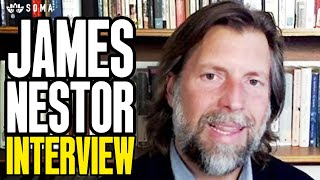
Niraj Naik talks with James Nestor about how breathing affects your body at a cellular level. They discuss oxygen and carbon dioxide balance, how breathwork might activate stem cells, and why most people breathe wrong.
Chapters
The chat.
Facebook link, if anybody wants to share it onto their pages.
Okay, so we are live. This is the first virtual classroom we're doing with a special guest. So I want to welcome James to the community, the Soma Breath community, all the way from San Francisco. Alright, that's it.
That's right.
Fantastic. And.
So sorry for anyone who was trying to get on now. I just got a bit confused with our time changes and all of that, but we're live now and.
We'Re gonna. I'll just give a little summary of what we're going to.
Talk about and discuss on the call today. And we also do a little breath work experience.
Just to.
Set the intention and the energy for this call. So firstly, I want to welcome James to the Soma Breath community. We've been really eager to talk to you. I'm sure most of our community has also read your book by now. I've been sharing it a lot, so I'm sure a lot of people have got the book. Who's read the amazing book, Breath out of Everybody on this call? Yes, most people have it right now. So.
Basically.
I first heard about James's book from the Joe Rogan podcast, which went crazy viral in like a few hours and got shared everybody everywhere. And I was really, really impressed by how you would learn all this information through actually doing it. A lot of people read books and just, you know, write stories based on other people's experiences, but James had actually gone through and tested this stuff out that we teach a lot of what we teach already in solo breath. All of the concepts and the physiology and the science that we support is really something that James has tested out himself. And in the book, it's very well documented. So what I really want to do is go through.
A bit of James's journey, getting to, you know, learning about breathwork, getting to where.
You are now in your level of awareness of the breath and its relationships with body. I know there's a lot of stuff you talk about actually that we don't cover so much, which is how mouth breathing really affects.
The facial structure, which is really fascinating. It's amazing how it does that. And maybe there's so many unnecessary things that dentists have to do, you know, when just simply changing the way you breathe could like solve so many big issues that people have. So, yeah, definitely want to go into these topics. And what we've got on the call today is like some of our master instructors who have been out there doing lots of.
Breath workshops and also training, retraining people on how to breathe correctly. So they're gonna have some great questions for you too, I'm sure, as well. So we'll also take a few questions from the community and. Well, this will be like two hours around. Two hours. All right, James, welcome. It's a pleasure to have you.
Thanks for having me.
Yeah, yeah. I'm glad we finally got to get on this call. So, to kick things off.
Do you want to give a quick introduction of yourself a little bit about your background? Because you're not like a breath work therapist or anything like that by qualification, you're actually like an author. So it'd be good to just get like a short kind of background of who you are and how you got to getting into breath work.
Sure. Well, I'm a science journalist. I've been writing magazine stories for years, for decades, actually. And it was actually through a magazine story that I discovered the real power of breathing, of breathing. Once I was able to meet free divers and saw what they did with. With breath, and they introduced me to a bunch of other people who were doing other things with breathing, healing themselves, heating themselves. And this was very interesting to me because when I looked at the literature of breathing and breath work, I didn't see too much in the scientific field. There were memoirs, there were how to books, and those are all great, But I didn't see anything that was answering the rest of the questions for the rest of the people. And so I thought that maybe there was a magazine story in this, and this started as a magazine story, and then that story got bigger and bigger, and I realized that there might be a book in it. So this was a very long time writing this book. Many iterations, many dead paths I took throughout several years to try to figure this out, because I was as confused as anyone going into breath work, going into breathing. There's misinformation on both sides, from the western medical side and from the non western medical, holistic side. There's a bunch of misinformation. And I just wanted to provide an objective view of this from someone on the outside of it. So I have no, you know, skin in the game on either side. I just went in and talked to the leaders in the field and looked at the studies and tried things out myself and recorded them and measured them, and that's how I was able to form this, at least in my head, and try to convey this stuff to a general audience.
Wow. Amazing. And you did a jolly good job of that as well. Fantastic. So what would you say is the most impactful thing that you've. You've learned so far, you know, it's.
Not one thing or the other. I found that in a lot of cases, the simplest breathing techniques can be the most transformational because a lot of people are breathing so dysfunctionally and they don't realize it. They think it's normal to always have a runny nose, to be snoring, to have asthma, to have allergies, but. But it's not. And. And then they get on the other side of that and they say, oh, my God, this is what my life could be. So there's obviously some very impressive people out there doing very impressive, quote, unquote, superhuman things. You look at whim, of course, Great example, Swami Rama, the tummo monks, they're doing things that were supposed to be medically, biologically impossible. And nobody would believe this unless there were studies and there were measurements on it and they didn't believe it for hundreds of years as long as this stuff has been around. And what's so great now is we have machines, we can study this stuff. We can objectively look at what the data says and learn from it. And it's interesting to see people who still poo poo a lot of the effects of proper breathing and its effect on your body without even bothering to look at the actual science or to talk to the leaders in the field. But you can only do so much. Numbers don't lie. And that's why I try to stick to that side of things. Yep.
Yeah. Is there any particular daily practice that you do, like a morning. Let's start with the morning. Typical morning ritual for James.
Yeah, you know, I try to steer away from that stuff. I think my own personal experience is not very interesting. It doesn't help a lot of people out. And so that's just my view of journalism. I think to have first person anecdotes are helpful to bring the reader along, to hold them by the hand and say, I don't know anything about this. Let's go figure it out. I'll tell you where I failed. I'll tell you what worked for me. But a lot of people have written thinking, I'm some breathing therapist now, and they're asking for medical advice. And it's two very different things between being a journalist and being objective and someone who's actually doling out therapies and techniques. I know a lot of people in that world who can really help out a lot of people. You know, Patrick McEwen's one person, you're another. Brian MacKenzie these are people qualified to do this work and I'm not. So that's a long winded way of saying, yeah, I do have a breathing practice. The first and foremost, the most important thing is awareness by far. So whether you're working out, whether you're walking around, whether you're sitting in front of your computer answering emails all day, is to become aware of your breathing. Because once you do that, you can notice how extremely dysfunctional it is beyond that. I have been waking up almost every morning for the past three months after I kind of really reached a breaking point with my job. Has been pretty stressful lately. And as my New Year's resolution, I do about 30 minutes to 40 minutes of Kundalini in the morning. And it's just been completely transformative. That might seem ironic for people. They're like, oh, you wrote a book about breathing. I wrote a book about breathing, about some of the leaders in the field, about what happens to your body, about the biology, about the physiology. But I'm by no means a breathing therapist. Of course I've adapted to nasal breathing. I use sleep tape, been doing that for years. But it's interesting to once again rediscover how powerful it can be just to have a short practice the morning. I'm not a morning person, I hate mornings. But I've managed to figure it out and it's, it's been great.
Amazing. Well, I'd love to slot in maybe one of our breath meditations for you for your morning routine, because what, what's the big, the big point that you make in the book, which I find is a lot is about breath awareness, but it's also about the, it's the paradox that we have, the relationship of oxygen with our physiology and carbon dioxide and this misconception of carbon dioxide being a waste, toxic waste gas. So the foundation of like SOMA breath, a lot of it stems from.
Basically changing that relationship with oxygen, understanding that actually carbon dioxide is our friend, it's not toxic waste gas. And we can use breath control techniques to actually create an optimum ratio balance of oxygen, carbon dioxide in the body. So the Bohr effect works more efficiently and you can get oxygen from the red blood cells and into the tissue cells. And from all the research I've done and my own personal experience dealing with an autoimmune condition, I really do believe that a lot of diseases are triggered by chronic hyperventilation and over breathing and then reducing, then the absorption of oxygen into the.
Into the tissue cells. So, you know, there are scientists from many Years ago, like around the time of like Buteyko and even before we talked a lot about diseases are the result of low tissue oxygenation. And if you can correct that, then you can actually resolve a lot of chronic lifestyle diseases. And Pranayama actually supports this completely because the whole point of Pranayama really is about breathing less over time. This is what I've, I've learned to, to see is that, have you seen, did you see there was a relationship with animals and their breath rates? I'm not sure if he talks about it so much in the book about the longer living animals have very slow breathing patterns and like around two to four breaths per minute. And like whales can breathe like even slower and hold their breath for up to two hours at a time and they live for 100, 200 years. And then you have the.
Rats and mice that actually live for just like one or two years but have like breath rates of 150, up to 150 breaths per minute. Did you observe this about.
Breathing rates with animals?
Of course. You look at breathing rates, you look at heartbeats, and.
In these ratios, the animals have the slowest heartbeats, are going to live the longest. The animals.
Who breathe the less are going to live longer. And that usually scales up to size, but not always. You've got some mice that live two years and breathe at something like 100 times.
And then you have the naked mole rat, which is also a rat, but in a very high CO2 environment, can't get cancer, lives 30 years. It's a rat that lives for 30 years and it's directly tied to CO2. Scientists can't say that yet because they haven't proven it, but I've talked to some top researchers in this field. They said of course It's a high CO2 environment. There's a reason why the naked mole rat can't get coronavirus. Okay, why bats don't get coronavirus. It's because they live in these high CO2 environments. And there is so much research and science that's going to be coming out about this. I was just talking to a researcher who works in a hospital, has been noticing that people on respirators have been made to be so alkaline, they're forcing them to over breathe. And by slowing their respirators, by making them slightly more acidic, they tend to get. Well, I know everyone's different and I know that all these calculations need to be carefully studied. I'm not an ER doctor. I'm just quoting from someone who's been in this field for 40 years and sees this over and over and over again. Not only when we're conscious do so many of us tend to over breathe, but even when we're unconscious, when we're on a respirator, they tend to make us over breathe, which can make us more alkaline, which leads to so many chronic problems.
Well, this is one of the problems with supplemental oxygen is if they overdose on the oxygen, you're going to kill the patient, you're going to cause free radical damage. And it's very dangerous. Actually, the ventilators are the things that seem to kill the people with COVID you know, rather than save them. And they've been using the wrong ones and it's been a whole load of a mess. But yeah, the naked rot mole rat, just the most fascinating creature ever. And we talk a lot about that in Soma in our course, the comparison. Because there's for sure a reason why the in Pranayama, if you look at some of the ancient techniques, the kumbhaka, breath retention is the most revered technique. And holding your breath in different ways and then training yourself to hold your breath longer and longer and longer, and you know, it's, it's very counterintuitive. Like as we've been. We've been told, don't hold your breath, you know, that's bad. Like, you should breathe deeper, breathe harder. And it's just a load of baloney, you know, because you try and do that. If you do that, you get sick. And asthmatics get worse symptoms of asthma if they hyperventilate. It's a known thing. And we know that panic attacks relieved by carbon dioxide breathing into a bag calms you down. You know, there's plenty of studies that show the calming nature of carbon dioxide as well, and that it's not just a toxic waste gas. So, yeah, it's really. It's great that you actually have got something out in the mainstream that speaks about this because. Because there's such a misconception. And as breath therapists which we train, one of the battles we have is going against this programming, this conditioning that people have.
That programming, though, is not based on any science. I mean, what we're talking about, researchers were talking about more than 100 years ago and proving that CO2 was so therapeutic. Look at Yandel Henderson's work at Yale. He's at Yale, ran a lab there for something like 40 years and was showing it wasn't an increase of oxygen that was oxygenating tissues, the opposite. Which is why when we're fed too much oxygen. You can lead to a state of oxygen deficiency. Breathing oxygen will lead to oxygen that you can die from that. So this was stuff these guys, Bohr and Henderson had known for so long. And it's interesting speaking at some of these schools, I've been speaking at medical schools and they're like, where'd you hear this stuff? I said, well, at your medical school, these are researchers who were, you know, check out the library, check out the archives. And nobody disproved any of this. We just thought that we had come up with a better solution. And that's another thing that's so interesting. It's just like nutrition. We've known that processed food is crappy, terrible for us. We've known this for 120 years. I was reading studies from nutritionists and doctors who said this stuff is terrible. They were never disproven. It's just we went along on our way and developed new candy bars and it took 100 years to start to turn that around. So these things take, take a long time. And you know, when you get into opinions and if you get in, if you get too emotional, it's not going to do anything. It really has to come down to the science and the data and everything we're talking about was first established by researchers at the most prestigious institutions. It's just ironic now that we're the ones bringing this stuff to light again, you know, to the people who should have been studying it.
Thank God that we're doing that because actually I've had to really change the mindset quite a few doctors about. Some of them come through our community and it's amazing. I'm a pharmacist by qualification, so we don't learn anything about breathing. Forget pharmacists don't know anything about breathing. And respiration. Doctors as well, they don't really know that deeply about it. You know, I had to really retrain people or they, or they, maybe they'd forgotten, but it's not given that much importance. It's like, it's like a low down on the priority of importance in their training. It's just like diet, nutrition is the most like less talked about in the medical world, right? Like in pharmacy we had no, no training on diet, nutrition. And so the thing is, diet and breathing are the two components of what makes energy in the body. Oxygen and glucose leads to production of. That's how you make energy. And the ancient yogis, they just knew, they understood that everything is energy equals N. Energy is matter and by controlling the energy within, they can have more sense of control of events on the outside.
Yeah. And this is basic biology. You know, this isn't some woo woo new age thing. This is just basic biology. Those are the building blocks of ATP of energy. And so we've now, at least in California, everyone's hip on, you know, is my avocado organic? You know, I'm watching exactly how much protein I'm eating. Zero carbs, no juice, whatever. And that's all great. Paleo or keto or vegan. But it's ironic that those people are so concerned about every calorie they bring into their body, but they're not looking at their breathing, where we get most of our energy from our breath. And if you're not doing that efficiently, you're never ever going to be healthy, truly healthy. And the ancient yogis knew this, of course, which is why so many of these practices. It was really interesting looking at ancient yoga practices and comparing them to ancient Chinese practices. And there's so much overlap they both have. You breathe and then you hold your breath and then you breathe slowly and then you breathe a lot and then you hold your breath and then you breathe slowly and then you know. There's a reason why Sudarshan Kriya is almost the exact same as Wim Hof Method, almost the exact same as Pumo, almost the exact same of Breath of Fire. What are you doing? Breath of Fire. At the end, you hold your breath, right?
Yes.
So. And there's a reason why these things are affecting people in the same way and helping them heal themselves of the same chronic conditions, because they're doing the same thing. You can call it whatever you want, but it just goes down to allowing your body to become more flexible, allowing you to have a balance of CO2 and oxygen and allowing your lung capacity to be where it should be and not always breathing into the chest. I mean, what's yoga more than just. It's breathing and stretching. Right. That's what it is.
You got it. You got it. And actually talking about whim. Wim's a great. I lived with him for a bit, actually a few years ago when we first met. We formed a band together and I made the soundtrack to the Wim Hof Method. I stayed at his house. Now he is a guy who does not eat properly at all. He's like, he's very little, but he loves macaroni and cheese. And, you know, we had to start, we started making like, curries just to have a bit of variety when we're sitting there, but he doesn't take supplements. He's, you know, he's not into all that stuff. He's really into, he knows yoga at such a deep level and he gets all of his energy from, from the breath. So he's got so much energy. Oh, and coffee, he likes coffee. But he's got so much energy, it's insane. So you know, where it's not coming from, the diet, you know for sure it's not coming from just the food and all these supplements. And another thing, like, Ben Greenfield's become a good buddy of mine and he's, he knows every supplement inside out. He knows the ingredients of every single, you know, like, supplement that exists on the planet. But he's turned so much more to the breath now over the last year or so, couple of years, he's driven more towards that and he's really educating his listeners. So more and more people are now realizing that actually this is the missing link in so many wellness practices out there. It's like the breath forgotten. Like yoga, mainstream yoga, the breath got kind of forgotten and yoga went off. Its traditional like.
Method, which was all about holding each pose, controlling the breath and using the basically maximum effort, pushing yourself into maximum effort whilst controlling the breath would reduce blood flow to a muscle. So if you contract a muscle like this for long periods of time, and one of the sutras basically says you should go into each pose with the mindset preparation, you're going to have to hold this forever. That's the translation of one of the sutras. And what that basically means is that when you hold a pose in a sauna for maximum effort and you control your breath with that, your muscle is forced to adapt to a low oxygen environment because you could produce state of intermittent hypoxia, a low period of oxygen. And then when you, when you contract, the blood flow reduces, which means then your.
Muscle adapts, like producing more capillaries. It basically equates more myoglobin as a source of fuel and it just adapts to become more stronger and more resilient to the stress. So the next time you do that, the activity, you're better prepared. But with mainstream yoga, you're basically just going in and out of each pose and you're just moving your muscles all the time. So what you're doing is you're constantly getting blood flow. My teacher in India, he says he's a medical doctor, he's an amazing yogi, Dr. Prakash Mouse, he says that it's like riding a bike with stabilizers. When you do this kind of vinyasa flow, you're literally riding a bike with stabilizers. And if you want to get really good at riding the bike, you need to take the stabilizers off. And that is then holding each pose to the maximum effort. And that is not very good for our world today because you can't create an hour long class which everybody can follow, because each person's gonna have a different length of time they can hold a pose for. So it's very hard to create a routine which everyone goes to. So, you know, maybe that's another reason why yoga's gone off the traditional practice, because you wouldn't be able to, you know, have everybody holding the pose for the same length of time.
Yeah, I, you know, I, I Learned this from DeRose down in Brazil who had traveled. This Brazilian guy, cool guy, interesting cat, he traveled to India back and forth to try to find the real yoga because he knew that vinyasa flow, which is great, I've done it for years and years, decades for what it is, but it's great just like any other. Calisthenics are great, but it isn't yoga. It's 100 years old. Right. And we know that. So he had found the same thing, which is why his classes are in this traditional way where you hold this pose and you stay there for so long, achingly long. And it's just interesting that now restriction bands for weightlifting are this latest craze, right? And they work, they build more muscle. So you place this big rubber strap on here and you constrict the blood flow in that area. But yoga is just doing this with bends.
It's the exact same premise, but it's been around for thousands of years. And this just goes to show, and this is something I just kept finding in my research is we discover this thing fades away, someone else discovers it, finds it works, names it, something else, comes back online, fades away, and this just keeps going. So many of the discoveries that, that we have now in modern medicine are just trying to move the human body back to its natural state and then it heals itself. And this is across the board from food to breath work to exercise. I mean, this whole concept of like, you should walk 10,000 steps a day, okay, it's good advice. Our ancestors didn't need the advice to walk 10,000 steps a day or to have weights in their house or to have a treadmill in their house. You know, this was, this was how we evolved. And it's so ironic now that so many of us have Weights in our, like for ancestors saws, like picking up a weight and putting it back down in the exact same spot or walking in the same place for an hour. How insane that actually is. But, you know, it's just a way of mimicking a natural environment. And that natural environment is what our bodies achingly need. From blue light blocking glasses to, you know.
Yeah. And probably back in our ancestral times, we would have one or two moments of a day of very intense activity where we would go and hunt or we would have to go into battle, defend ourselves. We do one period of extremely intense high intensity exercise, you know, and that's why we do now high intensity interval training and things like that. It's just mimicking what we probably used to do in the past. And actually I think with pranayama, the technique of kumbhaka, the breath retention, where basically what you know, is called Wim Hof, calls it Wim Hof method, but it's basically, you could call it Nishesa Richaka Kumbhaka or you know, basically our Soma breath technique is just a more elaborate version of that. And basically it's simulating high altitude training where.
Actually the world, some of the world's strongest people are the Nepalese Sherpas and the Gurkha army. You know, where they, their roots of the Gurkha army is the roots from the Nepalese Sherpas. They are like the strongest soldiers in the world, the most resilient, and they are constantly going up and down mountains, they're leading or that they're taking sheep up and down mountains or tourists and things like that. And they're going from a low altitude to high altitude throughout the day in intervals. And we know now high altitude training is like, it's very beneficial. There's so much amazing science behind it. And recently I saw these Israeli scientists, I don't know if you've seen the study from these Israeli scientists who are talking about hyperbaric oxygen therapy, but it's very misleading that the entire study, the way they've, the title of it is misleading because they're saying hyperbaric oxygen therapy is something that's now been shown to.
Prevent telomeres from shortening, all right. And also stopping senescent cells.
From developing. So.
What they actually mean, and if you actually look at the study is what they, what they've done is that they've basically mimicked high altitude training, but in a, in a weird way. So what the way we do it is high hyperoxic. So you're doing Faster than normal, deep rhythmic breathing for a few minutes, right? That changes the ph. You become a bit more oxygenated and you breathe out the carbon dioxide. But really what you're doing is changing the phase ph of it, then followed by breath retention and then you go in reverse, you go hypoxic and then you do rotations of that. So we have a protocol, a intimate hypoxic training protocol that runs over 21 days. That's our 21 day. We call it the awakening protocol because.
There'S so much evidence that this method can wake up the power of stem cells for reducing inflammation, initiating healing repair. But what the Israeli scientists said is that.
It doesn't matter if you go from like hyperoxic to hypoxic. If you. What matters is the different the ratio. If the body senses there's a big fluctuation in oxygen exposure, it tricks their body into thinking that you're going to a low oxygen environment. Right. So I could actually post that, I can post a link to their study.
So what they were saying, and I don't believe this bit is what they're saying is that low ops, when you go hypoxic, it's dangerous. Okay. I don't believe going hypoxic for a minute or two is dangerous, but they were saying that is there's already many.
Intermittent hypoxic training clinics out there in the world who do hyperoxic hypoxic and they're completely fine and safe. So I don't know why the Israelis are saying that it's not safe. But so what they said was that they would give mass like high pressure oxygen to a patient, which I think is even more dangerous, right. Then normal oxygen for a few minutes. So they go into a hyperbaric chamber. And this treatment costs $150,000 for three month course, right. And then the IHT clinics costs about 6,000 to $12,000. And that is like no higher than normal oxygen that you breathe in for a few minutes followed by very low oxygen. You breathe for a few minutes. And that's. But it's basically what the yogis were doing with Kumbak. For free. Absolutely for free. You know, and it's simulating the same, it's the same concept. You're creating a state of you're breathing in faster so you get more oxygen in breathing out carbon dioxide followed by holding your breath. So my actually my doctor who's on our board of sober breath, Prakash Marsh, he actually has a clinic up in Haridwar. So he actually has Made his own hypoxic training device with using.
Nitrous oxide gas and oxygen and different ratios. And he gives this, he uses it for very old patients who can't do the breathing techniques. Otherwise he just does the breathing techniques. But he finds that just with the oxygen gas, just breathing in high oxygen and then low oxygen over a sequence of a little protocol that he's developed, getting amazing results for all kinds of chronic diseases. But it's really good for people who can't do the breathing techniques. But for others who can do the breathing techniques, it's a free amazing method. But the great thing with the Israeli scientists is that they shown in the studies that the stem cells wake up our circulation. So they've proven that for us, which is great. And the telomeres.
Don'T shorten as.
Much as they would normally. So it reduced telomere shortening. So telomeres are associated with your longevity, for those who don't know, associated with longevity. So when you're, when you get older and you start aging, telomere length shortens. And if you can live a healthy lifestyle and reduce stress, things like that, you will be able to prevent your telomere lecture shortly. Supposedly some, some people say that it's impossible to hack this and it's very difficult to actually change the telomere length. And it's like your own biological clock of your age. And. But I do believe with all these hormetic stress inducing techniques like what we're doing with Pranayama and using the breath retention, I think we, there's a way now to hack it. These amazing scientists in Israel have actually shown it. So that's quite fascinating. Have you ever seen any of that that's coming out yet?
Yeah. You know, it would be interesting though to look at someone, to look at someone's. The record of their free oxygen because that's what HBO2 is doing. Your red blood cells are already full. If you're healthy, you know, you've got your 97%, 98%. But what it's doing is it's pushing more oxygen outside of the red blood cells and so that that oxygen will go to areas that are deficient. Which, which is why HBOT for, for healing wounds is very effective. Wounds can heal twice as fast this way. But, but what I don't get, what I'm having a hard time with is. So they've proven that this does X, Y and Z. But can you also prove that just controlling your breath would elicit the same responses? So what is the oxygen Delivery actually to the muscles. Because it's not just about the oxygen in your bloodstream, of course, that's, that's just a part of it. But how does that oxygen get to the muscles and to the tissues, which is what's really important? And what's the oxygen level in the brain? You know, and these are questions. You know, people have been doing breathwork for holotropic breathworks, been around for 50 years, 55 years, something. It's so, it's a long amount of time, but there's still no science on this. So I'm lucky enough, I don't know if I should be talking about this, but a leading institution, medical institution, one of the leading researchers there, I guess I'll just keep this anonymous. I'm going to be going out in a couple months and we're going to be doing some of these studies. So he's got the whole lab set up with FMRIs and EEGs and we're going to be poking and prodding and doing all of this because I want to look at the metrics of hbot, what it is actually doing and if you can mimic that with breathing. And my hunch is you could probably get maybe 85 to 90% there once you get good at really holding your breath and really over breathing. And that's the thing is to me, I don't think you can just take a person who's never done any breath work and have them get to those states of alkalinity or acidity. It's not going to happen. Right. You have to do this for a while and become very comfortable with a 4 minute breath hold to really get that fluctuation. And so that's what we're going to try to do to look at. And it astounds me that people haven't looked at this. It's not that hard to measure. We can do it in a couple of days. But I guess it's lack of funding or lack of interest or both.
Well, this is something I'm very, very keen to study myself. We're actually looking to fund stuff like that. So maybe we can discuss that actually, because.
I think one of the mechanisms of this technique that they're talking about, Carl's just posted in the link to the actual study so you can check it out, is actually it's creating a stress on the body. It's a positive stressor with very high oxygen and then low oxygen. It's creating that the brain or the body thinks.
That you're going to go into a period of very low oxygen and therefore that triggers it to adapt. But normal hyper, hyperoxic hypoxic training. So there's iht, which is just intimate hypoxia, which is where you just breathe normal and then low oxygen for a period through the machines. And that has lots of great results. And that's like what simulates Hyatt. But what they did was and they created hyperoxic hypoxic which is very similar to what we're doing in Somalia. And like Wim Hof does the same thing with his method.
So yeah, and I think it's that I don't think you need to even have too much of a period of being like in hypoxia for it to work. I think even like if you go when you get your hypoxic meter and you bring it down below 90%.
That'S what we get our students who go through our courses to do. And we have some amazing results. Like we. I'll give you one little story and the only way I can explain this actually being possible is through the activation of stem cells because so one of our. So Gary, who actually, he works in the company, his dad.
Has a very rare weight muscle wasting disease that's a bit like ms, form of Ms. And he could not pick up Gary's baby. When he first went to visit Gary's baby, like a couple of months old, he couldn't pick up the baby. He could barely like lift his hand over his head to throw all over his head. So he was like, what are you guys up to these days? And we're like, well we got this course, do you want to try it? It's 21 days, maybe it will help you. So he gave it a go. He did our 21 day course and then he did our follow up daily dose every day for six months. And then he came back and he was a different person. He had like, he could like literally pick up the baby and he was like holding it like this and then he was able to throw a ball over his head and then he went back and got tests done. Doctors are complete baffled. They didn't believe him. But he had started to grow back his muscle tissue, which is amazing. And we've had, we've got many cases like this. We got many cases where people have reversed autoimmune issues. These sorts of low energy, chronic fatigue, anemia. Anemia is very easily solved by this technique actually. And many of these sources myself, you know, included, you know, when I. Years ago. And that's why I got into this in the first place. And the only way I can actually.
Explain this is that we are waking up endogenous stem cells that are doing the healing and repair.
And the lowering of the inflammation. So I'd love. I really want to get the science behind this, you know, because we have so much anecdotal evidence we're doing right now with the doctor, a kind of.
Study on people who've already gone through our 21 days. We're doing, like, some surveys and things like that, getting some really amazing feedback. I just want to, like, really do it clinically, so that's maybe something we can talk about in the future. Yeah, yeah.
You know, it's interesting because most of the medical community, they can acknowledge that this stuff is working right. You see someone with crazy CRPs, and then they come back a month later and they're back down to normal people with autoimmune disease. I've seen this dozens and dozens and dozens of times. But until you determine how it works, they still can't accept that it works. So it's a tricky thing. Even the ones that I've talked to say, this is obviously helping people part. But unless we understand our model is we have to understand the mechanics of how it works in order to put it into practice. So that's why I think the anecdotal evidence, it's all over. The empirical evidence is all over the place. I mean, there's hundreds, thousands, tens of thousands of people who have shown this with measurements. Here I am before, Here I am two months after. I no longer have arthritis. I no longer have psoriasis, you know, over and over and over again. But I'm trying to double down on the. What are the mechanisms? I know stem cells are at play. I mean, Ben had written about this. That breath holds will induce mesenchymal stem cells. I always mispronounce that mesenchymal. I've heard it both ways, and that's known and documented. But if we're able to measure this and show X amount equals X amount equals X amount, that's when these things start to really come into the mainstream and start to be practiced. I mean, a lot of people don't really care. They're like, hey, I know it fixed me. Here I am. Here are my numbers. Here are my metabolic cards. I know it fixed me, but.
I think it would be even more beneficial to actually show what it's doing, how much of each. Things you need to do across populations.
Yeah, mechanisms is key. Otherwise, you know, it's just A correlation causation argument. But if we have a mechanism, we can really get doctors prescribing this stuff because they won't do it otherwise. They need to believe it. So. Yeah, Great, great. Well, let's club together and see what we can pull off.
So we got to the hour now we've done, we've been on for an hour. So I think it's a good time for us to do a little breath meditation before we go into the second half where we'll, we'll take lots of questions and go a bit deeper. So we ready for that?
Yeah.
Okay, cool. So I'm just gonna get the track ready.
So actually what happened was.
I've been really fascinated with the breath and its ability to do, to really work on alter states of consciousness where I am right now in Koh Phangan. We're an island that loves to experiment in the realms of alter states. And.
A few years ago I did a experience called Breathe in Light where we had a cinema in Koh Phangan where you lie back on beanbags, you have headsets. And.
I made like a three hour breath meditation, which is our Soma awakening technique, which is the rhythmic breathing to be followed by breath retentions and a bit of a guided meditation. And it would last for like the actual breath part of it would be about an hour. And then there'll be two hours of the most trippy, awesome, fractal psychedelic visuals. And so actually when I first.
Put the post up on our conscious community, I didn't mention anything about doing any psychedelics. But.
35 people came. I think Steve's on the call right now. Steve Whitney is one of our instructors. One of our. He's actually the head of instructors now. He was there, he was at this first, first event. And it was a bit of an experiment because I had no idea what was going to happen.
But I had made. As a pharmacist, I've made my own little concoction with some really good elephant variety of shrooms that grows on a particular elephant dung. And.
Literally everyone was like, yes, yes, yes, I want to do it, I want to do it. So it was the first for me experiment of combining our technique in this way with visuals in a theater like environment with headsets. So the sounds really present with you.
Mixed with a dose of psilocybin. And I mean, Steve will tell you himself like it was one of the, probably the most spiritual, profound awakenings that, I mean, at the end of it, everybody was like, how do I do this? More like how do we, you know, how do we go deeper with this? That's actually how we launched eventually the SOMA breath training, as for instructors.
But have you ever done. Have you done like, the more psychedelic, like, breath work experiences like holotropic and.
Yeah, sure, I've done Holotropic a couple of times, which was interesting. But, you know, as someone that is paid to be critical, I was wondering how much was actually caused by the breathing? How much was the set and setting of that situation? Because some people within. Within five minutes just went absolutely bonkers and they weren't breathing any differently than someone sitting in front of a tv, you know, watching Netflix. So that's actually one of the things we're going to be testing out in this lab is Sudarshan Kriya and an hour of extreme holotropic breathwork breathing. And to see exactly what happens to the brain, what happens to the body, to try to understand that they're all convinced it has the same reset, that other experiences can be even like electrotherapies, electro shock therapy. That's the ongoing hypothesis with these researchers is they believe it resets the neural connections. And some people have these neural connections into their emotional centers of their brain, which are really holding them back from having a breakthrough. The body's run on electricity, so this is a way of breaking that and then starting anew, which is why so many of these breathwork techniques are associated with rebirth. Right. I believe that there's something happening within the brain and we're going to try to really take a deep look to at. Look. Look at it.
That's amazing because I like the combination of the two. Like, I think. So there were people in who. We did it twice. We ran this. We've done it quite a few times now, but in the cinema we've done it twice. And there were a bunch of people who didn't take anything. Some people took the cookies and some people took the shrooms. So we had like a few people doing a bit of each. And the people who didn't take anything also had like spiritual, like experiences from it.
So I could explain it, because when you first is a combination, the visuals themselves, which we're going to see in a moment, are very, very tricky. That in itself, with these fractal geometries and stuff, definitely starts working with the brain waves and creating the states of itself when you bring in the music, which I make, which is very trippy in itself too, with the breath and with my specific technique. What makes us unique from the rest is that I'm very much about rhythmic breathing, breathing to a rhythm and with music because it has a beat to it, a pulse, you can time the breath precisely with that. And I think that that adds another whole dimension to it. When you rhythmically breathe long enough instead of just hyperventilating like crazy like you're doing holotropic or rebirthing if you keep it to a rhythm and it's. It's kind of slower. It's much slower than holotropics, much more fast. Hyperventilation I think. Right. I've only. I've done rebirthing, I've done a version of holotropic. But I don't know if it was a real traditional way of doing it. But I understand that it's. It's like fast rapid breathing, like panting almost.
For like an hour or two hours. Right. Is that. That's correct. Right. So rebirth things a bit like that. Yeah. I think what it does is it shuts off.
The. Stops the oxygen from getting to the brain. And if you look at some of the psychedelic.
Mechanisms, that proposed mechanism. So certain psychedelics work.
DMT is actually supposedly, in one of the papers I read, enabled is employed by the body. When you go into. When the cell goes into very low oxygen states, DMT seems to come in there to stabilize the cell to keep it from dying. I don't know if you've seen anything about this. I read a study about this. I can't remember exactly where it is. I'll try and find the link. Maybe Kyle can find this where DMT has been. Propose that when you get into very low oxygen states, DMT is kind of released by the body and it kind of supports the cell from.
Basically asphyxiation. So there is a study on this. Maybe Carl can look this up while we're doing the breath meditation or talking about it. Because there are many theories that. Does DMT really get released through breath work? And I do know that if you hyperventilate, you get dizzy, you get lightheaded and it's because you're messing up the Bohr effect and.
Oxygen is not getting into the brain. And actually in Stanislav's Grof's book, I read one of his long, long books, he still doesn't know his own mechanics. He doesn't know like why does it work? He says like, I don't know. But these are some theories. One of them is that you're actually creating a near death experience. You're tricking the brain into going into a near death experience like a voluntary, near death. And when you get to that point, massive doses of endogenous DMT is probably not the same that you find in plants, but some our own form of tryptamine.
That creates this very psychedelic, lucid effect. Because I've done a lot of these breath journeys, like, led them, facilitated them over the years. And the testimonials that people give me are so common. Like, this was like doing ayahuasca. This is like doing mushrooms. You know, when I did mushrooms, it was more profound. One, one guy, when I. One of the first times I ever did, like, a very powerful session with a.
More from Niraj

Can’t sleep? Here’s a science-backed way to finally switch off your brain and body. 💤


Guided SOMA Breath Practice with David and Chantal | Breathe Together Sunday | 2026-10-11

Guided SOMA Breath Practice with Piotr Ciepiel | Breathe Together Sunday | 2026-10-04


We’ve all been told we need to lift weights, run, or do HIIT to stay fit and healthy.




Guided SOMA Breath Practice with Kiera Young | Breathe Together Sunday | 2026-09-27
