Let Go of Stress & What Was Never Yours to Carry | SOMA Breath with Dustin Alexander
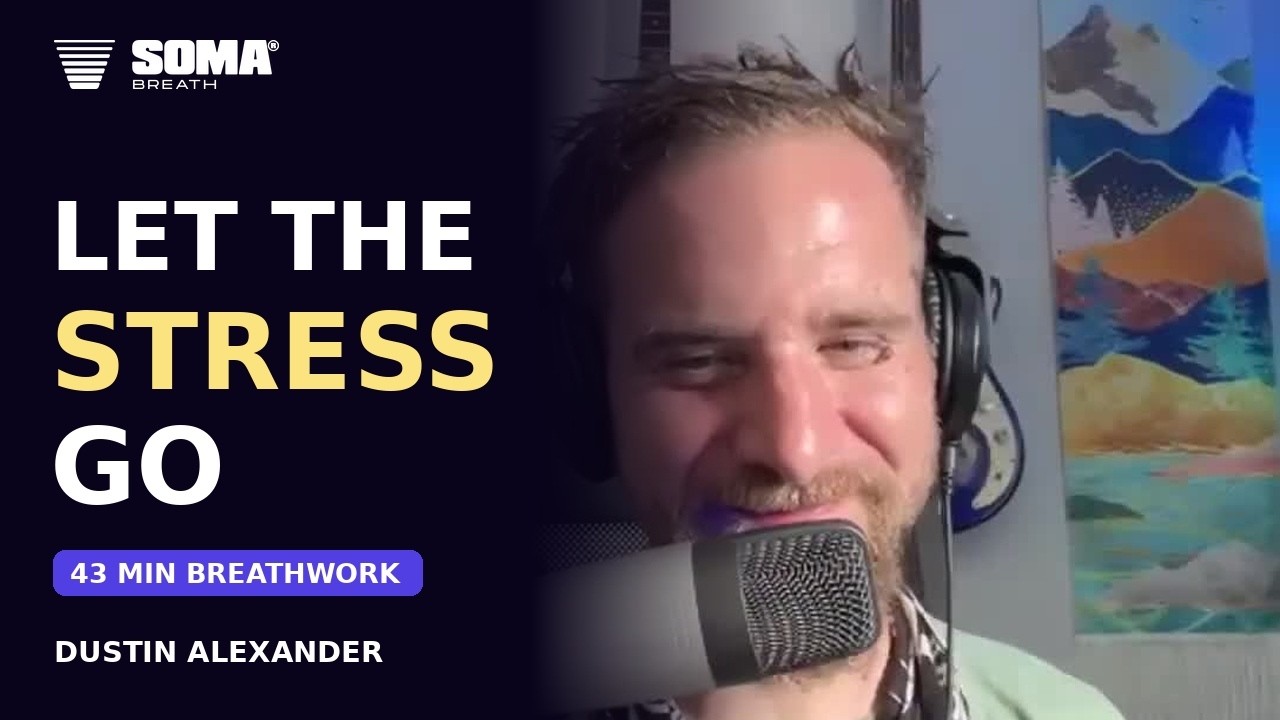
In this guided SOMA Breath session, instructor Dustin Alexander leads participants through a structured breathwork practice aimed at releasing stress and the metaphorical burdens that are not truly theirs to carry. The session begins with safety and housekeeping, including space preparation, the concept of a "window of tolerance" for breathwork intensity, and a list of contraindications (e.g., severe hypertension, pregnancy, epilepsy, pacemakers). Participants are then guided through a gentle pre‑breath stretch that incorporates intercostal expansion and pelvic‑floor (Kegel) engagement. Dustin explains the breathing rhythm (e.g., 4‑in/4‑out, 2‑in/2‑out) synchronized to music counts, emphasizing diaphragmatic breathing and the "golden note" on exhale. The practice proceeds to rhythmic breathing cycles followed by breath‑holds at the bottom of the lungs, with optional micro‑sips to extend the hold, and concluding top‑holds with pelvic‑floor tension. Throughout, the facilitator weaves a thematic narrative about recognizing and letting go of expectations, societal and personal pressures, and the weight we metaphorically carry on our shoulders, encouraging participants to visualize releasing this weight with each exhale. The session culminates in a gentle return to natural breathing, reflections on community, belonging, and the supportive nature of the earth, followed by a slow grounding and closing remarks thanking participants.
Chapters
Hello everybody, my name is Dustin and I'm here to guide you on this session. Um, I want to go over a few housekeeping, a few logistical things before we get started here. And actually, let me first get some music going here.
Beautiful.
So a few Things I want to cover. First and foremost, I want to talk about safety as we're going through this practice today. The first thing that I like to talk about is securing our space.
So as we go through the session today, we want to make sure that our body is taken care of here on Earth as we travel the astral planes.
So any space that you're breathing in today, make sure there aren't any sharp corners that you could fall upon and you are nice and Well taken care of. So, uh, uh, first and foremost, take care of that. And, um, I like to talk about the window of tolerance because everybody's experience is different with breathwork, and sometimes it can be pretty intense. And so the window of tolerance, it's kind of like listening to your favorite music. You want to listen to it loud, like you want to challenge yourself a little bit, but you don't want to be listening to it so loud that your ears are bleeding and then your neighbors are pounding down your door. And this is how I like to see our window of tolerance in breathwork. You want to be challenging yourself. You want to be challenging yourself in the breath holds and the breathing, but you don't want to be pushing it so far that it's intolerable, that you're not having fun, and that it becomes uncomfortable. That's not the point of today's session. So as we're going through today's journey, I want to remind you, with breathwork in general, you have the remote control to the experience.
That's the beautiful thing about breathwork, is that if it becomes too intense, you can just slow your breath down.
And if you want it to become more intense, you can just start taking deeper breaths. And it's a beautiful thing like that. It's, it's a, it's a journey that we have the remote control of. So a lot of people ask about sitting versus laying down. So if this is your first session, I do like to encourage people to lay down if it's your first. But if you're more comfortable with this style of breathing, and if you know your body, feel free to set up and sit up and just make sure your back is straight. Quickly, I'm gonna go over the contraindications. So slow rhythmic breathing techniques of Soma Breath, they're safe to be used for anyone and can be beneficial for everyone. And if you deal with any of these contraindications, I just want you to refrain from the breath holds and just let yourself fall into a meditative state. So these contraindications are severe or critical diseases or infections. If impairs your ability to breathe, uh, severe uncontrolled hypertension, usually after a heart attack, organ failure or late-stage terminal illness, pregnancy, and if you have epilepsy, a pacemaker, or a regular heartbeat. All these with the exception if your doctor gives you specific permission.
That's pretty much it.
So for today's session, it's very special. This is a very special theme for me. And, um, the title of today's theme is Releasing What Was Never Yours. And this is a story about the burdens that we carry as human beings, especially in today's modern society, and this idea of individualism and how this can be something that adds more burdens onto us. We'll get into that more as we get deeper. But what I'd like to do right now is before we get breathing, I'd like to get on a quick little stretch to make sure that we can take on this beautiful oxygen and that we don't pull any of those beautiful small muscles between our ribs.
They're called the intercostal muscles.
So this is a really simple stretch that I do before I do breathwork, and we're just timing our breath with our body. By taking a big breath in and reaching up to the sky. I like to think of this as a good morning stretch. So I breathe in, I reach up, and I hold at the top. And right up here, I like to flex my pelvic floor as I hold my breath. These are the muscles around our sphincter, our bladder, our sexual organs. And I like to think about squeezing this energy up my spine. And then you can lean left and lean right, and we're going to do a slow exhale. And come down. Into prayer position, just like that. Okay, very simple. So with me, big breath in, reaching up. Hold at the top, squeeze the pelvic floor, lean a little left, open up the side of the ribs there, lean a little bit right, open up that side, and then slow exhale. Coming down into prayer. Okay, 2 more of these. Big slow breath in, reaching up, holding at the top, leaning. You can even lean back and open up the chest and shoulders a little bit more. And then slow exhale coming down.
Okay, one last one.
Big breath in.
Hold at the top.
Flex the pelvic floor and stretch it out. Open up those ribs. Open up the chest and shoulders, and slow, slow exhale.
Okay, that's it.
Let's get into this breathwork. And as you get ready here and get comfortable and take your Last sip of water before we start the session. I'll give you a quick explanation of how this is go— gonna go, and this is very simple. Soon I'm gonna play music with a rhythm in it, and in that rhythm there's gonna be a count, and to that count we're gonna breathe.
So for example, The first round is in for 4 and out for 4, and you'll hear it in the music.
You'll hear the counting, you hear the breathing sounds. And when you hear in, we're going to breathe in through our nose. And when you hear out, you're going to breathe out through your mouth. And so when we're breathing in, we're going to want to expand the diaphragm. I like to think about like I'm blowing up a balloon in my belly as I breathe in, and it can be a little bit Strange feeling if you're not used to this sensation of breathing. It feels a little bit backwards, but once you get used to it, you'll notice you'll be able to take in more air. So when you breathe in, expand the belly and let it go into the chest. And when you breathe out, it's out through the mouth. And I think about it as like a big sigh, kind of like when you get home from a long day of work and you plop down on the couch and you make that sound.
It's like, ah.
We call this the golden note.
Okay, and that's on the exhale.
So we're going to breathe like that to a rhythm, and at the end of that rhythmic breathing, we're going to go into a breath hold. And this is also really simple but kind of challenging. We're going to let out all the air from our lungs, hold at the bottom. I want you to hold on as long as you can, and I know it will be a little bit uncomfortable, but we're just going to push past the discomfort a little bit. And whenever you need to during this breath hold phase, You can take a sip in of air, let it out, and keep on holding. And it's as easy as that. We're gonna do this as— you can take as many sips as possible. And at the end of the round, I will give a signal to take 1 to 3 breaths in, holding at the top of the breath, and squeezing the pelvic floor like we did on that stretch, those Kegel muscles.
Okay?
And that's pretty much it.
And Really, especially if you're new to this, don't worry about getting everything right, um, and just really enjoy the ride, enjoy the journey.
And I'm going to be here guiding you the whole way, so no worries.
All right, my friends, let's drop in together. And the way we're going to do this is we're all going to close our eyes. So as you close your eyes, start to notice that now the distractions of the outside world are Turn down, we can start to move within. And so while we're here, let's just take a moment and check in with ourselves. How are you feeling today? How are you physically feeling? How are your emotions in this moment? And how's your spirit? And by spirit, I mean that thing that keeps you moving even when things get difficult. You can kind of get a sense of that. And sometimes I know it's Sunday, it's the end of the week.
And I know for myself, it's been a long week, and it's okay.
We're just checking in, just observing where we're at. So while we're here exploring the innerverse, I want to ask you, where is it in your body that you carry the weight of the world? Usually it's the same place for a lot of us, on our shoulders. You know that feeling when things start to stack up? Responsibilities and things we feel we need to get done and do and be. And it stacks and it stacks and it stacks and it weighs down on us, and it can sometimes even depress us. But maybe here in this moment, even as I bring up this place in our body where we carry this weight, maybe you can start to feel it loosen up a little bit. Like, ah, I didn't realize I was carrying that. I didn't realize that tension was in my body, in my shoulders, and I can just let it go even for this moment. You may start to notice Even as you're here sitting and breathing, every exhale that you're breathing out loosens your body a little bit deeper. See if we can Zero in on this a little bit, almost like we're meditating on the exhale. You don't need to change the exhale, but just focus in. Let's observe this exhale, feeling our body decompress and become a little lighter. Every breath. Every exhale, a little lighter. You can start to notice little details, the warmth of the breath as it leaves your body. There's a lot of weight to being a human being, and I'm not just talking about personal stress. There's a collective weight, a cultural weight, an ecological weight, a future weight that can all bear down on us. But with this breath, with this exhale, And the next, and the next, it becomes a little lighter, like the body knows how to let go. The shoulders know how to loosen up. The nervous system knows how to slow down. Your breath knows.
This breath.
And the next, letting go a little bit deeper. And so as we move through this practice, as we move into this rhythmic breathing, I want you— I want to invite you to let those burdens, when they come into your awareness, or if anything comes into your awareness, just focus on letting it go with the exhale. Ah, letting go, surrendering. All right, this first round is in for 4 and out for 4. Here we go. In through the nose and out through the mouth.
3, 4.
Expanding the diaphragm.
3, 4.
And sighing it out.
2.
Just like that. Letting go. Letting go.
Let him go. 1, 2, 3, 4. In, 2, 3, 4.
Maybe we don't need to be stronger. Maybe we're just carrying a little bit too much. Maybe in this moment, you can let it go. Even if it's just a little bit, let it go.
3, 4, up, 2, 3, 4, in, 2, 3, 4.
Letting go.
3, 4, up, 2, 3, 4, in, 2, 3. Last few breaths. Let's see.
See if we can make them a bit deeper, breathing in a little bit deeper and letting go a little bit more.
Fully filling, fully exhaling. That's right.
Last couple breaths here.
1, 2, 3, 4, 5, 6, 7, 8. 1, 2, 3, 4, 5. 1, 2, 3, 4, 5. 1, 2, 3, 4, 5. 1, 2, 3, 4, 5.
Let's take one last breath all the way in, fully filling, holding at the top just for a moment here, gently holding. And with a nice big long sigh, let that breath go.
Ah.
Holding at the bottom gently. As you're here holding at the bottom, we're relaxing our body as deeply as we can, loosening the shoulders, relaxing the face, and Unclenching the jaw, relaxing the forehead, the fingers, the toes, your belly, just letting gravity cradle you into the earth. And we're holding here as long as we can. And when you need to, you can take that sip in, let it out, keep on holding. You can repeat that as many times as necessary, just reminding yourself in this moment And we're letting go even deeper, letting go of our body and even letting go of our mind, letting the thoughts pass on by, letting them pass on by. And we're just here letting go. Have you ever been on a long hike or a long walk with a big heavy backpack? And it gets to a point where you don't even notice the weight that you're carrying. And this is a wonderful thing. As a human being, we can adapt. We're so strong, we're so resilient, but that can lead to carrying so much unnecessary weight. And suddenly when we get to that destination and we slip the backpack off and it's like, oh, we almost feel like we can float away. I didn't realize I was carrying that much weight. Good. We're gonna take one big breath into this, to this sensation of letting this backpack go. We don't have to let it go. Just imagine that sensation as we take this breath in on 3, all together. 1, 2, 3.
Big breath in. Holding at the top.
And here we can flex the pelvic floor.
Good.
Driving that feeling, that beautiful feeling of letting that weight go, like you could just float away off the surface of the earth into space, letting go.
And let your breath go all together with me.
Ah.
Return to a gentle breath. My friends, we're all carrying burdens that are not ours to carry. And I know it can come from a place of love, of wanting to support those around us, and that's wonderful. Be there, support, love, be in community. This is what we need, but sometimes we take on the burdens of others. This can come in many forms, and one of the most common is expectations. They come from everywhere. Our parents— maybe your parents thought you should be or marry a brain surgeon. Or your friends have expectations of you, or your job has expectations of you. Or maybe you have expectations of yourself. Do you feel those coming up? That's okay. We're gonna let them go. This will be in for two and out for two. Let it go.
In two, out two.
In through the nose.
In through the nose, out through the mouth. Expand the diaphragm, let it go with a sigh.
In, 2, let it go. In, 2, 2, let it go.
In, 2, 2.
In, 2, 2, let it go. Out, two, in, two. Out, two, in, two.
Let it go.
Two, in, two. You can let it go.
Two, in, two.
Out, two, in, two. 2, out, 2, in, 2, out, 2, in, 2, out, 2, in, 2, out, 2, in.
What are you holding on to?
Out, 2, in, 2, out.
Let it go with the breath.
In, 2. Feel the weight slide off of Let it go.
That's not yours. Almost there.
Last couple breaths.
Make them a little bit deeper here.
Good. Let's take one full breath all the way in.
Hold at the top just for a moment here, holding gently. And with a nice long sigh, let it go.
Ah.
And hold at the bottom. Gently here, holding, holding as long as you can, taking sips where you need them, gently challenging yourself, pushing yourself slightly outside of The comfort zone as we're here holding, as we're here growing together in community, in ritual, in ceremony of breath. Our breath is analogous to our life. The next breath and the next breath and the next breath. And sometimes we can be in life just thinking the next thing, the next thing, the next thing, or what happened, and we lose our presence. But notice here, as we're holding, as we're sitting in the now, we're not worried about the next breath. You can kind of let go a little bit deeper. Our bodies carry these stories, and you know what I mean. When you've met somebody and you can just tell they've been through a lot, they carry it by the way they carry their weight. You can see it in the neck and the shoulders and the jaw and the chest and the belly and the hips and Our bodies carry these stories. We don't have to hold on to them. Can you let go of your body a little bit deeper in this moment? Let yourself drop a little deeper into the earth. You're doing so good. You've carried everything so far, and it's made you so strong. And you're stronger than you even realize. And if you can just let that backpack slide off, maybe we could start to find out together how strong you are. On the count of 3, Let's take 3 big breaths in, holding at the top of the third. With me.
1, 2, 3.
Big breath in.
Big breath out. In and out. Last big breath all the way in.
Holding at the top.
Flexing the pelvic floor and moving this energy up and up and up. Before you let the breath go, keep on holding it, but let your body relax into that pressure. And one With a nice, big, long, relieving sigh, let your breath go.
Ah.
And return to your natural rhythm, gently in and out. Gently, just letting your breath flow like waves, carrying you away. To this deep ocean, weightless in the water. Perhaps healing is not about becoming stronger. Maybe it's remembering that we have support. Maybe it's about remembering that you belong, and that feeling of belonging And you know what I'm talking about. Those moments when you've been accepted into this wonderful place or group or family, that feeling of belonging. You start to notice, I'm not in this alone. I am connected. I am held. And not only by community, but by the earth. In this moment, gravity is holding you. Can you feel it? Can you feel your breath moving without any effort? Can you feel your heart beating without you commanding it? That support is already here. Right here, right now. Can you feel it? Can you surrender to the embrace? Can you feel the floor beneath you, and beneath the floor of the earth, and beneath the earth of vastness? Resting inside of a web that has existed long before you arrived here. We all have our responsibilities, but you're not responsible for everything. You have a role, but you're not the whole story. Even in the most individualistic hero stories, the hero never does it alone. The hero has support both spiritually How has that shown up for you before? How did that feel? And can you trust that it'll always be there for you? My friends, we are all part of something larger. And even if it's just for this moment, you can set some of that weight down.
And lay it down.
Gently pull off that backpack and float away into the universe. Just float on. Great. You can gently, very, very gently start bringing yourself back to your space and your place. So slowly, so gently coming back. And notice as you do, maybe you feel a little bit lighter. And as you need to, you can wiggle the fingers and the toes. Maybe have a little stretch. You can start to open your eyes. And notice as you do, here we are all together from all around the world, coming together in this ritual of breath. And even in this way, we're supporting each other. So beautiful, my Somis. Thank you for joining today. Thank you for breathing with me today. And I hope you're feeling a little bit lighter now. Thank you.
Thank you.
More from Niraj

Can’t sleep? Here’s a science-backed way to finally switch off your brain and body. 💤


Guided SOMA Breath Practice with David and Chantal | Breathe Together Sunday | 2026-10-11

Guided SOMA Breath Practice with Piotr Ciepiel | Breathe Together Sunday | 2026-10-04


We’ve all been told we need to lift weights, run, or do HIIT to stay fit and healthy.




Guided SOMA Breath Practice with Kiera Young | Breathe Together Sunday | 2026-09-27
