Medical Understanding of Yoga: Interview With Dr. Prakash Malshe
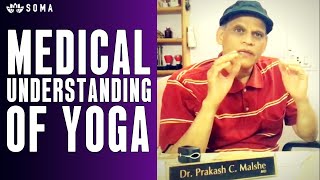
Interview (Haridwar, India) with Dr. Prakash Malshe about medical interpretations of yoga and pranayama. Dr. Malshe—trained in traditional yoga and a medical doctor—links specific yogic practices (breath-hold pranayama, bhastrika, nishesha rechaka, mudras, Shanka Prakshalanam) to physiological effects such as transient/intermittent hypoxia, nitric oxide and VEGF production, increased EPO, stem-cell mobilization, changes in muscle metabolism (myoglobin/ATP), and intestinal microbiome shifts via "drinking air" techniques. He cites classical texts (Hatha Pradipika, Gheranda Samhita) and personal/clinical observations (pulse oximetry readings down to ~79–80%, X‑rays of gastric air) to support these claims.
Chapters
Hello everybody. My name is Neeraj Naik AKA the Renegade Pharmacist. Today I'm here with my new friend and My new guru, Dr. Prakash Malshe.
Namaste.
And we're in India in Haridwar, a very auspicious place in India and we're going to be discussing yoga and going deep on yoga and pranayama and a medical perspective on it. So I've been searching far and wide trying to find people who believe in the same beliefs I have about yoga and the way yoga should be practiced. And Dr. Prakash Mahar has written an amazing book and we're going to be discussing that book. He's going to share a lot of his wealth of knowledge from that in this interview. So firstly I want to ask you doctor, could you tell me a bit, a little bit about your background, how you got into yoga and you being a doctor, It'll be really interesting.
Sure. In fact I came to the medical line much later in life but I was fascinated about yoga since my childhood. When I was about 10 years old I had read a book which was authored by none other than a very renowned yoga person, a yoga teacher. His name was Sripad Damodar Satabaleka. He lived up to the age of about 107 years and he had authored a book about the yoga asanas and he used to attribute.
His long life only to the effect of yoga. And he also mentioned that a regular practice of yoga can not only ward off diseases but can increase your longevity. And, and that actually fascinated me. And I had that desire inside me to learn yoga as and when the opportunity strikes.
Excellent.
The opportunity came only when I came to this town of Haridwar in the form of a very small yoga camp. We call it Shivir and It lasts about 10 days in which I had the opportunity to learn yoga firsthand from Swami Abdhyatmanand.
Swami Adhiatmanand at that time was living in Rishikesh Shivananda Ashram Rishikesh. It is also known as the Divine Life Society and it has its headquarter in Rishikesh. But there are branches almost all over the world. Swami Adhyatmananda was a disciple of Swami Shivananda, the great Swami Shivananda was also a medical doctor.
We celebrated his centenary year way back in 1987. So he was an ancient yogi, a doctor turned yogi. And I had the opportunity to learn firsthand from Swami Adhyatmanand who was the direct disciple of Swami Sivanand.
Wow.
Amazing.
But then what happened? You Know, when I started learning yoga, I could not put aside my medical knowledge. And so whatever technique Swamiji was teaching, I was interpreting in terms of the medical physiology to look at the yogic techniques. My point of view always remained that of a medical person, not of a lay person. What happens is whenever a lay person learns yoga, he takes the knowledge with great faith because of the devotion to the guru, devotion to the Swamiji. He takes every information, every knowledge that is given, he takes in with great faith. What a scientist has to do is a scientist has to do the inquisitiveness.
One has to take things only if they are logical. You cannot just take things on the basis of faith because the Guru is saying so, it must be so. So what was happening was when he used to teach, breathe, closing your right nostril, then close the left nostril, then exhale through the right nostril. Immediately a medical person thinks, what difference is it going to make if I breathe through the right nostril or the left nostril? Because anatomically, both the nostrils connect in the nasopharynx. Inside they are one only, outside there are two. But you know, if you give it a deeper thought, you know that even your right hand and your left hand, they are not the same. The things that you can do. If you are a right handed one, you will brush your teeth with your right hand, you cannot brush with the left one.
So exactly.
Similarly, what difference exists between your right hand and left hand? Differences also exist in your right eye and the left eye, the right nostril and the left nostril. Same way, right foot and the left foot. If you want a greater detail, you can refer to medical literature. And male Robin has excellently summarized about the right handedness and the left handedness. You may please go through that. Mello Robin, Melrobin.
Then what happened was.
When we attended that yoga camp, we also learnt the internal cleansing procedures. You will find their mention in my book.
Washing the intestines with water. That is known as Shanka Prakshalam.
It is a very marvelous process.
You need to drink a lot of water with added pinch of salt to it, warm water. And then you move the abdomen in a certain way, do some physical exercises of five types. You will find their mention in my book. The whole technique is known as Shanka Prakshalanam. And very soon, bowel evacuation starts. At first one passes some semi solid stools, then liquid stools, then colorless liquid. And I was very fascinated with that technique because in medical knowledge we are never exposed to Such techniques that one can induce loose motions, like watery loose motions and water. One can literally wash the intestines with lukewarm salted water. That was the first time that I learned, that was during the year 1986 that I had first attended this yoga shivir, when I was about 30. 30 years of age. 30 or 31.
Is it okay?
Yeah.
So that's interesting. So this is how you got into yoga and you started to. Did you start incorporating yoga then into your medical work?
When I refer to the medical literature, I noticed that actually.
Doctors commonly don't go to learn yoga because of their background. Most of us have learned medicine in the modern medical colleges.
Most of the medical research has been done in the Europe and the America.
And there is a common, I mean, way of looking at the ancient Indian practices.
As quackeries. I mean, even Ayurveda, yoga, all these ancient traditional wisdoms, the doctors tend to look upon them as something quackery, unscientific thing. Rather than trying to understand the science behind it, they simply reject them as worthless.
At the same time, the yogis who are teaching these techniques to common people, they do not understand the underlying mechanisms and therefore they cannot give the correct interpretation in scientific terms. For example, when a yogi teaches you pranayama, yogi will tell you that pranayama provides you some extra oxygen about which the doctors don't feel convinced because it is not the extra oxygen which can cure illnesses. Had it been so, we do have oxygen cylinders in our clinics, so we could provide oxygen in any amount, maybe 100% oxygen. Pranayam does not provide 100% oxygen, but the doctors could provide. But sadly, 100% oxygen does not cure any illness. 100% oxygen does not prolong your life. Moreover, it may even be harmful under certain, certain circumstances because you tend to have oxidative damage.
Right?
So yogis were not providing the correct scientific background, the correct scientific reason behind the yogic techniques providing you some beneficial effects. And that is the reason why doctors were not convinced. It is only the way how you think about it that makes all the difference. For example, when I started understanding the use of pulse oximeter, the pulse oximetry showed me that with the practice of pranayama, when you hold your breath and when you hold your breath beyond your comfort limit, then it really reduces your oxygen saturation. I mean, it brings the saturation lower, it produces a transient brief hypoxia. And then when I turned the pages of the medical literature and searched over the Internet, I came across a lot of benefits. Accruing from brief intermittent hypoxia. Indeed, a great amount of research has been done in the erstwhile ussr. What was USSR earlier? I mean the Russia and the other countries, they had done a lot of research on brief intermittent hypoxia. They used to have three different mechanisms by which to induce hypoxia. They would take you in a helicopter.
To a certain height, drop you there, bring you back after three hours. During those three hours you will have reduced oxygen available in the atmosphere and there will be hypoxia.
Then they also started providing with.
Low pressure cabins. What you will know as there are sealed cabins in which the pressure is reduced sub atmospheric. So you call them hypoxic cabin.
I saw such cabins. They are, they are, they do have, in India as well, the Defense Research Organization TRDO at Delhi, they are researching. And the third mechanism was they used to provide you with a gas mixture. Rather than 10, rather than 20% oxygen present in the air, they will give you 10% oxygen to inhale. And what they were observing, this hypoxia.
Produces lot of beneficial changes in the human body. It generates coronary vessels, collateral vessels, wherever there is obstruction, it produces nitric oxide synthase. It increases the resistance of the tissues towards a variety of injuries, including the radiational injury.
And their techniques to induce hypoxia, which were quite costly here in India, without knowing the term hypoxia, our ancient yogis have devised techniques which reduce the oxygen saturation. And without any gadget or equipment, you can just by breath holding, bring down the oxygen, as you must have seen in some of the videos.
And that's how we contacted you in first place, was because I was doing research on.
And you learned firsthand.
Yes.
Very good.
It's very good.
And you were able to bring this oxygen saturation down to maybe 80 or 79 at times.
Yeah.
That's good.
It's amazing. So can you tell us more of the processes that we do to create hypoxia?
The physiological phenomenon is very easy to explain because what happens is our system has been trained in such a way that something should flow in and out. It's not essential that it is air or it is oxygen or even an inert gas. It could be nitrogen, it should be anything which is odorless and non irritating. So our system has been trained, experimenters have done lot of experiments. Some of them, they have actually switched the mask. If a person is giving. If a person is given oxygen to inhale, then you gradually reduce the concentration, the person does not notice at all. Even if the oxygen is completely shut off and 100% nitrogen is given, the breathing continues. There is no sense of suffocation. There is nothing. No sensation, no unpleasurable sensation. And the person may become even unconscious. So to tell you the truth, our body only wants that something should flow in and out in the respiratory tract. That urge you need to overcome, you cannot overcome. The urge you can overcome because if you give 10% oxygen, one continues breathing and the oxygen comes down.
If you train your system, the respiratory system, to reduce the intake, gradual training, you can hold your breath maybe 60 seconds or 70 seconds or 80 seconds. When I was experimenting in the yoga center of stairs with the pulse oximeter on, I found that if you hold your breath inside the thorax, you have a deep inhalation and hold it there, it does not produce hypoxia. Rather, after about 50, 60, 70 seconds, you start having an.
Irresistible feeling that you need to breathe.
No hypoxia occurs. No hypoxia, because there is gas inside, there is air inside in the lung alveoli. So the exchange is taking place. I mean, the oxygen and carbon dioxide. Oxygen is diffusing in the bloodstream, carbon dioxide is diffusing out, so no hypoxia takes place. And you cannot hold beyond a certain limit because your system has been trained to see to it that something should keep flowing.
So then we started experimenting on other types of pranayama. There is one pranayama, known as bhastrika, in which you have a deep inhalation followed by deep exhalation.
And you have to repeat it at least about 20 times. In medical terms, what happens is when you inhale and exhale in this fashion, deep exhalation, you tend to throw out a lot of carbon dioxide. And when the carbon dioxide is thrown out, at least one urge is suppressed. I mean, then you can hold the breath for longer, and then you have to hold the breath in full exhalation. I mean.
And.
All the last air.
Out till the last draw.
Till such time as the sound is possible, there is some air inside.
You can't. To the point where you can't even.
To the point. Yeah, to the point that even this also stops.
Zero air in the rock.
There, you owned it. Then physiologists will say that it's not a zero air because some air is always contained in the broad open airways. That is known as the. Known as the residual volume, which you probably cannot exhale ever. So when you hold your breath at residual volume, the lung alveoli, which are the most Terminal parts where the gas exchange actually takes place. Those alveoli are in a shrunken.
Shape and whatever blood is reaching them that has to come back unoxygenated.
So it is only then that some hypoxia occurs. In other words, if you have to produce a brief intermittent hypoxia just by breath holding, you need to hold the breath in full exhalation. What in physiology we know as the residual volume, minimum volume inside. Hold the breath for the longest you can.
For which the yogic term that was used was Yatha Shaktya. I will come to it shortly. I had a very good background of Sanskrit language.
At my home. My parents knew good Sanskrit. We used to recite lot of Sanskrit mantras in, in the childhood. I, I learned Sanskrit in my high school till about the 10th standard. And so I was good at Sanskrit. So I was able to understand better the original yogic script. The original yogic text, particularly two I I have studied. One is known as the Gehrand Samhita and the other is known as Hatha Pradipika.
So when I was experimenting and I had discovered that it is only the full exhalation and holding for a longer time that produces brief hypoxia. Then later on I found one mention in a yoga text. That mention was about Nishesh Rejak. And then I was fascinated to have a look at that. What is Nishesh Rechaka? That term means nishesh is nothing remaining. Re chaka is exhalation. So if you perform exhalation with nothing remaining inside, no air should remain inside. Exhale fully and then hold it. How long? Yatha shaktya. This yatha shakti word was not correctly interpreted because other people used to interpret it. Yatha shakti. They will say as long as possible.
I interpret as long as possible.
Longest.
I mean there is a difference. As long as possible comfortably into bracket. They are saying as long as possible comfortably. No, I will say the longest possible duration. Even surpassing the comfort zone. Yeah, you have to come out of comfort zone. Then only you get the hypoxia.
And we've seen that, we've demonstrated this when we were practicing.
You have to exactly go to the next level. Yes, yes, yes. And that, what does it do? That brief hypoxia that produces second level defense mechanism. That activates the second level defense mechanism in the body.
Like a positive stress response.
Lot of positive effects occur.
We now know this is medical knowledge that hypoxia stimulates nitric oxide synthase. This is an enzyme which will increase the Production of nitric oxide. So hypoxia activates nitric oxide synthase enzyme and it increases your nitric oxide production. So there are a lot of beneficial effects. In prostate patients, it will relax the urethral sphincter in a better way. In patients of the coronary artery, it will dilate the coronary artery in a better way. Then about the erectile function, nitric oxide is of crucial importance. And we have seen that a small dose of brief intermittent hypoxia every day, it increases the erectile function in a miraculous way. Where the medicines fail, where the psychotherapy fails, intermittent hypoxia is effective.
And you've seen these results?
Yes.
Firsthand.
Yes, definitely. Definitely.
Amazing.
And what about. Okay, carry on. About the heart.
Yeah.
Hypoxia also produces one more chemical, which is known as the vascular endothelial growth factor.
And it leads to formation of collateral channels.
Amazing. Okay.
Bypassing those blocks. We call them natural bypasses.
So you. You recommend this for people who have.
I recommend this intermittent hypoxia for all healthy people as well as all sick people. Those who have coronary artery disease, though, those who have renal failure, those who have osteoarthritis of the knees, they will regenerate their cartilages. Wow.
And you've seen this with your patients?
Yes, of course. Yes, of course.
This is amazing. This is so fascinating. And you were also talking about epo.
Erythropo.
Intermittent hypoxia also increases EPO levels.
That is the reason why those patients who have chronic renal failure and who require to take periodically erythropoietin injections, if they do this pranayama, they will not require. It has been studied in medical research that the failing kidneys also have a capacity to secrete erythropoietin. It is only that their relationship, I mean, the level of hemoglobin and the level of erythropoietin, that relationship gets altered. And that is the reason why these chronic renal failure patients tend to have a slightly lower hemoglobin. If you expose them to hypoxia.
They will have more erythropoietin and they will increase their hemoglobin without the need to take injections.
And the one that you mentioned, that is really, really interesting to me and because this is like a lot of science is now heading in this direction is about stem cells. Yes.
This is a very important thing to know, that although oxygen is very essential for us to live, for the millions of cells to live at the same time, Hypoxia is essential for the survival of stem cells. Stem cells do not tolerate the level of oxygen that is prevalent in our blood. That is why during embryonic life, when we have very, very low oxygen saturation in the blood, you know what, in the mother's womb, we get oxygen. Only as much is available at the Mount Everest, so very low concentrations are available when we are in the mother's womb. At that time.
The stem cells circulate freely in the blood.
Then what happens after birth? After birth, when we breathe the atmospheric air, the oxygen concentration suddenly goes up in the blood, and the stem cells, they run away. They have to hide themselves in what we call as the niche particular place in the bone marrow where they stay surrounded by other cells. The oxygen is diffused from the outer side. The other cells consume the oxygen, and the stem cell survives in the center, but they cannot circulate freely in the bloodstream. That is the reason why these days.
Stem cell banking is very much.
Thing of current discussion.
That's right.
When a child is born, the newborn, we try to take a small sample of blood from the umbilical cord, and that cord blood is stored in deep freeze for future use. Although we are not sure what we are going to do of the stem cells, because to culture these stem cells, it is very difficult. And then again, culturing the stem cells requires very low oxygen concentration. While the atmospheric concentration is about 20%, stem cells survive and stem cells multiply in 2% oxygen.
So now what is happening is the stem cell researchers, they are trying to regenerate. Say, for example, they are trying to degenerate the coronary blood vessel or maybe the cartilage of the knee. So what they will do, they harvest the stem cells from the bone marrow from various sites, and then they inject those stem cells to the place where the repair has to be done, for example, in the knee.
So my question is, why you need to take stem cells from here and inject somewhere else, while all the body parts are connected through a meticulous network of blood vessels. Why the stem cells can't travel. Any other cell can travel from one place to the other. The blood cells are traveling. Even the cancer cells are traveling. So why do the stem cells not travel? The answer is oxygen. The prevalent level of oxygen that is there in the blood, it disallows. It does not allow the stem cells to go from one place to the other. It's like a curfew imposed on the roads where you cannot go and buy your daily needs. You cannot go out because There is police everywhere. Only if you relax that curfew for say 15 minutes, you will go and purchase your daily needs, the milk packets and the veggies and the fruit, and come back. 15 minutes is good enough for you. In a similar way, three minutes are good enough for the stem cells to travel from one place to the other. Because the whole body circulation time is about one minute. Three minutes are good enough, which we can produce with the practice of nishesarechak pranayama.
Amazing. So does it mention anything like this? Does it allude to any thing like this in the yoga sutras or in the pranayama text?
Any pranayama text. It's not mentioned. It is mentioned in the fifth chapter of the book, Hatha Pradipika.
It's mentioned.
It's mentioned. Hatha Pradipika says wherever you feel there is obstruction. By obstruction, it is meant a disease.
Yasmin. Yasmin yada deshe ruja badha prajayate tasmin deshe chitam varu manasa pariyad. If you feel there is obstacle in the heart, you concentrate on the heart. And not only that, do what? While concentrating on the heart, mentally inhale and then exhale fully and hold till the maximum possible.
Amazing.
So through intention.
Although probably the ancient rishis, they did not know the term hypoxia. They even probably did not know whether oxygen existed or carbon dioxide or whatever existed. But they knew this thing that if you hold the breath in full exhalation, focusing on a certain area of your body, it may be your shoulder, it may be your knee, or maybe your heart or whatever.
It will definitely improve the function of that particular part.
Amazing. This is amazing breakthrough stuff. So going back to yoga as an anaerobic exercise. So this is. There's a misconception out there that yoga is aerobic or anaerobic. There's a confusion actually. So can you enlighten us to what it has?
You know what? Whenever a muscle contracts, it squeezes the blood vessels entering it. So blood cannot enter if the muscle is in contraction. The blood can enter only when the muscle relaxes. If you see a physiology book, you will see this graph where the blood flow to a muscle increases as much as about 50 to 100 times during its relaxation than as compared with the contraction. So the muscle contracts, it squeezes the vessels, it relaxes, the blood flows in. What we do in yoga is we just contract the muscle only once, stay there for long time, so the blood is not able to enter.
And what the Muscle has to use, the muscle has to use its stored oxygen in the form of myoglobin. So if today you are able to flex the arm maybe for 30 seconds, with repeated practice every day, every day, maybe after one month you are able to flex the arm for.
More duration, maybe 40 seconds. So how could this occur? This occurred because during this time the muscles have learned to store more oxygen in the form of myoglobin. They may also store energy in the form of creatine phosphate. They may also store energy in the form of ATP. And all these three mechanisms could be working.
One has to undertake research, one has to do the muscle biopsy before and after a six month training period for yoga and see for themselves what changes occur in the muscle. But one thing is sure, that a person doing it on the first day will definitely increase the time duration, the stamina, the capacity with persistent training. And to me it seems that it takes place because of the increase in myoglobin, increase in creatine phosphate and increase in the ATP concentration of the muscle.
So basically you're training the muscle, but under contraction to become fitter, under lower oxygen so it can survive, it can operate under low, low oxygen.
We are, we are training the muscles. Yeah, to work without demanding more blood flow.
Right. So it's more, they work more efficiently.
And that's how you, if a, if a novice, an untrained person, climbs the stairs, immediately, his breath will increase, immediately his heart will start pumping more blood. That is because his muscles, when they become active, they demand more blood. When a yogi climbs upstairs, his heart rate does not increase that much to that extent. His respiration does not increase because of the yoga sana training. The muscles themselves have tremendous stored oxygen, stored myoglobin, ATP, creatine phosphate. And these day to day activities of climbing a flight of stairs may be a couple of flights. They are very trivial activities, they are small activities, not very major activities for a yogi. And so the day to day activities do not put a stress on the heart. There is an indirect effect of the asanas. If you are performing asanas every day, you are protecting the heart because it does not need to overwork any time of the day.
That's interesting. So these yoga moves which contract the muscles. Can you give an example of a couple of yoga asanas that.
Could you describe a couple you do where you contract?
Yeah, yeah, of course. If you raise your arms, it is the deltoid muscles which are contracting. You just raise the arms and stay there. So it is your deltoid Muscle which is in contraction and simply just standing like that. Yeah. Your deltoid and the triceps muscles are also under contraction.
Because most yoga that's being taught these days is very flow orientated. So you're always flowing from one posture to another. But when I was learning with you, you were putting the emphasis on actually holding the pose.
Yes, holding the pose. Everything is important. Yoga asana is a static posture. Yes. The definition of yogasana is sthira sukhamasanam. In Sanskrit, sthira is stable. Sukha is you should be able to enjoy it. It should be pleasurable, not stressful. And if these two things occur, you are stable, you are at ease, then it is an asana.
Ananta sama patibyam. In your mind, you have to contemplate that it is not going to end.
These are the original Sanskrit texts from the Gherenda Samhita.
Prayatna Shetilla is there should be minimum of effort involved. And ananta samapatti is a contemplation, a thought that it is not going to end, it is going to stay there for indefinite time. Only if you think in this way, you will be able to hold the asana, particularly for a longer time.
So that way you're actually overriding your urge to stop the posture. In the same way you're overcoming the urge to breathe, you're overcoming the urge to stop doing the posture as well.
We are actually stopping the urge to relax the muscles.
To relax the muscles. So you want to stay in contraction as much as possible. That's when you get.
I'll give you one more example. If you stand up, and then.
This is known as utkatasana, in which what we do is we just flex our knees and stand like this.
An untrained person, his thighs, the quadriceps muscles, they will feel exhausted within a span of about 15 to 20 seconds. But then with gradual training, your stamina increases and you can keep standing like this for much longer time. Maybe a minute, one and a half minute, two minutes, three minutes. I think if you persist with the practice, you can continue to stand indefinitely. Some people do it by shifting the stress from one leg to the other. But even if you are bearing the weight on both the thighs, both the feet, then also with gradual training, you can definitely prolong the time period. And then when you again stand up, you don't need to breathe too much. A new person, an untrained person, after holding this posture for maybe 15 to 20 seconds, will need to breathe two to three times and simply so that goes to show. That goes to show that the muscles probably had built up their own storage capacity.
That's right. They're becoming more efficient just by contracting and holding. Very interesting. So the other thing that really interested me and drew me to meeting you and talking to you was about the drinking air.
Yes. That is another area that I have actually discovered.
How to drink air. Because in yoga text.
It is mentioned very clearly.
Making the mouth like a crow's beak. One should drink air gradually.
I saw the interpretation of most of the yoga charyas in India. They try to make their mouth into a crow's beak shape like this. Any amount of effort will not shape your mouth like a crow's beak.
So it has to do not more with the shape of the beak, it has to do more with the movement of the beak. If you observe a crow, in what fashion does it move the beak? You know, it moves forward and backward.
The crow does it like this. Yeah. So way back, sometime in the year about 1988, when I was trying to understand what kaki mudra is. Kakha chanchu vada sena pibed vayamchaneshani. So I was sitting in Vajrasana and I started moving my neck in this way.
And suddenly a gush of air occurred. And the gush entered my food pipe and reached the stomach and I started feeling a gurgling sound. At that time I asked one of my assistants. I asked him to put the. To apply the stethoscope and.
On this area of the stomach. And then I did this thing.
And he will hear. He will hear a gurgling sound. If the air enters my stomach.
It produces a sound like grr.
So this is the technique of kaki mudra. You just move your neck forward and backward. Gradually I learned greater details by experimenting. I also learned that if you rub the back part of the tongue to your throat and swallow those thick secretions, which is also mentioned in yoga text, it is known as manduki mudra.
Keeping the mouth sealed.
Rub the posterior part of the tongue with the throat.
Manduki mudrikam vidhu. Rub the back part of the tongue with the throat and swallow the secretions. It is known as manduki mudra in yoga. What it does medical knowledge is that the throat secretions contain some nitrates. When those nitrates are swallowed, not only the secretions lubricate the food pipe. The nitrate also have a relaxing effect on the smooth muscles of the food pipe. And therefore this, the food pipe widens and becomes more ready to allow the Air inside.
In comparison with the other parts of the intestines. The food pipe does not show peristaltic movements all the time.
It is only when you swallow.
A wave of peristalsis moves down the food pile. At other times, when it needs to suck air, it can dilate in its whole length.
Suddenly.
Together.
All the length of the food pipe, it dilates and allows the gush of air to enter into the stomach.
This is the small sound that it produces. Chick sound and the air goes in. We have studied it with the X rays. A person standing upright may have a small amount of air in the stomach. It is seen in the X ray. But if you perform kaki mudra, the volume of air in the stomach, it becomes huge.
You can see those X rays in my book. They are published there.
Very fascinating. So tell us why we do this? Why do we drink air?
Yes. Yogis had a different view. Yogis thought that it is cleaning with air. If at times you go to a car workshop, they wash the exterior with water, detergent, everything. But about the seeds.
They wash them with a vacuum cleaner or a flow of air. They just blow away all the dirt. So air cleaning is possible. The intestinal cleaning with water is known as Shanka prakshanam. The intestinal cleaning with air is known as vata saar. About the present yoga Charyas, nobody seems to be teaching this technique. I doubt even if they know it.
But when I was reading the yoga text, it is clearly mentioned. Vat saram param gopyam. It has to be kept as a secret.
And it cleanses the intestines. Now applying medical knowledge to it.
Our gut contains lot of bacteria. Some of them are also anaerobic. Although most of the gut.
Can have air traversing it. The appendix, the vermiform appendix is a place which is a blind loop like thing where the air does not enter. So most of us who will be in a habit of drinking air, passing it down as flatus, they will have more of an aerobic population of bacteria in the gut.
Particularly two of the organisms which produce disease in the human gut. They are the Helicobacter. Full name is Helicobacter pylori. And also Entamoeba histolytica, the amoeba. While the Helicobacter pylori produces upper GI discomfort, peptic ulcers, acid peptic diseases, and in rare cases it also produces gastric cancer. Now we have a lot of antibiotics to kill the Helicobacter. We use amoxicillin, we use Clarithromycin. We also use.
Some prazols like omeprazole to suppress the acid and then we eliminate the helicobacter. A simple technique of drinking air may also eliminate the helicobacter infection, and that is by just practicing and perfecting the kaki mudra.
Do this. The air rushes into the stomach and then by inverting the posture, the air bubble is moved into the pyloric region. If you do it every day, helicobacter has to die.
Yeah. Amazing.
That air, when it moves to the colon, it also inhibits the entamoeba, because entamoeba also are anaerobic organisms, so basically.
Kills the bad bacteria. But there's another thing. You're saying it could potentially bring in the good bacteria from the atmosphere?
Not exactly. The bacteria are there. You see, if you eat curd, the curd has a fair amount of number of lactobacilli, which are good bacteria. Entry of air into the gut will facilitate the growth of aerobic bacteria. Aerobic bacteria are good. They do not produce foul smells. The foul smells are always produced by anaerobic bacteria.
And therefore it has been said about yogis that they do not emit foul odor. Yogis.
The body becomes light, lighter.
And you were saying this could be the technique they talked about, where the yogis don't need to eat much food. It can suppress apple soil.
Whenever I am on a fast, I am on a weekly fast on every Tuesday. And if Tuesday and I am on a weekly fast, my stomach, you see, if it starts having hunger pangs, I suppress those hunger pangs simply by drinking air.
The air goes in and the hunger pang is suppressed for some time. Then again, if it starts after an hour or two, again, drink more air. If you spend some about 10, 15 minutes for your breakfast, I spend those 10 to 15 minutes for drinking air. Then at lunchtime, if you spend about 20 minutes to take the lunch, I can spend those 20 minutes for drinking air. Same at dinner time. So you can ward off that unpleasant feeling of hunger pangs. The stomach is contracting and relaxing and you are not eating anything, so you can't stay hungry.
I feel it also helps with the indigestion as well.
And there is something more to it, because if the two surfaces of the stomach, they come in contact and then they rub each other, probably in some way.
It may produce some injury or abrasion or even ulcer. If those two surfaces are separated by an air gap.
There is no formation option, erosion or ulcer. I have not Studied this using. Using an endoscope, although. But it may make an interesting study. This is what I have felt. I have experimented on myself as well as on other people.
I feel it too when I do it, that it stops the kind of. Indeed the acid feeling.
Yeah, acid feeling. Because if you. If you remain hungry, your stomach secretes acid as usual. But if you are in a habit of observing a fast at a periodic, I mean periodically, at a duration of one week, then your stomach also learns that on this particular day it has to produce no acid. Moreover, if you drink air, any unpleasant feeling that was occurring in the stomach, it goes away. So you can satisfy the hunger to some extent. What we call as the satiety. Satites are of two kinds. Mechanical satiety. There are very old experiments dating Back to somewhere 1905, done by a scientist known as Cannon. He used to insert a balloon in a dog's stomach and then inflate it using such a kind of balloon. Inflate it from outside. So the balloon inflates the stomach and the dog feels satiety does not eat. Wow. So we don't need to insert balloon. We can only drink air. Air could be drunk using many more methods.
If you make gurgling sounds while drinking water.
This way also you are drinking a lot of air.
Yeah. Although it may not sound very decorative. I mean.
But at times when you are having hunger pangs, you can satisfy those hunger pangs by drinking lot of air. Plus also I have invented the pierced straw method. Okay, okay.
So show us how to drink air with a straw.
This is a simple straw that you commonly use to drink. I am cutting it short just for convenience. And with the help of a common pin, you just make a pin hole about one inch from above and take out the pin.
Now, using this pierced straw, when I drink water, you will observe some bubbles of air gushing through this pinhole.
So this has been a really fascinating insight into a medical perspective of yoga and pranayama. And this gives you both sides of the story, the scientific understanding of why these techniques work, and also the more esoteric side as well. And our amazing guru here has really done a great job in resurfacing some of this knowledge, this ancient wisdom, and made it now more accessible and more easier to understand. And now I believe firmly, as a medical professional, myself as a pharmacist, that every medical professional and doctor should have this book in their hands. So thank you so much for your time.
Thank you. An honor.
And I'll give all the information for where you can get the book with Dr. Below this video on this page. So speak to you soon. Peace.
Namaste.
More from Niraj

Can’t sleep? Here’s a science-backed way to finally switch off your brain and body. 💤


Guided SOMA Breath Practice with David and Chantal | Breathe Together Sunday | 2026-10-11

Guided SOMA Breath Practice with Piotr Ciepiel | Breathe Together Sunday | 2026-10-04


We’ve all been told we need to lift weights, run, or do HIIT to stay fit and healthy.




Guided SOMA Breath Practice with Kiera Young | Breathe Together Sunday | 2026-09-27
