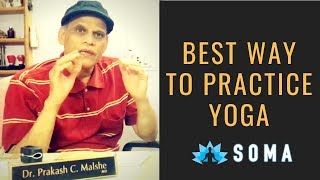
Niraj Naik talks with an instructor about holding static poses rather than flowing through them. The key is muscle contraction and stability: raise your arms to engage deltoids and triceps, hold utkatasana to work your quads. With practice, you build stamina, holding poses longer while breathing easier.
Chapters
So these yoga moves which contract the muscles. Can you.
Give an example of a couple of yoga asanas that.
Could you describe a couple that you would do where you contract your muscles?
Yeah, of course. If you raise your arms, it is the deltoid muscles which are contracting. You just raise the arms and stay there. So it is your deltoid muscle which is in contraction and simply just standing like that. Yeah, your deltoid and the triceps muscles are also under contraction.
Because most, most yoga that's being taught these days is very flow orientated. So you're always flowing from one posture to another. But when I was learning with you, you were putting the emphasis on actually holding the pose.
So it's important. Yogasana is a static posture. Yes. The definition of yogasana is sthira sukhamasanam. In Sanskrit, sthira is stable. Sukha is you should be able to enjoy it, it should be pleasurable, not stressful. And if these two things occur, you are stable, you are at ease. Then it is an asana.
Ananta samapatibya. In your mind, you have to contemplate that it is not going to end.
These are the original Sanskrit text from the Gherenda Samhita.
Is there should be minimum of effort involved. And ananta samapati is a contemplation, a thought, a that it is not going to end, it is going to stay there for indefinite time. Only if you think in this way, you will be able to hold the asana, particularly for a longer time.
So that way you are actually overriding your urge to stop the posture. In the same way you are overcoming the urge to breathe, you are overcoming the urge to stop doing the posture as well.
We are actually stopping the urge to relax the muscles.
To relax the muscles. So you want to stay in contraction as much as possible. That's when you get.
I'll give you one more example. If you stand up, and then.
This is known as utkatasana, in which what we do is we just flex our knees and stand like this.
An untrained person, his thighs, the quadriceps muscles, they will feel exhausted within a span of about 15 to 20 seconds. But then with gradual training, your stamina increases and you can keep standing like this for much longer time. Maybe a minute, one and a half minute, two minutes, three minutes. I think if you persist with the practice, you can continue to stand indefinitely. Some people do it by shifting the stress from one leg to the other. But even if you are bearing the weight on both the thighs, both the feet. Then also with gradual training, you can definitely prolong the time period. And then when you again stand up, you don't need to breathe too much. A new person and untrained person, after holding this posture for maybe 15 to 20 seconds, will need to breathe two to three times. So that goes to show. That goes to show that the muscles probably had built up their own storage capacity.
That's right. They're becoming more efficient by just by contracting and holding. Very interesting.