Invariantes Fund Co-Founder Fernando Pontaza on Applying Culture to Investing | Seed To Harvest Ep54
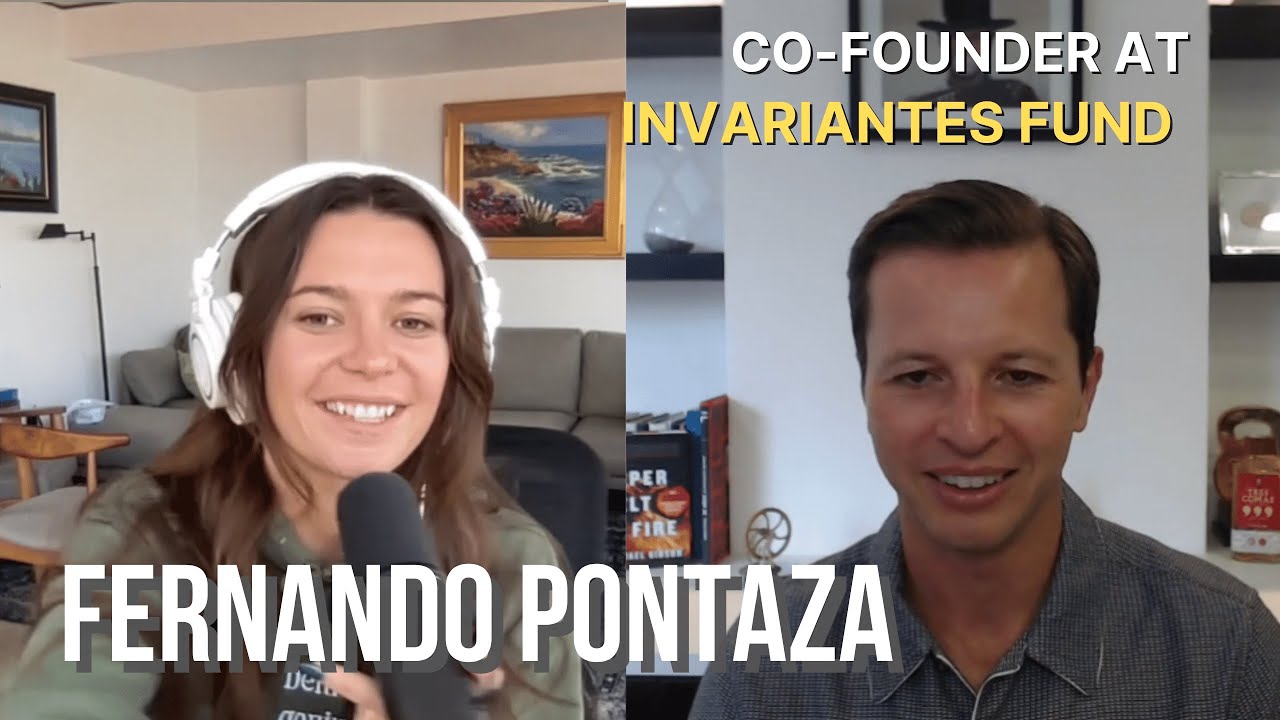
In this Seed to Harvest podcast episode, host Paige Finn Doherty interviews Fernando Pontaza, co‑founder of the Invariantes Fund. Pontaza explains the origin of the fund’s name, drawn from the concept of invariance and the legacy of a late Guatemalan dean who championed Austrian economics. He details the fund’s hybrid strategy: 50 % of capital is allocated to a diversified portfolio of emerging‑manager funds (fund‑of‑funds) and 50 % to direct early‑stage software investments in the US, Mexico, Central America and the Caribbean, split equally between new tickets and follow‑ons. The hybrid model is presented as a risk‑mitigation tool that provides exposure to a broad VC index while allowing value‑add through close relationships with smaller funds. Pontaza recounts Invariantes’ pioneering role as Guatemala’s first venture fund, its impact on democratizing venture access, and heart‑warming stories of LPs becoming angel investors. He shares his personal path from a computer‑systems degree in Guatemala, through an MBA in Madrid, banking, and a multifamily‑office role that introduced him to venture capital, emphasizing the positive‑sum nature of the asset class. Cultural influences—scarcity mindset, contrarian outlook, and the prevalence of fintech in Latin America—shape his investment perspective. The conversation also covers market trends: a post‑2021 slowdown in VC capital, a shift toward slower, more thoughtful dealmaking, and a rise in seed‑stage activity in Latin America despite a drop in later‑stage rounds. Pontaza addresses common pushback on the hybrid model’s double‑layered fees, explaining how the blended returns and risk‑dispersion justify the structure. He highlights relationships with emerging managers such as Hustle Fund, 1517 Fund, and Bain Capital’s venture arm, illustrating the network‑building aspect of the strategy. The episode concludes with reflections on the current market environment and a call to listeners to follow Invariantes.
Chapters
Hello everyone, and welcome back to Seed to Harvest with your host, Paige Finn Doherty. I'm a founding partner behind Genius Ventures and author of the illustrated children's book about venture, Seed to Harvest. And today I'm really excited to be joined by Fernando Pontaza, who is the founding partner of Invariantes Fund. Um, so thank you so much for coming on, Fernando. I'm so excited to share a bit more about you and your story because I think it's incredibly inspiring.
Yeah, thanks. Thanks for having me. And by the way, you nailed the perfect accent with the name and the fund's name. So kudos to you and Spanish.
Thank you. Yeah, we were joking about it before the show. I took 3 years of high school Spanish and I spent a decent amount of time in Mexico, so I've, I've been trying to practice my Spanish more. But to, to start us off, I would love to hear more about where the name Invariantes Came from, and maybe how that corresponds to your strategy of what you're investing in.
That's that's a good question, and one that I seldom get asked about. And the name it comes from our late founding partner, or sadly he passed away shortly after we started and raised our first fund. But he was the dean, and maybe I'll tie this even with our own origin story. But he he was a dean of a business school called Universidad. Francisco Marroquín. He was the dean of the whole college, as a matter of fact, which is a college in Guatemala anchored on Austrian economic principles, which is a rarity in itself, let alone Latin America. That's nightly swinging in a different direction and the way governments are being elected and whatnot. But it's a college here in Guatemala, and he was our founding partner, and he was a fanatic of astrophysics and mathematics and whatnot. And invariantes is the Spanish pronunciation for the term invariance, which is a property that something in particular has that doesn't change regardless of how you observe it and under what conditions, much like the speed of light, which is a constant in a vacuum in space with gravity, et cetera. And his mind frame was that such as that was a property that was going to be our property in the way we conducted ourselves, in the way our investment thesis was carried out. And in the whole essence of our entire fund. So that's the origin story of that. Wow.
Well, that's so— I'm so sorry to hear that you lost him, and I love that story. What a fantastic testament to his enduring legacy and how you're carrying that on through your work. I would love to hear more about the strategy. Like, what are those invariable things that you think about when investing, and what do you invest in?
Got it. Well, I guess it's part of it is our model. It's a hybrid model where we invest half of our capital in other funds, half in direct tickets. And that in itself, we try to stick to very meticulously. We, we done that in Fund 1, in Fund 2, and the current Fund 3 that we're investing out of, and which is still open, by the way, if there's any investors out there listening. We're, we did our third close, just leaving it open for a couple of months, month and a half. We're past our target and we'll likely execute a final close in the coming months. But it's being, you know, sticklers to that thesis of a hybrid fund, half in other funds, half in direct tickets. And, you know, we got some slack or flak. I don't know what the proper word is, but we got some pushback at the beginning because of the hybrid model. And you're going to invest in other funds and then in the ranks. I mean, what's that all about? But in our mind, we saw the half that we invested in other funds as a de-risked way to play VC, if you will, because let's say you're going to invest in a number of funds and those funds are going to invest in a number of companies. You're going to have a pretty, from the get-go, a pretty dispersed or distributed risk in a bunch of companies in that 50% of the portfolio. And you are also going to get perspectives on funds with different narratives, different geographical focuses, different sectors. And it will be, if you will, an index representative of early-stage venture capital, which is an outperforming overall asset class. And then the direct side of things, we're gonna reserve 1/4 of our portfolio for direct tickets and 1/4 for follow-on investments, all early-stage software companies in the US, Mexico and a region here in Central America and the Caribbean. And in a sense, that's part of what the Invariable concept is. We're sticking to it from Fund 1, which was our pilot fund that we deployed starting in late 2015, and our second fund that we raised in 2019, and our third fund, which is the current vintage. And it worked wonders for us in the first vintage, which Happy to report we've returned to investors about 1.44 times to date. And part of it was precisely the essence of that hybrid model where we get to interact and collaborate in a two-way street with emerging managers that we work closely with, that we really add value to, and who in turn add value to us. And we have a personal relationship with them. It's not the large funds where I, we would be, but One of a thousand LPs. We pick smaller funds with with close ties with them, and that form part of our vetted network of trust.
Yeah, and you're you're an LP in Hustle Fund, right? We had Elizabeth Yanon quite recently. Yeah, yeah, yeah, yeah.
We are lucky to be there, and that that relationship in itself is a testament to this hybrid model because we got introduced to Hustle Fund. Thanks to our first ever ticket, which was a commitment to 1517 Fund, which is a fund out of— well, back then they were based in San Francisco, but a fund that comes from the Thiel Fellowship, and they invest in people outside the college system. And Danielle referred to us to Elizabeth, and that was the clear example of our vetting effort in action. If a recommendation comes from our good friends in 2017.
Yeah.
We paid close attention to Elizabeth and Eric. We took advantage of early trip there while they were raising their first fund in its current shape. They invested before, but then in its formal shape, got to meet 'em and immediately fell in love with them as well. And we've been investing in their funds from our fund 2, and now with their current vintage from our fund 3, and also done a number of co-investments with them. And we We're grateful for that relationship.
That's amazing. And if I'm not mistaken, your first fund was the first venture fund raised in Guatemala. Is that correct?
That's right. That's right. We were spearheading the venture capital movement in Guatemala, the first fund homegrown in Guatemala, which doesn't mean we invest exclusively in the local ecosystem. As a matter of fact, We invest about 70 to 65% of our capital in the US and the rest in Latin America, favoring Mexico over other geographies. But we do invest in Guatemala as well. We've done about 7 or 8 deals here. But yes, we were the first fund structured as such as an exempted limited partnership and receiving commitments, making capital calls to our LPs, and then deploying that in both sides of our portfolio.
Yeah.
And, uh, we remained as such, uh, all the way up to about 2019, maybe 2020, when, uh, another couple of funds started popping up. But the more the merrier.
I would love to hear more about like the impact that you all have had as like one of the first venture firms in your geographic region. Like, can you share some of like the heartwarming stories? I'm sure you have some of like people being inspired by your story to go out and do their own thing. I would love to hear them.
Yeah. I mean, for example, we are, part of our thesis was democratizing the access to the asset class. A lot of people became enamored with the asset class itself when success cases such as Guatemala's own Luis Monán, who's the founder of Duolingo, now trades publicly. Back then he hadn't gone public yet. The success was staggering and people captured the imagination of founders.
Yeah.
investors alike. And part of our thesis on democratizing the asset class was having an accessible commitment size. I guess heartwarming stories would be the fact that more than a handful of our initial LPs have now turned into angel investors themselves after getting a taste and a favorable experience investing in the asset class. And they are investing locally and in Central America. And, you know, that brings up A smile to my face knowing that somehow we contributed to more people being active in the ecosystem in the region.
Oh, I love that. That made me really happy. I would love to hear more about like how, what initially sparked your interest in venture. I think like for me in San Diego, I'd say there weren't a ton of people that were from my college that worked in the venture ecosystem. So for me it was like, binge-watching Silicon Valley is where I really got my first taste of what venture capital was and sparked my interest. So I'd be curious to hear like, what was your first experience? What sparked your interest in venture?
Yeah, I guess for that, and I hope it's not such a long-winded answer, but I would have to go back to my college days when, where I studied, I studied computer systems and, you know, that in itself gave me that Mindset of logical and you know more more engineered type of mind frame. But at the same time, since I mentioned that the college had a strong load of macroeconomic principles and Austrian economic principles, it kind of sparked my interest as well in finance. So I wanted to switch from my original degree to working in in finance. Nobody would open their doors to me because they labeled me as a systems guy. So what do you want to work in finance? You know nothing about finance. And I had to, I was basically forced to get an MBA, which was a blessing in disguise in itself. I had to go to Madrid. I chose to go to Madrid, get an MBA and got to experience a different scenery and way of life and et cetera. Broadened my horizons and I started working at a bank there, came back, worked at a bank here. And then by pure chance, I got to switch to a multifamily office, which is my partner's multifamily office that managed a multi-asset class portfolio. Now, managing that multi-asset class portfolio in stocks, bonds, private equity, real estate, and on the private equity venture capital and direct deals, we— I got a taste of the asset class. And, you know, I figured or experienced the fact that it wasn't a zero-sum game like trading a stock where somebody wins, somebody loses, but a positive-sum game where you are really creating value out of nothing. By allocating resources to a founder and his or her idea. And also, you know, it kind of turns you into an optimist regardless of all the news and whatnot that you hear. You're in constant communication with young founders, creating a new way for us to collaborate, to have fun, to extend our life, to financial inclusion and whatnot. And if you're intellectually curious, then I mean, Mm-hmm. Get those 3 checkpoints and I immediately fell in love with the asset class itself. And even in inflationary times, I see it as a sound investment to diversify your portfolio as an investor, because you're investing in long-term outcomes of companies that will grow exponentially if successful, of course. And so, I mean, what else do I need to say about venture capital and how I fell in love with it?
Yeah.
And those were a few of the reasons, plus the fact that it's a very inclusive and I guess in a way down-to-earth asset class. Like you get like other managers are open for collaboration, founders are friendly, and it keeps you in check because unlike like the stuffy finance world that it's all about the suit and who you know here. It could be the next guy in Crocs that changes the world and keeps you in check and keeps you honest.
I love that. Yeah, your passion for venture is very clear. I think that's one of the things that really stood out in our early conversations was how deeply you cared about venture as expanding that opportunity to folks from all sorts of different backgrounds. I think it's also really interesting, like the hybrid model. I'd be curious to hear more about maybe some of the pushbacks that you got, um, or like common objections that you ran into deploying both as, as like fund of funds on half your portfolio and then also half direct? Because I think that that's unusual and I think a really interesting strategy.
Great question. And we did get some pushback mainly on the fee side of things since it's a double-stacked fee structure on the 50% that we invest in other funds. But we did like some, a bunch of, we put a lot of thought into it, but let's say Hypothetically that you're returning 3x on your funds are returning 3x to you and your directs are returning 3x to you. And then if you take out the carry from the funds and then the carry from our own carry post the carry of the funds, the impact on the blended side of things, all things being equal, is about 6x of your multiple.
Hmm.
Meaning you'll would get that much less in a pure, in the half that it's deployed only into funds. And if you deploy 50/50 like we do, so it's for all the value that it brings to us, which we've had experienced firsthand. Case in point, our first fund, 1517, was the fund that opened the doors for us to meet Luminar, which was to be our largest position. And we, we managed to return about 1.35 times our first fund just on that exit alone. Plus all the value add that you get from having these different founders with different perspectives, with different backgrounds that you can knock on those doors and bolster your own due diligence process. It far outstrips, and that's just naming a few of the potential value as well. It far outstrips that 0.16 that we modeled as the impact of doing a 50/50 portfolio versus doing an only direct portfolio. And it was also another way that we handled that objection because it was recurrent with LPs. It was that, again, the risk profile of it. I mean, we're fairly certain That if things don't go as well as expected, we will at least return 50% of portfolio with some gains. It's not going all— if we are terrible pickers, at least that percent of the portfolio will be very risk dispersed and somewhat safe, if you will.
Yeah. Well, thank you for sharing your experience. That it's super interesting to hear. I feel like a lot of venture firms have explored having smaller chunks of their portfolio devoted to investing in emerging managers. For example, like Bain Capital Ventures, Tribe Capital, both of those funds invested in, in our fund as well. And I think that even more, we're exploring that during a very bullish market and some folks have pulled back. Um, so I'm super excited continuing to scale out that strategy cuz I think it's very much needed in this ecosystem.
Congratulations, by the way. And since you opened it up to to me asking you questions. I'd love to hear how you got to meet the people from Bain, because the Bain story stems also from Central America. As a matter of fact, you know, Salvadorian Emily co-founded Bain Capital, and it's a brand that's very renowned in the Central American region. I mean, the family office, my partner's family office, is invested in a bunch of their funds, and I'd love to hear how you got to meet them. That's a story in itself.
Yeah. I met Bain through my partner in Fund 1, Josh. I think we actually might've mentioned it. We recorded an episode raising our first fund in our early 20s, which was really interesting. So I met Ziza and Sarah, who were the lead on the fund of funds there through Josh. And then we spent a lot of time like sharing deals. Our relationship is quite close in that way. Um, so I would say nothing, nothing too exciting. I, I met them through Josh, but they are wonderful people and it's, it's been fun seeing their dedication to supporting emerging managers grow. I would say, yeah.
Well, I'm, I'm glad.
I didn't know that they had Salvadorian roots though. That's super cool.
Yeah, yeah, yeah, yeah. To this date, hey, it's, check it out. Ask 'em, ask your, your main counterparts about origins and And then they'll tell you all about it. And interestingly enough, interestingly enough, from that relationship, we got also acquainted to one of the fund managers that we are invested in as well, which is one called Encore Related that's run by somebody that's funding. He invests in infrastructure software and he ran Bain's venture capital arm for about 7 years with outstanding returns. And now he spun off on his own and Yeah. He's one of those really technically skilled and which awesome writing skills manager that we've grown to love. And he also likes Guatemalan coffee, so we can bribe him with a bag of coffee.
I love that. Yeah, I guess like I'd be curious to hear more about, you know, I think like being in San Diego has definitely impacted like my journey as a fund manager. And I think the energy that I like to bring to my investing work, I'd be curious to hear from your Guatemalan roots, what elements or inspiration do you take from your culture that you infuse in your Well, you know, in general, I guess it's your perspective on things.
I mean, we grew up in Guatemala. It's a starkly different reality than the US. You view things and market dynamics living in Latin America that maybe are not present in the US and gives you somewhat of a stronger footing when it comes to analyzing markets like Mexico or other geographies in Latin America. You grow up with a mentality very much of scarcity. So, so you're hesitant on every ticket you write. It's not an abundant mentality, you know, just in general, even when you have conversations with your family, friends, and whatnot, talking about venture capital, it's almost taboo. Like, like, so what are you doing? Like Latin Americans invest in real estate or fixed income. And That's about it. Regardless if that performance is more or less than inflation, I don't think anyone even has any consideration for it. So, so that's, yeah, you kind of, you're kind of like in the loop, but also outside the loop.
Yeah.
Like you're going to be part of people's portfolio, but you're also a contrarian. And so, you know, that's somewhat of an experience of what we Feel like in Latin America also the market needs are different. Like 40-50% of all VC in Latin America is devoted to fintech, which is trying to crack that nut of financial inclusion, which is yet to be achieved in the region. So you see those, those different dynamics than, than what you see in the US.
Wow, that number is quite large. I didn't know that metric before, so thank you for sharing.
Yeah, Latin America just Actually, I have it on my screen here. It's 43% last year was an up vertical and into, into fintech followed by e-commerce with, with about 15%.
Yeah. Super interesting. Well, as we wrap up our time, so I'm curious if you had any additional questions for Joe, but I'm happy to answer any questions that you might have.
Yeah, sure. I mean, for example, I was, I was wondering as I was looking at again at this LabCo, which is Latin American venture capital. Association report, I saw that last year compared to 2021, the capital invested in VC in Latin America went from over $15 billion to about $7 billion and change. That was a stark dropdown. Now, 2021 was a record year. It was more than the past 10 years combined. And I want, I wanted Like, as a first question to ask you what your experience was like in the US, if you feel you've seen the same level of a slowdown, and then maybe we can get into early stage and late stage. But in general, I mean, you managed to raise a good chunk of your fund. Do you think other people are being successful? Because definitely, at least in deployment, things have slowed down in Latin America considerably.
Yeah, I was looking at it. I think for the for the U.S. specifically, to to count on the metrics that you mentioned about Latam, looks like in Q4 of 2022, venture capital investment declined by 14%, and quarter three was 37.9 billion. So that's in one quarter. But VC as a whole in the U.S. in 2022 was $209.8 billion. Actually, this might be— I'm not sure if that's the US, so let me double-check. Oh yeah, global funding in 2022 reached $445 billion, which is a 35% decline year over year from the $681 billion invested in 2021. So I think all things considered, like, 2021 was a record-setting year in many ways. And I think it also enabled a lot of people to get our start. Like, we raised our first fund, we did our first close on April 1st, 2021, and then it took an additional like 9, 10 months to close the full $5 million. Um, and that was in a period where funds were closing like a matter of days. And so I think like we had a really challenging fundraise in 2021, even with a great market, didn't have like a lot, um, of track record and we're building a network from scratch. So I think it honestly prepared us really well for having a challenging market because having already gone through an experience like that, I had developed like the grit and resilience in an environment that was really great. So I felt like well prepared for this and excited to continue investing. I think the volume of deal flow that I've seen has definitely increased, and I would say the volume of deals getting done anecdotally seems like it's been less. Firms are moving a bit slower as they're looking at their deployment rates. I think that a lot of other folks, like on the other side of the table from the LP side, are also raising like their fund of funds. They're adjusting their capital deployment schedule. And so I think we're seeing a slowdown, particularly of timing, which I think is impacting the volume of dollars deployed. As you know, all the way down the value chain, folks are adjusting their deployment timeline. But I think that the dry powder numbers of capital committed but not deployed are still quite high. I think that also people have been cautious to call a lot of capital in a period where there's been a lot of turbulence and uncertainty. So those are kind of my thoughts on like how the market has shifted. Still seeing like really great rounds get done, still seeing great companies being backed. People are just very much more taking their time and it's not as like FOMO-induced deals aren't closing in like a day or two. But I honestly think that's like a, a net positive and allows a lot of people to make thoughtful investment decisions and build better relationships with the founders that they back. Because I think regardless of the amount of conviction that you have, uh, to like enter into a transaction like a day or two after you meet someone, I think that like building that relationship before the transaction happens from an investor perspective is really powerful.
So yeah, that resonates. It resonates a lot with, with the Latin American reality. 'Cause again, after what I told you about lens deployment, the, the fact is that at least according to Labka's figures, capital raised was almost the same as, as last year, which was a record year itself with more funds. Like it's about 20 more funds than last year. So I guess it's smaller.
Yeah.
But happy to report that at least you see the bulk of deployment slowdown in later stage.
Yeah.
My little figures here are rounds of valuation of $50 million or more. That side of the spectrum decreased about 50 to 60% from last year, from 2021, that is.
Yeah.
But the seed stage, which is $50 million or less, actually increased in Latin America in deal count and in volume of dollars invested. So I guess it's fertile ground for us early stage emerging managers.
Yeah, definitely. I feel like that is very much resonates with what I'm seeing in the US is like a very high volume of pre-seed, seed deals, especially as you see like in some companies doing pretty massive layoffs. I think a lot of people are reconsidering like, oh, do I want to work at a company, or do I want to perhaps try and start my own thing? Because I think a lot of people were under the assumption that provided security to work at like a big tech company. And I think the, that lifting of the veil of security had a lot of people questioning like, okay, well, since that isn't necessarily as secure as I thought it was, like, why don't I just try and go out and think? So I think that I'm really excited to see the founders that are coming out of this.
Yeah.
Period. And perhaps reevaluating like what things that they thought might be too risky to pursue, but realized that it was far more risky not to pursue what they truly felt called to do.
Yeah. Fantastic. Yeah.
Yeah. Cool. Well, for those of you listening that want to follow Fernando and the work that he's doing at Invadiantes, I'll drop your socials in the show notes below. But I so appreciate your time today. I had so much fun chatting with you.
Thank you for having me. It's always a privilege and an honor to speak to a fellow venture capitalist, and I'm very much looking forward to meeting you in person next Tuesday in LA.
Special thank you to producer Riley Jennings and podcast editor Tate Doherty for your help on this episode. If you're listening and you'd like to connect with me, follow me on Twitter or LinkedIn, Paige Finn with 3 N's. Thanks again Thank you so much for listening. I really appreciate it. You can look out for new episodes every Monday at 5:00 PM PST. And if you'd like to learn more about the strategies and tactics of seasoned institutional investors and rising venture stars, check out our YouTube channel @SeedToHarvest. Also my TikTok channel, SeedToHarvest, where I post a lot of behind the scenes. Um, and if you like this episode, please rate and review this podcast wherever you get your podcasts, if that's on Apple or Spotify. Anyways, thank you so much for listening. I hope you have an awesome rest of your day.
Bye.
More from Paige



Paige of Behind Genius driving an AI electric train in St. Louis (Intramotev Visit)





