Pete Ericson shows why descriptive link text matters: search engines can't crawl images, and readers scan rather than read. Replace generic "click here" links with specific text like "read part one of Ceramic Studio Marketing" to help both Google and the people actually visiting your site.
Chapters
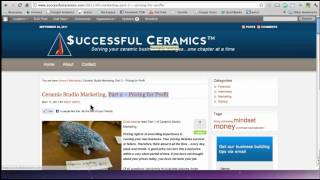
I'm going to show you how to attract more readers through the simple use of linking your story text the right way. Now, once you get this, it's not going to take any more time for you to produce your stories, but your stories will attract more readers naturally. So how do we do this? The first thing to understand is there are two fundamental ways that both Google, Yahoo, and the rest of the search engine world require, and that is that they require that you put real text links on your story. Google, Yahoo, they do not crawl through images. They don't crawl through animations. They need real simple text that's linked in order to find the following page. That's one thing. The second thing you have to understand is that we as humans, we don't read websites. We don't read your online magazine. We're scanning it. We're scanning through the text as fast as we can because we're in a hurry in order to land on something interesting to click on and then decide to read it. So we're scanners and we don't read. So keep those two things in mind. Now, what I'm going to show you is how search really works for your magazine and specifically how search works for each story in your magazine. And the truth here is that Google takes us readers straight to your story. Not to your home page, not to the featured issue. It takes us straight to your story. And let me demonstrate how to do that here. I am going to Google search and I am going to key in the words ceramic studio marketing and what comes up in search. Let's say I run a ceramic studio. I am interested in and in marketing information for my ceramic studio. One of the links that comes up Here is from successfulceramics.com, which is a magazine dedicated towards helping ceramic studios succeed in their business. So when I click this link, where does it take us to? It takes us to the successful ceramics magazine, the publication, and it takes us. And if you note this, it takes us straight to the article which is about ceramic studio marketing. It happens to be a part two article which is entitled Pricing for Profit. It doesn't land us on the successful ceramics homepage, it takes us to this story. And that's the thing you have to keep in mind is when people that don't know about your publication land on your publication, it's usually through a search and it's usually directly to a story that you've published. Now, what I'm going to do here is I'm just going to zoom in on this story to illustrate A point. If you were to scroll through this entire story, you'll notice that there's a lot of text here which discusses what you need to do to price for profit. But how many links are really in here? Not many. So the first thing that this publisher needs to do is to link up some of the text that's in here to other stories. Because we as humans, as we're scanning through, we're looking for things to land on. And links are big triggers. In other words, if I see a link, I might decide to click it if I know it's going to be on the other side. Right. Now look at this. Here's a link right up top. What does it say? It says, click here to read part one of Ceramic Studio Marketing. Okay. What's good is there's a real link here to the part one. But what's bad here is that I as a human see click here. I don't know why, where I'm going. I actually, I would have to read this whole sentence in order to figure out where I'm going. I don't have the time if I'm scanning. And as people are, they're usually cruising through and they're going to miss this, especially if it's buried somewhere in the middle of a story. Number two, Google. Okay? You have to pay attention to Google. And what Google does is Google takes the link text. And link text, in Google's eyes is more important than regular text. And Google determines what, well, what's the next page about? And link text that clicks to another page helps Google understand what that page is about. So in Google's eyes, this text here tells Google that the next page is about click here. Well, the next page is not about click here. It's about marketing. Ceramic Studio Marketing. But Google thinks it's about click here. Now, of course, once Google gets to the following page, it will understand what that page is about. But when Google ranks a page in search, the link text to that page makes a difference. So this is how we should do it. What I'm going to do here is I'm actually going to log in and edit this article because this is one of our publications and I'm going to help out the publisher just a little bit. So let's log in here and what I'm going to do is I'm going to zoom out a little because just to make this a little easier to work with. And all I'm going to do is go to click here and I'm going to hit the little link button. It's going to give me the link to the article. So I'll just copy that link and what we're going to do is we're going to remove that link and we're going to, we're going to link the text that says read part one of Ceramic Studio Marketing. That's what we want to link. So now I'm going to link this back, add the link. Now does this make a little more sense for both humans and Google? I think it does because humans can quickly land on this and say, hey, and what I'll do is I'll just publish this really quickly and then we'll go take a look at it. And now we have humans and Google seeing this nice link text. It says click here to read part one of Ceramic Studio Marketing. So I know what it's about. Google knows what it's about. More traffic will come to the site and that's the secret to linking text in your stories.