How to market your pottery or ceramic studio online
Pete Ericson and Ralph walk through building a WordPress site as your pottery studio's marketing hub. Start with a blog and email list via Mailchimp to convert visitors, post transparent photos and videos on YouTube, and use event plugins to list classes and open houses. A basic site costs $1,000 to several thousand and you can shoot video on your iPhone.
Chapters
The idea here is of course to. Go into online marketing. And as we discussed before, I think it really starts with a good working website that most people can create themselves or go to a, an expert to help them. We'll do that. Is that right?
Correct. Yep, exactly. Exactly. So that, that the website should be really the centerpiece of your online marketing campaign and everything should flow out from there into social media and video and you know, everything that's out there. Google.
That has to do with the structure of the website, I suppose, how you set it up and does it also affect the price? It takes the cost to do that.
I guess I can answer the price question first. There are really two ways to do it. One is to go to WordPress.com and do it yourself. And it's free or near free to do it there. But you have to, you have to really do everything yourself. Set it up and build your pages. And if you're technically inclined, then that's a fair solution and it gives you a very inexpensive or free way to build your web presence. The second way is to hire somebody to do it. And then you build a WordPress site. It's called a standalone WordPress site. And you have much more flexibility and customization and you can really put that site to work and power your business. But it'll cost a little money. So you know, that your dollar range probably starts at $1,000 and goes up from there. You could spend tens of thousands if you wanted to really go for it. But in the beginning, you know, a couple thousand bucks will probably get you a good solid start.
Yeah, I think most studios should bake that into their financing for a startup. If they start and if they don't have, if they are already in the business but do not have a website, they should start saving up to those $2,000 because doing it yourself is probably out of reach for the majority.
Think I wouldn't do it? Yeah, I agree. I think that, you know, for any business owner should be running their business, not learning how to build a website. And then they're gonna build it wrong anyway, so that's, it's gonna cost them money down the road. And a well built website is a money maker. It's a profit center. It's an investment that they should be making in their, in their marketing.
How do you define profits and profit center in this context?
Ooh, what a great question. So the, the, let me start, let me back up and start a little bit at the top first. And this will, this will make sense. I'll Give you my kind of marketing philosophy. My. My online marketing philosophy. Shpiel. And that'll. And then that'll flow into answering that how to measure profits online. So in today's day and age, with all these tools being free social media tools, Facebook, Twitter, Pinterest and websites that you can build for near free blogs, things like that, it's given the power to the business to be transparent about what they're doing. And that's what customers and potential customers really want to see. To see what. What is an organization? What's a ceramic studio, a pottery, a porcelain studio? What's really going on there? What are they doing? What kind of fun are they having? What kind of beautiful things are they making? And that transparency can be brought forward in the form, of course, photos and video, even audio blogging and all sorts of sharing. And of course, Google picks up on that and sends visitors to the website. But that transparency is really fundamental to online marketing today, and it should be the cornerstone. In other words, if you're a pottery studio, you want to think about what's important to the customer. How can I help my customer and do it in a way where I'm basically sharing how I make my pottery, what sort of. How does it all happen and what is important in the process? Why is it beautiful? What are the things that I do that make me a famous local potter or a famous national potter or whatever it is, and share those things with customers online? So that's sort of the philosophical component, and really the how can I help my customer? Portion of it is key. And that's really the approach that online today that a business needs to take when they're publishing things. The temptation is to simply put your products out there. We have beautiful things, we sell, we have classes, we sell, we have fun, we sell. And the temptation is to just push out those things. And those things are good to push out, but in order to actually capture a customer, they want to know more. They want to know who am I dealing with and what kind of environment is it in and what's the process and how does it work? Because that builds the story of your business, right? And that's what engages the customer. Okay, so now. Oh, and by the way, I'll just throw this in. The thing that you have to have to have to do today, whether you have an existing website or whether you're building a new site, is you have to start with mobile. In other words, your website has to look good on a mobile phone, period. If it doesn't, you lose half your Customer base right off the bat, that don't want to bother looking at your website because there's some statistics that have come out. 60% of smartphone use is done in the home. In other words, you're lying on the sofa and you have a question and you just pull your phone out of your pocket and you search on the web for it, you Google it and. And now you're looking at the solution on your phone. So the web. And of course, the good news today is, especially with WordPress, is you can make your website mobile friendly very easily. It's not hard to do. Okay, so now finally I'm going to answer your question. How do you turn a website. Say again?
Very good. The transparency thing and the, I think the contact, the personal contact that would be established through the website is a very important point, especially in this, how should I say, in this atmosphere of ceramic studios, which is heavily, sort of has an emotional aspect and they like intimacy. So they shouldn't be. What you're saying. They shouldn't be shy of showing their feet, their ideas.
That's right.
And throwing any technical. Maybe that's up to them to hide some technical, proprietary things they have. But they should give the. What you're saying the transparency should give actually the viewer access to this particular studio, like if they were visiting personally.
Absolutely. That's a great analogy. Yeah. And video is a great way to do that. You can, if you have an iPhone, which is probably the easiest thing to deal with, or an ipod or something that takes video. You can literally take a video of a class or part of your studio and upload it to YouTube right from the phone, and then you can take that YouTube video and put it right on your website. Very efficient, very quick. So, Ralph, let me answer your question, because you asked, how do you measure profits from a website? And the answer really lies in followers. How many followers do you have? And that boils down to primarily email subscribers. So in other words, people might find your website or blog when they're looking for something. But how do you keep them coming back? How do you keep your customers coming back? How do you keep your customers informed and in the loop? And social media is part of the answer, where you can have a Facebook page and Twitter account and people can follow you there. But the real magic and the real power and the proven power is in building getting an email subscriber. So each person that drops off their email address on your website and decides to subscribe to your news because you're being transparent about what's going on in your business and they want to know more, they will get that email automatically, or they should be getting that email automatically when a new piece of news comes out, which draws them back, obviously, and puts the studio or the shop or the class in the crosshairs of the customer again. So the email, even though email has been around for a long time and some people say, oh geez, there's so much spam out there, why would I subscribe to an email list? The truth is, email subscriptions are actually still growing. And they are because this is our primary online communication tool today. So building that email list is a direct measure of how well a website or a blog is functioning. If you can grow your subscriber base, then you know that every time something happens in your business, you can communicate that out directly to your followers.
Do you see that as a potentially time consuming feature?
No, it shouldn't be time consuming at all. In fact, if you hook it up right, and this is one thing WordPress does really well. And I'll jump to, let me jump to blogging a little bit. So what a studio should be doing is primarily running a blog, a news blog. So I have a promotion coming up, I type it up on my news blog, I post it on my website, I have a guest speaker coming in, I type it up, I put it on my news blog, I take a picture, I add it, and then what happens is you hook up a service called mailchimp. Now this is where, what was it called? Mailchimp.
Yeah, I haven't heard of that.
Yeah, so what I'll do is I'll show you real quick here. This is where you need a WordPress developer to help you. And you're going to spend a little money getting a developer to help you with this. But this is really fundamental and this should be the cornerstone of website operations. So with your news blog on your WordPress website, every time you publish an article or an event or a product or a class, whatever it is, maybe it's a video of something coming out of a kiln, that piece of news or all the pieces of news that have been published will automatically be emailed to those that have dropped off their email address on your website. And that happens automatically. So you publish once on your website and you know that every Friday at 11 o' clock or whatever you schedule, that piece of news is going to be delivered to your customer.
Do you have any thoughts, Peter, on how wide a Net Geographic leader should have for those emails? Or you would leave that up to any recommendations there or should just be some common sense for the particular situation or studio.
You know, as far as email goes, you'll probably get, if you're a local or regional business, you probably get more subscribers locally or regionally, naturally. But you know, if somebody's planning to move to the area or they're just interested in what you're doing, then you'll get subscribers from all over the planet. Especially if you're, if you're a niche producer, let's say you're a potter and you're making pots for babies or something. I'm just making this up. But you know, people that are interested in that, it doesn't matter where they live, they'll follow you and maybe you'll sell some internationally. So no, it doesn't really matter. But the important part is that you collect the list and I'll just show you a quick example here. So this is. Looks like a pottery or studio in the Philippines, I think. And what they do really well.
It's in Bolivia.
Oh, it's in Bolivia. I'm sorry. So what they do really well is the. They have this sign me up box here that says subscribe to receive updates about Clay Avenue Pottery Studio in Manila. And if you look at. And what I'll do is I'll just kind of mark this page up so it's clear. If you look at this, this is really the key to the success of this website. So Mailchimp. With Mailchimp, you get your WordPress developer to add this box to your website that's hooked into your news blog. So if you look here, this is basically just a news blog. You have an article at the top here and then you can pick, you have pictures and you could put video in there and you scroll down and look at everything that's going on and look how transparent they're being about their business. It's really fantastic. Yeah. And here comes the next article. You know, here's an after party thing they're talking about. I'm not suggesting you go publish your party pictures, but this is what they happen to be. Well, why not? Sure, but this is what they happen to be doing. Yeah, I guess if it's a party, it's in your studio and it's for customers and it has to do with ceramics, then yeah, that would make sense. But you can see how transparent they are and they're building their email list and this is really fundamental to making it work today.
Yeah, I can see that. It's an excellent means to use as part of your marketing.
Exactly.
If not totally necessary today.
Right, right. No, it is necessary. So email list building first. And if there's only one thing somebody who's listening to this or watching this does is they should hook up Mailchimp to their WordPress blog, WordPress site and make sure that those emails go out every time that they publish something on their website.
So that mailing list, that email list could really grow fast and furious.
Yeah. And of course you have to ask yourself, why would a customer want to get my news? You know, if you publish things like class schedules and you know, here's a new product or I think that that's good and people might subscribe to that, but if you pick something that's more niche oriented and this is where the, you know, the creative mind has to go to work. But you know, if you're a potter and you have a specialty, well, I would be blogging about that specialty and I wouldn't be afraid to share my secrets and what I do because this is what people really want and you want to attract that following and become that guru and, and sell your products and or services. So that's, you know, it's kind of a funny thing online. The narrower your topic focus gets, the Nichier you get, the more subscribers you'll get.
I know that from my own personal experience in other areas such as financing and economics.
Right.
The more they get into the details, the more attached I become intellectually and emotionally to stay, stay with this service.
Absolutely.
Yeah, that's true.
The details sell.
Okay, well, many other thoughts there, Peter.
Just this site in particular, we can talk a little bit about the way once you have your email subscription hooked up is you want to, you want to virally promote your articles. And so let's say you're publishing on a blog here and I'm going to just refresh this page so I can bring it back to its normal state. I'm going to go into this article here and we're going to see if they have any social hooks hooked up here. So on this bottom of this article, so we have a like button. That's a very good thing to do. If you have. This is something you want your developer to help you with and that's to install a like button and I would argue a Pinterest button on every blog article, news, blog article that you have. So if I like this post, I can just hit the like button and then it will share it on, on Facebook. And the like button I'm talking about is not this like button, but it's The Facebook, the actual authorized Facebook like button. And with a billion, a billion members in Facebook, it's something. It's something. Over 70% of the country, the US anyway, is logged into Facebook during the day. Which means that, that if I like this and I have 100 friends, then my hundred friends have a chance of seeing a link to this article that I like this article. And following that link, they can click and follow the link to the article and that's that commenting. They have commenting hooked up. I would recommend a service called Discuss to manage comments. And I'll bring it up here. Disqus is spelled D I S Q U S. And it's the best. It's free by the way, and it's the best. And your WordPress developer can help you with this. But it's the best way to manage comments on your website because you can log in with your Facebook account or your Google account or your Twitter account and then it handles comments spam nicely too. So which, believe it or not, is an issue. There's spam everywhere, not just email.
Do you have any recommendations as to. Well, my point here, from a very small business viewpoint, like a studio normally would be, they have very little time. They're tied up from morning to night. Yeah. We're running their studio or creating pieces to sell. And so the website should. Cannot be allowed to take too big a chunk of their time.
Right.
Any comments on that?
Yeah. So once the website is set up and operating correctly, which will take time to do, it's just a time investment you have to make in order to, to create that platform for you to speak to the world through the Internet, then you have then the biggest time sink is in updating your website with fresh content. So if you're going to publish this particular article, took some time to write, the owner or somebody wrote this article, somebody took the pictures, somebody posted it up here, and that took some time to do, there's really very little you can do to get around that. You have to budget. I would budget an hour every two weeks to sit down and write up. And it's a good time to think about the marketing of your business too. But write up what's going on in your business that you think your customers will want to know about. What you'll find is that every time you publish that new article is actually a new page on your website, which makes your website bigger. And Google will pick up on that article as well and it will send you fresh visitors. So there's a little bit of a. I have A sneaky trick that I use with video that studio owner could use. So what you do is you have an iPhone and I'm sure you can do it with an Android device, but I only have experience with an iPhone. Is you video something. So maybe it's a kiln opening, maybe it's a class in session, or you make it short, you know, just a couple minutes. And then you talk about what's going on in that video and what you're doing, something of interest. Then what you do is you hook up your. And again, your WordPress developer can help you with this, but you hook up your camera to a YouTube channel so that you can, right on the spot, press a button and upload that video with you speaking in it to your YouTube channel. Then you have, you can either do it Yourself or your WordPress developer can do it can create a new blog post and embed that video on the blog post and then maybe write up a few sentences about what that video is about and boom, you have really, in effect, probably in less than 30 minutes, produced a fabulous piece of transparent marketing for your website.
Yeah, yeah, I agree.
So that's if it were me. And I do this with my own business, publish a lot of video. And it doesn't have to be fabulous, you know, it doesn't have to be professionally done. It can be done through an iPhone today. And I'll show. Let me show you an example. So I found a pottery that has a YouTube channel here. And here's a clay pottery kiln opening. So let's just bring this video up. And this is a five minute. I have to skip this ad because we don't really want to know about a zombie apocalypse, but here we go. So here's a studio owner sharing a kiln opening and showing off their pots. And you can see that it's shot from a handheld, probably a phone. You know, the. The thing that this potter should be doing is describing what's going on. And it's a wonderful thing. So that's one. Now let's. Large pottery bowl, everything.
That prolongs the contact surface and increases the contact surface with your customers.
That's right. So here's a large pottery bowl. Let me see here. And it looks like the camera is mounted on a stand. And here's the potter at work. And it's. Talk about being transparent about your work. So if I'm interested in this potter on any level, then this is fascinating and this helps me bond with that artist.
Everything in movement is fascinating for them when they look at the professional.
Right. And by the way, what this artist did was very smart. You see how they put a link to their Facebook page right here. So down here on the bottom, there's a link. They put in the link to their Facebook page. Now what I would do is put the link into the website, to the main website, but maybe they don't have a website. And then the nice thing about video too is have you ever noticed you do a Google search for something and sometimes you get videos as a result? So I forget what the official statistic is, but I think something like 8% of search brings up videos. So if you're publishing videos about your studio on YouTube, your videos will show up right in search. And all you have to do is fill out your description. So you have a title of the video and that's the keywords in there are important. And then you have whatever the description is of what's going on in your shop. Because Google owns YouTube. So Google loves to show off YouTube videos.
Sure. It helps.
Yeah.
Okay, so. How exactly do we need to show them? How do you upload a. Just a comment or on a blog into your website?
Yeah, how to do that? Yeah, I can do sort of a quick preview and just show how easy it is. I'll pull up one of my own websites here. And this is a site, a publishing site, and I'm going to log into it, and here's my login, and then I'm in here. So if I want to add a new blog post, I just hit new post and I give it a title, whatever it is, for the pottery or the ceramic or porcelain studio. If I could spell it right, that would be helpful. And then you have your content area here. So you can type all your text in here. And then you can add pictures by adding media. There's a nice easy way to drag pictures into WordPress here, and you can bold and link text through the buttons here. And that's pretty much it. Once you've done that, you just hit publish. And if you're hooked up to mailchimp this, then you know that your blog post here will automatically get sent out to your email subscribers without having to do anything. And if you. Oh, and if you want to put a video in here, let me go back to where did the. Where did the YouTube. Here it is. So let's say I want to share this video on my blog. Well, you click the little share button and then all you have to do is copy the. The link that you get into into the blog post here. And you'll see how easy it is. Just paste that link in there and then I'll hit a preview here and we can, you can always preview your page. So there it is. So there's your video and there's your text. And now you've put a video with some text on your news blog. So and you can see once you play plays right in, right on your website. You don't have, you don't go to YouTube. It's embedded on your website so you never lose your viewer, they stay on your site.
All right, I'm familiar with Atrocious. Just wondering how we should. Through text in a chapter.
Well, yeah, if you're going to write this up, that might take a little doing. But as far as the studio or the shop owners go, this is where a good WordPress developer will help and train you how to run your WordPress site. And by the way, you know, I'm not a fan of WordPress just because I'm a fan of WordPress. WordPress is the world's largest publishing platform in the world. It runs 19% of global website traffic. And for content, what is it called? WordPress.
You talk about WordPress now?
Yeah, I'm talking about WordPress as a publishing platform. It, it's the most supported, it's the largest development community. It's easy to find people to work in it, you don't have to pay a lot of money. It's the code, the code is free, so that keeps costs down and it's mobile friendly. Most of the new designs that come out for WordPress and there are lots of pre made designs that are available are free. Or maybe you pay something for 20 bucks, 70 bucks for a beautiful design and you're off and running. And it's used by the New York Times, it's used by cnn, it's used by Best Buy, it's used by a lot of Fortune 5002, yet it's available for free. And the biggest users are sole proprietors and independent small businesses. So it's a wonderful tool that's here for the long term. It has, it has absolutely taken over web publishing. And I'd say if a studio is looking to change their website or upgrade their website, then it's time to jump into WordPress. Find a WordPress developer. I'll share the world's largest contractor site. Independent contractor site is called odesk. And if you want to find a developer to help you, what you do is you go to odesk.com and just search for WordPress and you'll find and you can search geographically. So if you want to find somebody in North America or in the United States or in a specific country, you can do that. And the range is great. You can find WordPress developers in the Philippines that speak English for $3 an hour or you can find very, very skilled WordPress developers in this country for $70 an hour or $50 an hour. And you know, you'll, depending on your needs, you'll, you'll certainly get more with the highly skilled ones when you need custom work done and they tend to be available. But I've had good luck in the Philippines as well. The world is at your fingertips here.
It sure is.
Odesk.com yeah.
They showed an Omega.
Yep. Odesk.
Okay.
Yeah.
Okay. So next question here. We talked about emailing. I suppose that's part of would be covered here because there are very regularly in the life of a studio being at the teaching studio or pottery, whatever, they have open houses and they have special events two, three, four times a year. They need, they need a. This Constant contact that we've been using is. Seems to be very good means to reach them. Reaching. It's normally it's, you know, incorporate sometimes a picture with it, but not necessarily. It just be a quick reminder. Don't forget my open open house in July or whatever.
So.
That should be a standard part, I think of the website, right?
Yeah. So I'm glad you brought up Constant Contact. So Constant Contact was the original email blaster provider. So you could build a list in Constant Contact and email out. Now mailchimp has eclipsed Constant Contact. So if you're current Constant Contact user, you can stick with it. It works fine. It does the job. But if you're looking at finding a better mailing list provider, then that's why I recommend mailchimp. Because Constant Contact won't hook into your website automatically. You have to go in and manually send out each email campaign and that takes time and we're running out of time these days. So what mailchimp does is it hooks the website into the email system so that when you publish a new blog article, then mailchimp sees that has happened on your website and it sends out that a link to that article to the email list automatically without you having to do anything. Yeah. So that's the difference between the two. And if you're either tired of if you're starting from scratch or you just need to integrate and make a simple solution, then I'd go with mailchimp and.
Okay, they eclipsed the Constant Contact in that sense, they did.
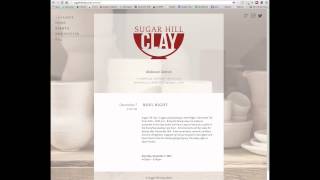
And, you know, we've been a constant contact user for a long time. I don't know why constant contact has not added that technology. I've asked them myself. Never got a really good answer. But yeah, mailchimp is the way to go. I kind of want to take your comment about events a little bit further. If you have a WordPress website and I'm showing you this Sugar Hill Clay here, and they have events front and center in their navigation here. So if I click on events and this is another WordPress site, what they have here are the upcoming events. So Noel Knight is coming up on December 7th, and it just. You can just scroll down from there. But what you can ask your WordPress developer to do is to add an event plugin that lets you publish events just like a blog post. But what you do is you set the event date and what it'll do is it'll automatically hide any events that have passed, so only current and upcoming events will show up. And that's another little, a little trick.
For that becomes a click when you go to the website that will be sort of on the home page.
Yeah, sure. You can have the events themselves or the titles of the events on the homepage, or you can have events in the navigation as it is here. And then if I want to find out more about Noel Knight, I just click into Noel Knight and I'll get all the information on it.
Right, right. Neat. Yeah, sure. Okay, let me see here. We talked about the emails, we talked about. Facebook and LinkedIn. I don't know if he didn't talk about LinkedIn, but. Well, I think a lot of them being in business, they might be interested in that.
Sure. Well, let's talk a little bit more about social media. That sounds good. So LinkedIn is a great network for business networking. That's really its primary goal. So if you're looking to connect with other business owners in your. Let's say you are a distributor or a manufacturer and you're looking for other retailers or dealers or whatnot, then LinkedIn is a great place to get in there and, and see what's going on. There are also some great groups in LinkedIn that are focused on specific subject matters that you might want to jump into as well. But the social networks that I would recommend from a pure marketing perspective are Facebook and Pinterest. And we talked a little bit about Facebook and I'll just finish that one up and I'll show you a Facebook page here that looks like this is glazy day's paint your own pottery and glass studio. And they have 664 people that like this page, which means 664 followers. Anytime they publish something on their timeline here, then these 664followers have a chance of seeing that. And they can drop a video in, they can drop a picture in. It's very friendly and easy to publish. And the purpose of Facebook is really Facebook is the elephant in the room. It's the biggest social network, a billion members. It's where the conversations are happening. Whether you like Facebook or not, this is where people are and they're talking. And if you want to have a conversation with your customers, then this is the place to do it, because customers are already here. They have Facebook accounts. And it's easy to simply click into a box and start writing because, you know, I'm logged in with my account here all the time. All the time. That's right.
More from Pete









From Donations to Subscriptions: How KB Independent Built a Sustainable Local News Model

