Pete Ericson’s video explains why and how magazines should publish online: stories are discoverable via Google and social networks, each article can attract new subscribers directly, and reader comments become dynamic content. He outlines content types to publish (text, audio, video, galleries), stresses native readability on smartphones/tablets (prefer web-native over app-only), recommends using open-source CMS (mentions WordPress, Joomla, Drupal) to reduce vendor lock-in, and summarizes monetization options (paywalls, memberships, ads, repackaging into ebooks/CDs/DVDs). A brief client case shows moving to 100% online can increase subscribers.
Chapters
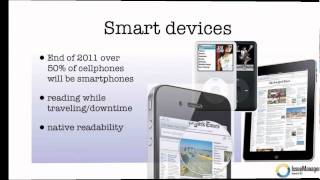
So what are the biggest benefits of publishing your magazine online today? Well, let's define what a web based magazine is today and just look at the bigger publishers. Better Homes and Gardens, Sports Illustrated, even in the newspaper realm, New York Times, Boston.com they are publishing on the web, which means that their stories can be found in Google Search. Their stories can be commented on and forwarded into social media such as Facebook and Twitter. Now let's start answering some questions. How do you reach new subscribers with an online publication? Well, here, Google is your friend. And what I'm showing you here is an example of a search for a tip. In this case, it's tips for arranging bookshelves. And look at that. The number one result is a Better Homes and Garden story about arranging and organizing bookshelves. Now stop and think about that. The number one result for this search is a story inside a magazine that answers that question for that person who's searching it. So we skip the home page, we go straight to the story, and a new reader lands on Better Homes and Garden and has a chance to subscribe to the magazine. Pretty neat, huh? How about social media? Blogs, Facebook, Twitter, LinkedIn? Each story that you publish should be set up so that it can be liked in Facebook. So if I like your story in Facebook and I have 100 Facebook friends, then 100 of my Facebook friends might see that I like the story and I give them the link straight back to your story. And there you might find a new reader. And on the commenting side, I give my readers the ability to leave comments on each story and each comment becomes more content for that particular story. Okay, so what can you publish on your magazine site? And now we're really talking about content. Well, of course you can publish stories, you can publish PDF downloads, but I want to focus in on comments a little bit more. If you're a reader of the New York Times, for example, you might notice that some of the stories get hundreds of comments. Hundreds. And what's interesting is that I can jump into a story, not read it, jump right to the comments. And through the comments, I can figure out what the story is about and what people's opinions against the story are. It's almost more interesting than the story itself. It's a powerful way to add dynamic content to each story. And guess what? You're not doing any of the work. Your readership is. Okay, how about adding audio interviews? Fire up Skype. Interview somebody of note in your industry and produce an audio file that can be imported into somebody's iPhone or Android. While they're traveling. How about video? If you're not exploring video today, you need to. Because guess what? YouTube is the second largest search engine in the world. That's right. YouTube is in search. Search traffic within YouTube.com is the second largest. That's after google.com. so, hey, yes, we're the Boobtube generation or generations, we love video. And you should be able to produce public and subscriber only videos on your publication. And there's another benefit to publishing public videos, and that's they're findable in search. You know how sometimes you go through a Google search and all of a sudden you get a few video results? Well, if you're publishing video on YouTube, those videos will show up when people are searching for you. And those are new readers to your magazine who might subscribe. No size limits. That's right. So stories can be any length, you can have any number of stories, and you can publish on any schedule. Pretty straightforward, right? Okay, let's talk about smart devices. IPads, Androids, Kindles. Your magazine should be readable on these devices. Look at this statistic. Nielsen recently revealed that at the end of 2011, over 50% of cell phones will be smartphones. Now think about that. That means in 2012, 13, 14, we're going to have. Most cell phone carriers are going to be carrying smartphones. And what do people do on these smartphones? They read. They read while they're traveling and they read while they have downtime. Now, when I got my iPhone a few years ago, which was the first generation iPhone, I suddenly realized that I had no more downtime. If I were standing in a supermarket, I'd be looking at my iPhone, checking my email. If I were getting an oil changed, I would be dialed into my iPhone, looking at email, reading stories, following people on Twitter and Facebook, and all of a sudden, I had no downtime anymore. Now, the key here is that your magazine needs to be readable on all these smart devices natively, in other words, automatically, without having to install an app of some kind. So that if, if I'm on my smartphone, I'm on my iPad, even a Kindle, or I'm online, I can just read the story without having to go to an app. Now, apps have fantastic applications and I love them to death. But the foundation for your magazine needs to be readable on all smart devices. Okay, let's shift gears and talk a little bit about workflow. Publishing your stories online is very different from publishing your stories in a paper magazine you design once. In other words, you create A master design for your site, and then you get to focus on content and you get to focus on marketing. And that is easy, much easier than having to recreate a layout for every single issue. And as a content management system for clients to use, they love to use it. It allows them to publish stories quickly with video, with audio, photo galleries, anything they like. Let's talk a little bit about cost reduction and I'm going to go to a different place. Now. There's some obvious benefits to publishing online versus paper. Well, yes, you're not laying out every issue, you're not printing the issues and you're not paying for the mailing costs of these issues. But what if you want to change development companies? You publish your magazine online, you decide for whatever reason that you're going to go to a different company. And what this brings up is the discussion of open source versus proprietary software. In other words, the software that you're going to use to build your magazine is very important. And let me give you the examples. So open source means it's software developed by a community and it's free. Firefox is a great example of open source software that was given away. It's a great browser, lots of people use it. And yes, it's free. And it's developed by a talented, passionate group of volunteers, proprietaries like Microsoft or in the web world, content management systems. And there are thousands of them. And companies produce proprietary content management systems to give people specific features. But the downside is clients get tied into those proprietary systems. And when a client decides to move from a proprietary system to a different platform, the cost and time is almost as much as the original build. And I've seen this happen for myself over the and over again. Now, just for your information, the three most popular open source content management systems and CMS you might have seen around stands for Content management system are WordPress, Joomla, and Drupal. We use WordPress, we love it, clients love it, and that's what we recommend. Okay, so now making money, how do you make money with an online magazine? Well, people pay for subscriptions. There's a paywall, it's called. You can have take it further and have a membership community where the subscribers get to interact with themselves and you get to produce special interactive content for them. You can serve up ads, charge for ads, you can serve up advertorials, in other words, stories that are really ads for your advertisers. And one of the big things you can do is you can repackage your existing content into eBooks, CDs and DVDs. So for instance, you have a great series of stories. Well create an ebook and sell it for 19 bucks as a digital download. Or let's say you're interviewing experts in the industry once a month and after 12 months you have 12 great interviews. Well, put it on a CD and sell it so people can listen to it in their car. And the same goes for video. If you're publishing video, put it on a dvd, put a price tag on it and sell it. So let's wrap up the major benefits of publishing online. Your stories have reach major reach into Google and into social media content. You have the ability online to publish audio, video, photo, galleries, all kinds of content and there are no size limits to the content. And your magazine should be readable on smart devices all by itself without the need for an app workflow. Use a content management system that's going to be easy to train other people to use and even fun so that you can push the stories out and focus on marketing and more content. And finally, yes, you can absolutely make money with a magazine and you can reduce your long term risks and expenses by doing it right online. And just as an example, we had a client come on board that actually was printing, stopped printing, went to 100% online, and in their first month they actually gained subscribers. Yes, some complained and went away, but more than enough subscribers joined in that first month to cover and increase the subscriber base. It was a big win and you can do it too.