Pete Ericson discusses why traditional publishing collapsed after the web arrived, how early digital strategies like paywalls killed discoverability, and why ad-heavy free sites fail readers. Most people now read on phones. His product Anvil aims to fix the backend and reader experience.
Chapters
And so what we're going to talk about today is I'm going to go through a little background on where we've come from as far as digital publishing and how we got to today and generally the mess that digital publishing is in today. We'll go into the must dos for digital publishing. In other words, what do you have to satisfy to the reader today? And then we'll look at Anvil and we'll tackle that. That mess head on. And I'm going to show you the front end more the reader experience, and then we'll. I'll show you the back end on how to actually manage the system with one dashboard. Yeah. All right, so here we go. So we're going to talk about how we got here. And you're. I know you're very well aware of the print side, the way it used to be, you know, 20 years ago, where you had really beautiful, fairly expensive.
And.
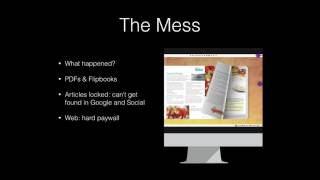
Physical object that you had to ship that people were willing to pay for. And then the Internet came along back in 1995, it started to become popular and all sudden websites started to crop up. They're really not as beautiful as print editions, but they certainly ran faster. They were much cheaper to put up. And today they're almost free. And so we have, we have. I don't know how to put it, but we have sort of a crash, especially from the print world into the digital world where really everything changed. And so the. What happened in phase one, or sort of stage one, is all the print publishers took their magazines and moved them into PDFs and into flipbooks and put them online and figured out we're done. Right? But what Jesse mentioned earlier is the problem with that is that those articles that are on the website, in a PDF or in a flip book, they're essentially locked away from the way the modern reader finds stuff. So when you go to Google and you search for an article on any topic, you generally don't get PDFs and you definitely don't get flipbooks. You get live web articles. And the second issue, which is a big issue, is social media has taken over the world. You know, Facebook has over a billion users. And what Google actually has, has done is they've changed their search engine optimization algorithms now, so social pointers drive how articles get found. So if you publish an article that gets shared in on LinkedIn or Instagram or Twitter or Facebook, Google sees that, they see how the links are pointed. And if humans are pointing links to these web articles, then that web article will rank higher in Search and get found. So there's a whole discoverability that's not happening with sort of the stage 1 of the web. Stage 2 or 1A. Some publisher said, well, let's start publishing content. Let's start charging money for it. But hardware paywalls came out, which is essentially you had to. You had to decide which articles were free as teasers, and the reader really was limited to those articles. And so the hard paywall, again, it's blocking most of a publisher's content or articles to Google and blocking social sharing, which is today the primary way we all discover new information. So. So that caused problems. And then today we have plenty of publications with no paywall at all. And what they're doing is putting up these skyscrapers of banner ads. Right. You go to a news site and you just have a tower of banner ads. And there's so many banner ads out there that it's created something that. And I didn't make this up.
It's a good term, though. I see it.
Yeah.
The banner ad blindness. I see that. I look at some sites and it's like, I don't even want to filter through all this crap.
Right, exactly.
Can I add something in here?
Yeah.
Another problem that we have here with this older model is what I call the expectation of free. The web users became accustomed to the idea that anything they were reading through a web browser was free. And so publishers answered by locking down their content, saying, if you want it, we're going to charge you. And they countered by saying, well, we'll give it to you for free, but we need to make money, too. So we'll put up all these advertisers on the thing. And so what they were doing essentially was disappointing their customers in two ways. You know, they were confronting them with the reality that content is not free, it's not free to produce, and it's not free to read. And so where Pete's leaning with this is the leaky paywall model that we came up with or that we built, where. Well, Pete could explain that.
But, yeah, let's keep going. We'll jump into that for sure.
We'll get there.
Yeah.
So phase one is coming into today. Phase two, where this is about a month ago, New York Times reported that over 55% of their readers are actually reading on their phones, which makes sense. That's how we live today. We get a. We're driving. We shouldn't be reading. We're standing in a line. We're getting our oil changed. You know, we're basically Filling in our gaps in time on our phones with news, and that's how we consume. Nielsen reported this was over a year ago, that Most people, over 83% of readers, prefer reading on apps versus mobile view. So even if you have a fully responsive site, We're okay with that. But what we really like is the app. We just pop the app. We can quickly get to the articles. It's fast. It's easy. It sits on your home screen so that.
Well, there's no navigating. You know, there's no navigating. Once you open your browser, you got to go to what you want, right? And if there's just a button on your phone for what you want, you just prefer that nine times out of ten.
Well, you know, if you have, like, those. What do they call them? Badges. You know, it's like, I might get a text, and it's like, I see this with my weather app all the time. It's like, oh, yeah, there was something. You know, I was in a meeting and I got a notification about rain or something. But a lot of times life is busy and we're so distracted. And then I'll look at my phone and go, oh, yeah, what was that? You know? So those little reminders, I think, are very beneficial.
Oh, absolutely. Yeah. We live for notifications on our phones today. It's just amazing. Oh, okay. So. And then the issue publisher really has the hardest here because PDFs and flipbooks, they. They really are difficult to read, especially on phones. You have to pinch, you have to zoom. And the trouble with today's society is time is our enemy. We don't want to fuss with anything. We just. We just want the info, and we want to tap it and go to the story and read it.