A conversational YouTube transcript (Pete Schnepp with Mike and others) summarizing findings from a six-week market review of Sherville, a commuter town ~45 minutes from Chicago. They highlight strong rental demand, low vacancy, limited new supply, local employers (a manufacturing firm and Franciscan Health), 10+ years of ~5.5% annual home-value growth (they expect lower future appreciation), average household income ~$81,000, lower property taxes (~28% below U.S. average), low crime (9.8 vs U.S. 22.7), median home/condo values (about $349k/$335k) and acquisition price $229k, low unemployment (~5.9% reported), and that Indiana is attracting in-migration and is landlord-friendly (e.g., 10-day eviction, no rent control).
Questions this video answers
Approximately 45 minutes by car.
About 5.5% per year.
Approximately $81,000.
Sherville crime rate reported as 9.8 vs U.S. average 22.7.
Property taxes reported as about 28% lower than the national average.
Chapters
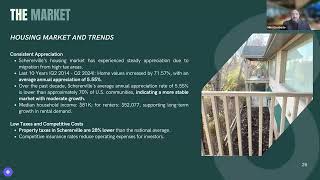
Some market stuff. So this is a summary of everything that we've kind of dug into those first six weeks trying to figure. Figure everything out. So Sherville, it's kind of a hidden gem. It's a small town. It was actually ranked one of the top 100 best places to live in 2007 by Money magazine. It's got population growth. It's 45 minutes outside of Chicago. And so what we find is that a lot of these people, they work in Chicago and they live in Sherville. It's a nice, upscale suburban neighborhood where you can get a lot more bang for your buck. And it's just a lot more family friendly. People that want to work in Chicago but don't want to live there. The rental market is strong out there. Vacancy rates are low, and it's not really on the radar. There's not a lot of construction or new supply or anything like that. It's limited. High demand, limited supply. And it's not like a big town where we've got developers coming in, building a whole bunch of stuff. Economic drivers in the area. There's a big manufacturing firm there and then Franciscan Health. Those are the two big local economic drivers. But like I said, a lot of it's coming from, from Chicago. The town itself is out outpacing like the job growth of the U.S. okay. There's some local government incentives to build the neighborhood or like increase in infrastructure improvement, stuff like that. So it's a cool little town. Mike was just out there a couple of weeks ago. I am heading out there this weekend actually for inspections and some more stats here. Crime rate in the neighborhood is rated a 9.8 compared to the U.S. average of 22.7. The town is like right off the highway. Right? So, Mike, when you pull off the highway, how many minutes till you get to Sherville?
Well, that intersection is a crossroads. So you can take that, it's us 41. You can take that north and really get closer to Chicago. You can take us 30 straight into Illinois. It's probably 10 to 15 minutes. And now you're in Illinois, so you get a lot of crossover there in that market. So, you know, those folks in Chicago definitely don't want to pay the high taxes but want to make the big bucks. So they'll prefer to live right there in Shareville and commute right into Chicago. It's 45 minute drive, so it's great.
Yeah. Cool. All right. Some cool trends that we saw for the area last 10 years. Home values increase. Well, an average of five and a half percent. Okay. Per year. Pretty good stat. It's what we would expect, actually better than what I expected. This is, this town, Midwest market is considered a linear market. So if you're in Phoenix like I am, Phoenix is considered a hybrid market. All right? And so Phoenix might be a little bit more dynamic in terms of appreciation, maybe a little bit more upside and some more downside. Right. In the, in the bad times, cash flow is not going to be as strong. In this market, I would expect higher cash flow and maybe a little bit less appreciation, but five and a half percent over the last 10 years. Years is a solid number. And I'll tell you, we, we're, we're planning for less than that in the next six years. What else? The average household income out there is 81,000. So, like mentioned, it's an affluent area. He called me to when he was out there a couple weeks ago, and he's like, pete, there's Mercedes. I saw a Lambo. You know, there's people out there doing well. They've got big houses and it's a good cost of living. Property taxes in Sherville, 28% lower than the national average. And out there, there's not really any major national natural disasters. It's not in Florida with the HUR or it's not a fire zone. So the insurance rates are, you know, what? You would expect fairly reasonable median housing values out there for a home is 349 and a condo value is 335. Price per unit. We're buying this at 229. Mike, you got a call from, from somebody recently out there from a broker, right?
Yes, I did. Yeah. When we locked up the property, we were, we were hunting for some more brokers to find some good deals out there. And the broker actually found our marketing material online and he contacted me and told me, hey, you've got that deal out there in Shareville. We can, if want to flip the contract, we could definitely find somebody to take it and pay you a fee on the contract. So that got me excited. I'm sure it got you excited, Pete, when you heard that. And, and also as we've been shopping for property managers out there, we've all the property managers are willing to take this because it's such a nice property and a great location. So we're, we're not having any trouble with the property management out there to be boots underground with me along with the property. But, Pete, I know you've been speaking about the market, and just so I can Dive in a little bit, interject there. I'm from the area, you know, I'm familiar with what's going on in Sherville and when you mentioned earlier about the area, these, these condos are situated in a very good school system as well. I went to Lake Central High School and that's where the tenants will send their kids is Lake Central. So they used to call it Tri Central because it's three towns that connect into the school and Cherryville is one of them. So they're getting a great deal with a great school, great education. I had, I had a class my, my, my senior year we, excuse me, my freshman year around over three. So it's a very large school and most kids want to be at Lake Central for the education and that's a great, great deal that they're getting out there with those condos. And not to mention when you look at the drivers that are there in Indiana, it's, it's mostly blue collar. At least that's what I grew up. The folks were going to middle and Arsler Mattel, the steel company that's out there, most of the guys work out there. The BP oil plant, a refinery. A lot of guys are working out there and have done, you know, 40 years or more in that, in that sector. So the guys are giving their lives for those industries. And same with the Franc Franciscan Health Hospital that's just around the corner. So these are major, major employers that are, they're continuing to hire and keep that and retain those workers in the area. So we're not going to have any trouble with that growth or that stability.
Yeah, thank you for adding that color, Mike. Low unemployment rate, 5.9%. It's a blue collar town, stable market, everything you might expect and everything is really checking out. Super nice. So migration trends. Here's a quick map. I don't know where we found this, but it talks about where people migrate. I was a little bit surprised because you get a lot of people coming from New York actually there, Peoria, St. Louis, Chelsea. You found something recently also about migration, right?
Yeah, yeah. U Haul every year publishes an article that, that shares just where people are migrating to and from. And there's no data on Sherville specifically, but Indiana was number eight in the nation, which is pretty significant in terms.
What was that again? Eight in the nation for what?
People moving into, relocating into Indiana.
That's insane. Into the state Indiana. But it goes to show people are, are moving to affordability right now. Right. They're mo. Moving out of places Like New York, California, and they have been for years. And that's not going to change.
Right.
This is an affordable town. Here's another stat that's slightly different than the other stat we saw. But again, unemployment at 2.9 compared to the other stat. It's a good town. Right. People are working, things are moving forward. All right, so this is one of the things that blew me away. Indiana is also considered one of the top five most landlord friendly states in all of the United States. All right, Right next door is Illinois. In Chicago you don't want to own property in Illinois as a landlord, you just don't. There's certain states you do not want to be a landlord and Illinois is one of them. But Indiana is the complete opposite. So we take it for granted here in Phoenix, you know, being in a landlord friendly state, I will say that my wife's family owns property in New Mexico. They've had somebody in one of their houses for three years and haven't been able to get them out. They're not paying for three years. Right. And so this is a state that is good to own, similar to us. 10 day eviction notice, no rent control. But here's something that we don't have in Phoenix, immediate action if there's property damage. So if somebody causes significant damage to our property property, we can go kick them out that day. And so I don't know how that would actually work out in real life, but it just goes to show that it's a good place to own real estate because you've got control. Right. So market stats. Renter occupied units account for 20% of the housing stock compared to the national average of 30%. What this means is there's good occupancy, balanced rental demand support, steady income. Right. So all the numbers just are reflecting positive amounts, low property taxes. Not only is it landlord friendly, you've got low property taxes, which, what, what is it, the eighth lowest in the country and then you've got reasonable insurance rates. I couldn't find a stat on where that fits, but I know that it's not anything outrageous. Right. So it's all checking off these boxes. Is this an area, a state and a regional area that makes sense to own income, property in general? Here's some additional info that I found on Chat GPT and I'm not going to go too far in depth, but if you, when you're reviewing everything on your own after this, if you want, feel free to check this out. Talks about some historical trends, current trends and future projections. All aligning with everything.