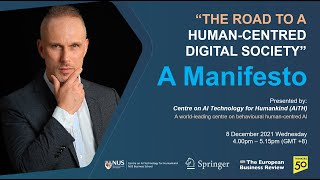
Professor David De Cremer argues that humans remain central decision-makers in AI-augmented organizations because AI lacks authentic awareness and meaning-making. He emphasizes human-centered design, flat communication and feedback loops, and leadership that facilitates conditions for technology to be accessible, corrected, and optimized to help the workforce and society.
Chapters
Humans definitely have their value in collaborating with AI. Basically we are primary AI is secondary AI as a statistical program, don't understand what it feels like, how we derive meaning. Although we model it after the human brain, artificial intelligence does not have those abilities or that sense of awareness. And this is quite often what we need. If we say we want to be human centered, we want to be driven to create value and a humane society, you need an authentic sense of intelligence to be able to connect with that. So I always say to business leaders, try to understand your company better than you do right now, because a lot of them still don't understand the company. Make sure that communication and feedback is pretty flat. So there's no hierarchy there in terms of limitations. People can communicate frontline, seeing whether technology works or not. Feedback is given, it's communicated, and it's optimized. So you're facilitating as a leader. And if you can do and create those conditions, then you'll see that technology will ultimately be optimized in a way that it helps your human workforce and the same thing in society. We can integrate it, but you need to make it accessible to everyone and see what it brings forward and if it doesn't work as we think it is, that we can correct it. So at the end of the day, we work together, but we still make decisions.