Virtual Book Launch - "Leadership By Algorithm", by David De Cremer

David De Cremer argues AI will handle routine data tasks but can't replace human leadership because it lacks imagination, empathy, and meaning-making. He proposes humans and AI work together: machines generate ideas, humans judge what matters and lead teams through organizational change.
Chapters
My name is David de Kremer and I'm the author of Leadership by who Leads and who Follows in the AI Era. Wait a minute. Some of you may be thinking, now, AI is everywhere, maybe even superior to humans, so jobs will be eliminated, but surely not the jobs of those in charge. Well, it may be the case. So where did I get the inspiration from to write this book? We have to go back about 25 years when I was a young scholar and I ran into a business person very confident in telling me about his successes on the short term, on the long term, how his attitude of pushing the limits made him successful. At one point in that conversation, I asked him, what if you push too hard? He looked at me and he said, well, science and technology will always be available to solve the problems that I'm causing. Okay, fast forward. Today we see AI is so present in our lives, being able to solve so many problems. And it made me think back at that encounter and I was thinking, did that person realize that he made himself very dependent on the technology? But even despite the fact that he made himself dependent for the technology to solve the problems that he caused, what I found amazing was that he was still very confident he was in charge. Well, today I still see the same kind of pushing the limit behavior, but I don't see that much confidence anymore. For example, when I teach leadership in the executive MBA programs, I have senior leaders coming up to me saying, professor, they say, everything's going to change. Shouldn't I become a coder? Why should I pay attention to my human emotions, our irrationalities, our human concerns, that we are tolerant, that we show compassion, Isn't that useless? Well, those questions itself already show yes, today our leaders fear for their jobs as well. But should they? If we look at AI, yes, it's superior to humans in many tasks. It's learning so quickly that it can imitate to become the best decision maker ever. Well, because it can communicate, it can act in volatile, complex and data rich environments, AI seems to fit the bill when it comes down to being the leader that we need today. On the other hand, however, AI doesn't have any imagination, no higher thinking that can make sense of things. So it's hard for AI to come up with a vision that people can connect to, that people are willing to follow. As the editor of Nature Machine Intelligence told me, AI is very limited in subtle forms of cooperation. So in my book, Leadership by Algorithm, I delve deeper into these issues and explore the ways that AI can help us run our organizations. And I conclude that AI will definitely be the new mba Management by algorithm in support of leadership. That is human, that will have to be human, should be human, because leadership in the 21st century will have to strive for a balance between striving for utility and maintaining and preserving human values.
Hi David, this is Jamie Anderson. I've got a question for you. I've been reading a lot lately about the impact of AI upon creativity and creative thinking. For a long time, many people said that AI will never replace human beings when it comes to creativity. But some of the things I've been reading recently argue quite the opposite, suggesting that AI will enable us to create new and novel combinations of ideas. It'll enable us to explore new conceptual spaces, spaces that we might not have even imagined before. And by enabling transformations in different aspects of business and industry, it will enable us to explore previously impossible ideas. So I'm interested in your opinion. Will AI even replace human beings in leadership when it comes to the field of creativity?
Thanks, Jamie, for your question. It's an area I'm very interested in. And at the same time, it's also great that it touches upon one of the great debates of today, which concerns the choice between augmentation and automation. Will AI replace us and will automate everything, or will AI help us augment our abilities so that we can perform more efficiently? So your question is actually addressing what will it be in the case of creativity? When I think about a creative person, I think this must be a smart and intelligent person. But the reality is, if we look at how AI has advanced in the last decade or so, it's still safe to say that AI is probably not smarter than an earthworm. Even though AI can learn what a painting looks like, how an artist moves, what a vegetable is, is it a hot dog or is it not a hot dog? It can learn all these things, but in a way, it has no clue what dancing means to a person, how a hot dog tastes, what vegetables really are like. So it has no connection with that reality. In that sense, AI is actually not intelligent to understand the meaning and experience of the objects that it visually sees and connects. And that's a really important insight when it comes down to understanding the role of AI in creativity. One of my favorite quotes is from Einstein, and he said that creativity is intelligence. Having fun? Well, let's go back to 2016, when the computer program Alphago beat the South Korean world champion Lisa Doll at the board game Go. Well, it was considered impossible. It was always said this is a game for humans only. But when AI won I didn't see AI jumping up out of joy or having fun, that it outsmarted a human, that it was excited about its own achievement. No, because the experience of having achieved something meaningful is simply not part of how AI works. And it is important to the creativity process. Let's define creativity as we see it in the literature. A creative idea, creative product, is something that is new and useful. And I would like to add, also meaningful to people. Okay, so this makes that there are two stages of a creativity process. The first one is to create something new. And I think AI is a champion there, because to create something new, you need to check out all kind of combinations of things that are already out there and see whether we can come up with something new. I think AI has the persistence, works fast, never gets tired, and these are advantages that humans don't have. When Einstein finished his paper on relativity theory, he said, ich bin kaput. He said, I'm exhausted. And this is where there's a limitation for people when it comes down to this first stage of creativity, the persistence aspect of keep coming up with new ways, of looking at things, of combining things. And this is where AI can augment us, help us. It's a champion. And studies have shown that this is indeed the case. They can come up with so many combinations. So this is a study where they gave AI a number of ingredients to come up with new pieces, creations. And they came up with so many creations, things we wouldn't think about. One example I very much liked was they came up with the creation of marmalade together with shrimps. And I know in the UK they say marmalade, you either hate it or you love it. But looking at the combination of marmalade with shrimps, I don't know about you, but I don't think it's a winner. I don't think people will like it, will find it useful, because simply it tastes awful. It makes no sense. So looking at from that point of view, this is where we need human involvement. And that's the second stage of creativity, where we bring in the experience, the flexibility of thinking out of the box, not just putting things together and saying it's new. No. Does it make sense? Is it something that will relate to what we think is culture? Can we empathize and sympathize with this? This is where human involvement is needed and where AI can contribute as an advisor, but will not be able to make that final interpretation. And it is an important phase because ultimately considering it to be useful and meaningful will lead to help US solve problems. And this is where AI also has a limitation. It may come up with a predefined problem and try to find a solution, but sometimes you find out new things that are useful, meaningful, and AI cannot connect them to problems that don't exist yet or have not been fed into their system. And this is for example how the post it came about. A researcher at 3M accidentally discovered an adhesive that was much too weak for the purposes he was working on until a colleague of his hey you know what? I need something to keep my notes in order and actually it's too weak for your project, but it's perfect for this. Hence the post it was born. So all of this suggests that AI in itself is likely not to become an autonomous creative decision maker, but it will definitely be playing part in the co creation process of creativity. Humans and computers working together to make better creative solutions. That will be the future. Hi David, and congratulations on the launch of your new book. I'm interested to hear your perspective about how the use of AI in decision making impact leaders efforts to innovate and be creative. Very topical question Caroline, and it connects very well with Jamie's question on AI and creativity as well. As I explained to Jamie, AI definitely has a role to play in the creativity process. But we also know that innovation is more than only a creative idea. As we all know, innovation is about implementing these creative ideas in order to make sure our companies are competitive and perform better. In your role as digital leader and transformation expert at PwC, you also know that the employment of AI requires a transformation process that changes our way of working and that needs to be led by our managers. So in your question I see that there are two issues that are important. The first issue really concerns, in my view, that how can AI be used to help drive innovation in our organizations? Well, I would say that right away, I would say there are three ways that AI can help. The first way is that AI is actually an augmentation tool. In the most direct way, it can help us to free time and space that we can work on higher level tasks. So basically AI helps us to get rid of the lower level tasks of taking notes during meetings, collecting information, even making appointments. As Google has shown today, AI can make an appointment for you to get a haircut. So it can actually save us time on all these lower level jobs. And when you have more time, more space available, you can be more creative because it enhances your efficiency. So this is one way. The second way is that AI can be your assistant by generating Novel patterns and generating new ideas and suggestions. When I explained the first stage of creativity where AI is very persistent in finding new combinations, it refers to this process. And this process can be part of how our design teams work. AI can be feeding new ideas, design teams can be putting in new criteria and AI generates again new combinations. In this way, AI enabled systems help design teams to create experimental playgrounds which can help the innovation process in its entirety. The third way that I see is that AI can also serve the role as making all ideas and possible new designs that emerge from the experimental playground available throughout the company. We need to know what is happening. So people at the same level, but also upwards that the board, C suite level leaders, they know what is happening, they know what the company is capable of and can make it part of their strategy. So we create a kind of hyper connectivity in terms of ideas that are circulating within the company. So employing AI in such ways drives innovation, but it also requires, as I said, the transformation process. And this is where leadership will play an important role. Because we need leaders to install cloud based architecture that helps collecting and analyzing data and eventually communicates the data. It's all there in that architecture. We also need to eliminate silos. It's still one of the biggest problems in companies today. Departments don't work in an integrated manner. A lot of data we don't know about that, we have it, but it's not circulating, it's not being shared. So we're not addressing the questions in the most accurate way possible. And also leaders need to integrate all that knowledge in the company and create a democratic form of data sharing. So when executives hear about this, one of the first questions they always ask me, so if this is all needed, what will be the kind of leadership needed in the 21st century? And this is something that I elaborate a lot on in my book Leadership by Algorithm. The kind of leadership that humans will have to display to make this happen. This AI enabled system driving innovation. So it's clear that in this transformation process we need leaders that are inclusive. Inclusive leadership, meaning that they will go out there to connect people and departments and eliminate those silos. They make the data available by being more transparent and they do so by promoting connections. That's one thing inclusive leadership. The second thing is also when we're working with data, as most companies today will have to do in order to remain competitive, increasingly we'll hire more data scientists. A problem that is related to silo formation is that data scientists usually work in isolation. They're not integrated very well with all the other departments, and they don't have a clear view of what's happening in the company. So traditional innovation teams usually also don't have the know how how to build and use AI models, so they will need to collaborate more closely with data scientists. So from that point of view, it's responsibility of inclusive leadership to make sure that data scientists are core members of the company from day one of any project, because we have to work with data in the most efficient way possible. And finally, inclusive leaders also embrace diversity. There's different ideas, novel solutions are being generated the whole time, and we don't want to let these efforts to be in vain. So it's crucial that leaders foster a kind of climate, a kind of culture that implements a mindset of divergent thinking that all employees at every level know that different ideas are needed to create the creativity and drive the innovation that the company needs.
Hi David, thanks for fast forwarding the discussion on the impact of AI on how organizations are managed and led with your insightful book in examining the boundary conditions, the limits between algorithm and human which functions like finance or operations and sales do you expect to be more amenable for leadership Algorithm? And if you allow me to add to this, which functions do you expect to benefit from co creation between algorithms and functional C suite leaders? I'm eagerly awaiting your response.
Thanks for your question, Alexandros. And let me rephrase the question somewhat because it includes two parts. The first part, as I understand it, is asking which functions in organizations can algorithms manage and make decisions in more autonomous ways and which functions would not allow so hence outlining the boundary conditions. It's an interesting question because as we can see today, AI has a big future in taking over many jobs in our organizations. If you look at the financial industry, we see that AI helps with customer service, making calculations for our investments, and also helps in detecting fraud. Their strength in pattern recognition, of course is very helpful here. Also in operations we see that robots help out. In manufacturing they even supervise our assembly line teams. And we also see the use of chatbots, service bots in sales and marketing. What is interesting in the jobs that I've just listed is that they have something in common. They're all repetitive in nature, they're basically routine tasks. And in such settings AI will manage us and will eventually take over our decision making authority. The reason why the question is so relevant and why I also wrote a book about it, is that decision making authority that algorithms are about to acquire does install some fear among people in management roles is management going to be replaced by AI as well. Some even say that authority in the future is algorithmic in nature. And in a way it should not surprise us. If we see how we've structured and organized our companies for the last 100 years, we see that we based it on the book of Taylor Published in 1911, Scientific Principles of Management. In that book it was the system that was celebrated. A system that becomes predictable, focuses on control, focuses on consistency and repetitive tasks that can easily be measured in terms of performance. We create a ticking the box culture. So in such algorithmic and matrix driven cultures, of course AI is going to dominate. And this is what we call management today. And management is indeed algorithmic in the future. So we see that this is not only a prediction, but if you look at the recent trends in business, we see that it's materializing and it's also present in the heads of many executives. So we see that there are companies who are trying to replicate the brains of successful CEOs. What are their imprints? Can we put this in algorithms? If you look, for example, at Amazon, we see that there are robots now supervising teams working at the assembly line and they can even fire employees without any human involvement. So coming back to your question, Alexander, it seems there are not many limits to the authority of algorithms anymore. Or is there another reality? Let's go back to the Amazon example. There's also been some follow up studies already to see what this kind of supervision, algorithmic supervision, does to human employees. And we see that many of them actually become stressed. Mental well being is negatively influenced because the work environment feels robotic, it feels non human, it doesn't feel authentic. There's a certain pace and consistency that apparently is not easy for humans to adhere to and it reveals negative consequences. So here's the question, in my view that we need to ask and it touches upon the question about boundary conditions that you refer to. If we know that our executive orders are coming from AI and not from a human, will we easily accept it? Well, I doubt so simply because of the mere fact that it's not coming from a human. AI can optimize our predictions and make the work environment more efficient. But what it cannot do is show tolerance and compassion, tolerance towards our failures. Put this in a broader context, have a certain sense of empathy. What humans need to stay motivated regardless of their efficiency ratio, because AI, at the end of the day, it simply tries to reduce error rates as much as possible in a context that it has no real connection to. I always tell people, hey, AI plays a game with me. Well, you know what? AI doesn't even know it's playing a game. And even what is more important in work settings, AI has no connection to the context, but it also has no connection to you in a very, very negative way. You could even say AI doesn't care whether tomorrow you're dead or not. So caring about your well being, showing benevolence is not going to be there either. And it's in situations like this where we need this kind of human involvement, that tasks cannot be automated, that decision making authority cannot be delegated to algorithms. And this is where the limits lie, where human involvement has to come in. And this is why I say in my book, yes, management by algorithm will definitely happen. Leadership by algorithm is, is a completely different case. So this allows me to go to the second part of your question. Which functions do you expect to benefit from co creation between algorithms and functional C suite leaders? Well, as I explained in my book as well, the future is one of cooperation between computers and humans. So yes, algorithms will play an ever larger role in in how the C suite makes decisions, no doubt about that. So C suite leaders therefore, in order to remain competitive, will also have to make use of insights driven by machine and deep learning solutions. We all know that machines can help us to assembly organize data within our company and we can use these data to run experiments to drive our innovation processes. As I explained in my question to Caroline, we create by means of AI enabled systems, experimental playgrounds and they produce so many insights, so many results that AI can summarize in a much better way than any human consultant can do. And they can communicate it even better to our boards, to our C suite leaders who hopefully will make use of that information. So AI acts as assistant there in my view, to the board, to C suite leaders. So smart companies today will have to make sure that their leadership uses and implements AI platforms for marketing, sales, HR and so forth. These data from all these different platforms need to be integrated so they can be used as advisory pieces of information. So it's a clearly cooperative relationship that brings value to your company. AI acting as a manager for the lower level jobs and collects the data and AI acting as an assistant and advisor to the organizational leadership. The only problem that I see today emerging from this line of thinking and which would resonate very well with you Alexandros, in your role as Director of Training and Education at Microsoft, is that most leaders today are not so very well aware and know on how to use AI enabled systems to collect data and use that data to drive their business. So it also signals at the same time that AI will definitely be there helping to co create value for organizations with their C suite leaders. But those leaders need continuous education and a certain level of tech sadness. AI has arrived and is here to stay. At the same time we also have to be careful that we don't assume that AI will solve all our problems and will take us out of any crisis. As COVID 19 has shown, if the context of AI is not clear, politically colored and the quality of data is low. We need strong and effective leadership to make sure that we make effective use of technology, but at the same time that we preserve and strive for the human identity that we always had in mind. It's with this balancing act that I hope that our future leaders will know that they need to be tech savvy but with a human centered perspective. I want to thank you for paying attention to the book launch and if you have any questions or want to give feedback please send an email to the following.
Sa.
More from Prof.
Thinkers50 Curated LinkedIn Live Session with David De Cremer | The Organizational Application of AI

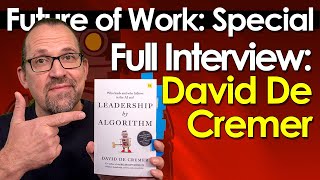
Professor David De Cremer on Who the Decision-makers Are In the Age of AI - HCLI Trailblazers #82
Unleashing AI's Potential for Global Business Leadership with David De Cremer | Paula Caligiuri

David De Cremer On AI Savvy Leadership | Episode #944 of Six Pixels of Separation