The Future of Intelligent Work: A Conversation with GM Garry Kasparov
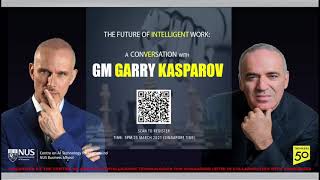
Recorded webinar (April 19, 2021) led by Prof. David De Cremer with guest Garry Kasparov and opening remarks from Anthony Cook (Microsoft). The discussion centers on ‘‘augmented intelligence’’—human+machine collaboration—covering causes and consequences for the future of work, education and training, ‘‘zombie jobs’’ vulnerable to automation, the limits of narrow AI (closed systems), corporate governance/AI ethics, and global opportunity/inequality. Kasparov emphasizes human flexibility, creativity and moral responsibility as the enduring 2% that directs machine capabilities.
Chapters
Foreign.
Hello, I'm Stuart Cranor, co founder of ThinkUs50, the world's leading platform for management ideas. We are delighted to be partnering with the center on AI Technology for Humankind at the National University of Singapore Business School for this unique and compelling event. Thinkers 50 scans, ranks and shares the world's very best management ideas. In recent years, the big story has been the arrival of miraculous and often scary new technologies. Tech is sexy, exciting and has created huge dominant corporations as well as enormous wealth and opportunities. The big challenge now is to make sense of the technology at our disposal, to use it to make the world a better place. To use technology to change our educational, organisational and personal life lives. Today's event promises to offer compelling new insights on the future of intelligent work. Our guides to this new world are truly remarkable. Garry Kasparov is the former world Chess champion. He's seen the development of incredible technology at first hand. Remember his battles with the deep blue supercomputer. And he's at the forefront of making sense of the relationship between machine intelligence, human creativity. Witness his latest book. Gary is joined by David decrema. David is a groundbreaking thinker whose work we have featured on the Thinkers50 radar listing of thinkers to Watch in the coming years. The future of intelligent work begins now. Join us.
Welcome to everyone who registered to attend today's webinar where we will discuss the.
Future of intelligence work.
Before we start with our conversation session, we have some opening words from Anthony Cook, who is Microsoft's Regional Vice President and Chief Legal Counsel for Corporate, External and Legal affairs for Asia. Anthony, the floor is yours.
Thank you very much for the kind introduction and also thanks for the opportunity to be here today. I think one of the things that we've learned over the past 12 months is that this conversation about what the future of work looks like, what the future of intelligent works look like, has only been accelerated by the circumstances which people have found themselves in and the role that technology has played in then enabling and reimagining the way that people can work. So I think the conversation today is incredibly timely and it will be wonderful to hear the insights that I'm sure we're going to be able to hear about the directions that we're seeing at Microsoft. We believe that the intent of AI, that it must be designed to augment human capabilities and that it has to be developed in ways in which engender trust in the technology. As our President Brad Smith has stated, we have to ask the question not what the technology can do, but what technology should do. I think that's something where from the objective and the mission of the center of AI for humankind, it's very much focused on the role that technology will provide to advance human beings interests and their well being. And so I think there is a strong sense that we have of the importance of these sorts of discussions at Microsoft. We started nearly four years ago now articulating a set of principles which we felt were critical to the way in which we would develop and use AI as a company, and that these would be critical in the way that we would engender trust in the technology. Those principles related to fairness, to reliability and safety, to privacy and security, inclusiveness, transparency and accountability. And we've moved not only since having those principles as statements, but then looked at how you articulate from statements into particular an operational framework which will then provide a governance for the way in which we make decisions about how we use technology, about how we make technology available to our customers and how we make tools available for those that are developing and utilizing technology. Of course we believe that AI can bring and does bring benefits to all sectors and conserve humans in ways across all types of industry. In the education sphere, which given our host today, I thought I would just highlight that technology continues to provide amazing augmentation capabilities. And so I think of things like providing, as Dr. Kellerman at the University of New South Wales has done, is created a virtual teaching bot that addresses student questions and makes available course materials over a 24 by 7 access regime, which then leaves tutors, which are inevitably a scarce resource at universities, to address and deal with students on more challenging questions. It also has enabled them to create more personalized study guides for the use of each student in class. It can also be used to then increase the inclusiveness of technology. So where we have AI that powers through an immersive use immersive reader, that's then part of our Office365 suite that helps students with dyslexia to be part of an inclusive learning community. Today we have a distinct privilege of having the Grandmaster Kasparov and Professor de Crema discuss this relationship between AI and humans and how it will influence the future of work. And as I said, I think it addresses and comes at a time when these questions are being asked both in place, like Singapore, where we are looking at the evolution of work practices. But it's a question that gets more broadly asked around this region and indeed around the world. So in closing, I'd like to thank the host today and I certainly look forward to furthering our collaboration and to what I'm sure will be a fascinating discussion today. Professor.
Thank you, Anthony, for your introduction and thoughts. And likewise here at 8, we also look forward to looking for further collaboration. We very much agree with your statements on we need to trust technology, but for that, we need also to look at how humans and AI technology will interact. And this is what we hope to achieve today as well. To talk about this, because the topic of this webinar obviously refers to the future of work, but today we would like to delve a little bit deeper into looking at something specific about the future of work, about making it truly intelligent, as Anthony already referred to. Microsoft is probably putting in a lot of effort in augmenting making it actually more intelligent. So future of work, in our view, has always been a little bit limited in the sense that it addresses some of the visions. But how to make it really work. This is something that we would like to talk about today and to discuss this in greater depth, I'm extremely proud and happy to have with us Grandmaster Garry Kasparov. I know most of you. No, of course, Gary. But I would like to highlight a few things about him that make it very relevant to the discussion today. He was the youngest world chess champion in history at age 22, and he retained that title for 20 years, which is an amazing achievement, of course. But for most of us with respect to artificial intelligence, what we remember is, of course, his game against IBM's supercomputer Deep Blue. And he didn't lose. He lost the game. But it was this experience that made people dream and believe, what can we do with machine? Although he retired from professional chess in 2005, Gary has been pursuing this relationship between playing chess, artificial intelligence, and seeing what these developments will be for the future of humankind relentlessly. Which also resulted in a book, Deep Thinking Where Machine Intelligence Ends and Human Creativity Begins. Gary, welcome and thank you so much for being here.
Thank you for inviting me, David. So it's good to start with the painful memory first. Thank you very much. Look, it's no bad blood, so I know it's a very important moment. It's a milestone in the history of human machine relationships. And I always remind people that the match in 1997 against IBM Deep Blue was the second one, a rematch, because I won the first one in 1996 in Philadelphia. But okay, that's for history. Record what's important, you know, that was the end of the grand quest to defeat the world chess champion. That was a dream of founding fathers of computer science, Alan Turing, norbert von Winner, Karl Claude Shannon and many other greats in computer science. And going back to the late 90s, I wasn't sure it was a blessing on the curse. Actually I thought it was a curse for me. Now I know it's more of a blessing because it's. I was a world champion when machines finally came of age and this match actually while it fulfilled the dreams of the founding fathers of computer science, but also prove them wrong in one very important instance. Because going back to the late 40s and 50s when the computer capabilities were minimal, they believed that the only way for machine to play chess well, to beat world champion for machines to become intelligent is to mimic the way we humans think. They just couldn't imagine that the brute force could be a factor. And that was the beginning. They had time to be philosophers because they could think about the impact of intelligent machines for humanity. And they always thought that machines would follow the human path in, in selecting moves in chess or just making decisions in general. Then we moved to the next stage which was exactly the opposite, that the brute force became a factor. And DeepBlue was as intelligent as your alarm clock. Though it was a very expensive alarm clock, $10 million a piece and it didn't make me feel any better losing to that. But the reason Deep Blue succeeded has and the reason that the competition between humans and machines in chess or in any other game, what I would qualify as a closed system, whether it's game of Go or shogi, the Japanese chess, video games, even Texas Holden poker, these games now become the machine's domain to dominate. It's a realm of computer dominance for simple reasons, not because machines can solve the games. Chess is mathematically speaking, it's infinite game. According to Claude Shannon, the number of legal moves is 10 to the 46th power 46 0. So that's, that's just too much for any computer in this, in this known universe. But it's about making fewer mistakes. That's the way you know machines, you know, prevail. I lost the match. Not because the blue played fantastic chess. Actually, if you today have your chess app on a mobile device, it's stronger than the blue. And when you download a chess engine to your laptop, it's much stronger than the sitting world champion. The difference between this chess engine on your laptop and Magnus Carlsen is about the same as between Usain Bolt and Ferrari. Again, not because machines are perfect, nothing is perfect in this universe, but because machines making fewer mistakes and they come closer to the hundred percent perfection than humans. But they will Never reach hundred percent. And that's, you know, that brings us to new era era where we can merge. That's what we know discuss in our article is this is, you know, it's the first, you know, machines, you know, couldn't do anything fast. And it was all about machines, you know, following humans to, to replicate our way of thinking. Then machines had brute force and everybody thought, oh, we don't need anything else. So that's AI but you know, it's the future as we all know, future of intelligent work is for humans and machines to work together. And that's, you know, that's what we're calling augmented intelligence. And that's what I recognized all the way back in the late 90s. And immediately after losing this match, I came up with a concept I call advanced chess. Human plus machine facing another human plus machine. So I was one of the pioneers of finding the most effective ways of human machine collaboration.
Yes. What you just said here, I think it makes clear to the audience right away what I appreciate so much when we got to know each other and when we wrote our article that was published last week, is the perspective that you were able to take. Yes, it was a defeat. And, and what I've noticed is most people are really, they want to know how you feel. But what you've done is you moved on and you put it in a perspective of, okay, what does this actually mean? Because I remember last year you told me, you know, what my defeat was. Actually, it was not a defeat. It was a victory for humans because it will help us to make ourselves better humans. So can you elaborate a little bit on this? Why do you see it actually as a victory?
Everything can be analyzed in perspective. So yes, going back as already mentioned, to 1997, I was furious. I was angry with myself, with IBM. But we have to learn from our mistakes. We have to learn from our losses. Otherwise we will never make any progress realizing that the future, it's not us fighting the machines, but us working with the machines, simply recognizing that you cannot beat them, join them. So I thought, you know, I thought about this event, you know, differently, in a different light. Yes, I said it was a victory for humanity because Deep Blue was built by humans. And that helped me to recognize that, you know, it's, this is the, all these Hollywood made stories about the horrible future, this very bleak future of machines dominance and human extinction. You know, they, they have no foundation just because we invented these machines, we build these machines and, and we just have to recognize it's another tool. I I keep saying that AI is not a harbinger of utopia or dystopia. It's not a magic wand, but it's not a terminator. I don't see any reason why, why intelligent machine should go after humans. You know, it's the, it's again, it's, it's, it's good for Hollywood. But if we want to be, you know, on, on, on a solid scientific ground, you know, we should look, you know, we should look at the realities of these, you know, of intelligent machines and how they can contribute to human progress. I understand this is a psychological challenge because you look back at our history of human history and we know that innovations always, you know, helped us to become more sophisticated. Machines made us stronger, machines made us faster. Now we have intelligent machines and they can make us smarter. But still, it's a psychology. It's not machines that are helping us with agriculture. It's not machines that helping us with manufacturing. It's not machines that just do some kind of physical work for us. This is irf. Cognition. And humans always thought about us being so unique. You know, we are this unique species. And it's not just on this planet, but not in the solar system, but probably in the known universe. But it's also had to do with this kind of hysteria, with the fact that now intelligent machines are taking jobs from people who have newspaper columns and Twitter accounts. And that's why, you know, it changes the equation in mass media, but so it called progress. So this is if machine can do the job that you're doing and do it better, maybe you do the wrong job. You know, it's this, it's. Machines always expose our shortcomings. And I think that is just, you know, for us, it's that instead of, you know, panicking, instead of crying over spilled milk, it's better to recognize that many of the jobs that we're doing today, they are, I call them zombie jobs. These jobs already dead, they just don't know yet. And sooner we just recognize that, the sooner we move forward, it's better for us because while destroying some old industries and old jobs, machines always create new jobs. And I want us to concentrate on the future to understand how many new jobs can intelligent machines bring to us. And here the possibilities are virtual and limited.
I can hear you say two things that are very relevant to discussion that we wanted to have in terms of AI augmentation and organizations as well. First thing, what you said, people are afraid of losing their jobs, but they're zombie jobs. So I'll just park you, because I will ask you a few things about this that I'm really interested. The other thing is also, again, your perspective is a positive and optimistic one, because I remember you told me last year as well that actually AI is not moving in fast enough. So a lot of people are afraid that it's going too fast. They're afraid of losing their jobs. But do you still see it this way, that you think AI should actually be moving in faster even than it is today? Yeah.
This is. Again, we can concentrate on the negative side of any new technology because technology brings problems. Not only just that it threatens jobs, but also, you know, it could be used for destruction. But technology also brings positives, and it's for us to make the balance. We have always developed technology to take our jobs and to make our lives better and easier. So we have to see the big picture and look ahead for benefits. If we only focus on the immediate disruption, the competition phase between human jobs and intelligent automation will delay or even miss out on the huge benefits in productivity and job creation that always come later. That means the faster we go, the faster we reach the benefits. Certain things are inevitable. And I don't want to thank the pandemics. That's bad. And it's, you know, for me also personally, I lost my mother to Covid and. But we know that pandemic forced us to move forward faster. It's just we recognize that many things that helped us to go over pandemics or just to keep our jobs going, it's technology. And imagine if we were more ambitious and had more courage to actually face these challenges five years ago, we, we could have some technology today to actually to reap the benefits even more than we did over last year. And I don't want to sound callous just about people losing jobs or having to retrain, but even their intelligent tech makes that easier. So you don't have to be coding expert to work with AI tools. For example, I'm 57, turning 58 soon. And I know, I know I'm no match for my kids, who are just much better, you know, in just working with technology. But I know that this new phase of this relations, this augmented intelligence, you know, humans plus machine collaboration, as we described in our article, requires experience, requires knowledge, requires, you know, thoughts from people who had experience. I don't have to know things about the machine, you know, at the level of a professional, but I can bring something. I can make a contribution for this collaboration because some of my experience could be very useful for certain computer Addressing certain tasks.
Again, just to add your positive perspective. It adds something to the way you've dealt with the DeVito IBM, because I would like to compare you to another world champion. But then in the, the Chinese board game Go Lee Se Doll, contrary to you, he was very negative about his loss because, you know, he retired in December 2019, saying that everything's lost for humanity. So he has a very negative view on it. You have a very optimistic view and you see the opportunities there. So it's something that I've always thought like, oh, this is really the big difference. It's how you look at the challenge. It's a challenge, but it's one that can bring us a lot of benefits.
Like you said, as I said, you know, just, you know, it's the, you don't want to stand on the way of history and it's the, the only way to make progress and to move forward is to understand the trends. Yeah, it's, this is for, for the GO champions, it was a shocking experience. I was not surprised. It's not about the complexity of the game. Anything that is, can be qualified, is qualified as the closed system. And any game is the closed system. Chess Go again, GO could be more complicated, but it doesn't matter. It's still the closed system. Shogi, Japanese chess, Texas hold', Em, poker, video games, they all are systems that, you know, that have the certain rules. It's a certain framework. And the moment we use this intelligent machine, especially new generation of Alphazero, the machines that even don't need human experience of the past, the machines that can play against themselves and to generate knowledge and to create their own table of evaluations, the set of values so they will follow their own logic that had been generated over these millions and millions of games they played against itself. Machines will always dominate the closed systems because as I already said, they always make fewer mistakes. And that's, you know, that's, that's what, what some of the professionals just couldn't recognize. But it's not the end of the world for a simple reason, because it's a closed system. It's a framework developed by humans. And the moment we move from one closed system to another one, machines experience, you know, becomes irrelevant because machine doesn't know how to transfer one, you know, that one piece of knowledge from this, from this system, system A to system B, even if these systems are similar, not authentic, but similar, because if you have machine, you know, dominating one of the video games on this specific map, the moment you change the map, even Keeping most of the rules intact. You have to start from the scratch. So this is plenty of room for humans to actually go in between. You have this two or many, actually many closed systems. And then it's for humans to understand how to guide these intelligent algorithms, the flock of intelligent algorithms, and to make the best of the knowledge. By the way, some of the knowledge could be absolutely unique. Even in chess. We learned a lot from AlphaZero that, you know, played against itself and just generated some new ideas. But still, you know, it's the, it's these human flexibility, not just creativity. Human flexibility is a very important factor of finding the best applications for this knowledge.
I think you outlined here and emphasized a lot the closed system and the advantage that humans have, the flexibility. So I want to draw our discussion a little bit into the context of organizations. Now. Our center is, as you know, based in a business school. We wanted to publish our thinking also in Harvard Business Review because it's relevant to organizations. So I want to move it now to the context and address two things you've been touching upon. So I'm going to come back to the zombie jobs that you said and that people have to accept that reality. So if that's the case, I would like to ask you, so how do you see the future then of training our employees and educating our students and even children? Because if it's true that there's a zombie job, does it also mean that we hear gurus say AI will replace repetitive jobs? The complexity, the creative aspects of the jobs, that's what humans will deal with. But I hear you actually say there are probably not that many jobs that have creativity. So does that mean we have to invest more as organizations into creating creative jobs? And do we have to train our employees differently? Because, let's face it, most of them work in a management system where metrics are the champion. They have to tick all the boxes, pursue all the KPIs. And I think that's an easy prey for AI. Anything that's metric driven and a closed system, like you said. So what does it mean for organizations? Do we have to invest more in job enrichment? And what do we do with our kids and our students? How do we train them?
That's an excellent question and it's probably central one for this discussion. Over the last few decades, one of the compliments for workforce was, oh, these guys work like machines. And that's what the problem is. Now. We want them to work like humans. We want them just to move to the other side of the fence, you know, Today's everything is metric driven, you know, and we very much, you know, we are like machines ourselves these days. But speaking about the future jobs, I don't think we have to create, you know, these jobs in our minds. We have to create technology. I don't know. I actually have no idea what jobs. My son, who is now turning 6 in July, will Covid 15 years from now for a simple reason. Many jobs that very lucrative jobs today, they didn't exist 15 years ago. You know, look at 3D engineers or social media managers or drone operators, the jobs will appear. And that's why we should stop teaching kids what we should not. We should stop teaching them knowledge, you know, as has been, as we have been doing over centuries. That's a classical system that haven't changed since, you know, it was introduced where? University of Bologna, 700 years ago or so. And then there's a classical schools. I guess it came from Prussia in the middle of the 19th century. This is the early education for kids. But it's all like a machinery that's assembly line. So there's a teacher in the center of the class. He or she is the, is the center of this universe. He or she, you know, is the only source of authority and knowledge. Sorry, just, you know, that's it, that's. It's over, you know, it's, it's, you know, imagine that you transfer, you know, by time machine someone from the late 19th century to our time. And this person will not recognize anything except the classroom. The classroom is still the same. It's, you know, it's, and, and it just doesn't work because everything today is interactive. The classroom, traditional classroom is still one way, one way street. So we have to change it. Instead of teaching what and presenting knowledge to kids, we have to teach them how it's all about applications. Because they can collect the data. I mean, they just, you know, they swipe their finger on the screen and they can learn more, you know, in five minutes that the teacher can tell them for a year but how to apply it. So this is, it's actually we have to teach them creativity. We have to make sure that they will develop their unique human qualities because these qualities will be needed when they will enter the world where intelligent machines will do a lot of work. It's again, we will look for a smaller field. We have to recognize the fact that we, we will belong to the last few decimal places. But there's nothing wrong about it because we will be still, you know, in charge of direction. It's like you know, I always ask people to visualize, you know, you have a very powerful gun, you know, and then you know, just you, all you can do is basically to change the direction of the bullet that goes, you know, one mile away from, for maybe just, you know, for a millimeter, but it will end up probably 10 meters difference, you know, in a mile. So it's the even this is tiny tweaking, you know, it's just a little, you know, just correction at the beginning of the process could lead to massive differences at the end, at the end of the road. And that's what is our role. Yeah, it's if in this combination we're responsible for 2% and machine responsible for 96% and we reach, you know, 98% efficiency, that's great because this 2%, even sometimes 0.2% could be the real difference between failure and success in the future.
So basically the 2% is still the most important thing, like you said, because it's giving the direction and it would allow to use the power of machine in what you called open systems. Because this touches upon, I mean as you know, machine AI. It's been called to have narrow sense of intelligence. It can do one task well, it can play chess well. But then if it goes to the board game Go, it doesn't know what to do. Humans have that ability. So if you look at it from the point of view of organizations where I totally agree with what you're saying, our employees have become half baked machines to say so. Because we all think in terms of metrics and just the exchange of knowledge, then where do we see that flexibility that you said? Because some people in the business are actually dreaming that AI will become the new strategy champion. We'll be running our organizations, we'll be able to automate our organizations. I know startups in Silicon Valley who make this their business purpose, to automate organizations. We don't need people anymore for a strategy. So what do you think of that statement? Because that seems to be a little bit contradictory to what you said. We still need that 2% for the direction.
You know, I joke once that we will know when machine reaches human intelligence because it will tell us, hello, I'm here. Yeah, this is not for us human to do to make these predictions about this bleak future. I strongly disagree with those who are preaching the end of human dominance in the area of cognition because AI will dominate. Actually not AI AGI, they say it's near, it's just around the corner. It's super intelligence and it will bring, bring Unpredictable and possibly catastrophic results. I see no shred of evidence it's happening. And again, the Silicon Valley should not act like Hollywood. So the scientists should look at facts. And yes, we see machines could do more, more and more, but it offers us the opportunities. It just, you know, it's the machines still lack this flexibility. Yes. Can machine ask questions? Yes, but they don't know what questions are relevant. Machines do understand things. Yes, but they don't know what matters most. It's all for us to actually understand. So how our unique human qualities can be invested in these human machine relationships. And as for this strategy, look, it's again, it has so many factors and it's an open ended quest. Machines can help, but I would not rely on machine to, to, to come up with, with a strategic plan. This is, you know, that also, you know, brings us to another debate which is, you know, bordering, you know, philosophy, semantics and, and science. Can machines be creative? Again, depends on the definition. So can machines make a movie? Can machines, machines paint a picture? Can machines write music? Absolutely. Because they can follow certain patterns. Will you like it? I don't know. I'm sure there will be millions of people who like it and probably hundreds of millions that will not like it. So I don't like a lot of the modern art, for instance. So that's the, it's the, but the reason I believe that the creativity, the way I understand it is not achievable for machine. It's very simple because creativity means you are revealing, you know, something new. I mean it's, it's you testing something that, that was not tested before. You are open new horizons which means you're running a risk of failure. And machines by definition cannot look at the failure as one of the options it always looks for best return. It's always about a bottom line. So that's why I think it's for humans to have this luxury of being creative and making mistakes. And that's where machines can help us to not to avoid mistakes, it is impossible, but to minimize the risk of making mistakes because our decisions and our strategic vision could become more effective if we know how to merge our capacity with machines. Brute force and pattern recognition.
You've just said, Gary, a lot of things that I think a lot of business people listening now will find extremely relevant. So allow me to pick out three things that we also discussed in our article. And the first one that you said is, look, machine doesn't necessarily decide which questions we should ask because that would be like. We use data to determine our Purpose. But like you said, the 2%, that's human, they decide the purpose and we find the data for it. So I think that is definitely an important point. The other thing that you're saying about creativity rings so many bells with me because as you know, in companies, what is the most important thing today? Innovation. We need to be innovative. But you just said AI shies away from failure because it's probabilistic, it just doesn't want to fail. And everyone else is saying, oh, in order to grow as an organization, you need to learn, so you need to fail. We need to have these data. But if that's the case, I want to ask you the following. We referred to earlier about the COVID 19 crisis, the pandemic. And what is interesting, everything you said is so applicable to that situation because in the beginning of the pandemic, pandemic outbreak, where was the AI community? Why didn't they speak? I've had this question a lot of times and I always said, well, it's easy because it was unknown for everyone, including AI, they didn't have data, so humans had to speak and ask the questions. So how do, how do you see that develop in terms of AI using for our future? Because we're talking about the future work. But quite often, as you rightly say, so it's unknown, we don't know yet. So what is the exact role? Who leads who?
Yeah, it's a tricky question because, you know, to make this cooperation fruitful, you know, you have to know how to split the responsibilities. I still think it's for humans to decide on strategy because going back to my analogy with this bullet, long range rifle, it's about direction. And as you just pointed out, AI community was almost blind at the beginning of the pandemics because they had no data. But also it's not just about AI community, it's about business community. For last few decades, we have been moving into the risk free zone. Mitigating risk became sort of the, it's a sacred cow. It's just, you know, for all businesses, you know, you have to look for every opportunity to reduce risk and to keep your benefits. Yeah, okay, that's probably, you know, at a time where, you know, the government's always, you know, willing to support businesses with helicopter money. So that's working. And there was a rationale on this defensive behavior of the corporation, especially in the pharmaceutical industry, because if you have the great drug, but you know, in the testing, you can have some negative results, say 5%. It's, you know, you could end up with lawsuits that could, you know, really endanger a business. There was a business logic for pharma, for big pharma to invest heavily in heart diseases or in diabetes, something where they can make improvements, gradual improvements. They didn't look for breakthrough innovations. And also to keep their books intact. So just to secure the profit and at the same time, at the same reason, you know, dictated them to reduce or even to quit any investments in vaccines and antibiotics. Too risky. Now what's happened during the pandemics. Exactly. It's now that's the logic of the business, dictated the opposite. Now, even if you have 30, 40%, you know, risk of failure, good, because you need result. It's not about, you know, making sure, oh, every person is being protected. We know we're losing people. Even if you have tens of thousand people potentially affected, maybe hundreds of thousands of people potentially affected by this new vaccine, we are saving hundreds of millions. And the math is very simple. And the public mood change and the business model is changing. I cannot understand that because that's very human. This is not that you can quantify. This is not about metrics. This is about our attitude. And this is, you know, how can you say that the risk, you know, that was unacceptable five years ago now becomes acceptable because of the pandemics. Show me, show me the metrics again. It's for humans to actually teach machines and machines will learn and eventually they will make us better prepared for a new crisis. I have no doubt about it. But still, it's for humans to learn from these lessons, to ask relevant questions. And also there's one very important moment in human relations. Data collection is endless. You can keep collecting data. At what point you want to stop and say, enough is enough, let's make a decision, because that's again, that's intuitive decision. So I'm going to sacrifice some of the material and some of potential of the quality to gain time. And how this time machine, time quality, material triangle works. In my early book, How Life Imitate Chess, I talked a lot about material, time quality, correlations. And again, it's those things that machine cannot compare without some human contribution into the process.
I can see. So what I like what you just said is the paradox that we've seen before. Little risk, now risk exchanging or even maybe sacrificing explainability for the sake of the bottom line. What we see in business, because yes, I mean, we want to see data, data, data, like you said, we want to be able to explain it all. But at one point you have to Make a decision. So how do you look at. And this is the broader label of AI ethics. This is responsible AI. Microsoft is also working on that concept a lot. Where we see now that because we realize with using automation, with using AI, we may create risks or we may miss out on certain things because if we rely too much on the data that AI is proposing us, which questions we have to ask, we need some corporate governance frameworks there. We need to regulate it. So in a way, with these frameworks, we even suppressing risk taking even more, which may lead to actually even less innovation, less risk taking, less decision making, less acting on the situation itself. Where do you see that bottom line that companies have to. How should companies act? Because right now they're just as, you know, the regulator says this and that's what happens, but at the same time, they do want to automate the running of their organizations. I mean, do I see a little bit of a crisis emerging there?
Look, I think it's a crisis in our heads. You know, it's not, you know, in our relations with AI because somehow people think machines unbiased, but now we know better because machines look at the patterns, look at data, and data is biased and, and the algorithms, you know, just follow these patterns. So many companies keep going, thinking AI will make right, quote, unquote decisions on its own, no accountability, and the public somehow shares these beliefs. I think it's absolute nonsense because talking about ethical AI is like talking about an ethical knife or an ethical car. AI is a tool and tools do not have ethics. We, we humans do. AI is far bigger and more powerful than knives or cars. And so it's ethical. Unethical users require more attention. I agree. I'm not against these discussions, but I'm afraid that these discussions will be used to divert accountability from where it belongs. The programmers who make it and the companies that use it. So AI ethics are human ethics or just ethics, period. AI is a mirror. Think about it. Just, you know, it's a mirror that can show us our worst biases and help us fix them. Or it can multiply the power of our bad habits. You know, if you look at the mirror and you don't like what you see there, you have two ways. One, you can distort the mirror or take a hammer just in a radical solution. Or you can start looking, you know, at your problems because it reflects, you know, who, who you are and what is, you know what what is, what is inside of you. So, you know, it's up to us to design it and use it wisely and to hold people responsible when they don't.
Yes, yes. Yeah, I like what you just said. AI shows us our worst biases. It's that mirror. So this relates again to what we've been calling the augmentive intelligence, the third type of AI. It augments us, but at the end of the day, yes, it's just there to make us better because we may be the 2%, but it's our moral compass, our intuition that puts the ethics in it. So a final question before we go to questions of the audience. I agree completely with your assessment that what we see in the corporate world now is when they talk about AI ethics. I see too many companies saying, hey, we put the stamp of approval of Microsoft, of Google on the technology and then it's an ethical technology, a responsible technology. And this may be true in terms of, okay, we try to reduce biases with data scientists are doing. But a problem that I see is that among business people, the business leaders itself, there's a certain, would I call it even a biased perception of, oh, the approval has been given by the big tech companies that this AI is ethical. So as a leader, I don't have to be ethical anymore because AI can do it. I mean, it's even further consolidated by a company like Google who says ethics as service, as if you can provide it as a service to the machine to make it more ethical. So if this would be the direction, I'm a little bit afraid of that because we will get worse leaders than we've ever had. What is, what's your opinion about that?
I couldn't agree more. Because at the end of the day, you know, AI will be, will get more sophisticated and it will be basically programming itself, but it will be programming itself still using the data from our history. And when we look at our history, we definitely can find, you know, many, many moments, many periods that we're not proud of and something that we know we are now looking and reconsidering the moments of reckoning. So just it's around the world. But how can you communicate back to AI? So this is very important for us to recognize. It's still, you know, human centered cooperation, AI and humans. And the moment you say, oh, we have a stamp, Google, Microsoft, Apple, whatever company, whatever tech giant puts a stamp, that's not the end of the story. Because AI is a tool. And the moment you start feeding it with bad ideas or even unfiltered pattern of the past or unfiltered data, AI can run the risk again. We know the problems, the racial problems, the gender problems, I mean, ethnic problems of the past. And this data does exist. And AI simply looks at numbers. You know, just it's, and the human history, we as we know, it's just, you know, it's, it's not, you know, it's not the perfect story. And it's very important for us to not to be selective, but actually to understand how we process it. The only way to keep AI on par with our ethics today is to control the process and not to let it go. Because then we'll see AI to become a monster. Because all of a sudden, you know, it will amplify our worst instincts. We think we got them under control, but the patterns from our history will tell AI the opposite. And many of the decisions that we will take for granted will be based on the past because again, it's all about overall numbers. And overall numbers, the big data, it's very questionable. And we can definitely now challenge many ethical things when you look at this big data, what we're doing now in our social affairs. But we have to make sure that the social, political and scientific areas just being connected. It's like looking at the big picture.
Okay, I very much like your human centered approach to AI, of course, that's our center. So this is where I'm going to leave it from my point of view. So we're going to introduce you to a few questions from the audience. So an overall question that I already saw was that the audience realized that you and I, we share the sentiment of augmented intelligence. Humans will stay in control. But people say, like humans will also develop over time. Evolutionary speaking, machines will develop. So at one point, and they refer to the concept of singularity, what will happen to humans? Will we develop and become obsolete or will we become machines? Because is singularity an outcome or does it stop where we describe its collaboration?
Look, it's definitely not a question for my lifetime. I think maybe in the very, very distant future we'll see humans merging with machines. So maybe we have some kind of cyborgs and we see already some, some of the elements of machines, you know, helping humans to become more sophisticated. It definitely helps humans, handicapped humans, you know, humans who cannot hear or cannot see. So technology helps them to become, you know, relevant persons again just to join the workforce. People who had, you know, some, some of their limbs amputated and now they can go back to normal life. Yeah, we can probably see some chips being implemented, but I still think there's a fundamental difference. The bridge that we will never Cross. Again, I might be an idealist, I might underestimate the power of technology. But again, that's what I see. And I think it's just, you know, for us to, to make the best contribution for the future, it's not to fantasize about what will happen 100 years from now. We have concrete challenges today and let's, you know, work on them because there's so many things that we abandoned in the past because it was too risky like space exploration or deep, deep oceans exploration. Let us move forward. AI offered us unique opportunity to mitigate risk because we can calculate better. We have more powerful machines now. I mean, look what we could do. Now we, we are watching and it just, nobody even considers. It's, it's a miracle watching the direct, you know, the life, you know, reports from Mars. From Mars, you know, this is just, you know, it's what, 80 million kilometers away, you know, this is, you know, and, and we think it's normal. This is, you know, that, that tells us that the cooperation with machines, you know, makes us, you know, all powerful. So let's, you know, let's use this, you know, powerful for challenges and let's stop worrying, you know, what will happen because, you know, if we go back to expansion, to exploration, I think many things will sort, sort out, sort out on their own. It's just, you know, this is the way that Europeans move to exploration in, it's the end of 15th century, so just going around. So that's. And many problems in Europe have been resolved because just people, energy just went elsewhere. So let's ask, you know, just to look at the stars, look, you know, to the bottom of the ocean. I'm sure we can find many things that will help us to solve our other problems because we're looking at some of the big challenges, you know, with climate, with our waste like plastic. So, and we're still looking for solution within the old system. Now maybe now we can now move to a new level. So just, you know, just to follow the first goddaughter theorem that, you know, this, the if solution is not found within the system, eventually go up, you know, and you find solution there. So I think we just, you know, we have so much to do and so much to dream of that, you know, why should we now waste our time, you know, dreaming about this bleak future and about the terminators, the matrixes and other things that could end humanity?
Yes, the dreaming element. Rather than a nightmare, it is something of opportunities.
Absolutely. By the way, you know, this is something machines Cannot do. They cannot dream even in a sleeping mode.
Yeah. And they have no imagination. So we do need ourselves and we need to keep ourselves sane in the things we're strong at. So you just said exploration. But with exploration comes some sacrifice as well. Of course. And this is related to a next question of Ms. Lin Tan. She said that we argued that AI may even have to move faster because like I said, we have a lot of work to do, we have a lot of dreams still to fulfill. But if we look at it from the perspective of the global challenges, first, governments may be slow in adapting their laws and their rules, their attitudes towards machine. You also have a certain type of social inequality. Maybe some of the more developed countries will take more, benefit from it, learn more from it. See the exploration. Poor countries don't have that luxury. So do you think it's a valid reason for the development of technology to slow down? If we look at social inequality, for example.
Oh, that's a very, I think it's a wrong perspective. Just you know, this calculation based on, just, you know, on, in my view, on the reverse logic, everybody benefits, some more, some less, but everybody benefits. Now speaking about the benefits for poor countries, I mean just think about, you know, some medical technology, some, you know, again, take radiology for instance. So you have technology that might, you know, threaten a good, know, white collar jobs in Europe or in America or in Singapore because AI will do more work. You know, just, you know, looking at the, at this, at these pictures and will giving a diagnosis. But imagine now how this technology could actually influence the cost of the procedure. Now this is something that you know, was too expensive and available only for, for the most advanced countries and for sort of the top tier, even in these countries now will be available for more people eventually. You know, this technology, if we develop it, you know, this online diagnosis and then some of the treatments that could be, could, could benefit from AI's development and will be available for poor countries. It's, this is, it's moving forward. We should understand. It's, it's, it's not win, win, win, win, win situation. There will be wins, there will be losses. But I think we should look at the balance, in balance, humanity wins because you know, we look, look at, look at the level of poverty in the world. It kept reducing. Yeah, we have some richer countries, some poor countries, but you know, it's incompatible with what was 100 years ago, even 50 years ago, even probably 10 years ago. We, we see this development worldwide and yeah, we would love to see more progress. We Would love to see more equality and opportunities. And I emphasize in opportunities, not in the outcome worldwide. But you know, it doesn't happen overnight. And I think AI actually helps us to offer these opportunities to other people because just working online, you know, we are minimizing the fact that, yeah, I live in New York, you live in Singapore, and somebody lives in London. And we have advantage of those who live in Harare, in Quito, Ecuador or in, I mean just in, I don't know, just elsewhere in Ireland, in Palau. All of a sudden, you know, this, the connectivity this new technology offers us to offer opportunities for talented kids. I believe talent exists everywhere. I know it from chess. But it's all about opportunity. And if we offer this opportunity, we will benefit as humanity. So again, there will be losses. And I just, you know, I'm not, I'm not telling you that, you know, just it's. Everything is, will be rosy, but, you know, the overall balance will, will be very beneficial for, for, for, for us as human race.
Okay, so that's a clear point of view that you're taking there another question, because it seems like your concept of zombie jobs really elicited a lot of thoughts with people. So we have a lot of questions on the zombie jobs. So as you're probably aware that in many countries, governments are trying to install skills, future initiatives, training their. There are people, organizations are engaging in this as well. But what is it that we should do? You've already mentioned that yes, our flexible mindset is important, the creativity. But what can people do themselves? It sounds nice that we have that 2%. But if our jobs are zombie jobs and what can we do as individuals?
Look, my concept of zombie jobs came from a report that I saw a few years ago, McKinsey report about the job market in the United States. So they figured out that the average human creativity was required only in 4% of working activities. 4%. That tells you that the remaining 96% of jobs, that's what I call zombie jobs, is this. It's this. I don't think what. We can have a game plan. So that's this. Today we do this, tomorrow we do that. It's more about changing our attitude toward education. It's just, you know, understanding that, you know, we, we can control our future to a certain extent, but not, you know, we don't. We're not in the commanding position. Oh, you know, this is a plan. This is central planning. This is more about investing in the future and helping our kids to become flexible. So just to have knowledge and ability to apply the knowledge for the new jobs, because the new jobs will appear. I don't know what will be the effect of the pandemics three, four, five years from now. Huge effect. It will have the same effect as the big wars had before. I'm not talking about just devastation, but I'm talking about the push for breakthrough innovations. Because all of a sudden, people looking for results. There's so much hunger by young people to do something. And I don't know what I should tell them. Do pharma, do AI, do space exploration, do that. But we just have to offer opportunities. It's all about creating opportunities. And we should not worry about the lack of talent to feel it. Now we potentially have access to what, 8 billion souls in the world and more people we can bring into the loop, you know, so better results we all can expect. And as long as we have this global view, as long as we look at this big picture, the picture that goes even beyond the surface of Earth, you know, as I said, goes down to the oceans or up to the space. So I don't think we should worry about the future.
Okay, that's a, that's a good answer. So final, final question. The general sentiment that I see in a lot of questions that we're getting is, and you mentioned this in the beginning of our conversation, AI imitates, basically. And we also say this in our article. I mean, the real deal is the authentic intelligence of people. That's the real deal AI imitates. So AI can imitate painting. A painting can be creative. Artists are using technology, which is augmentive, of course. Then do you think there could be a problem in the future when AI comes up to such a level that everything AI creates is indistinguishable from what humans can create? The only big difference is going to be it's not the real thing. It's not the emotion. It's not like you were playing against IBM. You said as well, look, the computer can help me with my calculations, but in the moves it makes, I can learn some new things. But I can also see AI was lacking creativity. Deep Blue was lacking creativity in certain moves. So what I'm trying to say is I'm a little bit afraid sometimes that if AI is up to the level of humans and creates exactly the same things that humans can, people won't mind anymore. Whereas as a human, I, I would actually find that regretful because I mind about the sentiment that an artist has, the philosophy, the thinking, the things that we bring, that makes us humans. Is there a real threat there, you think?
Look, You said it's a final, final question. I think that actually brings us to the beginning of our conversation. That's the, that's the question that will be asked all the time in different forms. Now yes, AI could get better and better and better, but whether it can create something indistinguishable from humans work, I don't know because we don't have a formula to create great movie. So how do you identify great movie by the way? We can disagree. So I like, I love Casablanca. That's one of, one of the best movies I ever seen. You know, what was the cost of the movie was insignificant. They just, they, they shut it in a couple of rooms. So you don't need to, to, to sort of just to mega millions investments, you know, just to, to, to, to build a movie. Some people like love Avatar so because just all other, you know, this mega productions, you know, this, this is the, the modern movies, the tastes are different and that's, you know, that's guarantees that you know, that's here AI is, is, is, is, you know, it doesn't, doesn't fit because it could follow certain formulas. But you know, but we, you know, we, we have different tastes sometimes tastes and our views about certain things. Products of art change throughout our life. You know, when I was a kid I like you know, certain books. Now I like other books and I just, you know, and yeah, I'm probably already, you know, fixed on some of my, you know, the best movies or best books. But I'm just, you know, I'm already, you know, just close to 60. But you know, this is ongoing process and I think that's this what we can do, you know, just to make us feel better. Because it's about psychological confidence is we should simply recognize that AI will help us to learn more. You mentioned chess and the Alpha AlphaZero that you know, played 60 million games against itself, came up with some new ideas. And I know I enjoyed it because actually some of our views about the game, some of our concepts have been challenged. You know, we all thought that, you know, the machines, you know, getting stronger would be, would play very dull chess. Very like, you know, trench war, you know, positional chess. Because they, they couldn't, you know, go into this, you know, all in attack. No, no, it's just, you know, to the opposite. You know, Alpha 0 proved that it could be very aggressive chess. Fantastic. I'm very dynamic player myself, so I loved it. But you know, it's by learning it it just doesn't mean that it's, it's the end of the story. Because still, you know, we know that it's, it's. AI will be liking one thing. Yes, I can end up with chess. We started with chess. Let me end up our conversation with chess. If you have a machine that did hundreds of millions of iterations and came up with its own set of values and, and patterns for a certain game, a certain closed system, there's one problem. If I play my game, if I lose a game by making certain moves, I know that I did something wrong. The problem with 4ai, it could follow this path, make a potential, lose the game. And because it's one loss versus hundreds of millions of iterations, it will take ages for machine to recognize that it has to change some of the, or tweak some of the evaluations. I can do it, you know, just instantly I can say, okay, I think this little, you know, problem can be fixed if we just tweak this evaluation. So I think that there's always room for humans to invest our flexibility and make sure that, you know, the final product of AI's work, you know, will, will give us great, great, great satisfaction. But again, AI doesn't understand the idea of satisfaction. It will, it will follow some of our patterns and some of the things will be, will be loved by people and some people and disapproved by others. Great. You know, that will be a new competition that will enhance our creativity. And that's what I want. I want AI's knowledge to contribute to my creativity, not to downgrade it.
Okay? Yes. So actually, if I summarize it, the beauty of humanity lies in its so called imperfection. It's all about human centered AI. Very much so. Gary, thank you so much for your passionate and very, very dynamic thoughts. And like you said, yes, you were a little bit of an aggressive player as well. Passionate player, I would say so.
A little bit of steam.
Yes. Yeah. Oh, yeah, no, no, you have a lot of steam. So I want to thank you so much from our center, from NUS Business School, from people around the world who've been listening, thank you so much for sharing your thoughts and we wish you well. Thank you so much.
Thank you.
All right. Okay, so. And thank you everyone for watching our conversation. We will also be editing some of the recordings, so in the next few months, you'll see some of this conversation appear as well. Thank you again, Anthony Cook as well from Microsoft, for giving your thoughts and supporting our cause. Basically, Human centered AI, these people you'll hear more from us. Thank you so much and have a good day. Bye. Bye.
It.
More from Prof.
Thinkers50 Curated LinkedIn Live Session with David De Cremer | The Organizational Application of AI

Professor David De Cremer on Who the Decision-makers Are In the Age of AI - HCLI Trailblazers #82
Unleashing AI's Potential for Global Business Leadership with David De Cremer | Paula Caligiuri

David De Cremer On AI Savvy Leadership | Episode #944 of Six Pixels of Separation