The Road to a Human-Centered Digital Society
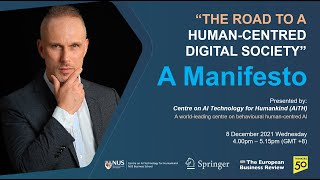
A launch event for a manifesto on human-centered AI built on four principles: competence, belonging, control, and well-being. Siking Yong discusses Singapore's AI governance approach, and a panel debates how to embed ethics into organizations and keep humans in control. The Center also announced a S$600 annual award for the best human-centered AI paper.
Chapters
The center on AI Technology for Humankind just published a manifesto, the Road to a Human Centered Digital Society. Because we want to make sure you don't stay up at night thinking about a looming tech crisis.
Foreign.
I'm very happy that this manifesto exists. It's a great starting point and happy.
To see how it moves forward.
Someone has to take a step back and moderate the reset button. With that note, I pledge my endorsement on this manifesto.
We at may believe in this manifesto.
Due to its focus on human upskilling.
Something that ties in well with our values of democratizing AI literacy.
The manifesto costs what ocean and collective action. We are happy to partner with the.
Center on AI Technology for Humankind to.
Help make this a reality.
Hello everybody, My name is David de Kremer and I'm the director and founder of center on AI Technology for Humankind, or also referred to as aid. It's my pleasure to welcome you all at today's event where AID will present and discuss its manifesto, the Road to a Human Centered Digital Society. This event is special not only because today is finally the day that we can make our manifesto public to the entire world, but also because we have amazing guests who will discuss the manifesto, talk about the AI Governance framework in Singapore, convey their thoughts about what the notion of human centered approaches to intelligent technologies should stand for and how they see the future in light of aids. Warning that if we don't take care of humanity first, a tech crisis might be looming. But before we engage in these discussions, we want to briefly introduce the manifesto to you all. Taking care of this task will be deputy director of eight, Dr. Andreas Deppler and postdoctoral researcher at AID, Dr. Mahak Nahpal.
Thank you, David. Intelligent technologies are everywhere. You can find them at work, in your house, in the Internet of Things, in smart cities. And with that we see more and more concerns, concerns about the risks and harms of intelligence technologies related to the data vacation, surveillance of lived experience, the monopolies of the big tech firms, the fact that algorithmic decisions are often unexplainable, inscrutable, and also how we consume media, how we consume information is more and more complex, governed and mediated by algorithms. And as you can see earlier this year in the attacks on the capital in Washington D.C. this can have real impacts and can lead to real violence. At the same time, when we look at the current narratives about technology and AI, we see that it is dominated by a mindset of technocracy and techno solutionism. In fact, technology is portrayed as the solution to most problems now, even societal problems. Even problems related to the technology itself. We are being told that the only way to not become obsolete is to upscale ourselves in the free market. And some tech firms such as Google, even go as far as offering tools to fix what they call tricky ethics. We see parallels indeed between what's going on right now and what happens about 15 years ago when the global financial crisis erupted. We see parallels between the financial sector back then and the technology sector today. We see a male dominant and hyper competitive culture. Back then it was the traders and the bankers, now it's the programmers, the software and AI engineers. We perceive there to be an overconfidence in computation, analytics, statistics. Back then, banks became too big to fail. They had to be rescued by the governments. Now we have cloud platforms that are too big to fail in a sense because everything we do is driven and powered by these cloud platforms. And back then, one of the reasons why the crisis took its turn is also that many years before banks switched to a mode of self regulation and regulators took a hands off approach. We see the same happening today with technology where the regulators have always started to think about how to regulate AI and digital technologies. As a result, we sat together in our team and we published a manifesto. You can read it in AI and Ethics. That's the detailed version on the left hand side and you can read a shortened version in the European Business Review. Both fees were published and the links can be found on our website. With that I would like to hand over to my colleague Mahek who will tell you about what human centered AI is and what we recommend should be done so to prevent tech crisis.
Awesome.
Thank you so much, Andreas. So I'll talk to y' all a little bit about what human centered AI is and more specifically what our manifesto is about. So as our manifesto states, and as a leading center on the behavioral human centered AI approach, we believe that we need to build an understanding of what it means to employ a human centered approach to the adoption and integration of intelligent technologies in our businesses and society. But first, what is human centered artificial intelligence in the first place? By this we mean that AI systems must be designed and deployed in ways that serve the needs of and create benefits for humans. In other words, in response to machine centered approaches, we have human centered AI. A human centered approach to developing and deploying intelligent technologies not only appreciates the complexities of human nature, but also strives to harness the potential of AI to serve the needs of and to create benefits for us humans. And so in line with that, we at the center on AI Technology for Humankind proposed the following building blocks that need to be taken into account when building human centered AI. First of all, we have competence. By competence we refer to the fact that human centered AI needs to augment and enrich human capabilities rather than automating away the very attributes that make us, that make us uniquely human. By belonging, we refer to the fact that AI systems should act in line with the norms and values of a humane society. Third, with respect to control, AI systems should give users a high level of control over their direction. And fourth, by well being we mean that human centered AI should advance the self esteem, confidence and happiness of all humans. Now, in trying to use these building blocks to create human centered AI, here are our recommendations for what that entails. In other words, what should stakeholders be aware of when in the pursuit of creating that human centered AI? And so first of all, we should be preparing machines to serve humans rather than preparing humans to serve machines. And second, the process of building human centered AI must begin with a realistic attitude, which essentially means focusing on the AI systems and their present capabilities and the actual material harms and benefits that they presently create. Third, the the future of work should collaborative one, where machines are deployed in ways that respect the autonomy and abilities of workers and in turn make work better for everybody. Fourth, the ultimate responsibility for technologically augmented decisions must remain in human hands. You know, the decisions made by AI are set in place by those who develop and deploy these technologies. And as a result of that, humans must retain ultimate responsibility for these decisions. Fifth, we can only have ethical AI when ethics is fully integrated into daily organizational lives. Leaders need to translate principles into specific practices, which means that moral upskilling is needed for all workers. Sixth, businesses can use machines for good if we're clear about what kind of value ought to be created for end users. That means being clear about the fact that the adoption of these intelligent technologies should be more than solely profit driven. And finally, for human centered AI to serve the needs of all, rather than just a few, we must be sensitive to how values and interests are displayed differently across diverse cultural and social contexts and how these differences may impact our thinking about technologies. These are our recommendations for the pursuit of human centered AI. And with that, I'm going to hand the reins back to David so that we can get the show on the road.
Thank you Mahak and Andreas for clarifying what the manifesto that we've written in the last few months entails and what we hope that we can, how we can inspire the debate and what we can put on the Agenda for many institutes, governments, countries and talking about putting on the agenda for the next part in this event, we will introduce you to an interview that we had with Siking Yong who is the Assistant Chief Executive here at IMDA in Singapore focusing on data innovation and protection. It's a shorter version. The longer version will be available later. For the next part in our event, I'm sitting together with Siking Yong who is an Assistant Chief Executive, Data Innovation and Protection at IMDA in Singapore, which is infocomm Media Development Authority. He's also the Deputy Commissioner of Personal Data Protection Commission and he's definitely known for his excellent work on the Singapore AI Governance framework. Zikin, welcome to our event.
Thanks. Thanks David for the invitation. Happy to be part of this.
We're definitely happy that you want to be part of this because I don't think there's anyone else in Singapore who would have more expertise to the topic of AI governance, human centered AI and ethical approaches. So let's jump in right away and I've got the first question for you. You know that our event is about the manifesto that the center on AI Technology for Humankind is launching called the Road to a Human Centered Digital Society. I've asked you to take a look at the manifesto. So may I ask, what's your opinion about the manifesto? Do you think there are some important things that are being mentioned?
Yes, yes. I've read the manifesto and as I was reading it, actually it resonated a lot with the work that we are doing. I don't claim to be an expert in this area, but perhaps someone who is passionate because we started our work a few years ago realizing that the use of data to power AI is going to be a matter that is going to grow as more companies adopt this. And it is up to absolutely important that consumers trust the companies that are putting out these products and features, right? So that you can build a virtuous cycle. If they trust, they will use. If they use, companies will want to build on their trust. Right. And will be incentivized to continue investing in this. So it's absolutely important and from this little conversation you can see already how we see trust and the role of consumers in the creation of this virtual cycle to be absolutely important.
So in your view, which perceptions, if there's a difference, which perceptions matter most to determine? Yes, this is a trustworthy, intelligent technology solution. This is human centered, the end user, the designer, or the one who is actually governing it.
The way I look at it is that there are two perspectives to Trust, right. So as I mentioned earlier, one perspective is do consumers trust your product, your organization, the services that you offer? So we spoke about how you ought to manage that relationship and the information and communication in that relationship. On the flip side, I think one of the main drivers and impetus for us putting out our framework is that AI is a tool that is used to develop products and services. It is not this abstract genie that you let out of the lab, right? So it is a tool, and as with any tool, it is the people that control and manage and govern the organization that have to be responsible and have to make the right decisions. That's the other perspective of trust. Because you are empowered to make the right decisions at the right level so that the products and services that you put out, it holds your brand, it has your reputation behind it, you want to be responsible and you want to create that, you want to use it to build that relationship with your customer. Once you realize that everything flows because you will make sure that the right persons are put in charge, the right decisions are made at the right level, and the right processes are put in place to make sure that at the right stages, decisions are made that will promote trust, that will promote responsible use of data, responsible deployment of the AI. So that's why I look at it from these two angles. The role of governments and regulators really is to ensure that both sides are taken care of.
If I understand it well, then basically the perceptions of the end user, the perceptions of the ones who design and implement it, they're both equally important. And the government and the governance frameworks being used actually are more, to put it more distinctively are the objective measures to see whether the relationships, interactions are going well. But the perceptions of both stakeholders are equally important for you to determine. This is fair, this is ethical, this is trustworthy.
Precisely to pick up on a phrase you use, I think it is objective.
May I ask, for someone who's been working on an AI governance framework, how difficult is it really to balance the objective stance with also taking into account basically the psychology, the perceptions of these stakeholders and make it concrete in terms of actions? Because a lot of people will say, oh, these governance frameworks, you know, they're pretty abstract, just like human centered AI is pretty abstract. So what are the concrete behaviors, the outcomes that come out of it? And taking into account my perceptions, because that's truly human centered. So I can imagine that's quite a balancing act. Do you have some experiences, some challenges that you could share?
Well, I would say that that's the work we are doing right now. Right. And it is imminently possible to develop from principles a set of controls or criteria that you could look out for when you want to have an objective assessment of whether the framework has been implemented. You can see evidence of that in our self assessment guide that we put out, I think, last year, because we took the first step in converting those principles into things that you can look out for that will be evidence that these principles have been implemented within an organization, whether it is internal controls or whether it is documents that record processes and decisions or information that they provide on their website that they are directed to consumers. We are also examining the possibility where some of these more abstract concepts like bias and fairness can also be subject to tests. Tests using software tools. There's a number of tools that are out there. We are looking at them and we're hoping to put all these together as an objective framework. We are calling it our AI Governance testing framework and toolkit. We are working towards a minimal fiber product right now, but that's how we're taking the next step to make sure that there is to try and build together with our stakeholders and partners, some kind of objective measure.
May I challenge you a little bit? Because there are critics, of course, who are saying as well, of course I like the governance aspect. Technology becoming more prominent. It makes people more vulnerable, of course, to the decisions being made by technology. But according to these critics, the governance that we're trying to employ, and especially the way you describe it, where you put in a lot of work, you try to balance it out, it's going to stifle innovation in the tech industry. It's slowing us down. It's not creating the value that we could see. Because if we go back, for example, an example has been Facebook when Cambridge Analytica case started. Well, Mark Zuckerberg was very clear about it. Oh, up until that point, he realized that suddenly his only task was not to be an engineer and to be innovative as possible. Suddenly. He also said, I'm responsible. We still haven't seen much change there, although he's saying he has changed. But for me, that was in 2018, such a big revelation that he admitted on the radio publicly, oh, I thought my only job was to be as innovative as possible, just to push the limits. And today we hear the same critic again, if we are too focused on governance. So how do you see that? Do you agree that it would slow down innovation in technology sector? And what can we do about it? I mean, is it maybe a good thing that we don't go too fast and how can this be related to a human centered AI approach?
Well, I did also kind of resonate with a point in your manifesto about we shouldn't put technology and innovation on a pedestal and make that our only goal. The way we've looked at innovation and protection, and hence you see that in my job description, innovation and protection, right, is that imagine them as twin propellers on a plane. You need both to be equally powered, otherwise you can't take off. And if either one of them are in balance, you're going to go around in circles and you might even fall out of the sky. And that's the kind of approach that we look at it, we take, right? Yes, innovation is an absolutely important aspect of our society, but so is protection and making sure that individuals, you and I, are along in that journey. We could be individuals as consumers, we could be individuals as employees. Right? Or we could be individuals as developers and innovators. Equal opportunity for all. So we need to make sure that both are equally balanced, otherwise you're going to have a bit of a disaster.
I mean, we're all pro technology, obviously we want to use technologies for good. I mean, technologies themselves are not going to decide whether they're going to have bad or good intentions. Today it's still the people, the organizations, the governments behind it, their intentions matter the most. So I think a human centered AI approach doesn't preclude or try to avoid governance, actually wants to have governance in the equation. Because like you said, if we focus only on technology and how fast we can go, what we fear is that we will put machine first then. Because then basically, if you have such an innovation only mindset, I always call it innovation only mindset, the end user in itself becomes machine because we want to get have machine to become better and better all the time. And that would be contradictory to what you and I have been saying. The end user is human. We take into account their interests, their perceptions. It's an important stakeholder. And that because we put that stakeholder center stage, how do you see then the future of AI governance develop? So what are some of the future projects that you're engaging in and how you see what the new challenges will.
Be aligned very much with the topic we've been talking today. Right. I shared a bit about how our conversation with owners of business owners and managers will take the form of working towards some kind of objective measurements. Right. We also need to have conversations with employers to make sure that as they bring AI into the organization, they treat their staff well, that they prepare their staff through upgrading of skills, through proactively looking at jobs, identifying tasks that will be affected and how to redesign jobs as some of these tasks might be affected. So we've done some work with the LKY Centre for Innovative Cities around a guide on how employers should engage with job redesign in an AI age. Then we've also talked about how individuals who are crucial to this, your project managers, your product managers, your business owners, they also need to understand how they make a difference. So that's where the work of the Singapore Computer Society in the body of knowledge and also developing a system for professional certification of skills.
Right.
The ability to, to run these governance frameworks within an organization when they are managing projects or when they're managing products, that becomes important as well. And that's taken off as well. We saw the first batch of certified professionals. So as you see, even though we speak of the framework and the principles, the work that we do is very much focused on how this impacts tasks, persons, jobs and responsibilities. So it's very much anchored on humans.
Si King, I want to thank you very much for this interview, for your very insightful comments and for sharing also your work on the Singapore AI Governance framework and your thoughts about how we can actually balance our tech driven innovation mindset with also our humane and human centered mindset. I think as you said, there's a lot of challenges still lying in front of us, so it's still a lot of work, but I think it only is going to get more and more exciting because we're going to create more and more benefits. So I think we're waiting a lot of good work.
Thank you, thank you, thank you for the opportunity to participate, share my views.
Right.
And yeah, I look forward to see how we can collaborate.
And we would like to thank see King Yong again for his very insightful interview and thoughts about when it comes down to a human centered approach to in AI governance. And now as promised, we have an amazing panel talking more about what a human centered approach means to intelligent technologies and how such an approach is needed in terms of building the future of work and building our future societies. So I would like to ask each of the panelists to introduce themselves briefly, who they are, what they do and how it relates to today's theme. So can I start with you?
Sure. Very good afternoon to everyone and David, so glad to join you on this very momentous occasion on the launch of your manifesto. Really delighted to be a part of it. So I'm Sansan Lim, I'm professor of Communication and Technology at the Singapore University of Technology and Design where I am Dean of Humanities, Arts and and Social Sciences. So my own work has been on the social impact of technology where I focused on technology domestication by families. And I also look at public perceptions of smart city technologies. And my most recent publication has been Transcendent Raising Children in the Digital Age. And currently I am working on Digital Disruptions in the workplace to understand how automation impacts on individual employees, feelings of safety, adequacy, employability and so on. So I'm really delighted to be here and I look forward to the conversation.
Thank you, Sun. Sam Simon, may I ask you to introduce yourself briefly?
Hi, Simon Chesterman. I'm Dean of the National University of Singapore Faculty of Law, also Senior Director of AI Governance at AI Singapore. And like Sun, I'd like to congratulate you, David and all your colleagues on this manifesto and look forward to a rich discussion to come.
Thank you, Simon. Shannon, may I ask you to introduce yourself briefly?
Sure, Happy to. Thanks for inviting me to be here. I'm excited to talk about this great manifesto that you put together. I'm Shannon Valor. I am at the University of Edinburgh where I hold the Bailey Gifford Chair in the Ethics of Data and Artificial Intelligence. I'm a philosopher of technology and ethicist. I focus primarily on the impact of new technologies on human capabilities, skills, habits and virtues, the ways in which these technologies enhance or impede our flourishing and the development of our character intellectually and morally. I'm the author of the book Technology and the Virtues. Some recent work that I've started is focusing on the notions of responsibility and answerability in our relationship with decision making or decision support and autonomous technologies, thinking about how to make those systems more answerable to people and really, really excited for the conversation. Thanks.
Thank you, Shannon. That sounds very, very promising, what you mentioned in terms of your research. And last but not least, John, if you could introduce yourself briefly.
Yeah. Thanks, David. And welcome. Good morning everyone from a very cold and windy northeast coast of England being battered by Stormberg. It's a pleasure to be with you all and I'm delighted to be part of this event. I'm Professor John McIntyre, Pro Vice Chancellor at the University of Sunderland here in the northeast of England, where I've also been a professor of Applied artificial intelligence since 1998. I've been working in applied AI for 30 years and as I've said to David on previous occasions, if I go way back to the start of my career, someone had asked me back into this very much from a computer science and engineering background about the solutions I was building and whether or not there were any ethical connotations of those solutions. I would have been confused even by the question that building solutions and solving problems was what I was about. And as my career has developed and I've seen more and more growing, I've also had the opportunity to be the editor in chief of a scientific journal published by Spring called Neural Computing Applications, which publishes very, very much that applied AI work. I've seen the technology grow in power and the spread of use to the extent that a few years ago I started to observe things which were cause for concern. There's an applied AI guy was the person going, I'm beginning to wonder about this. That led me to with a number of colleagues a couple of years ago, feeling that the time was right to start another journal specifically on AI and ethics, and work with Larry Metzger of George Washington University in the US and with our publishing editor in Springer, and created the AI and Ethics Journal, of which I'm now co editor in chief. So that work is very much about giving an outlet too and creating a useful body of work, published body of work to the communities. And I think there's a great breadth of the community really interested in what's happening in the AI now. So I'm really delighted that I think the manifesto is very timely, very important, and delighted to be part of this event.
Thank you, John. And also thank you for collaborating with us in Terms of the AI & Ethics Journal collaborating with the center. We're very grateful for this. So as you can see, I didn't promise any too much. We have four great speed, four great panelists here, diversity of backgrounds. So let's jump into the first question. So first question I have is the event is organized around our manifesto and we just saw a brief introduction of the manifesto. But of course I also asked each of you to read the manifesto because I'm really interested from your point of view, where you're coming from, your background, what you thought of the manifesto and which points resonated most with you. So if I may start with.
Simon. Thanks very much, David. So I commend the manifesto to everyone tuning in or watching the recording. It's very readable. There's even a version with no footnotes, if that's your fancy. And I confess, as I was reading it, I was actually reminded of a question that Gandhi was famously asked about Western civilization, what he thought of Western civilization, and he responded that he thought it was a good idea. And by that he meant that the germ of an idea is there, but how do we actually achieve it? The thing that I think was especially helpful to me about is that it avoids the two extremes that we see too often. It avoids the techno utopianism that is the idea that technology is the be all and end all, the solution to everything. But it also avoids the sort of techno apocalypticism we sometimes hear, and instead focuses not on this sort of idea, the Terminator style idea, that the machines are going to take over, but rather a little bit like what Pedro Domingos once said, that the problem isn't that the machines are going to get too smart and take over. The problem is they're too dumb and they've taken over already and that there is this reliance on machines. And I think that to me, that targeting of the. The challenge is to chart a path for ourselves that retains all the benefits of technology, but avoids either transferring too much power to the machines themselves or to the companies that control those machines. In terms of the positive, that's the analysis of the manifesto in terms of the prescription. Competence, belonging, control, wellbeing, these are all fantastic. But I wouldn't be a good lawyer on the panel if I didn't point out that the devil is of course, in the detail. And so the question I'm sort of mulling over is what comes next? Who's going to ensure compliance, when and how? And on the who question, I particularly agree with the manifesto's argument that the idea that we can transfer all these ethical questions to the machines themselves is ludicrous. And I think that really came out in John's comment that this is an area in which technologists realize there are questions and that the machines can't provide all the answers, not because the machines aren't smart, but because these ethical questions don't have simple answers. I mean, we've been working on this for thousands of years. As humans, if there were answers, we probably would have reached them, even though we're not as smart as some machines. And then I'll stop with this. But the last question that this is, what's really nagging at my mind is the Collingwood dilemma. This is the idea that in terms of regulating a new technology, if you try to regulate too early, you don't know what it is that you should regulate against what the harms are. But if you wait too long, then there are so many sunk costs, there's a degree of path determinacy. It's too hard then to rein things back in. And the timing of the manifesto, I don't think we're too late to regulate. And I suppose my concern is the possibility that we might be too early, that it's too hard to get people to see the problems, to be aware of the costs and thus to mobilize action. But that if you like, is the kind of next step. But really congratulations on this first step and I'm curious to see where we.
Get. Thank you. Simon. I very much like what you just said there to balance being too early versus being too late. I completely agree with this because and it's not only in terms of technology, we've seen it in the past as well. Where do we intervene to make sure innovation happens? But normative standards are also still maintained. So I think that's a big question. I want to talk more about this later. Shannon, can I ask you, were there points that resonated with you from your.
Perspective? Of course, absolutely. Let me just pick up on the thread of the last comment though, because I think it is important to remember something which is, and I think you've just gestured to it, we've been here before and quite recently in fact. So all of these arguments about regulating too soon versus regulating too late, stifling innovation, the uncertainty and the complexity of the ethical issues being perhaps an impediment to moving forward aggressively with governance of these technologies, all of these things were said at the advent of social media platforms, at which point concerned ethicists and social critics and others identified all of the harms associated with social media platforms today. When Facebook launched, when it was clear the scale that it would have, people recognized what the dangers were. And a lot of the concerns about regulation sort of hampering innovation won the day and we're paying the price for that right now. So I would like us not to make the same mistake twice at the same time. I think it is true that we have to be really clear about what we expect governance and regulation to do. And I think what I really appreciated about the manifesto is that it is more than just an empty set of principles that everyone would agree with, which frankly a lot of AI ethics sort of principles documents end up being toothless in part because there's no reasonable person who would dispute or disagree with the principles articulated in them. So it doesn't leave us with any particular motivation to change anything. And I think what the manifesto does is particularly the extended version in the AI and Ethics journal is it not just articulates some high level principles about human agency and belonging and well being that no one at that high level would dispute, but it really talks about what this means in practice, in terms of the implications and recommendations. It also has a very distinctive perspective on what I see as the greatest danger perhaps of AI development right now, which I think is that we are creating a world. And here I'm articulating essentially the same themes of the manifesto, but they're themes that I've been thinking about already for some time as well, and others have. Luciano Floridi has talked about this several years ago. The fact that we're creating a machine readable world and machine readable people with the interests of a kind of machine architecture and machine capabilities as the goal rather than as the means to promoting human capabilities, which is really what technologies should be about. Technology should be about enhancing our experiences, our capabilities, our strengths, our virtues. And increasingly I'm seeing AI being designed exactly backwards in ways where the end in itself seems to be to advance AI's performance in various domains and humans are being twisted into knots in order to make that possible. I thought the most striking piece of the manifesto was that example of the call centers where they're using AI to try to restore empathetic behavior in human call center agents who have only lost that capacity for empathetic behavior because of prior waves of computational analysis and optimization of their performance according to metrics that are only appropriate for machines. We measure humans by the standards that are appropriate for machines, and then we tell them we need to find technology to make you more human. It's perverse. Another brief example of this. You know, we've seen how all of the over promising about autonomous driving technology has not only led to a number of sort of safety issues that really are need vital attention by regulators. You know, if you're talking about, you know, autonomous driving technologies being beta tested on public roads without public consent or, or guardrails, that's something that regulators should be paying close attention to. But increasingly I'm hearing that the solution is to require pedestrians and cyclists to wear electronic beacons so that they can be tracked at all times by the vehicles. So we can't make the vehicle avoid the people. So we'll make the people wear new kinds of privacy violating devices to make sure that the machines know where they are. So what I really appreciate is this point in the manifesto about the standard by which humans are assessed and compared should not be the standard that we use to assess and compare machines, that humans should be assessed and compared by humane standards and machines should be promoting those goals for.
Us. It's very insightful. Thank you for sharing that point of view, Shannon. The call center is also one of my favorite examples because like I said, it's a little bit of a perverse effect, of course, that you first make people act like machine and then you criticize them because they act like machines. Let's call machine into teaching some humanity again. Yes. If that's going to be more generic, then, yeah, we may have a problem. That's also the kind of tech crisis, of course, that we're referring to, so very much like your focus. And we're also going to talk more about this later on that shift where what does human centeredness really mean? So, Shen, can I move to you? Because I hear Shannon also talk about we need to have these standards. We start machine as a mean to an end and then suddenly becomes an end in itself. So that shift there, there's a lot to do with communication. So I can imagine there were certain things, things that must have resonated from your point of view as well in the.
Manifesto. Absolutely, David. So, you know, I really loved how your manifesto very explicitly called out the fact that a lot of big technology companies are just so obsessed with the techno solutionism. And I work a lot with engineers. You know, it strikes, it strikes home for me. And of course, you know, you've also talked about being very machine centered. Right. So in the research that I do, I interface at length with users, whether it's young people, whether it's families. And I'm so conscious of how the needs that they have might be quite different than the needs that are imagined by technology developers. So let me give you an example from educational technology. Now, when you have a parent, when you're a parent of a young child in an elementary school, you can actually virtually follow your child into the classroom because the school will send you a report of how active your child has been, how actively they participated in answering questions, and so on. And so there's a lot of data that naturally gets transmitted to the parents. So parents then are able to see whether or not their kids are kept on their toes. And this creates actually a relationship of accountability between parents and children where parents may actually interrogate the child. You know, why were you less active this week compared to last week? And it breaches that relationship of trust, that mutual understanding that could otherwise be fostered between parent and child. But it's great for the EdTech company because they're sitting on a treasure trove of data that they can mine in order to refine their educational technology platforms, in order to introduce more bells and whistles for teachers, for schools, for parents purportedly and so these kinds of distortions of the perceptions of human needs are really leading developers down the wrong path because they're making all kinds of mistaken assumptions about what humans want. So if you think about social media, there's the mistaken assumptions that we want more of the same. You like these TikTok videos, we'll give you more of the same. If you think about quantification and wearable tech, you want to be able to gauge your sleep patterns, your calorie intake and so on. Here we'll give you more of the same. We'll quantify everything for you. And the other big assumption, of course, is that we as humans are so prepared to trade off all kinds of agency, all kinds of privacy in order for greater convenience. And yet very often the reason that we behave in this way is because the technology has conditioned us down that path. So, you know, Frischman and Seligner talk about, for example, techno social engineering, creepy. And increasingly in our society, we are all victims of this techno social engineering creep, whether we like it or not. Once we get immersed in a particular technological platform, we avail of its affordances, we enjoy its conveniences, and then the data is then used back against us to give us more of the same, because that's what we've been conditioned into. And this is very troubling because as consumers, there is a limit to how much resistance we can express. You know, the platforms that we're using, there are a lot of network effects in terms of the platforms that we all have to use because other people are on them. And these network effects complicate our ability to exercise greater autonomy, greater choice, greater resistance to these platforms. So I will say that the manifesto is very clear in, as I said, showcasing the fact that techno solutionism is the dominance discourse and it certainly should not be. And the machine centered approach to technological design is something that we must increasingly.
Interrogate. Thank you, Ishan. This is really interesting that your perspective here, using social media, what's happening in education, to really point out that we see that developers in these areas, they may even misunderstand our needs or human concerns. So basically we start using technology not for good, but for bad, whereas we could use technology for good. And I think that's going to be an important question I would like to address, as Simon already alluded to as well. How are we going to regulate this? How we're going to find that balance, that we can use it for good? Or as Shannon said, what are the ethics and the standards that we use? Where are we going to integrate this. So I think I see already a kind of common focus emerging. So, John, may I ask you. Because some just refer to. She teaches engineers and I.O. you started off with an engineering mindset, like you already said, and then you. I suddenly. Oh, asking questions about ethics and.
Technology.
How. How did this all come about? So what were the points that resonated with you when you read the.
Manifesto? Well, yeah, so. So I'm going to pull out three and fascinating, the opportunity to go after such fantastic speakers and there's things said by each of the other speakers. I want to kind of come back if I can. The three things that really start. I think the manifesto is fantastically well produced and very, very timely. And indeed, I think threads together, the seven themes thread together very, very well. And so pulling things separately from them is slightly difficult because they are integrated. But I do like the idea of humans first. The things that Shannon were talking about, Swanson just now talking about, you know, kind of that normalization of a surveillance society and, you know, the limitations of liberties and the things that Shannon was talking about in terms of the, you know, having a perversely reverse the idea that it's technology which is driving rather than enabling. I think they're really interesting questions. And I think the principles of. Not human Second, not limitations of liberties, not things which are the wrong way around. I think the human first theme is very, very important. My own personal journey, and indeed the journey of establishing the journal and creating a very eclectic editorial board, which takes many different vantage points, including intellectual, geographic, social, cultural vantage points into account, is very, very important. So pluralism is, I think, a very important part of the manifesto. But I want to come back to one which I think is extremely important. And perhaps I'll expand on this theme as we talk is about the embedding of the principles within organizations and the truth and the actuality of that. Because one of the things I see as the greatest threat around AI right now is the danger. And there are many, many documents now which are either corporate frameworks and guidelines on governance of AI, or there are regional, national and supranational regulatory frameworks emerging. The European Union, all of them. The US has produced them. I completely agree with Shannon's point. There's a lot of kind of woolly stuff earlier on. A good friend of mine is Lord David Putnam. He was on the House of Lords Select Committee that produced its first guidelines in 2018. And they are absolutely motherhood napple pie. They're absolutely, as you said, Shannon, you know, things which no One could possibly disagree with AI for good and all of that. The practicality of it and how do you do that? Is, is the thing which I think vexes people. But what we see now is a lot of the illusion of governance, a kind of veneer of rectitude without the actuality behind it. And in some ways I fear that that's more dangerous than not having it at all. If there's no framework, there's no guideline, then at least you know it's not there. You know, there's no break, there's no check and balance. And you can see the danger. And I would give, and I would use this as an analogy. I could take what's happening in AI now and make a comparison to what the tobacco industry did when Big Tobacco was. What was the pattern of behavior it was to lie about the harms they were doing to individuals in society, suppress counterfactual research, actually sponsor very dodgy research, and intimidate and harass whistleblowers. And what happened as a result of that. You can go and find there's a compelling video of the seven chief executives of the big tobacco companies back in 1994 giving evidence of Congress swearing north and immediately perjuring themselves. And it is all in the pursuit of profit, of course. And then if you look at what happened in the world in.
2008.
You had the financial crash. And if you look, I'll just pick out Lehman Brothers as an example, very, very well developed and mature risk management protocols, which were of course sidelined. They were being ignored in the pursuit of profit. And of course what you end up with is a catastrophic point of failure. So in the case of the financial system, it was the crash in 2008. In the case of the big tobacco companies, of course, it was the burgeoning number of people who were dying with cancer and all of the health effects on society. So my question is, are we at a point when AI has created the veneer, the illusion of governance, but behind this illusion, actually that's all sidelined? And it's a pursuit of profit. There's the possibility of the inadvertent, the accidental harms. And they're all now, I think, apocryphal case studies of those. But there are also a number of cases of deliberate harm. And I think recent whistleblowing within Facebook, for example, has demonstrated there's an awful lot to be questioned there. Issues recently with Google, that pattern of starting as a company that says do no evil, but then ending up in a place where you've got members of the AI team being fired because they're part of counterfactual research, intermittent wisdom. So there's a pattern which I think is emerging and I think we've got to be very cautious about.
That. Yeah, thank you, John. I think you're pointing out something very important and I want to go to Simon again because Simon and Sean, you also referred to this actually earlier, Sean is saying illusion of governance. This must trigger something with you. You're also chairman of our scientific committee here in Singapore on AI governance. So what I understand is there's an illusion of governance because basically, let's face it, the big tech companies have so much power, they basically still do what they do. It seems that developers like Sean also said, misunderstand human centeredness. We don't design it very well. And actually, because the governance is an illusion, we're not governing these designers and these developers also in a very good way. So very vulnerable. So governance is an illusion. So what's your response to that, Simon? What do you.
Think? So I think maybe I can give a counter example or a good bad example. I had a Canadian fellow teacher once who there was a student in class and he said, don't worry, no one's completely useless. You can always be a bad example. And the bad example of how to deal with this might be going back to your interview with Z Kin, the early days of data protection and indeed to some extent, how data protection is still governed around the world. Because the governance of data protection relies on consent. And consent, everyone knows it's been an open secret for years now that consent is not fit for purpose because it's the illusion of governance in that in theory I'm engaging in a contractual relationship with a corporation that in exchange for providing my data, they'll provide some service. In practice, I have no choice. And in reality, I mean, I've written books on data protection, even I don't read the terms and conditions, there's no point. And so that would be one worry that if we go in that direction, if we had this, that would be a clear illusion of governance. You have the veneer, if you like, of the consent, which is the get out of jail card for the corporations to say. But you agreed, you chose to use these services. And I think what, and I think it was Shannon who highlighted in the last few years, and you touched on this earlier, David yourself, that we've realized the sort of harms that this surveillance capitalism, as Zuboff calls it, but the harms of the attention economy. What it's done to education, as son was pointing out earlier, must go beyond just presuming In a very 19th century way, buyer beware. I mean, one thing we learned through the 20th century is that bio beware is a terrible way of managing potentially harmful products. And instead in the mid 20th century we introduced product liability. John highlighted the impact of tobacco and the tobacco companies where now we have to regulate. And so where there's a harm like this, you can't just leave it to the free market, you can't leave it just to individual consumers because that would be the real illusion of any kind of.
Governance. Thank you for that comment. What I find interesting, Simon, if I may say this, maybe play a little bit of devil's advocate as well, is what you mentioned is reading the small print. Yeah. Hardly anyone does this and it's not unique to technology, but we see this, it's a recurring thing, as we said, financial crisis, tech crisis, basically most crisis is, are the same in processes, they just look different depending on the industry or where it happens. But also what you just said in what you said earlier, remember that balance not intervene too early, not intervene too late with the tobacco. Yeah, we see the harm. And this is usually I teach in a business school, you see this as well. People decide whether something's ethical depending on the result they achieve. And we don't seem to be able to move beyond this. And like Shannon actually alluded to put ethics as a lens there. And in this case, I think the human centered approach to AI should have the human centeredness, the awareness that we're trying to make clear as the lens to look at. How are we going to regulate decision making and design in this? And I think we have to step up. I mean, certain stakeholders will have to step up. And I think the bigger question is going to be are these stakeholders very well represented by the governance frameworks that we see today? I think that's an important question as well. So if I may ask, because you've also, you've alluded already a few times to it as well. If we misunderstand human concerns, their fears, their vulnerabilities, what are your thoughts about this illusion of governance from a more communication perspective? Like I said, shareholders, are they represent the stakeholders, are they represented or not in our.
Society?
Right. So in fact, I'd like to extend the discussion of governance to the whole issue of literacy, which is that ever since technology has become more pervasive in society, ever since consumers have to had to become more circumspect, that suddenly a Great deal of interest in fostering people's literacy. And literacy seems to be the answer to all the problems, whether it's fake news or scams and so on. But that really is not governance. It's essentially giving big technology companies that excuse, that veneer that John was talking about. It's giving them the excuse to say, hey, we're putting money into public education. And therefore it's all well, because we've taught people to let the buyer beware, right? And unfortunately it doesn't absolve them. But a lot of big tech companies, they will mount high profile public education campaigns and they will do CSR approaches to boosting digital literacy. And that seems to be their get our jail free card to say that we've actually put in our effort to boost the consumers literacy and therefore we'll be able to justify them introducing all kinds of innovations because now the burden is pushed onto the consumer that we've helped you to become more au fait about technology and therefore you should be more circumspect. And unfortunately this is really unfair because the truth is the technology has advanced to such a scale, to such a point, to such a great level of complexity that is well beyond the individual consumer. Just look at the whole business of deepfakes. How really can anyone conceivably be able to tell apart a deepfake video from otherwise legitimate video? So these are some very clear challenges that governance needs to, to pay greater attention to. And we shouldn't allow big technology companies to be able to get away with just saying we're pouring a lot of money into public education, into boosting digital.
Literacy. Thank you. I hear you say something very interesting. You gave the example of becoming data literate, but in a way this is something what Shannon referred to. We're becoming very machine centered because actually like you said, it's represented as csr, maybe even a PR strategy because we're helping people, but we're actually asking them to adopt a machine. So we'll teach you how to read machine because it's going to be the dominant force in it. And also here you say that basically tech companies avoid their responsibility in it because it's an easy way out. So Shenan, if I may come back to you, you discussed earlier this shift from a mean to an end and the meaning itself becomes the end, which is machine. Could we even see the same things in terms of regulation the way we've been talking about it, where basically, yeah, we're going to regulate how we design machine and what the role will be of machine in our decision making and its consequences, even hold it accountable, all these discussions. But actually, is our governance going to be the same? It's also going to be machine directed and not human.
Centered? Yeah, absolutely. And we're actually already sort of seeing this happen in the criminal justice sphere in kind of lots of kind of public services provisions. The idea of automating, means testing for public services. There's already a move to use these technologies to enable government and regulation and policy to be automated and turned into a process of machine administration. We should be deeply concerned about this. I think. Another thing I would just want to press, and it's been really, I think in the background of what all of the panelists have been saying is that the current regulatory system isn't positioned to deal with the incentives that are driving the behavior that we're talking about. We are not talking about a bunch of people who are designing technologies in this manner for malevolent reasons. We're talking about people who are incentivized by the systems we've constructed. To behave exactly as we are seeing and to regulate without thinking about the underlying incentives in the system is simply to encourage more creative and aggressive ways of evading these responsibilities. So what we have to think about is why is it that technology companies aren't incentivized to to build the kinds of tools that we actually want and need. What is driving that and how can we change those incentives? Some of those changes of incentives have to do with making the regulations stronger and more capable of re internalizing the costs that currently are being externalized into society. As we've been talking about this notion that sun you were talking about with the responsibilization of individuals, shifting the burden onto consumers, that's been the dominant strategy. And just as we see in the environmental domain, for regulation to work, you have to make polluters pay. You can't let them make society pay for the cost of pollution. Just like with cigarettes, we couldn't let societies keep paying the health care costs and other associated costs of smoking related deaths and illness. We had to internalize those costs within the producers. And we have to start thinking about doing that within the technology sector where the harms are paid for by the people producing them. But we also have to incentivize the good things. Going back to this notion that technology is not the problem here. And really even this notion of human centered AI, there's a sense in which the AI we're talking about is already human centered. The problem is which humans and which Human values are driving it, right? Profit is a value. It's a human value. Machines don't care about profit. People do speed, efficiency, optimization. These are human created values. So in one way, what we really need to do is have this deeper conversation about the values that actually are core to a flourishing and sustainable and just society. Because a society that only cares about profit and efficiency is one in which we're all increasingly miserable and divided and impoverished in many ways. So what I'd like to see then is this deeper conversation about what values can we reward people for serving with innovation? How do we put those positive incentives in place as.
Well? Thank you. So I see you point out a few really important things. I wish we could go on for hours now because first of all, I agree with you. AI is not a problem. I mean, it's the same thing as when a gun would be fired. Blame the gun. No, it's the person who pulled the trigger. You can't blame technology. It's still us who use it. We code it, we provide information, we define the problem for the technology. It's still us. And I see that that's sometimes missing. And that's what we called we don't only need digital upskilling for our leaders today, we really need ethical upskilling still today and more than ever, actually. I think with the power of technology and we say it elevates human skills, it can augment our abilities, while we need ethical awareness even more than ever, leaders need to raise their games. But also, I also notice in everything that everyone's saying is we're not that clear yet about what human centered AI is, because as I alluded to earlier, it seems the last two years I suddenly see that everyone's using human centered AI. Everyone has realized, oh, we need to package it. You refer to csr, which is sometimes also a PR strategy. Simon, you've referred to it already, becomes a marketing tool. Sometimes we have to prick through it. Because a fear that I have is that I see that a lot of companies, big tech, are saying they're human centered, but this is clearly not the human centeredness that you and I understand. So we need to become clear about this. So, John, may I ask, as the editor of the new journal AI and Ethics, I mean, these are issues. I know that you feel very strongly about the lack of responsibility of big tech companies. But also, how can we do this? I mean, you're editing this journal now that we can make clear that what we see as human centeredness becomes that we can reach somewhere, consensus and how can we achieve this? And how could this influence governance and responsibility taking by.
Companies? Yeah, thanks. I think. Let's stand back. The very fact we're having this event and you produce this fantastic manifesto tells us that we've moved forward massively over the last few years. I rediscovered an article that I published in a national newspaper in the UK six years ago and the very final paragraph was we really need to start thinking about the issues of the ethics of the way that AI has been developed and implemented and rolled out, both from a scientific and academic point of view, but also from a commercial and product development point of view. And that was a kind of nascent thought six years ago. And here we are and there's the manifesto, there's the journal, there are lots of events now taking place, lots of people thinking about this stuff. So we have moved forward very significantly in a short space of time. I do think that there is an issue for me around where the locus of governance and responsibility sits. And I see a lot of kind of people looking for someone to tell them what to do to. Okay, there it is. This is either the. These are the rules and these are the rules you've got to abide by, and that's how you do it. When we established the Iron Ethics Journal, one of the things we wanted to do was not kind of disappear down philosophical rabbit holes, as it were. Not that there's not a very important place for philosophy, but we wanted to try and identify the practical issues. And there's been some very, very good examples, including the bad examples I talked about this morning. But when you look at more mature fields, there is no one central locus of governance. Governance is actually with everyone. It's not okay the government owns it, or the board of directors or the shareholders own it, or the coders own it, or the academics and the scientists own it. Actually, everybody owns it. And I'll give you a real good example. I think the field of genetic science, just like the field of AI, developed very rapidly and developed to the point where there were tools and techniques available to do things which caused the whole field to stand back and ask questions. I would argue that whilst there can always be points of failure, the field of genetic science is one in which self individual regulation of the people who do that work, and organizational regulation, whether that's an academic or scientific institution or a corporate entity, and governments and society at large is all concerned. And all has broadly consensus, of course, points of argument, but broadly consensus. And it really, I think, came down to arriving at a point a bit of a tipping point where it was, look, the fact that you can do this stuff doesn't mean to say that you should do it. And we really have to stand back and think. And that's where I think we need AI to go. We need the field of AI not to be looking and pointing elsewhere and said, tell me what to do or I'll tell you what to do, but that we get to a point where we can all agree this is, this is where we want AI to benefit society and we don't want these disbenefits into this.
Home.
And I'll finish this little piece by borrowing a line, believe it or not, from a Spider man movie. And the line is with great power comes great responsibility, which I think was said by Spider Man's uncle. But in this context, without great power, it sits with the big tech companies more than anyone else. And in fact big tech is an umbrella term describing a lot of organizations, but just nine companies. Nine companies are influencing the forward development of AI in such a way that they, I believe have a massive responsibility. And there are certainly signs that they're not executing that responsibility well. And so I think we could do well to pressure them to be better, to accept that responsibility and execute that responsibility on behalf of society at large. And if we move in that direction, I think we'll be moving certainly to a better.
Place. Thank you. Okay, because we're running out of time but I love each of you your perspective. So I want to ask one question for each of you, just a short answer. So if I could summarize a little bit everything that I've been hearing and what John just said. Everybody owns it, everybody owns basic. We need self regulation as well, not only the third party regulation. It's very clear also by listening to Shannon to what Simon has been saying as well. It's easy to give this bad example. It's very clearly human centered approach requires that we also understand the necessity and the importance and the understanding of what human values are. What is ethics? Because ultimately we're still responsible. So may I ask each of you, how do you see that we can bring human values like ethics, fairness, trustworthiness, which we now try to operationalize in technological features, how we can make this more concrete in our governance frameworks Because I think that's going to be a challenge. So what's your view on it please? A short answer. Sen. Can I start with.
You?
Me?
Right. Yes. Sen.
Yeah. Yes. I actually would like to highlight a very important role that we all as educators play, which is that we really need to think about rewiring engineering and STEM education so that upstream we already have these technologists, these engineers, thinking about human values, understanding what cultural norms are, understanding what are the civilizations, different principles on which our society is built. And so we bake that kind of understanding and appreciation for values into society, into. Into the future technologies and.
Innovators. Thank you so much.
Simon. Yeah, I mean, to me, the key thing is, is it goes back to a point Shannon raised, which is the incentives and how do we incentivize people to ask the question. And I would. I would draw on the environmental literature, the environmental law literature, and environmental impact assessments. And recently UNESCO issued its document, and one of the key arguments is for ethical impact assessments. So I think if every organization, I mean, I agree this has to happen at every level, but it starts with sort of people like John who sort of came, Came to their sort of Road to Damascus conversion years later. But I think now everyone should follow in that path and ask themselves a question, not say, it's not my responsibility. But organizations should be not just incentivized, required to ask the question, to demonstrate that they've thought seriously about it and they've come up with a credible answer. And that's the way, I think, to at least get ethics through that, through that first step. And then you've got to have hard laws and so on to follow. But it starts with asking the.
Question. Thank you. Sounds fair.
Shannon. Yeah, I think I would say I can't add something as important as what sun and Simon have already said. I think both of those are critical elements and requirements. But there's something else that I'll throw in here, which is a principle that has become increasingly influential in circles where people talk about the kinds of values and ethical principles that need to be governing technology development. And that's a principle that came out of the disability activist movement, but has been kind of generalized more broadly in a lot of ways. And the principle is nothing about us, without us. And it articulates the kind of requirement of participatory design and technology development. The idea is if you're designing a technology for a particular population or a particular set of stakeholders, they should be driving the identification of the needs. Going to Sun's earlier point about how much of the technology we're seeing isn't serving the needs that people actually have identified in their lives. And so I think we need to think about how can we generalize this principle and socialize it within technology development so that the expectation is that it is the people who are affected by these technologies that are the primary voices in what shapes technology takes in the future, what shape AI takes in our world, because we use the word we a lot, right, when we talk about what should happen. We should do this, we should do that. But that hides a great many injustices and asymmetries and imbalances in power and resources that we really need to rectify if we're going to get this.
Right. Thank you, Shen. I think some of your points really resonate with what we also mentioned in the manifesto, that cultural sensitivities value, pluralism needs to become part as well of promoting governance. And that's something that we haven't really been doing so far. So thank you. So, John, keep it short, I know you like to talk, so I'm.
Going to give a simple phrase, ethics by design. I think the idea, what we've seen, and there are plenty of case studies now, you can't bolt ethics on afterwards. You can't develop a product, get it out there, realize that it's doing something harmful and then try and wind it back and unravel all of that. It's just too difficult. And so you've got to break the ethics into the AI development. And that goes directly, I think, to the role of the AI ethicist. Where does this sit? If it sits like the risk management in the Lehman bank, where they're sidelined in the pursuit of profit, then that's just going to fail. That's the illusion of governance, which is sidelined in the pursuit of profit. But if you've got an AI ethicist as part of the development team, then you've got a chance that products will be developed in the right.
Way. Okay, thank you so much and I want to thank all of you, son, Simon, Shannon and John for an amazing discussion. Like I said, I feel like we can go on for another hour, come up probably with a lot of research projects, but I think it also illustrated by using your diversity and perspectives how rich this field is when we're going to look at bringing ethics into governance, to basically make sure that the relationship between machine and humans develops the way we would like to see from a human centered point of view. And I think we see behavioral sciences, psychology, legal sciences, ethics and philosophy, engineering, and it's all coming together. So I think this is also an important message. It's very interdisciplinary and that's what humans are. Humans are complex. We need different perspectives. So I want to thank you again for being here and for contributing so much. Thank you so.
Much. Thank you, David. Thanks.
Everyone. Okay, Absolute pleasure. Bye.
Everyone.
Bye.
Bye. Okay, so with this panel discussion, we're at the end, almost at the end of our event because we still would like to make two more announcements. The first one is that as you've noticed here during the panel discussion, it's an emerging field and we see many disciplines coming together, but we also see many questions that we still need to solve at the level of society and as we alluded to earlier, that we want all of you to participate in. So how do we see this participation? So the center on AI Technology for Humankind is actually very proud that I'm very delighted that we are hosting an annual award for the best human centered AI paper that's published in the academic journal AI and Ethics that John is the chief editor of will rewards a case, a cash prize of 600 Singapore dollars for the best human centered article in that journal each year. So how will we decide this? In order to know this, I've introduced my good friend and our PhD student at the center of AI Technology for Humankind, Jack McGuire, to talk a little bit about more what it will be. So Jack, what is this award about? How will it judge be judged? How will we decide what's the best article this year?
Sure. Thanks, David. So, as aif, we're going to be judging the quality and contribution of papers that will be published in AI and Ethics based on our definition of what human centered AI is. And so as you've heard earlier as part of the introductory talks of this event, our definition focuses on four key dimensions. So that's competence, belonging, control and well being. And if you want to learn more about those, then you can download and read our manifesto. And alternatively, that's all explained in the AI and Ethics piece that we submit there as well. So the paper is going to be based on the extent to which they embody these values, these four dimensions, and the extent to which they give justice to the critical importance of this key area. And obviously if they, if they've been executed with academic rigor. And finally, one other key thing that we're going to be looking at is whether the paper can showcase practical and societal implications and easily resonate with a broad audience. So those are the things that we'll be looking.
At. Okay, sorry I was gone. It all sounds great, Jack. I think this is what we need, that kind of content and the practical relevance for society. May I ask, when will we present the award for the first.
Time? Yeah, sure. So we're going to be accepting submissions all through the calendar year of 2022. So the first award, the inaugural award, is going to be issued either at the very end of that year or early 2023. So that'll be when we take all this into consideration. And so we very much hope that those of you out there who are budding enthusiasts of this area that you wish to consider submitting your pieces to this outlet, AI and Ethics. And hopefully you can be the first awardee and receive the generous cash.
Prize that we have on.
Offer. Thank you for explaining, Jack, and it sounds exciting. So I'm already curious about who will be the first winner. So I said there were two announcements in terms of participation and the second announcement is really that we would like to invite all of you to join our community. Community that's focusing on behavior, on behavioral, human centered AI. Looking at an interdisciplinary approach, but really bringing it to the society, to the organizations that everyone can participate. You can do this and pledge your support to our manifesto by going to our website, the website of our center, as you can see here on the screen. And you can simply sign up by noting your name and email address and we'll keep you updated with all our future movements in this space, so including events, research, interviews and thought leadership. So if you believe in what we're trying to do and find this important towards the future for all of us, then please join in our movement towards a more humane digital society and register here. This makes that we're at the end of the event. I want to thank everyone who attended the event, listened very much for your participation, for paying attention to this, what we believe is an important topic and will shape our future in collaboration with Machine. I also want to thank our interviewees, the panelists, everyone at the center on AI Technology for Humankind, for putting this event together. And I hope that today we've provided you a little bit of inspiration and also a glimpse towards the future when it comes down to machine and humans working together. So thank you all and see.
More from Prof.
Thinkers50 Curated LinkedIn Live Session with David De Cremer | The Organizational Application of AI

Professor David De Cremer on Who the Decision-makers Are In the Age of AI - HCLI Trailblazers #82
Unleashing AI's Potential for Global Business Leadership with David De Cremer | Paula Caligiuri

David De Cremer On AI Savvy Leadership | Episode #944 of Six Pixels of Separation