Inside LinkedIn's Internal AI Search Strategy - From the Woman Who Built It
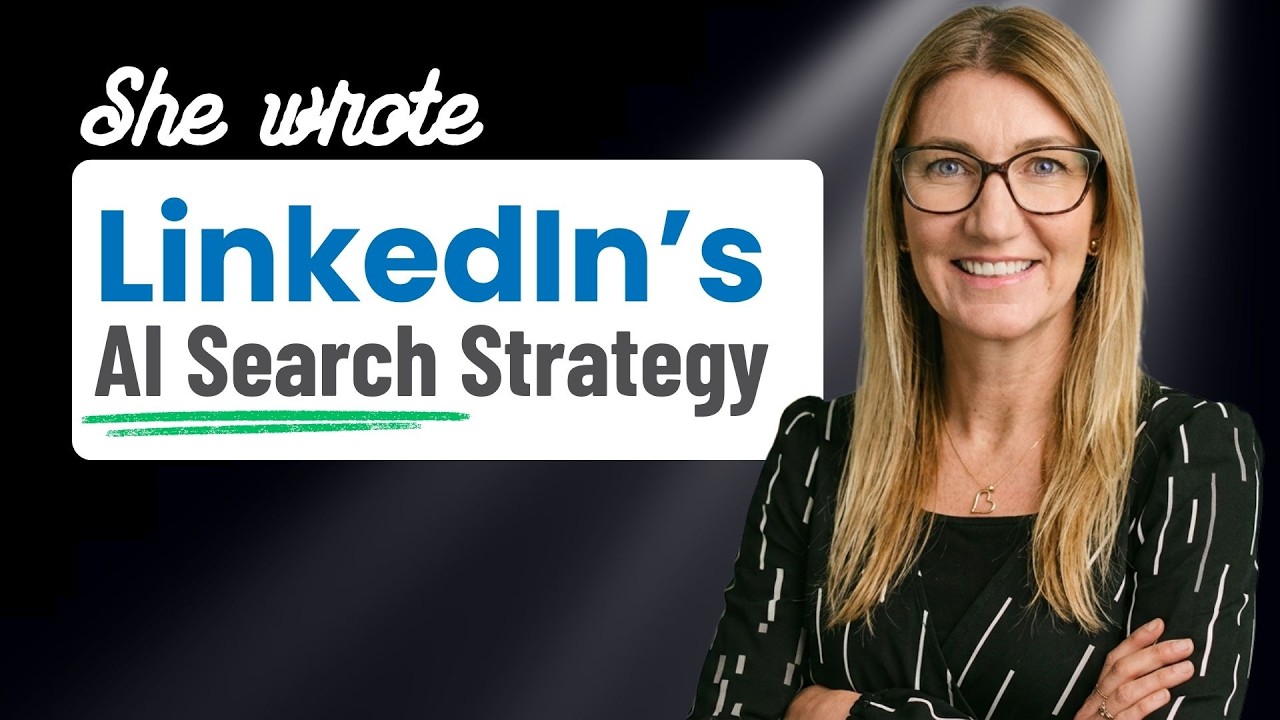
In this Executive Signal Podcast episode, host Raj Khera interviews Brooke Weller, LinkedIn’s AI search strategist, about the company’s internal approach to AI‑enhanced organic search (AEO). Brooke explains how LinkedIn audited its declining organic traffic, formed a cross‑functional AI Search Task Force, and built an internal content guide that reshaped pages, added FAQs, schema, and .txt files to improve LLM visibility. She details practical tactics such as repurposing sales calls into LinkedIn articles, creating comparison pages, leveraging long‑form articles versus short posts, optimizing post URLs through first‑line text and hashtags, and using LinkedIn’s metadata fields. The conversation also covers the importance of executive and employee advocacy, the role of paid promotion, and a suggested 90‑day plan for companies of any size to boost AI‑driven brand citations. Throughout, Brooke emphasizes that AI search does not favor large brands; smaller firms can win by providing machine‑readable, question‑answer content that aligns with customer prompts, and by ensuring brand continuity across all digital assets to prevent hallucinations.
Chapters
Buyers are asking AI who to trust before they even speak with you. If you're not part of those AI conversations, the deal's gone before you even knew it existed.
The best part about how LLMs work is that it doesn't discriminate. It doesn't favor the big companies. You can be a smaller company and you can get in. In the same conversation, you just went through 2 funnel stages that usually take months, and now it's taking days or maybe hours.
Welcome to the Executive Signal Podcast. My name is Raj Khera, your host. I've built 3 SaaS companies, sold them to publicly traded firms, and today I welcome Brooke Weller. She is LinkedIn's own AI search strategist. She's the person who built their playbook and she shares it with you.
Every week you should go and grab 7 different sales calls and just turn those into a LinkedIn article.
Let's say you had an executive that would give you, say, an hour a month of their time. What's the way you spend that 1 hour with them? Welcome to the podcast, Brooke. How are you?
I am doing great. How are you?
I'm fantastic. I'm excited about this conversation because there's a lot of companies that are still trying to figure out how to get inside AI answers. AI visibility has— is so important now. There's a lot of data showing that that's where people start their conversations. So you developed the AI strategy for LinkedIn. Tell me what you did. Walk me through how you evaluated where LinkedIn was in terms of AI visibility so that you could create that plan going forward?
Sure. So it, it, it may be a longer answer because it's not something you can just walk into, in my opinion, audit and be on your way. Although auditing is a great tool, which I did when I joined. I saw an opportunity immediately when I joined LinkedIn and The reason being is that we had, they had seen a drop in traffic from traditional organic search. And the team that I joined was the organic web, organic search team under Ina Mecklen. And when I joined, at first I was, you know, the shiny new thing and, you know, hey, we're, I had put out some things on LinkedIn as far as AI search goes when it first became, you know, started getting traction in the industry. And I, I have a background in all media, right? So I started out in building websites and then that led to analytics, which led to SEO. Then I joined an agency and tied that to paid media, went through paid media, paid social. And my last role before I left the agency world was SVP of media and analytics, and that covered everything, content, paid social, organic social, SEO. It covered all of analytics, trying to figure out how to, you know, look at multi-level attribution. And I'm saying all of this because I think that every single one of those different practices is in digital marketing. They're all so important right now for AEO. Mm-hmm. And so, when I joined LinkedIn, I came with this background, And a different perspective than their current organic search team had. And you can imagine that, you know, massive company, you know, there's very, there's very clear lines between this team and this team and this team. And the, the thing that I will tell you about AI search that's different than SEO, in my opinion, is that you have to figure out how to break down those silos. Mm-hmm. Because you need the social team, you need, you know, you need the social team to be launching content. You need to align your messaging as a brand to what your customers are searching for or prompting. And so when I first joined LinkedIn, it was a lot of, it was a lot of retraining, if you will, and having these conversations about what it's going to take to establish an inside AEO practice. And at the time, of course, we have no idea what to call it, right? It's like at that time, I think it was GEO and we landed on AI search as a group because we wanted to, again, encompass all of these different search practices and digital marketing best practices. Welcomed with open arms across the board at LinkedIn. And I think that had a lot to do with Cassie Dell and Ina Macklin. They're just incredible advocates of the program and of their employees. what I was able to do is just meet with all these different groups and talk. Ina created what we call our AI Search Task Force, and that pulled somebody, it's almost like a tiger team. It pulled individuals from each discipline into a conversation about AI search. And that, at that time, we were just spitting out industry updates. We were, you know, following the, you know, hardcore SEO people that were you know, going underneath the systems in a, under a microscope and they were finding like the technical side of how LLMs work. And then, then there was the mark— generalist marketers that were like, oh, hey, I, I, I manage Reddit or I manage, you know, the, the reviews or social. And so those people had like an opinion and I was just collecting, collecting, collecting. I looked at what tools we have because at that time it was almost a year ago that I joined, um, the LinkedIn organic web team. And we, we were at a point where they had tested tools, but we weren't exactly sure what these metrics were. And I talk a lot on my own LinkedIn profile about measuring AI search because, I mean, a year later, it's still very loosey-goosey as far as measurement goes. And digital marketers, like, what we thrive on numbers, we thrive on results, we thrive on data. And, you know, now it's very hard to map back like what's happening in an LLM response with a prompt, and the visibility is limited. I've probably tested every AI visibility tool there is, and so I can speak to what the data is and what we're missing as a world in AEO and what you have to do very manually or use AI to do to extrapolate the data you really need.
I think one of the things you said is very interesting, and that is at a large organization, people are in swim lanes, but the strategy behind getting found inside AI crosses swim lanes. I like that LinkedIn pulled in people from different teams. Is there a specific type of person that you bring in? What's it like? What is that conversation like?
So I think that AEO being a new thing actually opened a lot more doors. And, and people see this all over the industry. It's either companies are either appointing their SEO person to become AEO and some are resisting it. And then there's other people within the org that, again, they're hand raisers and they're like, I'm just in the industry and I'm interested in what's going on. And so they're like, oh, this might have a piece of my discipline.
Right.
At a larger company, it's more, it's actually more of like a budget line item discussion. Yeah. It's like, if we're gonna go and do this, like, where does the funding come from? And when I first joined, it was testing, and it was testing things we didn't know if it would work or not. And so, I think that was the, again, I credit Ina Mecklen all day because she rallied the team, she rallied the company, she advocated everything we were doing that first 3, 4 months that we pivoted. And she, you know, she really was a cheerleader of the program. And so that made, it was almost infectious. That made people within the org interested and excited and, you know, giving the whole SEO side of it like a second wind. And it was just refreshing. It was refreshing for me as well because, you know, obviously LinkedIn is LinkedIn. It's like the most, one of the most amazing companies in the world, but They really do treat people well within the org as well. So, it was kind of like a rah-rah moment when I first joined, and then it was like, okay, now we need to get to work, and now we need to hit these, you know, goals, and now we need to prove this out. And so, you know, after that honeymoon period, we all just got to work, and we started rolling out kind of these extensive tests.
One of the things that I've heard other people state is that getting ranked inside AI is 90% traditional SEO, and then there's a layer on top of it. But it kind of feels like it's more than just a 10% layer. And especially as you work across different teams, you've got marketing, content, comms, product, the SEO team. Some companies are just saying, hey, this is an SEO issue, let them deal with it because it's 90% SEO anyway, right? Let them learn that extra 10%. But it's much more than that, especially when it comes to executive visibility. Now, at a large organization, getting the C-suite, getting VPs involved in part— being part of that strategy because they carry so much authority and credibility with them can be a challenge. Did you also incorporate executives as part of the overall strategy? And if so, how did you make that happen?
That's something I observed. Again, I came in as an AI strategist, so my purview on that is limited, but I know, you know, what I witnessed as far as Ina advocating for us was it was actually the fear of loss, I think, that catapulted the company to be more interested in AI search, which was hey, we're losing traffic to our websites. And that was, you know, published in our first couple of blogs that we wrote about our journey.
Yeah.
And that is, you know, that's a big awareness, that's a big trigger, I think, across other companies. And depending on the size of the company, I think I disagree that AEO is 90% SEO, but I think that SEOs out there in the world have the most amazing opportunity in front of them to get more visibility within their company, to do something that's outside of driving traffic to a website. One of my biggest qualms in the SEO organic world is very rarely did the organic team or the organic practice tie traffic to revenue very rarely. And now all of a sudden it's, you know, the, the, it's harder to match that back with AI search, but it, it's a whole team effort now. And an SEO person has an opportunity to raise their hand and say, hey, I, I have ideas for earned media. I, and, and earned media now is, you know, it's all about the mention, but it used to be about the backlink. So it's, it is an SEO practice that needs to be elevated in order to be executed across an org. Same thing with content. So, you know, what I like to say is that SEO is a part of AEO. There's so many things that SEOs are good at and they're very, very smart. Yeah. But my point being is that within a large company, Or a small company, it's, it's really like raise your hand and say, here's what I wanna test. You know, companies are all about testing and raise your hand, go talk across the hall to, you know, the PR team. Go, go across the hall and talk to your social media manager is who needs to be optimizing LinkedIn now, right? Because LinkedIn is, you know, number one cited for professional queries across LLMs. So, you have to check in with your people constantly, and I do recommend what Ina did is making that tiger team was extremely valuable. Another thing that I think catapulted the LinkedIn journey into AEO is that we created this content guide internally because we had a lot of, there's so many different LinkedIn microsites, B2B, business.linkedin, business help, business, or LinkedIn help, LinkedIn Learning. And those are all under our remit. And so we had, imagine how many stakeholders were coming to us asking like, what do I need to do on my owned content in my website to make these content changes so that it's more digestible? At the time we were calling it digestible for LLMs or eligible for visibility, or, you know, how to get our content elevated into this. new way of doing things. It wasn't necessarily a new way of doing things actually, but it was more of like a retraining of content and having the question-answer formatting and making sure there's FAQs. And again, these are standard owned on-page SEO best practices, but now from a different lens and a different tracking. And so we wrote an internal content guide and we thought, And, you know, I put this content guide together because honestly, I was getting a lot of questions every day and I had my goals. And then I also, they have their goals. And so I was kind of being torn in different directions. And so I wrote this internal content guide. It was internally probably 23 pages and it caught on like wildfire within the org. And it did get attention. I'm sure this was Ina also. Yeah. elevating it up the chains, but it did get attention from VPs, from executives, and they all said, oh, this is amazing. And LinkedIn has this incredible internal, like, promotion mechanism where every month they shout out groups and teams. And so the, the web org team, the web organic web team got this shout out, which made it go a little bit more viral internally. Yeah. And then one of my coworkers, Arjit, he is kind of our AI innovation guy, and he said, well, I'm gonna take this content guide and I'm gonna plug it into AI. So he built an incredible tool that took the content best practices and basically made a tool that reviewed all of the LinkedIn pages and then came back with the best practices across scale. Schema and FAQs and everything. And so now people to this day use that tool when they're launching a new web page or they see softness in their LLM visibility score for a specific topic and a page isn't getting cited. And like, they're very forensic now about, you know, our visibility. And now they're continuing to use his tool. So it really just moved, moved outward like that. Additionally, the thought leadership team was, you know, said, hey, our, our audience is, is B2B marketers. And they took a pulse of what these B2B marketers were worried about and struggling about and nervous about. And guess what? It was AEO and AI search. And so they, Realized very quickly that we have a story here and we want to publish it. So that's where that owned guide that I created internally became an externally facing guide for all B2B marketers.
Kudos to LinkedIn for that because it's an amazing guide and we'll put a link in the show notes here. There is something that, that, that you include, and I can't remember if it was this specific guide or a different one, but there's a note that if your brand isn't appearing in AI answers, You're losing pipeline before it even begins. So there are conversations happening that you don't even know about. And I think it was Forrester or Gartner, maybe it was both of them, that said 94% of all vendor selection starts now with an AI conversation. And Semrush pointed out that 75% of people trust whatever AI is recommending. So there's stuff happening that if you are not part of that, Regardless of your company size, almost, that there's just things that you're missing out on. And so there's another stat that I found really interesting. There's research that looked at 89,000 LinkedIn URLs that were cited across ChatGPT, Perplexity, and Google, and found that LinkedIn is the second most cited domain in AI responses behind AI, a big bit behind YouTube. I think this was Meltwater study. With LinkedIn. And it found that LinkedIn was appearing in roughly 11% of all of the answers. That is phenomenal. That means if you're not publishing on LinkedIn, what are you doing? Right? So how did that, how did that shape some of the recommendations, either whether you had internally or what you recommend to other companies who might just be seeing LinkedIn as a social network for professionals instead of an amazing opportunity to publish content? What would you advise executives to, to think about?
So take a step back on that question. And, you know, you mentioned what, you know, what CMOs and, you know, what companies should be thinking about as far as AI search goes and what you just said. If I heard that as a CMO, I would be alarmed. I would be freaking out. That means what I've been doing to, to launch my, you know, what my BDRs are doing, what everyone in my company is marching towards is, is B2B sales. Whatever we've been doing for the last 2 decades isn't gonna work or isn't working. And wow, I need to get on board and realize that people are going to AI instead of my website to learn about my brand and Again, like what you said is that if you're not in that conversation, you're losing pipeline. It's so crazy. Put that, quantify that into numbers. Like think about, think about how much a typical SaaS product costs per year. Like let's just say $60,000 to $120,000 for, and that's probably SMB, that's probably not even mid-market. Imagine having that much revenue loss because you're not showing up when someone says best SaaS, best insurance aggregate software tool. And it's like all these other brands are coming in. And if you're a big dog brand and you're well known, you might not even be in those responses because the best part about how LLMs work is that it doesn't discriminate, it doesn't favor the big companies. You can be a smaller company and you can get in. And we've seen those kind of case studies out there as you research like AI search even more. And so I would be alarmed. And I know there's a lot of industry folks that are like, this AEO thing is, is, is BS. I, I don't care if it's BS or not. It's not BS because you always, as a digital marketer, you have to follow your customer. And if your customer behavior changes, you have to pivot. You have to change your marketing, your go-to-market plan to combat that. And so, like I always say, a spade is a spade, call it whatever you want, I don't care. Follow where your customer is and be there when they're asking questions. And right now, every day it's leaning more and more, more people are using AI to have these conversations and there's a proliferation of types of AI out there. And so you can't just like optimize for ChatGPT anymore, you have to think about— How do people interact with Claude? How do people work? How do people talk to Siri? How are, you know, how are they, how are human beings discovering brands? And now you have to worry about how are these AI agents discovering brands as well, because humans are using AI agents, AI agents are going and discovering brands. And so you have to make your content machine-readable as well as attractive for humans. You have to, you know, you really have to change your strategy. So if I could stand on a mountain and scream out anything, I would be like, take this seriously. Now I'll answer the second part of your question, which is where LinkedIn fits in. Before AI search, people were doing business on LinkedIn. People were doing big business on LinkedIn. If you talk to people who have any company that has put a real effort into building out their LinkedIn, they will tell you that they drive sales from LinkedIn. So now take that in everything you're doing on LinkedIn, amplify it, keep doing it, do more. Don't just— I, I worked at an agency where I had 65 clients at one time, and I would look at their LinkedIn and, and other social media channels, and I would see huge discrepancies between what their, even their company pages are saying versus what their website says. I would see the conversations around LinkedIn. I would see their competitors that have, that are posting in their, in their, their, their employee advocacy program was amazing. And I would tell them time and time again, you have to increase and update your LinkedIn. This is an amazing opportunity for you. GovTech, fintech, HR, recruiting, all of it. Like, It's, it was so amazing. This is before AI search. Yeah. And I would find crazy discrepancies across people's LinkedIn. So if anything, another alarm bell goes off and you're like, let me just go ahead and check what I am actually looking like on LinkedIn, step one, and let's improve upon it and start using it as a communication tool. Not because of AI search, because your customers are on LinkedIn. First and foremost, your customers are on LinkedIn. So if they're gonna see you, your voice, your brand needs to be, you have to have brand continuity. You have to be consistent in what you're talking about. You have to create these categorical entities, if you will, where I might have 5 different services that my company hits or solutions of problems people have. You need to talk about that on LinkedIn. You need your customers to talk about it on LinkedIn and advocate for you. And you need your employees to talk about your products as well. And it's just so convenient, in my opinion, that doing all of that will also help you in your visibility in AI search. So,
yeah. I noticed, I noticed a big change when I started becoming much more active on my posts and really talking about one specific type of topic. But every now and then I would pepper in, I guess the term for it is origin story. And every time I posted my origin story, I mean, that would get a ton more likes and all that if that was a metric I wanted to chase. But the real value was when I posted thought leadership content, how-to content, instructional material, trends, analysis of trends. And it wasn't so much that people were engaging with the content online. But Brooke, when I went to networking meetings, people would come to me and say, Raj, I love that post that you put out about how to do XYZ. And next thing you know, we're having a deep conversation. It's kind of like we just picked up where the post left off. And I look back, they didn't click like, they never commented, they didn't engage. And this happens all the time, especially with executives, because I find that sometimes very senior executives don't actually engage with, with posts. But sometimes they really do when you hit a nerve. And I remember one post I talked about, which is when about a year ago, so many people were— Gen Z was very worried, or they still are, that AI is taking jobs away. And I commented on it as a parent of 2 Gen Zers who are in their 20s looking for jobs. And so it was a completely different perspective, but The CEO of a $1.5 billion company also started engaging. It is amazing the people you can reach when you post something genuine and authentic.
Yes. And I'm clearly drinking the Kool-Aid at LinkedIn. So, you know, don't let me be the one to sway you to do more on LinkedIn. Just look at the data.
Yeah.
And on that note that you just said, so That, that means people are doing their research on LinkedIn, right? But more so, I would say the research and the sales cycle and the, the entire funnel that's, that a customer goes, you know, the marketing funnel exists because that's actually the buyer journey. Yes. So, Marketing 101, um, we, we track the phases a, a buyer goes through when they are adopting or making a decision, and it starts with Learning about the— it starts with identifying you have a problem that you need a solution for. So that's phase 1. And then the next phase is, what do I have? What brands or what, what am I even looking for? And in that phase that you used to take months, especially for SaaS purchases, used to take months to figure out every single feature of every competitor. Get on a demo call with every single one of those vendors. Then you have to go and manually put together like your pricing analysis and your feature analysis, and you have to figure out, you know, is this right for my company? Can we afford it? You know, what are we losing if we gain this? And then at the end of the day, you have a consideration set and you choose and you make a decision, and that then you go into negotiation and that part takes a long time, and then you have a sale. So thinking about, again, the mind of your customers is so important. Now they're going to an AI agent and they're saying, step 1, I have a problem, and they're telling the AI agent what my problem is. The AI agent is moving them into the consideration set by recommending brands in what we call a top-of-funnel query. So now the LLM is saying, I got you. I got you. I'm going to save you some time. Here's the top 15. Sometimes it's a long conversation, and so there'll be a lot of citations. Citations meaning when AI recommends a brand when you're searching for, when you have a need. So now it's saying, I got you. Here's your consideration set. And so in the same conversation, you just went through 2 funnel stages that usually take months, and now it's taking days or maybe hours, like I have conversations with my LLMs where I am talking to it for a month and I forget about it and I come back to it. And so we need to be thinking about where the brand fits in that conversation, which I know we'll get into later with the conversation funnel. But what I mean to say is what you— to amplify and echo what you said is this buyer journey is shrinking. And it's a blessing and a curse, right? If you do it well and you leverage a tool like, or a platform like LinkedIn, and the LLM is pulling in like, here's what people are saying on LinkedIn, here's what people are saying on Reddit, here's what people are, you know, here's something I came up with on my own. Now you have this consideration set, and the next question people are asking is compare them to each other. And so you, again, these are huge, long, arduous steps in the B2B buying process that are shrunken down, shrunk down to minutes or hours. And then you walk away with like, hey, put this into a formal document for my CTO and make sure to include XYZ, XYZ. So now here's the problem for brands. Maybe you show up in that top of funnel query or prompt. Maybe you're in that consideration set. But when you ask the LLM to go and get all the details that you need, if you don't have the details accurate across all of these different platforms, that's when the LLMs hallucinate. And what you will get is the LLMs talking about your brand in a way that you don't want to talk about your brand, or it will pull pricing that is outdated from a Yelp page or Capterra that you haven't touched in 10 years. And so when we talk about, and I profess like on my mountaintop, like digital AEO is good digital marketing and you have to have brand continuity. What I mean by that is go across all of these entities and fix what's broken first. Make sure that your brand is being, You control how your brand is being spoken about because that's what's gonna be pulled into the LLMs. So when somebody grabs that price sheet and says, Claude, spit it out into a PDF for me, you wanna make sure that your brand is accurate in that list as well as top of the list.
Yeah. Oh, so many golden nuggets. Thank you for sharing that entire plan. That's a really good plan, uh, to get going, almost like the first steps in your marching order of what you should do. Because LinkedIn's content gets cited so much inside AI answers, AI responses, I think one question is going to be, well, should I post an article on the LinkedIn Pulse newsletter? Should I just do a LinkedIn post? Should I reshare? So Semrush did a study on LinkedIn visibility and it found that long-form articles, the, the, the between 500 to 2,000 words, account for almost 2/3 of all of the cited LinkedIn content, whereas the posts, which are between 50 to maybe 300 words, make up about a quarter and then only 5% for the reshares. So when you look at those distributions, how should teams balance long-form articles and short-form posts when they consider creating content that's going to help amplify their brand inside AI?
Well, I would think of LinkedIn as a secondary owned platform, and I would write content in my newsletters. I would create a newsletter, and every time as a company I write, you know, my email that goes out to my patrons, or, you know, I'm gonna send a newsletter and say, here's what's new in the company, or, you know, here's the research that we just did. Um, you know, you can take, you don't have to start over from scratch and think of LinkedIn as like a brand new channel that you've, that you have to hire someone to like build out. You can use the content you are currently giving to your customers. Um, a, a really great place to find content, especially for LinkedIn, is your sales team and recorded sales team calls. So,
yeah.
That the data, the questions people are, your customer, your prospects are asking on a sales call. Yeah. And the sales team's response should, every week you should go and grab 7 different sales calls and just turn those into a LinkedIn article. Because what we know about what is pulled into LinkedIn, cuz we've done extensive, our FinStrat team or our, our data team has done extensive research into, you know, what gets cited and why. And it's like education content, how-to content, like voice of the customer, your own unique narratives. Only your company and only your brand can talk about it. That's the uniqueness is what's getting pulled in. And I have an opinion, and this is not a LinkedIn opinion, but I think it's because, you know, by this point the LLMs have like seen the whole world and they're like, okay, great, amazing.
Yeah.
But what people are asking their LLM, they're saying today, 2026, last week, this week, and the LLMs, they're trying to grab onto something new that hasn't already been regurgitated. Yeah. And that's why posting regularly on LinkedIn, it gets you into those conversations where people are asking specifics about a niche industry or people are asking for education. You know, for something that's not already in the, the training data or whatever that these LLMs are pulling from. And so that's why I think it's doing very well. Again, that's not an official product, like, you know, secret. It's just my opinion as far as the trends and what's happening with LLMs. But take your emails you're sending to your customers, take the content, take a phone— I mean, Yeah. You are gonna take this podcast transcript and turn it into an article and you're gonna post it on your website. You should also post it on LinkedIn and you should link to the guide that you just mentioned and you should, you know, cite the sources in there. And you know, all of that is helping with reach and engagement in platform, but it's also gonna help, you know, put your article at the top of a list when someone searches for AEO expert or You know, some of the questions you're asking me, even the Q&A that you sent me prior to this, put, turn that into a LinkedIn post. Here's what I asked Brooke Weller and here's how she answered. Like, there you go. Question, answer, question, answer. You are asking me the same questions every B2B marketer wants to answer. So that makes great content. So there's a lot of ways you can repurpose what you're already doing. And post it on LinkedIn and, and have it show up in LLMs.
Brooke, this is such golden information. I appreciate it. And yes, this will absolutely be turned into an article. In fact, that's one of the things that our tool does is helps take prerecorded information and turn it into this kind of stuff in your authentic voice, because there's so much training that goes on the backend. And what I like about building this particular product is, um, it allows me to keep my engineering hat on and also my marketing hat, which I love doing as well. So. Very fun stuff. I mean, what a time to be alive, right? But pretty neat. There's, there's something that you mentioned in your guide. And as we keep going and building out this 90-day plan, if we call it, for executives to figure out what they should be doing next, you stated that you're seeing month-over-month increases in brand mentions and citations after you restructured your content. Now, you spoke about your internal tool that you built to help evaluate the potential of of content. What exactly are you doing? Is there a specific team that's taking content and modifying it? Is it now everybody's using your internal tool and they're kind of making their own content by themselves? How long does it take and is it resulting in a step increase or a moderate increase? A lot of questions there, but you get the gist of where I'm going with it.
Um, yes and no to your answer, and I'll explain why. So yes, we saw lift when we changed and updated content. Um, I think that's baseline though, and that's why I said no, is the, the baseline is to, you know, and if you were gonna put a 90-day plan together, I'd be like, make sure your house is, is in order right before you go out there on the street and sell your products. So looking at all of your pages, looking at how your pages come together to form sort of these entities, I like to call them category entities because that's what LLMs love. And if you're in SEO, you know, like categories are huge when it comes to building websites and pages for, you know, like on-page content. And so think about your products, your services, and work through those pages. For us, again, this is my opinion. LinkedIn's microsites and blogs and product pages are all very well designed. So from a visual standpoint, like they're really well designed. There's nice imagery, there's nice, you know, there's a nice customer journey flow or user experience. But what those pages lacked was the meat and potatoes behind what it was, what they were talking about. And that's what we did first. We went through all of the pages. We said, what is this missing? If I were an LLM or a human, what information am I not getting from this page? Is that information somewhere else? Can we consolidate pages? Um, we actually went through a huge page consolidation where we, you know, chopped off tons of pages that existed. And that was a huge risk because that, you know, we were already— they were losing traffic. We were worried about, you know, total pages, but it was like the right— we knew it was the right move. And again, this is Cassie Dell's, like, you know, she's, she's very much a genius when it comes to like how all the microsites work together and what the right thing to do is. But, you know, we narrowed down that content and then we sharpened our content and we made it very reflective of what customers cared about because, and we knew that because we were using AI visibility tools to reverse engineer and find the prompts that our competitors were showing up for. And so if your competitors are showing up for questions like, XYZ, and then you look at your own webpage and there's nothing on it that answers those questions. Like all of a sudden it became a game of how can we insert some content that flows naturally with what we already have and then use it to have some gain. So we added FAQs to a lot of pages. We saw a huge lift from that. We actually, we, there's so much controversy out there about schema and llms.txt files. We saw a lift, we keep seeing a lift, we keep improving schema, we keep improving the metadata, we keep, you know, we, we added the, the .txt file, we saw a lift. So that's us. Again, everyone, that's the other hard part about AEO is like what works for us doesn't necessarily work for everyone. But again, if your 90-day plan has testing and learning And you, you do something on a couple of pages that works, then the next round of the testing, you roll it out more globally, basically. And that's what we did. So, um, that's to answer your content question is it's now a, and it, it was always a, a best practice, but in a different way. Like we did change content for AEO specifically. The SEO team has been working their butts off for years and years to make those pages rank for SEO. And so there is a slight difference, I think, in the approach there. But I've seen in the industry, most SEOs and most content editorial teams are realizing that and going forward with that. A lot of teams don't necessarily want to make all of their pages be these question and answers because that doesn't, it's not really attractive to humans in that format. And so Sometimes you'll have like a really nice blog that is like your brand's blog and your brand's voice. And then you'll also have some other pages nested within your products and solutions that are more geared for LLMs. And both strategies work in for different ways. Again, you're writing for humans, but you're also writing for machines right now.
And I know that what you mentioned earlier about the comparison pages, for example, We saw a dramatic lift instantly when we put comparison pages out. And I think a lot of companies are a little leery of saying, well, I don't want to mention my competitor on my site as somebody to even consider. But what we found was, it doesn't matter if you think that or not, people are typing that into AI. And so if you don't want to help influence the narrative, all right, stay quiet. But if you really want to change how, as you pointed out, prevent AI from hallucinating about you when someone asks that question that they are asking. You really need to shape that narrative and producing these comparison pages made a big difference. One of the things we tried, and it worked really well too, and this is good for AI companies because almost inevitably if you sell a product that is AI native, somebody's gonna say, well, can I just build it in ChatGPT? Can I do it in Claude? So we What we created were comparison pages with Make Media versus Claude, Make Media versus ChatGPT. One day later, I went to go look online to see if we were ranked and we were already being cited in those AI responses. Took a day. It was so fast. And now, and this was months ago and we're still ranked because I think AI citations over time do drop. But those comparison pages, they seem to have a lot of gravity to them. So thanks for that part of the strategy. I think it's really very helpful. What other kinds of content are you looking to— should people consider to generate visibility inside AI responses? Videos, infographics, carousels. Do they make an impact?
On LinkedIn?
On LinkedIn and also for getting found inside AI visibility, AI answers.
But you mean LinkedIn content?
Correct. Yes. Posted on LinkedIn.
So when we evaluate posts, you know, that the stats that you shared for posts and articles, those include posts that have documents or carousels. I don't remember the exact specifics, but in that AEO guide, We, that just was just released recently. It's a more extensive practitioner's guide, if you will, to actually executing the content on LinkedIn. And I know that it goes through how many posts with video versus image and carousel versus document. Like there's a lot, there's a lot of really good stats in there. I didn't memorize them, sorry.
Yeah, no worries.
What, what, what I'm, what I did, we did internally because we were testing LinkedIn for ourselves is we had all different types of posts running and, um, we called it customer zero testing because we were the customer testing LinkedIn to see if we were able to show up. And something that we got really deep into the rabbit hole on was like how these post and article URLs are created. And it's one of the coolest features of LinkedIn, in my opinion. And basically, LinkedIn is handing you a golden ticket to update your URLs because LinkedIn could have— they could make your post URL like linkedin.com/xyfjtw and not include your full name and not include your full title of your post, but they do. And I think that's another thing that's very attractive to search engines as well as LLMs is that you can use— and again, SEOs have been doing this for a really long time— you can use that URL syntax to your advantage by learning how those URLs are generated. And they're auto-generated. As soon as you click post, boom, you've got a URL. Something that I'm speaking at Brighton SEO next weekend, or maybe it's in 2 weeks, but something that I'm going to talk about in Bright— at Brighton is the ability to control that URL. So if you write an article and you don't use hashtags and you don't, you know, post it with an image, that first line of your post becomes the URL. So that means that And I think this kind of thwarts people that are using, doing AI slop, by the way, because a lot of those webs, a lot of those posts that start with like an aggressive hook, those aren't going to show up in LLMs because they just don't have any real content in them. And so the LLMs are rewarding authentic content like yours, your narrative or your story of your examples of what you talked about. That's your unique voice and that is sustenance, right? And that's why the LLMs are pulling that type of post in. Whereas if you say like crazy, crazy whatever post, that becomes your URL and it's just really not worth anything to LLMs.
Yeah.
And it doesn't map to any customer questions. And so if you look back at a lot of my posts, sometimes I use a hook, but I've been testing and we have other people out there testing this on LinkedIn, but You know, testing the URLs and what first line. So when we posted our guide online, our thought leadership team, the first line of the post was often, you know, how to use LinkedIn for AI search or how to leverage LinkedIn for AI visibility, how to optimize LinkedIn, first line of the post, because that's the question people are asking in LLMs. And then the post should answer the question because again, the LLMs aren't looking for questions, they're looking for answers. And so your post should answer that question. Another hack, or if you will, I probably shouldn't say hack. Another expert tip is that you can use hashtags. If you have hashtags, it actually disrupts the URL syntax. And so if that, if you're trying to use a first line of your post, methodology, but you use hashtags, LinkedIn defaults to the hashtags. And so instead of using a hashtag like Make Media #2026 #We'reAwesome, like that's not going to be great, a great URL. It's gonna be Make Media 2026 We're Awesome. And that doesn't, that's, again, not valuable to LLMs, but if your hashtags say make videos from your content automatically or use AI to make your videos, like use your hashtags like that, that becomes your URL. Yeah. So people can really like construct their own URLs and like if you do that for a month and your articles also, the content of your articles is reflective of those hashtags and everything is kind of becoming this like purposeful category entity, then your articles and your posts will be cited for in LLMs for the topics that you're talking about.
So that's a very useful tip. Are you suggesting the hashtag should go to the top of a post or at the bottom?
Doesn't matter where they are. They disrupt the URL no matter where they are.
Okay. Interesting. So even if you, if you publish an article, say for example, uh, on LinkedIn Pulse, the newsletter, and you put hashtags on the bottom of it, those hashtags will default as being the URL.
Actually, it doesn't work on articles that way.
Okay. Just for posts.
It only works on posts, but, um, but an article, the title of an article. So every time you post an article, it turns into an automatic post. Have you noticed that?
Yeah.
When you're posting an article, there is very specific SEO there. There's like a whole section that you can fill out for SEO in your article. And those are, that's like metadata of your article. So again, think about your LinkedIn as another owned content entity or piece and fill those out. And then the title of your article. When, when it gets reposted, the title of your article becomes the URL of the post.
Let me zoom out. Let me— that's a good, good tip too. Let me zoom out for a second and ask who should be posting, because I think a lot of times the larger companies, they have teams that would be creating this kind of content. I mean, for a smaller business, it makes sense. Typically the owner or like the executive level team would be posting it, but for a large company, Should, should they have a company newsletter or should they, the executive team, each of them have their own newsletters and articles? What's the best practice here?
I recommend both, but I know that a company newsletter isn't probably going to get a lot of attention. And, and, and I don't know if this is true or not, or the reason why, but I think company pages is like only 9% of total LinkedIn, you know, slash LinkedIn, linkedin.com slash that gets pulled into LLMs. It's really more about the employee voice that is getting published. But I guarantee you that LLMs are looking at it, all of it, and making sure that it's a cohesive, you know, uh, point of view, in my opinion.
Okay.
But
yeah.
But employees talking about brand, the founders talking about it, like those go really far. For us, B2B, we have individual product B2B showcase pages in our business pages, and those do really well for us for citations. So I don't think that our numbers are the same as like the overarching stats, but they're close. But we do see success with Pulse articles that are written by our showcase pages, essentially.
Okay. Now, the way I found you was through a webinar you did, excuse me, a livestream you did with Ina and with Cassie. And I found it 3 months after you went live. And it was because LinkedIn had promoted it. And so, can you talk about the value of paid promotions, whether people should be amplifying or paying for boosting posts or specific articles? What's the value in doing that?
I think that if you were to, you know, want to put marketing dollars behind posts, I mean, I, again, I have a paid media background, so I live and, live and died in LinkedIn Campaign Manager and ran thought leadership ads and boosted posts all day. And so there's value in that, right?
As we close out here, I have one question that I think a lot of people are Wondering about, and that is, gosh, I don't have the time to do everything you discussed. There's so much here. And maybe they don't have the teams or even the buy-in that you had at LinkedIn. So let's say you had an executive that would give you, say, an hour a month of their time, because executive thought leadership, I think, is huge. What's the way you spend that 1 hour with them? What do you do?
Record a Q&A.
Okay.
Yeah, record a Q&A. Ask 'em how they started the company. Ask 'em what their, what is their customer pain points? Ask them, um, what questions they're getting from customers. Ask them, uh, you know, specifics. I think, I honestly, I think the founder journey and the founder stories are gonna become more and more valuable as AI slop outside of LinkedIn is bad as well. And These LLMs are pulling articles written with AI, and then AI is pulling AI into AI, and then somebody is learning from AI. And so like this, the distillment of actual unique knowledge pool is getting smaller and smaller. And therefore, I think that uniqueness is very important. So I would, I would interview. I think you could take, you could get a lot from an interview, 1-hour interview with your CTO or your CMO or your CEO. So
yeah, I think asking the right questions is the biggest thing. And actually the way we did this conversation was Make Media has its own agent that does this kind of research. And in about 30 minutes after entering the information I was looking for, it created a docket for Brooke for me. So it helped do all the research and I got what was like a Steve Bartlett Diary of a CEO type of docket ready to edit and tweak. So Brooke, thank you so much for your time. It's very enlightening. Thank you. Loads of tips, and I look forward to hearing more from you, especially following your, your newsletter on LinkedIn, which is very impressive. Thank you so much.
Likewise. Thank you.
If you enjoy this podcast, please click like and subscribe to this channel and take a look at some of the other options that are available to watch right now.
More from Raj

Consultants and Fractional Executives Are Landing Lucrative Deals With This System

He Grew His AI Startup From 0 to 2,300 Teams - The Content Strategy That Crushes