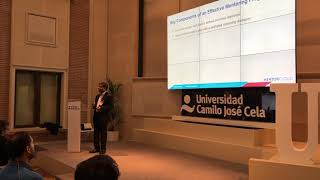
Dr. Ravi Gundlapalli’s recorded keynote at the 2019 International Mentoring meeting in Madrid promotes a platform-driven, boundaryless approach to mentorship. He defines mentoring succinctly as "sharing and learning," links mentoring to mentors' desire for significance and mentees' pursuit of success, and argues programs must be cross-functional, cross-hierarchical, cross-generational, and cross-location. He emphasizes practical program elements—executive sponsorship, clear communication, mentor/mentee skills training, smart profiles/matching, communication/scheduling tools, regular check-ins, recognition, and analytics—and presents Mentor Cloud (a white-label mobile platform that uses IBM Watson for matching) as an implementation. Personal anecdotes (14-hour travel, first mentee a blind student who graduated MIT in 2015) and a book giveaway (The Art of Mentoring) punctuate the talk.
Questions this video answers
14 hours
"Sharing and learning"
The Art of Mentoring
IBM Watson
A first mentee, a 16-year-old blind student, graduated from MIT in 2015 and is now running two companies.
Chapters
Good morning. I'm going to break the sequence of Spanish into English. So I am the one that is making this conference. International.
Says international. So I am the international one. I traveled 14 hours from Silicon Valley to be here. That tells you how crazy I am about mentorship. Anytime in the world, I hear the word mentoring, I show up.
So I hope I'll try to speak slowly. You know, Indians, we speak very fast. But today I realized you guys speak way too fast. Very, very fast. But I'm sorry, I can't speak your language. But I'm now going to work with Julio to really change the entire mentoring landscape in Latin America. So I hope by next year, or maybe two years, I'll be able to speak in Spanish. I'll learn, but I don't know if I can speak as fast as all of you. It's very interesting, but very, very glad to be here. Thank you, Julio, for inviting me. And so I'm going to talk about the platform approach to mentorship. The first thing is, by the way, I'm so crazy about mentorship. I also wrote a book. It's called the Art of Mentoring. I have few copies, not enough copies. So I'm happy to share with some of you, but I have simplified the definition of mentorship in two words. You know, number one is mentoring is about sharing what we know with the people we care about. You know, if you share something on Twitter, like some leaders do, without to anyone, mentoring is about sharing with somebody that we care about. You talked about reverse mentoring. So the sharing and caring is very important.
The second side of it, from the mentee side, it's about learning, because nobody can claim that they know everything. We all have something to learn. Today I figured out I have to learn how to speak Spanish.
But not from anyone, but from people that we trust. So whether it is mentoring or reverse mentoring, there has to be that sense of trust, because then you know the other person is sharing the knowledge with the utmost care for you. So I define mentoring in my book in all my speeches as sharing and learning. And if you think about it, whether you're entrepreneurs, whether you're early career employees and students, your life has to be a mix of both. You have so much to share, and you also have so much to learn. And I have two more words to describe it. When you share your knowledge, you are attaining what I call significance. That means your presence on the planet means something to other people. It should not be that we live just for ourselves. So I call it significance. And when you learn, you are achieving Success. So mentoring is also a combination of two individuals. One individual looking to establish a legacy, looking to give back, looking to become significant, and the other person that wants to achieve success faster.
People will eventually become successful. We talked about CEO E. So many cases of entrepreneurs getting the help they need to become successful faster. So sharing and learning, significance and success, that's all mentoring is all about.
I also define mentoring as, you know, working as one. Now you mentioned to me about ESA1 because when you bring people together, you know we are no longer living in the same building or same country. So whatever mentoring programs that you're having, whether it's for entrepreneurs, whether it's for alumni, whether it's, whether it is for employees, it has to be cross functional because that's where innovation happens. It has to be cross hierarchical. People should be able to learn from anyone, whether they are above themselves or below themselves. And also cross generational. We talked about reverse maintaining because I learned so much from my daughter. You know, how to tweet fast, how to do Instagram, how to do Snapchat, she taught me how to install Snapchat. So there's so much to learn from other generations.
It also has to be cross location because the boundaries that we see in the world today are drawn by men. But the wisdom and knowledge should not have any boundaries. Because knowledge, you know, that's why our company's name is called Mentor Cloud, because the cloud has no boundaries. It can form over, you know, Israel and it can reign over England. There is no boundaries for clouds. There should be no boundaries for knowledge. There should be no boundaries for wisdom as well. So we talked about mentoring program. Now some of you might be thinking, how do you, what are some of the key aspects of mentoring program? Because I spent many, many years.
The number one is you need a good executive sponsor in your organization. It's extremely important because it has to come from someone that really cares about it with a very clear objectives. And second, how do you communicate it? It's not about if I go to someone and say, can you be my mentor? It's like, I don't know what it is. I don't know what you're going to take from me. So how to communicate it properly, that it inspires the mentors, it excites the mentees, and you got to have a good champion. The third most important thing, which is why I wrote the book and I know that there are a lot of certification programs, is the skills of being a good mentor. And being a good mentee is not taught in any school in the world. I have spoken on all continents. No university has programs on how to be a good mentor. Because in universities, you are taught to take exams on your own. You're not supposed to ask other people for advice. But in real world, when you're building your career, when you're building your company, you have to take help of other people. So important to really train on how to be good mentors, how to be compassionate. There are lots of traits that we talk about, and I know there are certification programs that Red Day Mentoring actually runs. And second thing is you got to be able to create some very smart profiles of people so that you can match them. Because I said you got to bring people together wherever they are in the world. Because my best mentor could, could be sitting in Johannesburg or in Sydney, Australia. So we live in a world where wisdom should be available to anyone that is seeking it. Very important is to be able to match the right people, whether it is personal lives or whether it is professional lives. Magic happens when the right people come together. And it is also true in mentorship as well. When you bring the right mentor, when you bring the right mentee together, that's where the magic happens. That's where the wisdom is getting transferred. And it has to allow certain abilities to rapidly have those conversations. Because mentoring is nothing but a good conversation. Two people coming together and saying, okay, what are you looking for to achieve? What can I share based on what I have learned? So how do we catalyze those conversations and conversations leading to relationships? And any platform that you consider should have these sort of tools. And very important to be able to communicate, though it's not enough because we all use WhatsApp, but we need tools like that so that mentors and mentees are able to communicate quickly and also maintain a good record being able to schedule meetings. And you also, because it involves people, because it involves relationships, there has to be tools for sort of regular check in because you want to know, how is the mentorship progressing? Does the mentor need any help? Does the mentee need any help? So our job as so called the mentoring champions, and I'm sure all of you are mentoring champions in your own organizations, you got to be able to ensure that these partnerships are going on successfully and very important to recognize people. I saw some mentors being interviewed and it's because mentors are doing this as a way to demonstrate their own leadership. And also it's also a way for them to give back. If you think about it, human race thrived because one generation passes on the Wisdom to others. There was a reason why our ancestors wrote on caves. They could have just forgot about it. There is a reason why there are books, there is a reason why there are universities. Because human beings, we are all about sharing. When you watch a good movie, we like to tell other people. When you go to a good show, we tell people same thing. So when people do that, you got to recognize them. So there has to be mechanisms to automatically reward such people because that's what mentors are doing this for. They've already achieved, they've already built companies. And when I mentor, one of the things that I found is one of my first mentee is a 16 year old blind student. He came up to me and said, sir, can you mentor me to get into mit? I was in India at that time and that goal itself really inspired me. How can someone who cannot see is aspiring to go to mit? So as a mentor, I got challenged. Hey, can I really do this? And long story short, I accepted him as a mentee. He has graduated from MIT in 2015 and now running two companies, successfully being a visually challenged person. So he taught me the difference between having sight and having a vision. I see many people in the world who have beautiful eyesight, but they have no vision for their life. Now that's what you got to acknowledge. When people come forward and say, can you be my mentor? They're giving you the opportunity to really make an impact on other people. And lastly, any program, any platform, because I represent a company called Mentor Cloud, we talk about how do you provide analytics? Because you want to see how it's going. Because when we're all in one office, it's easy to call the mentors, hey, how is it going? But when you talk about the world as your field and you want to bring boundaryless mentorship, you got to have tools that automatically give you those reports on an ongoing basis. So here are some of the sort of the effective components that I have found. So we offer a platform and it's called Mentor Cloud. And you'll be hearing more of it because I'm going to be working with him. That's why I traveled all the way to be with all of you. And I'm sitting there thinking, we need a conference like this in America. So I must say, all of you from Spain, you should really congratulate yourself for having a session like this because America is not having a discussion like this on this very important topic of mentorship. We talk about everything else except the most important thing. So America needs this more than anyone. So I'm going to take this back to our country and say we need a conference on mentorship. And the conversations that I was hearing with a little bit of Spanish I understand is just phenomenal. We talked about the mentoring for entrepreneurs, mentoring for students, mentoring in academia, reverse mentoring. This is important because America has about 80 million people who are over 60 years, people who have, since the World War II, who have built all these nuclear reactors, universities have been all those are going to retire and go away. How are you going to preserve that?
How does the country survive when all these people leave? You know, there is an African proverb that says when an old person dies, an entire library burns down because there's so much in our heads, we got to extract it. And everybody cannot write a book. And the best way is to connect them with somebody younger who is hungry for success and let them extract all the knowledge. And the beauty of it is the more knowledge I share, it all is still here. If I give you a dollar, I lose it. If I share my knowledge, it's still here. That's the beauty of it. So the more you share, you still have it. So very quickly, what we do is when we go to an organization, we offer a platform and one of our customers, oldest customers, ESA sitting here, we are very, very glad to be working with them. So we offer a private platform just for esa. Because I talked about trust. If you also went to esa, if I went to esa, there is the trust, right? So trust is important and being able to care is important. So we offer a white label platform and we offer sort of profiles and we use the world's biggest machine, IBM, Watson, to match. You know, matching is not done only in match.com and other so called matrimonial sites. We use the same algorithms to match mentors and mentees on our system. And it's available on the phone because all of us are on the phone all the time and the younger generation, the millennials, are on the phone a lot more. So it's available on the phone as well. And we provide lots of tools in how to be good mentors, how to be good mentees, how to deal with situations in that.
And we also offer the sort of the knowledge to make sure that your program is successful. So we work with some of the best brands in the industry and we're very proud because they teach us, because they've been doing mentoring even before I was born, but they are teaching us how to leverage technology to make mentoring global. And today I'm very proud to say that is, you know, people say, did you fly? Did you take all those flights to build mentor cloud? No, that is not my flight map. That is mentors and mentees from all over the world communicating, sharing wisdom across borders. That's the world I believe in. That's the world I want to see where borders do not come in the way of someone being able to share their knowledge or even learn from them. So with that, I have a gift. I have few copies of the book. Some of you that I get a chance to meet during the networking session. I'll be happy to share you a signed copy. And I'm very, very grateful for you inviting me. And I made this conference, once again, an international one. Here is my book, by the way. It's called the Art of Mentoring. And since mentoring is so simple, you got to do this right. If it is complicated, if it is like maintaining a nuclear reactor, then obviously you have to take the training and everything and you will do it right. Because it is simple, because it involves people, it involves feelings, it involves relationships. You got to do this the right way. So it is an art. It is not a science for the playing the tickle. So. So with that much, gracias. Thank you so much for inviting me.