Episode 11 on Reading
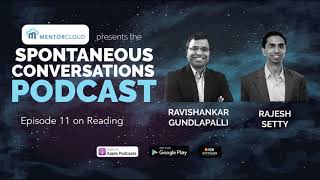
Dr. Ravi Gundlapalli and Rajesh Sethi discuss three types of reading: tactical, topic-specific foundational, and life-foundational. They argue reading builds thinking vocabulary and only matters if it changes how you act. Books like Fierce Conversations can expand your capacity to take meaningful action.
Chapters
Hello there. Welcome to episode number 11 of Spontaneous Conversations. This is Ravi Gundlapalli, founder, CEO of Mentor Cloud.
And this is Rajesh Sethi. I'm a serial entrepreneur in the Bay Area.
So Rajesh, when you asked me what topic to pick, I just looked at a book and I said, why don't we talk about reading? The importance of reading in everyday life.
It's a great topic, Ravi. And I'm sure that when you said reading, you are not thinking about murder mysteries and those kinds because that's also reading. And I also know that you didn't talk about like.
Scandals and taglines.
Exactly. Yeah, I was looking at some business books and I'm thinking, wow, how important it is to continuously feed your brain with good ideas.
Yeah, very good. So let's focus on reading. That will lift you in some level. Upgrade you. Give you an upgrade in some level. For me, you know that I read at least one book a week and I have done that for more than 10 years. Would I have done anything other than it? Probably not, because it has been such an enriching experience. And there were two or three kinds of reading that I do. One is that just tactical stuff. Suppose somebody is doing some social media. They said, have you looked at this? Have you looked at that? Maybe there is a better way of scheduling posts, something very, very basic. But that's not long standing because the tactics will change as the platforms change. Second is foundational stuff in the same social media. What about what kind of mindset should I have for winning in social media? That's the foundational stuff on that particular topic. The third kind of reading that I do is basically foundational stuff for life, like linguistic philosophy, the power of language, trasism, those kinds, how to live a good life, those kinds of things. All with that balance, I think one thing that I realized not only I feel more confident, I am more calm in my composure because.
Most people are not doing it. There are people who read two, three books a week, but that's far and few.
So you're talking about a well balanced reading. And as you're talking, the thought that came to me is this notion of thinking vocabulary. Right? So because suppose if somebody hires me to do a job, you know, like put a painting up on the wall and all I have is a knife, right. I can't do anything with it. Correct. Whereas If I have 20 tools, you know, a drill, a nail, a hammer and everything, I can do the painting job in like less than five minutes. Now if you apply take the same approach to the sort of concepts in your mind if a solution, if a problem comes up. If you have read books on leadership, books on negotiating, books on presenting, books on creativity, innovation, thinking. Imagine how many tools you have in your brain to assemble and come up with a solution. So reading, I think actually gives you thinking vocabulary that you can address. Attach anything, whether it is for a conversation like we are having today or to address a problem.
I totally agree with you and it's a beautiful metaphor, thinking vocabulary. I was always looking for something like that to describe what is the power of reading. And honestly, like you rightly said, suppose we both were not well read. Not that we are genius people, but without reading well, spontaneous conversation will be a total dud. Because where is the thing to draw from?
Exactly. I mean, where is the arsenal, right? We have read Robin Sharma, John Maxwell, so many of these authors that take you to a different world and you start thinking about this amazing concepts, like Jason Womack, one of our common friends, productivity. This whole notion of most important things is such a very powerful concept. And unless you are filling your brain with good concepts that other people are thinking, then it's all like ingredients to create a good recipe. If all you have is one all purpose flour and nothing else, how many dishes can you make?
Yeah, first of all, I can't make any dish, anything but that. Apart jokes apart, but I agree with you, it's a metaphor that you used. It's brilliant. Let me also quickly touch upon.
Reading for the sake of education and reading for the sake of entertainment in the name of education. Because lot of people say they want to have a checklist item that I read that book and I'm done with it. But if they don't act on it, if they don't reflect on it, if they don't make use of it, then it's entertainment for me.
You know, that's again interesting concept. The thought I was, the thought that your statement gives me is every book should lead to a behavior change. How about that? Otherwise you just read it didn't mean anything to you. You were Ravi before, you were Ravi after. So what have you done?
Only what you have got is you can intellectually debate on a topic which is pretty much useless because you have not done anything with it.
Correct.
Let's look at Jason Womack's book. He reads Rights for Productivity. So not only do I know a lot of productivity tools that Jason talks in his book, if I start implementing them, I actually become a better person. I'm actually better at helping other people from the behavior Change that I made in my life, that made me better.
That make me valuable. Actually, people say, oh, my God, Ravi not only read Jason's book, he's actually telling me some good things that I can now implement. And that's what really helps, is when you create a behavior change and then the value you get from it and you're able to share it with other people.
Yeah, Beautifully said, Ravi. In fact, there is one more thing that can happen. It can change your worldview. Things like how you are looking at the world can change. That means that can lead to other things in the future. Because if you read a book about conversations, how you view a conversation itself is very different. My favorite book, All Time Best, which is not very famous unfortunately, because Susan probably does not want to market it, is Susan Scott's book called Fierce Conversation.
Yes. You have talked about I should read that book.
Yeah. It's one of those books that not only changed my worldview. And you mentioned another concept called behavior change. I have not looked at a conversation in the way I was looking at it before I read the book, and it has changed me. I cannot unchange myself because now I am aware of the concept. For those of you who have not read the book, I really urge you to read it. And if I can summarize the whole book in one sentence, I'll be badly paraphrasing it, but you will get. The essence of it is, while there is no guarantee that any single conversation might change the trajectory of your life, business or career, any single conversation can. What is the conversation that has your name on it?
Yes, absolutely. I think this was one of the. In the first episode you mentioned it. It's very powerful. Every time I hear it, it sounds so.
Life changing.
Right.
Because one conversation can change, but who knows which is the conversation?
You don't know. Go ahead and pick, because you don't know. And this particular conversation we are having might be the one. So imagine the amount of respect I will provide for this conversation, because I don't know whether this is the one. This may not be the one, but this might be the one.
So, you know, because the fact that this might be the one, it is best to put your 100% in the conversation. Exactly. Instead of doing it as a very tactical thing. Okay. I'm supposed to talk to somebody. Let me do it as a regular ritual, because this could be that meeting, this could be that sale, this could be that interaction that can change everything. Imagine we also talked about the power of being in the moment.
Yes.
Imagine with this view that a single conversation can change and being in the moment to make the best out of that conversation. Oh my God, imagine how wonderful life would be.
Exactly. So now think about it. If I didn't read that book, thanks to one of my mentors, Yakov Solovechik, he almost gave it as a homework that you have to read the book. And I said, I'm not interested in peer's conversation. He said, I don't care, I want you to read it by next week. And I can't thank him enough for, for putting this book on my table because I would not have picked up this book on the bookstore because I look at the title and say, who wants to have. I'm a simple person. I don't need fierce conversations. I would not even have flipped open to see what that book is about now that I read it. It's been 15 years. I have never looked at a conversation in the way I looked at it before. And not only the worldview has changed, but the behavior has changed towards a conversation. Plus my power, which I define as the capacity to take meaningful action, has changed in a very, very big way. Because if I am giving attention to a conversation in the way I am giving, the other party will know that I have their attention.
And most of the time they are having conversations with other people and they know that the other party is not even listening to them because they are distracted. They are checking their stuff and all those things. But that has changed the way how things happen in my life on one book, Ravi.
Absolutely. And I think, you know, the power of reading is also that if I wanted to, if you wanted to speak with Susan Scott or Robin Sharma or Jason Womack, it's going to cost you a fortune and access to their wisdom. That they worked a year or two years and really put their best of the best of the best ideas into a piece of paper. I mean, it is your best investment to get access to their wisdom because it is humanly impossible to meet all these people. And some of us are lucky. I get a chance to have lunch with Jason. Get a chance. We are just lucky. But there are so many people I would love to meet, I may never meet in this lifetime, but the least I can do is read their book and improve my thinking vocabulary and become better.
You said it beautifully and you are right. Susan is a good friend, Jason is a good friend. So we are lucky, really lucky there. But even if they were not friends and we got opportunity to get their books, they have put their thinking, mind, heart and Lot of conversations they have had on the topic and finally come up with a 200 page book with their best thinking packaged and ready to be consumed. It's like 20 bucks. It's the best deal in town.
Exactly. Because you're essentially getting a concise wisdom of somebody's lifetime work. People write a few books and it's their lifetime of wisdom, of their experiences. You suddenly are opening up yourself to a library of content that you cannot otherwise have access to. Now, all of this will make sense only if you are going to do something about it.
I totally agree. In fact, because we talked about karma points in one of the previous episodes, actually many previous episodes, I always take a book if it touches my heart. I just go and buy 50, 100 copies of the book and start distributing. Because sometimes I don't know how to pay back. I know that $20 was not the right amount, but it's my own way of slightly settling the account by buying dozens of copies. Because honestly, Ravi, the books that become very famous, many of them are not really good books, but they are really marketed very, very well. But the books that are really good books, unless the author is saying, I am going to market like crazy, they are not going to become very famous like a book like Mastery. It's not like the best seller, it's one of the best books. That is fierce conversation. Not very best seller, not a big best seller. But it's something that everybody has to read. So I always think that it becomes my duty to go and change the equation in some form or fashion.
So we both agree that in the white space that we're going to create for ourselves, it is very important to read good books that elevate our spirit, that elevate our thinking, that elevate our worldview, our whole perspective towards life. And then if that can also lead to a change of behavior that leads to something exciting, that's where the power of reading is.
Yeah. And the last one I always want to add is it can increase your power. Power in philosophical terms is the capacity to take meaningful action. Suppose something took you one month to do it. With all the reading and learning and conversations and everything, it only takes 15 days. You got 15 days back in your life.
Yeah. You know, it's a very simple thing. Right.
It's impossible for you to know everything about every topic in the world.
Yes. Right.
But, you know, last week I was on a webinar by Jason Womack and he taught me how to create, to do lists. I have been doing to do lists for eternity. But this guy has spent so much time, has given me his technique in like five minutes that has done wonders for me. So if I am wise, the best.
Is maybe you can share a little bit because that webinar may not be accessible now.
Absolutely. You know, like one thing that Jason says is you should always have a notebook because when you're writing, taking notes, and I take a notebook, you take a notebook. But he said all the to do lists right on the backside of the page. Because always write only on one side of the page, any notes. And all to do lists are only one side. So when you're going back and looking at your to do lists, you don't have to search, they're just there. They're always there in one place. And the other beautiful thing he said is he said have some note cards for, for six or seven people that you normally interact with. And anytime you have let me ask Rajesh this question immediately write down the piece of card. Ask Rajesh about this because there is no reason to ask at that particular moment because you are going to interrupt him. So at the end of the day, ask these five questions. The problem with texting and Skyping and everything is we interrupt each other and destroy productivity on both ends.
Beautiful. That already is a powerful tip that I can put to use immediately. Exactly.
So this is the power of reading is that there is no way I could have discovered it on my own with my own energy or intelligence that God has given. So the power of reading makes you infinitely intelligent. And I've heard from experts over and over again. There are people who read one book a day. And the people like Terry Gross from NPR who does Fresh Air, she reads two books a day.
This person on NPR that does forum in San Francisco called Michael Krasny, he reads 400 page books in a day. And when you hear them speak.
You are kind of attracted to them. The words they use, the passion they have, it's all because they're well read.
Beautifully said. Until you told me this, I was feeling very good about me because I read one book a week.
Suddenly you cut me to size and made sure that where my place is. Thank you so much for that gift.
Yeah. I want to end this with a quote from Mark Twain that I am again reminded of. A man who does not read good books is no different from the man who does not know how to read.
Beautifully said, Ravi. So my closing comment is very simple. I think it's like a no brainer that people have to read, they have to read good books, they have to take action. They are to take action. The comment I wanted to make was they want to take action very quickly to make the most out of what they read, either by themselves or people that matter most to them. Let me double click on it and I say that suppose you read something really good, immediately you write it down. Then you start thinking, who in my network will benefit from this because they can't read all the books. There can't be many Michael Krasnys who will read 400 page books in a day. So we know the limitation that we have and our network has. But we took the time to read the book. So we take some one or two highlights and immediately start thinking, who are 10 people that should benefit from this? Whether they like it or not? We say, I read this book. Here are some things that I thought were relevant because of blah blah, blah. And immediately either you increased your power to take capacity to take meaningful action or you increase the capacity to take meaningful action for other people and you.
Become incredibly valuable in your network. People look at you as an expert saying, he's not only consuming, he's also kind of distributing.
Totally agreed. Totally agree.
So with that closing episode number 11 on spontaneous conversations. Thank you so much. Please provide your feedback. And again, we pick these topics literally 5 seconds before we hit the record button.
So thank you for listening. Find more about Ravi at mentacloud. Com.
This is Rajesh Seti signing off. More about me on my blog, rajesh.com blog.
More from Dr.

Essentials of an Entrepreneur by Dr. Velumani Arokiaswamy, Founder of Thyrocare

Skills & Traits for Better Employability | Amritkaal Mentors – An Initiative by MentorCloud

What Leaders Look for First-Time Job Candidates | Amritkaal Mentors – An Initiative by MentorCloud

How to Innovate and Lead Wisely in Today’s World with Navi Radjou - An Initiative by MentorCloud

Crafting Your Academic Journey with Dr. Manish Kothari - – An Initiative by MentorCloud



Advaitha Jagruti: Awakening The Spirit Of Adi Shankara In Indian Youth | Dr. Ravishankar Gundlapalli

Testimonial | Sanjeev Sharan | Catalyzing Growth From Within | MentorCloud Mastermind

How to Make a Mentee Feel Comfortable #mentorcloud #mentoring #coaching #wisdom #experience

Testimonial | Kellie Teal-Guess | Catalyzing Growth From Within | MentorCloud Mastermind